If you could have dinner with any fictional character, who would it be?
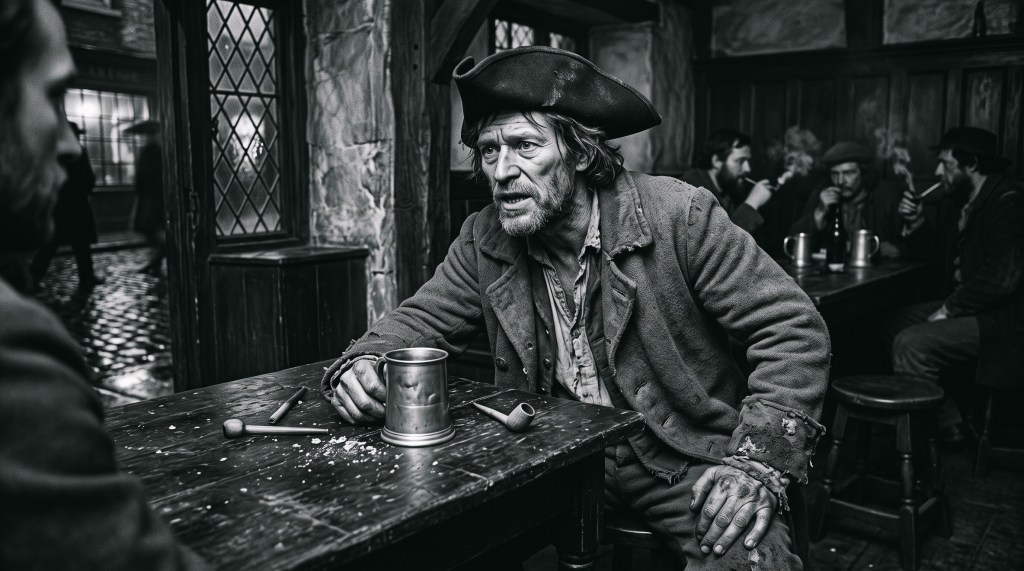
The Bell Tavern, near Surgeons’ Hall, Old Bailey, London
Sunday, the 24th of July, in the Year of Our Lord 1757
Aye, let a man drink first. This is the Sabbath, sir, and somewhere in the tangle of steeples above this smoke-drowned city there is a parson levelling his finger at a congregation and bidding them rest from their labours. Rest, says he. Rest, in the name of the Almighty. Well, and I say unto him what the Preacher himself declared for all ages: vanity of vanities, saith the Preacher, all is vanity. What profit hath a man of all his labour which he taketh under the sun? I shall tell you what profit I have took of mine. Three shillings and sixpence, paid in coin upon the cutting table, from a surgeon of some reputation in Bow Street on Tuesday last. A cold ‘un, fresh-lifted from the churchyard at St Bride’s, not two nights in the ground when we lifted the lid and drew him from his rest. The gentleman of the knife in Covent Garden was so eager to set his cold iron upon the viscera that he’d not quibble upon the price. That, my friend, is profit. And I make no apology for it.
Now, to your question. Your question, which wants some considerable turning over before I answer it entire. You ask me what character I would choose, from the boards of the theatre or from the leaves of a printed book, to set a chair for at my table. Very well. But hear me first upon the matter of my trade and my philosophy, for I am not a man to be hurried from the table of his own reasoning.
I am a resurrectionist. That is the word they give me, and I own it without shame. The law of this kingdom, as any man of affairs will tell you, holds that a corpse is no man’s property. It cannot be owned. It cannot be bequeathed. It is not the subject of theft, for it is nothing. It is clay. It is the vessel emptied of the humours and of the animating spirit, no more the rightful possession of the bereaved than the husk of last year’s grain belongs to the stalk. I take only the vessel. I leave the shroud in the coffin, precisely as I found it, for the shroud belongs to the living who purchased it, and I am no thief of linen. I am a tradesman. An artisan in the service of the anatomical arts. There are gentlemen not a stone’s throw from this very bench, within Surgeons’ Hall itself, who send their assistants to my door and are grateful for what I bring them, even as they would cross the street rather than acknowledge my acquaintance in the daylight hours. Such is the nature of a necessary commerce.
The Murder Act of five years past gave the surgeons the dissected bodies of hanged murderers, aye, and no doubt they were grateful for the augmentation. But how many murderers does this kingdom hang in a twelve-month, compared to the bodies that the anatomists require? Not a quarter sufficient. Not a tenth. The demand is prodigious, the supply from Tyburn lean and unreliable, and so I provide the remainder with mine own hands, in the dark and in the wet, whilst the press gangs is ranging along the waterfront and taking honest men for the war in France and all its far colonies. They press men into His Majesty’s service without so much as a how-d’ye-do. I merely press them into the service of knowledge. The difference of philosophy between us is not so very great as some would have you think.
The Preacher understood the trade, I am persuaded, though he dressed it in nobler language. There is one event unto the righteous and unto the wicked, he said. To the good and to the clean and to the unclean. One event, which is to say, one end, which is to say, the grave. I have lifted the children of great men and I have lifted the children of poverty from the same cold earth. I have taken from the same churchyard a lady of quality, mistakenly interred in the parish ground instead of the family vault, and a cobbler’s apprentice scarce seventeen years of age, and I tell you, friend, when they lay upon the sacking in the barrow, the flesh itself made no distinction. The Bills of Mortality make them equal in their columns, the great and the mean alike reduced to a numeral in the weekly reckoning of the dead. I am the great leveller’s assistant. Death himself is my employer, and I am merely his journeyman.
The humours depart at the same hour in all men: the choler and the phlegm, the black bile and the blood alike. And what remains is the clay, and the clay is mine. The miasma that hangs above the Fleet Ditch and breeds the fever and the fluxion, it does not stay itself for men of gentle blood. The flesh is grass, as the prophet declared it. I have seen it wither. I have felt the cold of it between my hands in the churchyard at two of the clock in the morning, with the miasma thick about my knees and the dark lanthorn shielded under my coat. There is a philosophy in that cold, friend, that no university has yet seen fit to teach.
But come, then. Come to your question.
Were I to sit at supper with any soul born only of ink and imagination, which would I choose?
I choose the spectral monarch of the boards.
I choose the murdered king in his nightgown. Him that walks the battlements of that famous castle by the cold northern sea, in the stage play they have performed these many years at Drury Lane. I was in the upper gallery not three winters since, pressed close amongst the heat and the smell of it, the night that Mr Garrick played the son, and I will tell you something I have not told another living man: when that armour-clad shade came upon the stage and the footlights threw his shadow large against the painted drop behind him, every soul in that gallery fell silent. Every one. The orange-women ceased their crying. The bucks in the pit left off their chattering and their preening. Because there was something in that figure, in that terrible and royal figure, that reached into the chest of every man present and gave the heart a little squeeze. Here was a monarch slain in his sleep. Poured full of poison in his very ear whilst he lay in repose in his own orchard, and murdered thus most foully, by his own brother, for the vanity of a crown. And now he walks. He cannot lie easy, for his account upon this earth is not yet settled. He comes back through the dark to speak of it. He comes back, I say, and he walks, and he will not lie down.
Now, I ask you: what better company for a resurrectionist?
Were I to arrange the supper here in this very room, I should order two pewter pots of the ordinary ale and a mutton pie with the fat still running, and I should set this armoured king down in that chair there, cold as he no doubt remains, and I should say to him without ceremony: Majesty, I have certain professional enquiries I would lay before you, and I beg your indulgence for a journeyman in your own trade.
For I have been in closer congress with the dead than any man in London, saving perhaps the night-watchman at the charnel house in Clerkenwell, and yet not one of the cold ‘uns I have lifted has ever seen fit to enlighten me upon the fundamental matter of their condition. What is it? What, in very truth, is the state of the dead? Is there weight to the soul, as certain divines have argued? For when a man breathes his last, some physicians have observed a discernible alteration in the heaviness of the body, as though something of substance departs with the spirit and rises free of the flesh. I have held sufficient of them in my arms to believe I have felt something of this, some strange and small alleviation that passes understanding, but I cannot swear to it upon a testament.
And I should ask him, this poisoned sovereign, why does he walk? Is it a mercy or a torment to be as he is? Because in my trade, sir, an unquiet corpse is a considerable inconvenience, and I would wish to understand the mechanism of it. The church teaches us that the dead sleep till the Resurrection. The Preacher himself declares that the dead know not anything, and that there is no work, nor device, nor knowledge, in the grave whither we all go. And yet here is this royal shade, walking most industrious about his battlements and haranguing his unfortunate son at all hours of the night. There is a contradiction somewhere in the fabric of these teachings that I am not learned enough to locate, but I suspect that the murdered king might be.
I think, besides, that he and I should find ourselves of one mind upon the vanity of earthly rank. He was a king, aye, and wears the memory of his murdered dignity upon him most heavy. But he was also a man slain by his own blood for the sake of a crown, which is to say, for the chiefest of all vanities. And I have had a lord’s son upon my shoulder, wrapped in common sacking, and carried him through the midnight streets to the anatomist’s door, and I tell you, friend, there was no difference betwixt him and the cordwainer’s apprentice we lifted the week previous. The press gangs do not enquire a man’s breeding before they seize him for the Seven Years’ War. The miasma in the alleyway does not hold its stinking breath out of respect for gentle blood. We are all of us, in the end, subject to the same lifting.
And I think the murdered king knew it. I think he knew it at the very moment the poison entered his blood and the humours overturned themselves in his body and the dark bile rose up and extinguished him. I think that at that dreadful and final moment, he became, in the eye of God and in the reckoning of the flesh, one of mine.
Which is, if I am pressed upon it, the nearest thing to brotherhood that a man of my vocation might hope to discover.
Pour again, friend. The Sunday is not yet done, and I have a night’s work to plan before the first grey light comes creeping over Ludgate Hill.
Bob Lynn | © 2026 Vox Meditantis. All rights reserved.


 Vox Meditantis
Leave a comment