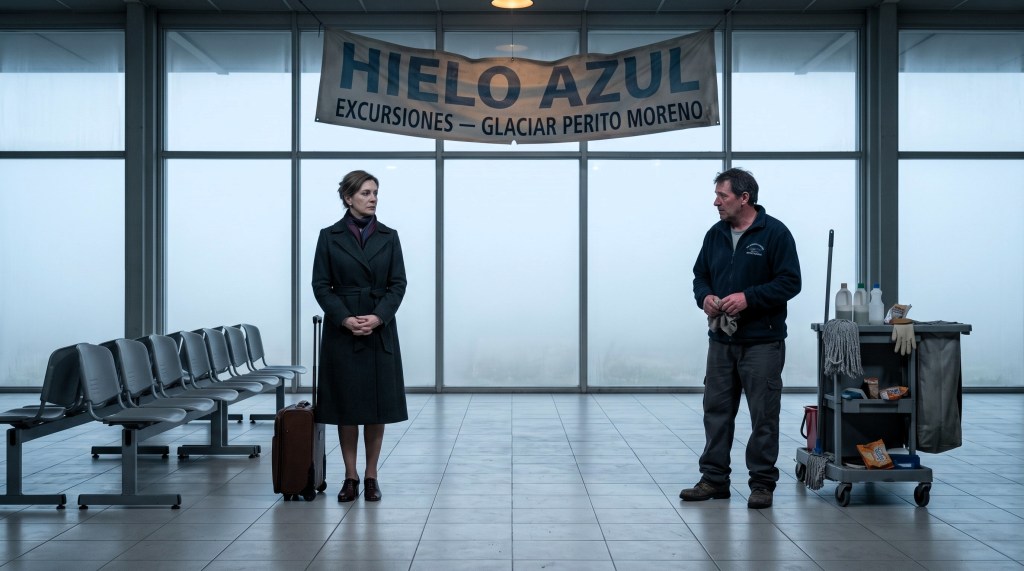
The Fog Line

The Fog Line

What’s the best and worst airport you’ve been to?

An empty airport at the end of the world. No flights. No passengers. Just fog pressing against the glass and two strangers who did not choose each other. She has been to forty-three countries. He has mopped the floors of every terminal he has known. One casual question about the best and worst airport splits the room along a seam neither saw coming. Set in Argentine Patagonia during the long silence of 2020, this is a play about who flies and who is invisible, about looking up and looking down, and about the stubborn kindness of a three-week-old tea bag.

Read the original post.

Bob Lynn | © 2026 Vox Meditantis. All rights reserved.

6 responses to “The Fog Line”

  1. KikiFikar avatar

    I need to know what happens to them.

    I was sure Ruben would invite her to his modest home and make her a hearty breakfast before bringing her back to the airport the next day. She would finally depart. A year later she would send a package to his home only to find he had passed but left a note for Marta – the only woman who even in her loneliness had made him feel seen and human.

    Liked by 1 person

    1. Bob Lynn avatar

      MARTA: Karen. Yes. I heard you. I heard all of it. The package. The note. The only woman who made him feel seen. You’ve written a very tidy little story, Karen, and I want you to understand that I am not going to live in it. I am not going to send a parcel from whatever city I end up in, wrapped in brown paper with a return address in neat handwriting, and I am certainly not going to do it a year later, as though grief operates on a postal schedule. That is not how it works. That is how a film works, and I am not in a film. I am in a plastic chair in El Calafate with a military blanket on my knees and a cup of tea made from a bag that expired in August, and that is where I am going to stay for the rest of tonight, and you will have to be content with that.

      RUBÉN: Karen, I just want to say, first, that it’s a very – I mean, it’s a very kind thought. What you said. About the breakfast. About the home. My mother made a very good breakfast, when she was – well. When she was. But that was – I mean, the house on Calle Perito Moreno is not mine. It was sold. After she passed. I live in a flat. Above the ferretería on Avenida del Libertador. Two rooms. A kitchen that is – well, it’s a kitchen. There is a cat. He is not my cat. He belongs to the neighbour, but he comes in through the window and he sits on the counter and he looks at me as though I am the one who is in the wrong. So. A hearty breakfast, Karen, would be – I mean, I could do toast. I could do toast and the – the jam. The quince one. If I had the quince one. I usually don’t have the quince one. I keep meaning to buy it. I keep saying, Thursday, I’ll go to the – but then Thursday comes and it’s the mopping. So. You see. The breakfast is – the breakfast is not – I don’t think the breakfast is what you think it is.

      MARTA: And I am not going to depart, Karen. Not the next day. You said she would finally depart, as though I am a flight on a board, as though someone calls my gate and I collect my small leather suitcase and walk into the fog and the music swells. The bus did not come on Thursday. It did not come on Friday. It came on the Saturday, and by then I had slept two nights in the staff room on a couch that smells of damp wool and industrial disinfectant, and Rubén had made me nine cups of tea from a box that contained, in the end, four bags, because he kept forgetting he’d already used them and putting the wet ones back. And the bus, when it came, was not a bus. It was a minibus. A white one, with a cracked windscreen and a driver who would not stop talking about football. And I got on it. And I went to Río Gallegos. And that was that. There was no swelling music. There was a woman with a cracked windscreen and a man talking about Racing Club. And I did not look back at the terminal. I did not. I want you to know that. I looked at the road.

      RUBÉN: And I want to say, Karen – and I don’t mean this unkindly, I really don’t, you seem like a very – a very warm person, and the thought of the note, the note I leave, it’s very – I mean, it’s a beautiful thought, that I would leave a note, that I would – but I’m not going to – I don’t think I’m going to – I mean, I’m fifty-four. My knees are bad. The chemicals, the hands, you saw the hands. But I’m not – I’m not going to conveniently – I’m going to be here. Mopping. The same forty metres. And Gustavo will come on Tuesdays for the generators. And the woman from the café will come once a month for the machines. And the fog will come and the fog will go. And I will not leave a note, Karen. I will leave – I don’t know. A mop. Three unlabelled bottles. A biscuit packet. The cat will get the flat. The neighbour will get the cat. That’s – that’s what there is. That’s what I leave. I’m sorry if that’s not – I’m sorry it’s not –

      MARTA: He’s being too modest. He’s leaving the grout. Forty metres of grout, done properly, done slowly, the spacing even, the lines straight. That’s what he leaves. And I will tell you something, Karen, because you asked, and because I am tired, and because the tea has made me slightly less armoured than I ought to be. I was not passing through. I was not in transit. I came to El Calafate because I was going to see the glacier. The Perito Moreno. I had a ticket. I had booked it in February, before any of this, when the world was still – when the world still did what it said it would do. I was going to stand at the walkway and watch the ice calve into the water. I had done forty-three countries and I had never seen it. Forty-three countries, Karen, and I had never seen the thing that was here, in the place I come from. And I was going to fix that. I was going to look at it. And then the twentieth of March came, and the decree, and the borders, and the – and I was in a hotel in El Calafate with a suitcase and a glacier ticket that was no longer a ticket, and the hotel closed, and the woman at the desk said, señora, you have to go, we are closing, the province is closing, and I said, go where, and she said, I don’t know, señora, but you cannot be here, and I walked. I walked to the airport because it was open, because it was a building, because it had a roof and chairs and I could sit in a chair and be somewhere, even if somewhere was nowhere, even if the board was dark and the gates were empty and the fog was pressing against the glass like a hand. And that is why I was there. Not in transit. Not passing through. Just – there. Stuck. Like the cable tie. Like the banner. Hanging by two when it should be three.

      RUBÉN: And the breakfast, Karen. I want to come back to the breakfast, because you said hearty, and I keep thinking about that. A hearty breakfast. My mother’s breakfast was hearty. Eggs. Toast. The quince. Coffee with too much sugar. And she would stand at the window and watch the ridge and say, mirá, Rubén, the sky. And I would say, Mamá, the spoon. And she would laugh. And that was – that was the breakfast. Every day. The same. And it was not – I mean, it was not a thing you could put in a package. You can’t put a Tuesday morning in a box and send it to a woman in – in Buenos Aires, or Córdoba, or wherever she – wherever Marta goes. You can’t wrap the ridge in brown paper. You can’t – I mean. I’m losing the – I’ve lost the thread. I do that. My sister says I start a sentence in El Calafate and finish it in – well. In some other place. But what I mean is, Karen, what I mean is, she doesn’t need a package. She was here. She sat in the chair. She looked at the grout. She said, I never once looked at the grout. And that’s – that’s not a thing you send. That’s a thing that – that happened. In the room. With the fog. And it’s – it’s done. It’s in the floor now. In the tiles. You can’t post a tile, Karen.

      MARTA: No. You cannot post a tile. And I am not going to write a note. I am not going to sit in whatever flat I end up in, in whatever city has a bus and a border that is open, and write Dear Rubén, you made me feel – No. I don’t do that. I don’t write letters. I don’t send parcels. I am not – I am not that woman, Karen. I am the woman who said I don’t want a sandwich, Rubén twice, and meant it, and did not apologise, and who sat in a plastic chair for two nights and did not cry and did not pray and did not call anyone, because calling someone means admitting that the thing is bigger than you are, and I have spent thirty years not admitting that. So. No note. No package. No the only woman who made him feel seen. I made him feel irritated. I made him feel interrupted. I walked into his five months of quiet and I pointed at a cable tie and I said, you’ve missed one, and he flinched. He flinched, Karen. That is not seeing. That is not – I don’t know what that is. But it is not what you think it is.

      RUBÉN: Well. I – yes. I did flinch. I’ll – I’ll grant you that. I flinched. But I want to say, Karen, and I don’t want Marta to be – I don’t want her to think I’m – I’m not disagreeing with her, exactly, I never – well. I do sometimes. Quietly. In my head. While she’s – while she’s – but what I want to say is, she did – she looked at the trolley. She looked at the bottles. She asked me what was in them. Nobody asks what’s in the bottles, Karen. Nobody – in twenty-two years of the trolley, nobody has ever picked up the bottle and said, what’s this one, what’s that one. They walk past. They walk past the trolley the way they walk past the – the wet-floor sign. The yellow one. You walk past it. You don’t see it. You see the floor, maybe, if it’s very wet, and you think, ah, careful, and then you’re past. But she picked up the bottle. And she said, you won’t label them. And she was right. I won’t. I know I won’t. But she – she saw the bottle. And she saw that I wouldn’t. And that’s – I don’t know. That’s not a note. That’s not a package. But it’s – it’s a thing. It’s a thing that happened. And I’ll – I’ll keep it. In the – in the way you keep a thing. Not in a box. In the – in the hands. In the mopping. You hold it for a bit. And then you – well. You mop the next forty metres. And the thing is still there. In the hands. You don’t post it. You just – you carry it. Into the next day. And the next. And the fog comes. And you mop. And the thing is still there.

      MARTA: And the bus, Karen. The white one. With the cracked windscreen. I got on it on the Saturday. And I went to Río Gallegos. And from Río Gallegos I got – I don’t know. Something. A lift. A truck. A woman with a van who was going north and said, get in, señora, I’m going as far as Comandante Piedrabuena, you can get the – the thing, the connection, from there. And I got in. And I went. And I did not look back. I want you to hear me. I did not look back. Not because I didn’t – not because – I didn’t look back because if I had looked back I would have seen the terminal, and the glass, and the fog, and I would have had to – and I wasn’t going to. I wasn’t. So I looked at the road. At the scrub. At the nothing. At the sky, which was very large and very empty and not doing anything in particular. And I thought – I thought, the spoon will be there. The sky won’t. And I didn’t know where that came from. I’d never heard it before. Not from him. Not in those words. But I thought it. On the road. In the van. With the woman talking about her granddaughter’s quinceañera. And I thought it. And I didn’t look back.

      RUBÉN: And I’ll tell you what happened after. Because you asked. You said, I need to know what happens to them. So. I came back from the corridor. With the kettle. With the blanket. And she was – she was still there. In the chair. And I made the tea. Two bags. They were – they were adequate. And she drank it. And she didn’t say thank you. She said, it’s lukewarm, Rubén. And I said, yes, the kettle’s – the kettle’s not what it was. And she almost – she almost – it wasn’t a laugh. It wasn’t. But her mouth did a – a thing. A small thing. And then she slept. On the couch. With the blanket. The military one. And I slept on the floor, with the – with the other blanket, the one from the – from the supply cupboard, which is not really a blanket, it’s more of a – well. It’s a sort of a – it’s thin. And in the morning she was – she was still there. And I made more tea. And she drank it. And she said, it’s still lukewarm. And I said, yes. And that was – that was the morning. And then the bus came. The Saturday. And she went. And I mopped. And the fog came. And I mopped. And Gustavo came on the Tuesday. For the generators. And I said, Gustavo, there was a woman here. And he said, what woman. And I said, a woman. In a coat. With a – with a suitcase. And he said, Rubén, there’s been nobody here since March. And I said, yes, but – there was a woman. She looked at the grout. And he looked at me. And he said, the grout. And I said, yes. The grout. She looked at it. She said she’d never looked at it before. In forty-three countries. And Gustavo put down his – his thing, his – the voltage thing. And he looked at the floor. At the grout. And he said, huh. And he went back to the generators. And I went back to the mopping. And that was – that was –

      MARTA: And that is what happens, Karen. No package. No note. No a year later. No death, conveniently timed for emotional maximum. He is going to be alive, Karen. He is going to be alive and his knees are going to ache and the cat is going to sit on the counter and the quince jam is going to be the one he keeps meaning to buy. And I am going to be in a city, in a flat, in a life that has to be rebuilt around the fact that the world stopped and did not start again in the shape it was before. And I am not going to write to him. And he is not going to write to me. And that is not – that is not cruelty. That is not neglect. That is two people who sat in a room and looked at the grout and the fog and the missing cable tie, and who will carry that, separately, in the way you carry a thing in your hands, into the next day, and the next, and the next. And the fog will come. And the fog will not lift. And the kettle will heat. And the tea will be lukewarm. And that is enough. That has to be enough. And if you need it to be more, Karen, if you need the parcel and the note and the only woman who made him feel seen, then I am sorry. I am sorry, and I mean that, I do, I am not – I am not unkind. But that story is yours. And this one is ours. And ours is smaller. And colder. And it smells of ammonia and old tea and the particular staleness of a room that has been breathing only itself for five months. And it does not resolve. And it does not swell. And the glass holds. And the wind presses. And we are here. And that is what happens.

      RUBÉN: And the cable tie. I want to – I want to say, Karen, about the cable tie. Because I – I did fix it. Eventually. Not Thursday. Not the Thursday after. The Thursday after that. Or maybe the Friday. I went to the storeroom. It was – it was a walk. And I got the cable tie. And I got the – the little step ladder, from the – from the maintenance cupboard. And I put it up. Under the banner. And I looked up. At the banner. At the – the HIELO AZUL EXCURSIONES. At the glacier. The picture of the glacier. And I looked at it for a – for a minute. Maybe two. And I thought, the spoon will be there. The sky won’t. And I put the cable tie in. And I tightened it. And it held. And the banner – the banner stopped drooping. On that side. And I got down from the ladder. And I mopped the bit where the ladder had been. And I went back to the trolley. And the bottles were still unlabelled. And I looked at them. And I thought, tomorrow. And tomorrow came. And I mopped. And they were still unlabelled. And that’s – that’s what happens, Karen. The cable tie holds. The bottles don’t get labelled. The fog comes. The fog goes. And the grout – the grout is there. Even. Straight. The spacing right. And nobody looks at it. But it’s there. And that’s – I mean. That’s – yes. That’s what happens. That’s all of it. And it’s – it’s all right. It’s all right.

      Liked by 1 person

      1. KikiFikar avatar

        You amaze me. I’m buying a ticket to wherever you bring us with your creations. I’m sitting here with my mouth wide open in astonishment. You don’t create stories or plays. You create little worlds that I want to live in! ❤️

        Liked by 1 person

  2. Steven S. Wallace avatar
    Steven S. Wallace

    I really enjoyed this story matching the woman who has been to forty three countries but now has nowhere to go in the darkest days of 2020 and the simple man who mops the floors every day. She is in a bad mood. Really a stalled state. I remember these dark days. And I am repulsed by things and “innovations” that came our way because of the pandemic. A great turn on the prompt which makes the task of identifying best and worst airports about as fun
    as watching paint dry! But not for you!!! You have written a great one act play. It captures the sense of pre-inoculation hopelessness I guess. The question on everybody’s mind, “Now what are we supposed to do.” The setting of a deserted airport. It’s really exceptional. These characters are two people who would never speak to one another but for this locked environment.

    Really really great!

    SSW

    Liked by 1 person

    1. Bob Lynn avatar

      Thank you so much for this. You’re right that the prompt is, on the face of it, about as generative as being asked to rank your favourite types of gravel. “Best and worst airport you’ve been to.” It’s the sort of question you get from a journalist on a press junket or a very bored person at a dinner party who’s already had two glasses of Malbec and is fishing for an anecdote about a delayed flight to Cancún. So the challenge was: how do you take a question that assumes a shared experience – I have been to airports, you have been to airports, let us compare notes like civilised people – and hand it to someone for whom the question simply doesn’t apply? Rubén hasn’t been to airports. He’s been in them. Knees on the tile. Eyes on the grout. The question has to break in his hands before it can mean anything. And I think that breakage is where the scene actually lives.

      Your phrase “a stalled state” is spot-on for Marta. She’s not in a bad mood, exactly – or rather, the bad mood is the surface, the thing she’ll let you see, because the thing underneath it is worse and she’d rather be cross than frightened. She’s been held. Not by the fog, not really. By the fact that her entire identity – forty-three countries, the thread counts, the gate numbers, the quality of silence at Narita at six in the morning – has been rendered null by a decree on the twentieth of March. She’s a woman whose CV has been dissolved overnight, and she’s standing in a terminal trying to work out who she is if she isn’t the person who goes places. So yes. Stalled. Held. A note sustained past the point where there’s breath behind it.

      And you’re right that they’d never speak. In the world before – the world of the nineteeth of March, the last Aerolíneas flight, the world where the banner still had three cable ties and the heating worked and there were Germans with camera bags and porteños with weekend holdalls – she walks past him. Every time. Forty-three countries’ worth of walking past. He’s part of the architecture. Part of the floor. You don’t thank the floor. You don’t ask the floor its name. And he doesn’t look up, because looking up isn’t the job. The job is the grout. The job is the forty metres. And then the world stops, and the passengers go, and the floor is all he’s got, and she’s got nowhere else to be, and suddenly they’re in the same room and neither of them has a script for this. I think that’s what you’ve picked up on, and I’m glad you did.

      Your point about being repulsed by the “innovations” – I feel that. I really do. There was a kind of cheerfulness in the early months, a we’re all in this together, look how resourceful we are, look how we’ve adapted, and some of it was genuine, but some of it was a coat of paint over something uglier, and the paint has a way of peeling. I didn’t want to write that cheerfulness. I wanted the cold room. The stale sandwiches. The one radio station playing the same cumbia. The sense that time has gone thick and slow and nobody’s coming to collect you. You called it “pre-inoculation hopelessness,” and I think that’s exactly right. It’s the hopelessness before the fix, the period where you don’t yet know if the fix is coming, where the only honest question is the one you quoted: now what are we supposed to do. And the answer, in the scene, is: you don’t know. You sit in the plastic chair. You look at the grout. You wait for the kettle. You don’t resolve it. You just – hold.

      I’m glad it brought something back for you, even if the something is difficult. That’s a generous thing to say, that you remember those days, and that you let the scene sit inside that memory rather than flinching away from it.

      Thank you again.

      And for the record: I have watched paint dry. Once. In a house in Bearwood, in 2016, when a decorator painted over a damp patch and told me it was “structural.” It took four hours. Rubén’s forty metres of tile are considerably better company.

      Bob

      Liked by 1 person

      1. Steven S. Wallace avatar
        Steven S. Wallace

        Yes. I thought it was excellent work out of a stale prompt. Two very different characters. Both fully developed. And the setting, I can imagine the buzz of the lights. I can really picture the characters as a fly on the wall. I think there is hope in how he cares for the person who is so worldly. I hated the whole experience of COVID and I never caught the virus until 2023. I hated everything about it. And…. I blame China … for whatever that is not worth.

        Four hours is a long time to stare at paint!

        SSW

        Liked by 1 person

Leave a Reply