What is the best purchase you have ever made?
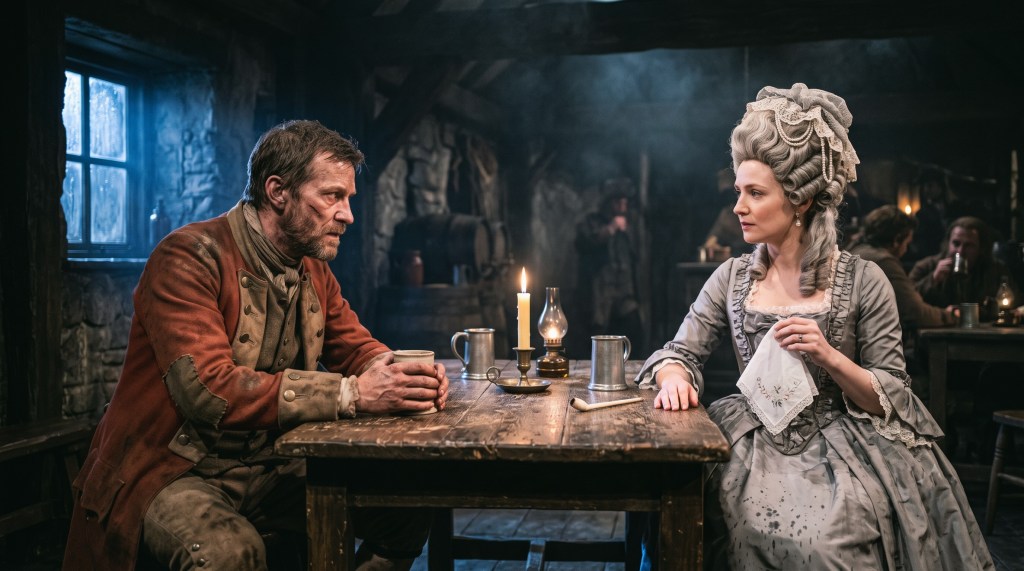
The common room of a nameless alehouse in an alley hard by the Wapping waterfront, on the evening of Wednesday, the 23rd of July, in the year of Our Lord 1735. Rain, which has fallen without mercy since the dinner hour, streaks the small, soot-blackened windowpanes and has reduced the alley without to a rind of mud and standing water. Within, the low ceiling is dark with the accumulation of many seasons’ smoke; tallow candles gutter at intervals along the tables, and the air hangs heavy with the mingled smells of damp wool, stale malt, river brine, and the faint, sweetish reek of cheap tobacco. The light falls unsteadily, catching the grain of scarred oak and the dull gleam of pewter pots, and leaving the corners in a comfortable obscurity.
At a table in the far corner, half-swallowed by that obscurity, sits a SOLDIER. He is a man of perhaps three or four and forty years, though the ravages of campaign have aged him beyond easy reckoning: his face is lean to the point of hollowness, deeply scored by wind and weather, and marked along the left jaw by a scar of considerable antiquity. His coat, of a dark reddish hue now faded to the colour of old brick, is patched at both elbows and stiff with dried mud at the hem. His hands, wrapped about a clay cup, are calloused and scarred in their own right. He does not drink. He watches: the door, the man dozing at the far hearth, the shadows that thicken at the edges of the candlelight, and then the door again. His vigilance is habitual, automatic, the vigilance of a man who has learned to read stillness for the shape of hidden danger, and who has not, in a considerable number of years, been persuaded to stop.
When the door opens, admitting a gust of rain-cooled air and a sharp increase of street noise, the SOLDIER does not start. His jaw tightens, almost imperceptibly. One hand shifts a fraction toward the interior of his coat, then falls still.
What enters is not, by any apparent measure, a threat. A LADY, of evident and considerable quality, stands in the doorway: her gown of pale dove-grey silk is spotted with rain at the hem and sleeves, her powdered wig immaculate save for a few drops of moisture caught in the curls, and she holds a small embroidered handkerchief pressed firmly against her nose as she surveys the room with the frank and entirely unselfconscious revulsion of one who has wandered into a place she cannot quite credit the existence of.
THE SOLDIER: (rising from his bench with unhurried, practised courtesy, offering a slight, measured inclination of the head) Your servant, Madam. You find yourself, I venture, some considerable distance from your natural quarter of the town. Pray, do not permit the appearance of the house to alarm you unduly; it is honest enough, for all its rough constitution, and the landlord, so far as I have been able to determine, is not a man of any notable villainy.
THE LADY: (without ceremony, still clutching her handkerchief, directing a frank and unsoftened survey from his hat to his boots) Good Lord. You are absolutely filthy. I do not say it to be unkind, but it is plainly evident, and I see no reason to pretend otherwise. What has become of your coat? It appears to have been dragged at considerable length through the mud between here and the Strand, and then permitted to dry in that condition.
THE SOLDIER: (after a brief pause, in which the ghost of a measured smile moves across the scarred jaw) Madam is most observant. The coat and I have shared some difficult passages together, I confess; it has been, upon occasion, in a considerably more deplorable condition than you presently witness. I beg pardon if the sight gives offence. (He gestures, with practised courtesy, toward the opposite bench.) Will you not sit? The weather beyond is cruel, and this bench, though rude, is at the least dry. May I ask what errand has brought you to this neighbourhood in such a tempest?
THE LADY: (sitting without the least hesitation, arranging her damp skirts with brisk, efficient hands, and looking about the low-ceilinged room with unconcealed distaste) I was directed to this street by my footman, who has demonstrated himself, beyond any further reasonable doubt, to be an absolute fool. I sought the apothecary in Gun Alley. He directed me here instead. Whether he misheard me, or whether he is simply incapable of reading a street sign, I cannot determine; either explanation reflects very poorly upon him. (She glances at the man dozing by the hearth, at the drinkers at the far table, then back to the Soldier, with perfect composure.) I must say this is a thoroughly disagreeable place. How do you bear it with any regularity?
THE SOLDIER: (weighing each word with the care of a man who has learned, to some considerable cost, that candour freely given is a species of recklessness) The mind, Madam, accommodates itself to its circumstances by degrees. What at first appears entirely disagreeable grows, with long familiarity, merely familiar. I have slept on ground considerably less hospitable than this bench, I assure you, and in company a great deal less pleasant than the present. (He settles back, his gaze moving, briefly and almost involuntarily, to the door, then to the shadows near the hearth, then returning to her face with the same quiet, unrelenting attention.) I am relieved to hear that your misdirection was the consequence of an incompetent servant, rather than of any other design. One grows, with long experience in difficult employment, somewhat watchful of persons who appear in unexpected places and circumstances.
THE LADY: (with a forthright bafflement that carries no awareness of its own effect) Do you mean to say you suspected me of some wickedness the moment I entered? That is a perfectly extraordinary supposition to make regarding a woman of my station. I carry no designs of any sort upon you or upon anyone else in this room. I wanted only camphor and a preparation of white willow bark for my housekeeper’s rheumatism. I have no interest in your affairs whatsoever, I am afraid.
THE SOLDIER: (inclining his head with a smooth, polished deflection that acknowledges the point without conceding more ground than is safe) And I am most glad of it, Madam, for it is considerably more comfortable to be of no interest to persons of quality than to attract their attention without prior notice. I spoke not of you yourself, but of a habit of mind that I have found, by long and somewhat painful experience, very difficult to shed once acquired. The battlefield is an indifferent schoolmaster; it teaches its lessons without regard for the refinement or the comfort of the pupil, and those lessons do not easily depart when the schooling is done.
THE LADY: (receiving this with the brief, uninvested attention of someone who finds the information mildly interesting but not personally affecting) You are a soldier, then. Or you were. I confess it is not a profession I have greatly occupied my thoughts with. My late father had a nephew who purchased a commission in the foot guards. He died of a fever in Gibraltar in the year twenty-seven, and not of any wound, which I always thought was rather a waste of the commission fee. Were you with the foot guards?
THE SOLDIER: (his gaze sharpening slightly, though his voice does not waver) I was not, Madam. I served in a line regiment, in Flanders and the Low Countries, and in engagements I shall not weary you with the recounting of. (He turns the clay cup slowly in his calloused hands, the movement unhurried and deliberate.) You mention the purchase of a commission. It is a matter I know something of, as it happens.
THE LADY: (with complete and airy unconcern) I imagine you do. I have always thought it a somewhat irregular system, paying for the right to command men who have been given no choice in the matter of who commands them. Though I suppose it ensures the officers are at least men of some property, which is perhaps a recommendation of sorts. Was your own commission purchased, or did you rise by some other means? I am told that common soldiers do sometimes advance, though I gather it is not the usual course of things.
THE SOLDIER: (a flicker passes across his face, something between pride and old injury, that resolves itself, in the space it would take another man to blink, into a perfectly composed expression) By merit, Madam, as much as by the goodwill of a colonel who was not without generosity, though I confess I was not, at the time, entirely positioned to trust the offer when it was first extended. (He looks at her with a steady, measured calm.) You will forgive me, I think, if I find your candour upon the matter something refreshing. Most persons in polite company affect a studied ignorance of how the army is constituted, or of how men advance within it, treating it as a subject too ungenteel to sustain.
THE LADY: (with a dismissive wave of her handkerchief that suggests she finds this custom of polite pretence simply absurd) I have never seen any use in pretending to ignorance of things one is not actually ignorant of. It strikes me as a waste of both breath and time, and I am not greatly given to either. (She leans forward slightly, with the unselfconscious curiosity of a person to whom the principle of delicacy in conversation has never presented itself as worth the effort.) Since we are sitting here with nothing of pressing urgency to occupy us, I should like to ask you something. What is the best purchase you have ever made?
THE SOLDIER: (He does not answer at once. A silence settles between them, during which he looks down at his hands, then at the guttering candle, then at some middle distance that lies well beyond the plaster of the tavern wall. When he speaks, his voice has lowered a half-degree in register, and the careful, managed quality of it has given way, very slightly, to something less guarded.) That is a question of some weight, Madam, and I shall answer it with the honesty it appears to deserve. (He reaches into the breast of his coat and withdraws, with a deliberateness that speaks of long habit and careful custody, a small object on a cord of worn leather: a compass, its brass casing dark with age and handling, the glass of its face scratched in several places, but the needle trembling steadily within.)
THE LADY: (peering at it without ceremony across the table) A compass. It looks exceedingly old and thoroughly knocked about. I should have supposed that a man of any resources would purchase a new one, rather than preserve one in quite such a condition. What did it cost you?
THE SOLDIER: (turning it in the candlelight so the needle steadies by degrees) In coin, Madam, near to nothing. I took it from the body of a sergeant at Malplaquet, in the year nine, when you were, I dare say, not yet born, or barely so. He had no further use of direction, and I had, at that moment, a very pressing need of it. In every other accounting, however, it has cost me a great deal more than I have yet finished paying, and I do not mean that in any light or figurative sense. (His thumb moves over the scratched glass in the unconscious gesture of long, long familiarity.) A man who knows with certainty where north lies is not, as a general rule, a man who perishes in a bog, or who walks into an ambush in the darkness. I have known brave men, Madam, men of a quality and a character that makes my own look thin by comparison, who were destroyed not by the enemy’s force but by their own uncertainty as to where they stood upon the ground. The compass, small and ugly as it is, gave me a surety of direction that no commission, no patron, no quantity of good fortune could have furnished. I knew, at every moment in the field, exactly where I was. That is no small matter.
THE LADY: (without any perceptible awareness of the weight of her next words) But is it truly yours? You said you took it from a dead man. Does that not mean you are in possession of something that rightfully belongs to another? I raise it not to be disagreeable, but because it seems a perfectly plain question. The sergeant’s family might reasonably have some claim upon it, one would think.
THE SOLDIER: (In the space of a breath, something moves in the muscles about his eyes: a small contraction, the kind a more impulsive man would not have been able to suppress. Then it passes, and he folds the leather cord with deliberate care, and when he replies, his voice is level and without any heat.) You raise a point, Madam, that has occupied minds of considerably greater legal learning than either of ours. The dead carry, so far as I have been able to determine, no instruments of navigation into whatever quarter they are next dispatched; and a sergeant fallen at Malplaquet has, I venture, no family of sufficient means or information to pursue the matter in any court in England. I do not, however, entirely dismiss what you have said. I have put the selfsame question to myself on certain evenings of sufficient darkness, and found no answer that fully satisfies the conscience. (He tucks the compass back within his coat with the same slow care.) Nevertheless, it remains the best purchase I have ever made.
THE LADY: (entirely undaunted) Well, I think it a rather gloomy sort of treasure. (She sits back, with the serene self-possession of someone who has delivered a verdict and sees no reason to qualify it.) If I were to name the best purchase I had ever made, I should say without any hesitation that it was my setter bitch, whom I acquired at Smithfield market three years since for what my coachman told me was a very fair price. He was, for once, perhaps correct. She has not yet disappointed me in any regard, which puts her significantly ahead of most creatures of my acquaintance, of either sex. Do you like dogs?
THE SOLDIER: (and here, for the first time in the exchange, something warmer enters his expression, arriving by slow degrees, the way warmth enters a room that has been cold for a long time) I have had occasion to like them very well, Madam, in circumstances where the honesty of their feeling was a notable contrast to that of the men immediately around me. A dog’s attachment is not dissembled; it cannot readily be. It is perhaps the most honest form of loyalty one may encounter, and loyalty, in my long experience, is a quality that greatly benefits from being plain and without disguise. (He takes a measured sip from his cup, his eyes resting upon her over the rim with the steady, cataloguing attention that never quite leaves him.) Your setter has given you no cause for grief or for doubt, then? You trust her without reservation?
THE LADY: (with absolute and cheerful certainty) Entirely. Why should I not? She has given me no reason whatsoever to doubt her. She comes when I call, she does not destroy the furniture above once in a while, and she appears glad to see me upon my return from any absence, which puts her well ahead of most of my acquaintance. I cannot conceive of any reason to suspect her of hidden designs.
THE SOLDIER: (with the careful, deliberate delicacy of a man who knows he is walking, with each word, across uncertain ground) Madam, I wonder, with the greatest respect, whether the absence of any evidence of treachery ought always to be read as a certainty of trustworthiness. A man, or indeed a hound, may have offered no ill to this day, and may offer considerable ill tomorrow. The world contains those who have cultivated a most agreeable exterior over a very long period, precisely so that the blow, when it falls, may fall upon a ground the less well defended.
THE LADY: (looking at him now with the frank, unadorned bafflement of someone encountering a philosophical position they find not so much threatening as simply impractical) That is a perfectly dreadful way to live. If one suspected every creature of some concealed villainy, one should never sleep soundly, and one should certainly never make any friends at all. (She tilts her head, studying him with the dispassionate interest of an apothecary examining a curious specimen.) I think, if you will permit me to say so, that you have a very disordered spleen, to reason in such a fashion.
THE SOLDIER: (the phrase lands. A very small but visible adjustment occurs in his expression: the faintest closing and opening of the eyes, as of a man receiving a verdict he already knew but had not anticipated hearing aloud from a stranger. He replies without irritation or injury, but with the quiet, rueful recognition of someone acknowledging a judgement he has, in his more honest moments, already delivered upon himself.) The regimental surgeons were of much the same opinion, Madam, and a good deal less gentle in the expression of it. An excess of black bile, one of them told me, with the cheerful detachment of a man appraising a horse at market. He recommended infusions of agrimony and a reduction of salt meats, which advice I found considerably easier to receive than to observe in the field. (He sets down his cup, his fingers resting lightly on the scarred table.) But you are not mistaken, and I do not take the observation amiss. Suspicion carried to excess is its own species of confinement. A man who trusts no creature is as surely imprisoned as a man in the Marshalsea, though the walls of his gaol are invisible to all observers but himself.
THE LADY: (with the frank, unguarded directness of someone to whom it has simply not occurred that the question might be unwelcome) And do you trust me? You have been watching that door since I sat down, and you watch me with very nearly the same expression you give it. I am not without powers of observation, even if my aunt frequently informs me that I am rather deficient in the faculty of suspicion. It seems to me that you make no very considerable distinction between a potential enemy and a gentlewoman in damp silk who wants camphor for a housekeeper’s rheumatism.
THE SOLDIER: (a silence of some consideration passes. He turns the cup. The candle gutters in a draught from some unseen gap in the plaster. His eyes move, briefly and almost against his will, to the door, then back, and in the steadiness he achieves in returning to her face there is visible, if small, effort.) I trust you, Madam, to be precisely what you appear: a lady of quality, misdirected by an inattentive servant, without interest in my affairs beyond the curiosity natural to an enforced and accidental proximity. I trust you to speak your mind without ornament, which you have most eloquently and consistently demonstrated. Whether I trust you beyond those limits… (He pauses, and when he continues, the words are given with the careful deliberateness of a man handling fragile instruments.) I have found, by long and hard schooling, that trust, like credit extended to a merchant of uncertain standing, is wisest offered in small denominations at first, and increased only as the account is proved sound over time. It is not a reflection upon you, Madam, or upon any person in this room. It is the arithmetic of long experience.
THE LADY: (sniffing, whether at the odour of the room or at his reply is not entirely clear) That is a very great deal of words to say “not yet.” I find the machinery you require to produce a plain answer quite exhausting. But I suppose if one has been shot at with any regularity, one develops peculiar habits. Have you been shot at a great deal?
THE SOLDIER: (and here, something occurs that has not previously occurred in this exchange: a brief, dry contraction of the features that is, in this man, the nearest functional equivalent of a laugh) On more occasions than I find it agreeable to count, Madam. And stabbed. And robbed. And, upon one occasion in Bruges, accused before a magistrate of a theft I had not committed, by a man who had smiled at me across a dinner table not two hours beforehand. (He says the last item very quietly, and in that quietness it carries the greatest weight of all.)
THE LADY: (and here her bluntness operates, with perfect inadvertence, in a direction she does not intend and cannot see) How perfectly dreadful. Though I should think the matter was easily resolved if you were in fact innocent. Innocence is surely its own defence. The magistrates exist to determine the truth of such matters; I have always assumed they do so with reasonable fidelity to their function.
THE SOLDIER: (with an exquisite restraint that is itself a kind of art, and with no edge in his voice, merely a very flat, dry precision) The magistrates, Madam, determine the truth of a matter in proportion to the quality of the men who present it to them, and the weight of the purse that accompanies the presentation. I was, at the time in question, a man of no quality and no purse, and the magistrate before whom I stood had, I venture to say, no very great devotion to abstract truth divorced from its material accompaniments. (He meets her eyes without heat and without apology.) I was acquitted, in the end, not by virtue of innocence but by virtue of a corporal who had the presence of mind to produce a witness at the last possible hour. I have not forgotten the distinction between the two, and I am unlikely to.
THE LADY: (and here, for very nearly the first time in the conversation, something resembling perturbation crosses her expression, though it resolves, quickly and characteristically, into a practical question rather than any sustained feeling) But that is perfectly wicked. If the magistrate was corrupt, why was he not reported to some authority and removed from his position? Surely someone of appropriate influence might have done something.
THE SOLDIER: (gently, with the patient precision of a man who has long since reconciled himself to the constitution of the world, and who does not think less of her for not having had occasion to see it clearly) The persons of appropriate influence are, Madam, as often as not, the very persons for whom the present arrangement is most convenient. Power, in my long observation, tends to protect power; it is not a principle I arrived at with any pleasure, and I should greatly have preferred to find the world otherwise constituted. (His gaze moves, once more, to the door, then back, and in that small and habitual motion is the whole history of what he has just described.) The world, I find, is not greatly interested in the preferences of men in my station.
THE LADY: (with the serene, unshakeable confidence of someone whose world has never given her any serious cause to revise it) I shall tell you plainly: I do not believe the world is as thoroughly wicked as you describe it. I have found people, in the main, to be well-intentioned enough. My housekeeper, my coachman, even my fool of a footman, are all honest people, of that I am entirely persuaded, and I have no reason to suspect otherwise. I think, perhaps, the difficulty lies not with the world at large, but with the variety of the world that a soldier inhabits, which is, by its nature, not a very representative portion of humanity as a whole.
THE SOLDIER: (after a pause in which something in him seems to arrive at a decision, and that decision is to speak directly, and to spend whatever it costs him to do so) I think you may be right, Madam, and I mean that without any reservation or irony. The soldier’s world and the lady’s world are so far removed from one another in their constitution that they might as well be two entirely distinct countries, divided by a distance no carriage can traverse. In your world, people are, I dare say, well-intentioned in the main, and that faith has served you, by your own account, without disappointment. In mine… well-intention was, more often than I care to number, the attribute of the man who died first, because he paused, upon the threshold of an action, to verify the good faith of his opponent, and was afforded no opportunity to correct the error. (He says it quietly, not with bitterness, but with the measured, empirical quality of a man stating a principle of natural philosophy.) I do not blame you for your faith in human nature, Madam. On the better evenings, when the black bile is less ascendant and the fancy quieter than usual, I come near to envying it.
THE LADY: (examining him with the frank, unsentimental assessment of someone who has absorbed what she can and does not intend to be moved further than that) You are in a very melancholy state. Has no physician attended to you since your service ended? There are men of considerable learning and reputation in Cheapside. My husband consults one such for his gout, with what I can only describe as very modest results, but one supposes one must try something. I could speak to him on your behalf, if you thought it would serve any purpose, though I cannot promise he receives patients of your standing without a recommendation of some weight behind it.
THE SOLDIER: (the undisguised social calibration in her final clause arrives with the precision of a well-placed shot, but he does not flinch. He adjusts, without resentment, and replies with a sincerity entirely devoid of self-pity) You are most generous, Madam, and I mean that wholly. The offer is kindly made. (He looks down at his hands for a moment, then back at her, with a directness that is, for him, a small but deliberate act of will.) I do not think, however, that any physician can greatly address what ails me in the fashion you describe. The spleen is, I suspect, not the whole of the account. A man who has learned, over many years, to trust the needle of a compass above the word of any living person does not readily or quickly relearn the prior arithmetic. The apothecary’s preparations are a kindness; they do not, in my experience, reach the seat of the difficulty.
THE LADY: (with the blunt, disencumbered directness of someone to whom the question presents itself as entirely natural) Then what would reach it, do you suppose?
THE SOLDIER: (A long silence. He turns the clay cup upon the table. The candle gutters once, and rights itself. Beyond the shutters, the rain has diminished to a low, uninsistent murmur, like a conversation held in the next room. When he speaks, it is with the measured deliberateness of a man drawing from a very deep and seldom-opened place.) I have asked myself that question upon a great many evenings considerably worse than this one, Madam, and arrived at only one answer of any substance. (He looks at the door. At the man by the hearth. At the place within his coat where the compass lies. Then at her face, with what is, for him, a prolonged and almost uncomfortable steadiness of gaze.) To be proved wrong. To watch a man approach across a courtyard without first reading treachery into the angle of his stride. To sit in a room of strangers without mapping, in the same breath, the location of every exit. To receive a generous offer from a gentlewoman in damp silk, who has no conceivable interest in my affairs, without turning it over in my hands for the disadvantage that must be concealed within it. And to discover, at the end of such an experiment, that I was mistaken in my caution. (A very slight pause, during which the candle flame bends and steadies.) That, I think, would reach the seat of the difficulty.
THE LADY: (standing now, arranging her cloak about her with brisk, practical movements, and with the air of someone concluding an interesting but essentially resolved conversation) Well, you are wrong about me, at any rate. I carry no concealed advantage of any sort. I wanted an apothecary and found an alehouse and a soldier with a battered compass and a disordered spleen. I shall leave presently and think very little more upon this conversation, not because it has been without interest, but because I am not, in the ordinary way of things, given to prolonged reflection on matters I cannot practically address. I wish you well, and I mean it entirely plainly.
THE SOLDIER: (rising from his bench with a formal inclination of the head that is, in this instance, without any trace of mere ceremony) I believe you, Madam. (He holds the words a moment, as though testing them for weight and finding them, to his own slight surprise, not without substance.) That is, I think, the longest reach of trust I have extended to any person in the better part of ten years. I find myself in your debt for the occasion of it. (He glances at the door, then back to her.) Might I trouble you to permit me to call a sedan chair? The streets between this quarter and the city are not, at this hour, well-suited to a lady unescorted, and I confess I should not be easy in my mind, knowing you were abroad in them without company.
THE LADY: (already at the door, pulling her cloak straight, entirely and characteristically untroubled) You need not trouble yourself on that account. I am not frightened of the streets. I am not greatly frightened of anything, which my husband tells me is the consequence of a deficiency of imagination rather than any strength of character. (She opens the door; the damp night air enters, bearing the smell of rain and river mud and distant coal smoke.) Good evening to you, soldier. I hope your spleen improves and that your compass continues to serve you well.
THE SOLDIER: (watching her pass into the dark, and speaking, for once, to a back already turned, so that the words fall into the wet air of the doorway rather than at any attending face) And I hope, Madam, with all sincerity, that your confidence in the world is never purchased at too great a cost.
Whether she hears him is uncertain. The door swings to. The room settles back into its familiar arrangement of sounds: the low, irregular snore of the man by the hearth, the murmur of the drinkers at the far table, the drip of rain from a cracked timber above the shutter. The SOLDIER stands a moment, his hand resting at his breast where the compass lies inside his coat, its needle pointing north, steady and undeceived. Then he sits, and wraps his hands again about the clay cup, and turns his gaze, as he has always turned it and will, in all likelihood, always turn it, back to the door.
Bob Lynn | © 2026 Vox Meditantis. All rights reserved.


Leave a Reply