What’s a promise you made to yourself that you’ve actually kept?
The Globe Theatre, Bankside, Southwark. Thursday, the five-and-twentieth of July, sixteen hundred and sixteen. Late afternoon.
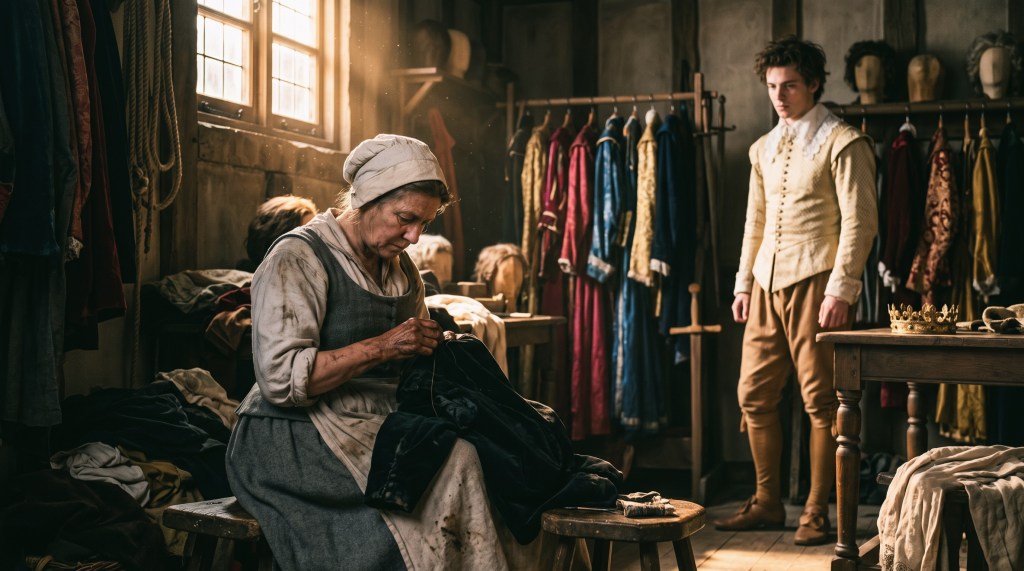
The tiring-house is close and stifling, the summer heat pressing through every gap in the planked walls and lying upon the room like a physical weight. Shafts of amber light descend slant-wise through those gaps, each alive with the slow spiral of dust and loose thread, so that the cluttered space swims and shimmers as though at the bottom of a warm, golden sea. The air carries its history in layers: the sharp, medicinal bite of the vinegar-soaked cloth hung near the door to ward against contagion from without; beneath that, the softer persistence of dried lavender pressed into the hems of hanging gowns; and beneath both, impossible to lift by any remedy, the oldest smell of all, the dense and fundamental odour of bodies in heavy wool, which no vinegar on earth has ever yet entirely expelled. Along the walls, on iron pegs and rough-hewn racks, gowns of silk damask, fustian, taffeta, and velvet hang in a long, still procession: murrey, watchet blue, tawny, and a deep, assertive crimson that draws the room’s light to itself with something like appetite. The prop-table is an oak board of considerable and practised disorder, bearing wooden swords wrapped in tin foil, a battered leathern shield, three pig’s bladders not yet punctured, a tangle of paste necklaces and gilt circlets, a bundle of property letters tied with red tape, and a cracked looking-glass propped at a tilt against the wall, in which the whole room is caught and held and slightly distorted. Beneath the table, two ledger books lie open, their pages dense with iron-gall figures. Near the far wall, a half-finished gown in pale stuff hangs pinned to a dress-form, waiting on a boy’s next fitting.
BESSIE MAUGHAM, head tirewoman to the King’s Men, is seated on a low stool angled towards the largest shaft of light. She is in her late fifties, compact and economical in all her movements with the natural efficiency of a woman who has spent thirty years in a cramped room and learned never to waste a gesture. She wears a plain grey kersey petticoat and a clean linen smock, her sleeves rolled to the elbow. Her hands are the whole testimony of her trade: quick and large, the right index finger calloused where she drives the needle, the skin of both stained in gradations of walnut brown and the fainter amber of saffron dye that no lye-wash has ever fully shifted. Spread across her lap is a heavy velvet doublet of deep, faded black, its lining coming away at the right shoulder seam. She stitches it closed with small, exact movements, lips compressed to a thin, intent line.
The doublet is old. It belonged, once, to a man now three months dead.
A YOUNG GENTLEMAN leans against the prop-table with studied negligence. He is perhaps two-and-twenty, arrayed in all the careful magnificence of current fashion: a padded doublet of pale straw-coloured satin, a falling band of fine Flemish lace bright at his throat, hose of deep tawny silk. His hair is artfully disordered. He arrived some quarter-hour since, having inveigled his way past the stage-keeper with a coin and a winning manner, and has since been composing, within the comfortable performance of his own thoughts, several different accounts of this afternoon’s adventure to relate at supper. He watches Bessie with the easy, approving attention of a man watching a skilled performance: admiring, but entirely untouched.
From beyond the tiring-house door, the muffled, rhythmic thunder of the groundlings’ feet comes and goes in waves, and threading above it, intermittently, the high, sweet, trained voice of a boy actor delivering some great lady’s speech to the afternoon house.
Bessie does not look up from her needle.
BESSIE. What’s a promise you made to yourself that you’ve actually kept?
She pulls the thread taut and bites it off clean.
GENTLEMAN. (startled from his reverie, then swiftly amused) I beg your pardon?
BESSIE. (turning the doublet in her hands to examine the next failing seam) ‘Tis no great riddle. A vow. Made in private, before God and thine own conscience alone, no witnesses, no notary’s seal to give it binding force. And then – kept. Not quietly amended, not let gently slip, not buried beneath a season’s worth of fine excuses and warm intentions. Kept.
GENTLEMAN. (straightening with sudden enthusiasm) Ah, you put me in mind of a philosophical exercise! I am very ready for those. Let me consider – (tapping his chin) – yes. Yes. I made a solemn vow upon the first day of last February that I should have my masque complete before this winter’s coming. It is to be a magnificent work. A sea-nymph and a magician, twelve scenes, a great transformation –
BESSIE. Have you kept it?
A pause.
GENTLEMAN. The winter is yet some months off.
BESSIE. And how many pages have you written?
A longer pause.
GENTLEMAN. The conception is entire. All twelve scenes are formed in my mind. A sea-battle. A transformation. The closing scene shall be, I am resolved, the most affecting thing placed before a London audience in twenty years.
BESSIE. (drily, without looking up) Then you have kept nothing of your vow as yet. Only the intention of keeping it one day. Those are two very different creatures, my lord.
GENTLEMAN. (wounded) You are, I think, the most combative goodwife I have ever encountered in a tiring-house.
BESSIE. Very like the only goodwife you have ever encountered in a tiring-house. If you know of another house with my like in it, I should be very glad to learn the name of the man who runs it.
The GENTLEMAN laughs despite himself. He pushes off the table and begins to drift along the wall, trailing his fingers over the hanging gowns with the easy familiarity of a man in a room he has decided belongs to him. Bessie’s jaw sets almost imperceptibly. He pauses before the great crimson gown of Italian silk, its skirts stiffened with buckram, and extends two fingers to touch the paste stones at the neckline.
GENTLEMAN. This is very fine. What figure wears this?
BESSIE. (without looking up) Take your hand from the sleeve. The Revels Office sent a man last month to inspect what we put before the public, and I have no desire to give him fresh cause for complaint. Step away, my lord.
The GENTLEMAN withdraws his hand. Then, irresistibly, extends two fingers once more to stroke the fabric.
GENTLEMAN. A queen, surely. It carries the very weight of a queen.
BESSIE. It plays one. Before it came to us, it dressed a countess in earnest, until the heralds took a sudden interest in what her ladyship’s household was wearing, and the whole wardrobe came to market. (a dry half-smile) The sumptuary laws have been this playhouse’s great benefactor over the years. Her ladyship’s disgrace was our company’s good fortune. Most of what hangs on that rack arrived by much the same road.
GENTLEMAN. (still gazing at the paste gems) And these stones – from the gallery, a man would swear upon his very life –
BESSIE. From the gallery, a man believes what he is instructed to believe. That is the whole business of this house, my lord, and has been so since the first afternoon it opened its doors. (re-threading her needle) Now step away from the sleeve. You have oils on your hands.
The GENTLEMAN steps back, obedient as a corrected puppy. He turns to the prop-table and picks up the false beard from its wooden block, holds it to his smooth chin, tilts his head at the cracked looking-glass with an expression of solemn appraisal. Then his restless hands reach for one of the gilt paste crowns. He picks it up and it slips immediately from his fingers, skittering towards the table’s edge.
Without looking up, without breaking her stitch, Bessie’s hand shoots out and catches it.
She sets it back on the table. She does not speak. She does not look at him.
The GENTLEMAN sets the crown down with exaggerated, careful deliberation.
GENTLEMAN. (changing his approach; a hint of archness) You put that question very suddenly, goodwife. What occasion brought it to your mind?
A pause. Bessie stitches.
BESSIE. I was thinking of a man who is dead.
The GENTLEMAN’s expression changes. Something genuine surfaces beneath the performance.
GENTLEMAN. One of the company?
BESSIE. The greatest of it. (she smooths her palm slowly across the black velvet doublet in her lap) He was buried the three-and-twentieth of April last. At Stratford, as he had wished. I did not travel north for the burying. I had work here. There is always work here. (a pause) He was a careful man. Not given to grand gestures or fine speeches in ordinary life; those he kept for the page. But what he undertook, he honoured. Every obligation, every private resolution. The most methodical soul I have known in all my years of this trade. God rest him.
GENTLEMAN. (gently; he has settled himself on the opposite stool without quite noticing he has done so) And this doublet – it was his?
BESSIE. It served him in his capacity as a housekeeper of the company. He wore it to the house meetings, to dinners when there was business to conduct with the other playing companies, to the signing of papers. He was not an idle man. (she holds the doublet up briefly against the shaft of light, scrutinising her repair) He left it here. Along with a great deal else that he left unclaimed. I mend it because the mending wants doing. And because – (she pauses) – because it is ill luck to let good cloth go to waste.
GENTLEMAN. (quietly) Surely not only for that reason.
BESSIE. (a long silence; she does not look at him) No. Not only for that.
From beyond the door, the boy actor’s voice rises briefly into something that sounds like formal grief, high and trained and practised, before the murmur of the house swells beneath it and swallows it whole.
GENTLEMAN. (after a respectful interval) You have not answered your own question, goodwife.
Bessie looks at him now, as though she had half-forgotten he was in the room. She takes his measure with the same level, unhurried attention she gives to a doubtful seam. He meets it steadily, and to his credit does not look away.
BESSIE. Have I not?
GENTLEMAN. A vow made to yourself. Yours. Not his.
She is quiet for a long while. She runs the side of her thumb along the repaired seam, feeling for any unevenness in the stitching.
BESSIE. When I was three-and-twenty – which is a very great while past now, and you need not smile at that, my lord; the years make no exceptions for anyone – I came into this playhouse. My mother had been a seamstress to a household near Aldgate: caps and smocks and the like. When she died and the household had no further employment for me, I came here because a tirewoman’s place was all I could find, and I needed bread on the board. (a pause) And I hated it. The first year of it. The noise, the men, the indecency of the whole enterprise. God forgive my pride: I thought myself above it.
GENTLEMAN. (genuinely astonished) You?
BESSIE. Ay, me. I was young and choleric and very foolish, which is a combination that serves a person no better at three-and-twenty than it does at any other age. (something in the corner of her mouth that might almost be a smile) I made a vow. In private. With God as my witness, since there was no other to hand. In the small hours of a January night, when the Thames lay half-frozen without and the rats were making free with the walls of my lodging. I vowed that I should stay one full year. Not merely endure it: learn it. Every seam. Every property. Every name of every cloth that came through that door – the taffeta from Cheapside, the buckram, the fustian, the samite and the sendal when we could afford them. The names and natures of dyes. The art of making paste stones pass for rubies before an afternoon crowd. I would make myself so entirely necessary to the running of this company that they could not think to be without me.
GENTLEMAN. And at the year’s end?
BESSIE. At the year’s end, I made the same vow again. And again the year after that. (she glances briefly at the black doublet) It is the only manner of vow I have found I am able to keep. The faithful renewal of it.
The GENTLEMAN stares at her with an expression entirely stripped of its usual performance.
GENTLEMAN. Does it not become – forgive the question – does it not become a kind of confinement? To renew the same obligation, year upon year, without wider liberty?
BESSIE. (with perfect evenness) Oh. Liberty. (she takes up her shears and cuts a length of new thread with one clean, decisive stroke) In all my years I have not met a man – and I observe it is almost universally men who advance this argument – who wanted liberty for its own sake and was made better by the having of it. What they mean by liberty is the licence to let slip whatever they have pledged. To be wherever they are not. To love whoever does not stand before them. (she glances up briefly, without unkindness) Forgive my plain speaking.
GENTLEMAN. (a little stiffly) You are very plain, indeed.
A pause. From beyond the door a great wave of laughter rises from the afternoon house, builds, and breaks and falls away. Something in the bill has pleased the crowd. The GENTLEMAN, somewhat subdued, picks up the paste crown again and turns it in his hands.
GENTLEMAN. I have broken my share of vows.
BESSIE. I know it. I saw it when you came through that door.
GENTLEMAN. (looking up; half-amused, half-stung) Did you? By heaven. And what did you see, goodwife? Am I so easily read?
BESSIE. You have very fine hands, my lord. (not unkindly) Uncalloused. Unstained. Every part of you declares: nothing has adhered. Not labour, not time, not grief, not obligation. You are rather like a garment that has never once been worn. Very lovely to look upon. And quite unable to tell me what the weather is like without doors.
The GENTLEMAN sets the crown down quietly. He is still for a moment: a genuine stillness this time, not a theatrical one.
GENTLEMAN. (with unexpected, unguarded honesty) I made a vow, some years since, that I should make something lasting. Not merely a masque for a winter’s evening. Something of genuine substance; something that might endure beyond me. And I have not. I tell myself it is because my choler rises too swiftly and my melancholy follows too hard upon its heels, and the balance of my humours is altogether against sustained endeavour. My physician is pleased to confirm it, and charges handsomely for doing so. But –
BESSIE. (quietly, not softly) But that is not the whole account.
GENTLEMAN. (after a pause) No. It is not.
Bessie nods once: the small, contained nod of a woman confirming what she had already reckoned. She sets the doublet aside with care, folded precisely, and reaches into her workbasket for a fresh task: a length of stiff buckram that wants cutting.
BESSIE. There is a thing I have observed in thirty-some years of this work. The players who weep most freely upon that stage – who can summon a full grief on the instant, who shake with rage or tenderness at a word – they are not, as a rule, the men who feel the most deeply when they are off it. They are, in the main, the men who feel the least. Who have learnt to wear passion as I dress those boys in their gowns: as a covering only, put on in haste before the bell, and removed when the crowd goes home. (she begins to cut the buckram in clean, measured strokes) And then there are others who make no great show of it upon the boards. Who do not weep publicly, nor compose fine verses to announce their inward weather. And those – (a small pause) – those are the ones whose grief, when it comes truly, I do not think I could witness without cost.
GENTLEMAN. (very quietly) To which manner of man did your dead man belong?
A long beat. Bessie’s shears do not slow.
BESSIE. He wrote the finest grief in the English tongue, and never, in all the years of my acquaintance with him, wept a visible tear. (she cuts) Draw your own conclusions, my lord.
From beyond the door the boy actor’s voice rises suddenly close and almost distinct, as though the scene he plays is moving towards the back of the stage: something of inconstancy, of seas, of the great distance between one shore and another. Then the groundlings stir, the full noise of the house rises, and the words are swallowed whole.
The GENTLEMAN rises. He has the manner of a man who arrived with a settled intention and finds, now, that the afternoon has done something to him he had not prepared for and is not yet certain how to name.
GENTLEMAN. (picking up his gloves from the table) I came here this afternoon, goodwife, to be diverted.
BESSIE. (not looking up) And were you?
GENTLEMAN. (a genuine, somewhat rueful smile) In a fashion rather different from the one I had in mind.
He pauses. He looks at the folded black doublet.
GENTLEMAN. I shall begin the masque tomorrow morning. Betimes. Before the household stirs.
BESSIE. (serenely) Of course you shall.
GENTLEMAN. (a flicker of protest) I am in earnest, goodwife.
BESSIE. I do not doubt it for a moment, my lord. (she does not look up) Mind you the door as you go. It swings wide on the left side. If you let it catch the rack, three gowns go to the rushes and I shall lose the rest of my afternoon in the recovery of them.
The GENTLEMAN goes to the door. He remembers her warning. He places both hands upon it with exaggerated, elaborate care and begins to ease it open. The sounds of the Globe rush in entire and sudden: the great collective pulse of five hundred souls, the cry of the orange-sellers in the yard, the projected boom of the senior player rolling out some great oration like a tide coming in, and beneath it all the high, sweet voice of the boy, threading through the noise of the house like a needle drawn through heavy cloth.
The GENTLEMAN eases the door a little wider. It swings too far. He grabs for it, misses, and the door catches the rack with a sharp report. The rack sways. Three gowns begin to slide.
Bessie is already on her feet, needle still in hand, one arm extended to the rack before the first gown touches the rushes. She steadies it with calm, unhurried efficiency, eases it back to true, and settles each gown into its proper order. She does not look at the gentleman. She does not speak.
The GENTLEMAN slips through the door. It closes behind him with a soft, firm thud.
The sounds of the house fall back to their muffled distance.
Bessie stands a moment, one hand still resting lightly on the rack. Then she returns to her stool, sits, and picks up the black doublet. She unfolds it. She brings the repaired seam close to the shaft of amber light and runs her thumb along it, feeling each stitch in turn.
It holds.
She gives it the small, private nod of a craftsman satisfied, and sets it aside. She picks up her needle, threads it without looking, and bends to the buckram.
The afternoon light through the gaps in the planking has shifted westward with the declining sun, and the hanging gowns stir in some almost imperceptible breath of air from without. The crimson deepens. The murrey turns briefly towards purple.
From beyond the wooden wall, the boy actor’s voice soars suddenly into a note that might be lamentation, might be exaltation: at this distance, in this close room, it is quite impossible to tell which.
The groundlings thunder.
Bessie stitches on.
Bob Lynn | © 2026 Vox Meditantis. All rights reserved.


 Vox Meditantis
Leave a comment