What’s your biggest dream?
Saturday 26th July 1802
The candles have burnt low. It is, by my calculation, some three hours past midnight, and the Faubourg Saint-Germain holds its breath in the thick stillness of a July night. From the window, which I am permitted to open though not to lean beyond, I can hear the Seine, faint as a rumour, moving through its ancient bed below the city. Paris sleeps. My gaolers sleep. The footstep in the corridor beyond my door has settled into that slow, somnolent rhythm that tells me the man responsible for it is three-quarters given over to his dreams. And so I write.
Whoever you are, should these pages come at last into any living hand other than my own, understand from the outset what it is you hold. This is not a lament. I am Marguerite de Kerguézec, of a house whose patents of nobility predate the Valois’ claim to Brittany by some fifty years, and I have not the inclination to set out my sufferings for the sympathy of strangers. What I compose here is of an altogether different character: a record of method. The account of a campaign conducted by a single officer in enemy territory, without reinforcement, without quartermaster, and without communiqués save these pages alone.
I shall begin, as one must in any honest accounting, with the present condition of the field.
The house is handsome. I will concede this without reluctance. Its ceilings are high and its furnishings are of the best Consular taste, that cold and martial elegance which the new court imposes upon every drawing room of ambition in Paris, as though beauty itself had been conscripted and issued a sabre. I am given two rooms and a dressing room. A maid, a pleasant girl from Lyon who asks no questions and plaits hair with moderate skill. Access to the ground-floor library, whose collection runs heavily to republican pamphlets and the new civil codes, with a scattering of natural philosophy to lend it the semblance of breadth. There are, in that library, no maps.
They have thought of a great deal. Almost everything.
I was presented this afternoon at the salon of one of the Consul’s newer admirers, a woman of commercial wealth who has acquired the manner of an ancient house along with its furniture. These gatherings are a form of theatre with which I am now thoroughly conversant, and I have learned to move through them as an actress through a familiar scene: with command of every entrance and exit, and the capacity to deliver her lines with an expression of complete conviction. One must study the audience. There were officers of the administration, two deputies of the tribunate, a woman of letters whose politics have kept excellent pace with each successive government’s requirements, and several others whose loyalties are of that flexible and serviceable character which the present age has made so fashionable a quality. I was observed throughout. In this occupation, I have learned to distinguish the quality of a gaze. There is the gaze of frank curiosity, which belongs to those who consider me an interesting exhibit. There is the gaze of administrative calculation, belonging to those who measure my utility as an instrument of restraint upon my brothers in Brittany. And there is a third variety, more even and more composed than either, which belongs to the agents of the Minister of Police’s cabinet. I counted two of that species present today. They do not blink as other men blink.
It was in the latter quarter of the afternoon that a woman, the wife of a provincial barrister newly arrived in Paris and still intoxicated by the air of the capital, put a question to me with the frank air of one who considers her candour a species of social virtue. She had been holding forth upon the general prospects of the age: the Peace of Amiens, the repaired roads, the great new code of law being prepared at the Tuileries, as though the history of the preceding decade were merely an unfortunate but ultimately productive act of civic clearance.
“And you, Mademoiselle de Kerguézec,” she said, with that small but deliberate pause before Mademoiselle that told me she was more observant than I had initially given her credit for, “what is your greatest dream? Your dearest ambition? What do you most ardently wish for, in this new morning of France?”
The room attended to my answer with that collective, almost imperceptible adjustment of posture that indicates shared interest. I smiled. I have been refining this smile for four months and twelve days. It is entirely transparent, and in its transparency reveals nothing beyond what it is designed to convey: the pleasant and undemanding disposition of a young woman of good family who has arrived at a sensible accommodation with her circumstances. I said something gracious about the Breton coast in August, and expressed, in terms measured carefully to invite no further enquiry, a modest hope that I might one day walk those cliffs once more. It was received with the satisfied murmur of an audience that has heard a well-rehearsed aria. The conversation moved onward to Haydn and then to the prospects of the autumn season. The Minister of Police’s men watched me with their blank and unblinking calm.
But here, in these last hours before the light comes, with no eyes upon me and the ink drying as I pause to think, I shall answer the question with the honesty it deserved and did not receive.
My greatest dream?
I wish to become a cartographer of the dead.
There is, in the lowest cellar of this house, below the wine racks, below the coal store, at the foot of a staircase so narrow that one must descend sideways by candlelight, a door. It does not appear on any plan of the building that I have been permitted to examine, which is itself a species of intelligence. It is secured with a medieval iron hasp of the kind for which a household loses the key two generations before it thinks to enquire where it has gone. Through the patient application of a length of bent wire across two successive nights, I have established that such a hasp will yield to reason, given sufficient time.
Beyond it is Paris. Not the Paris of wide new streets and the Consul’s borrowed grandeur. The Paris beneath Paris: the ancient limestone workings from whose flanks rose every fine building and every revolutionary monument alike. The Sorbonne and the scaffold of the Place de la Révolution were quarried from the same stone. I find this worthy of considerable contemplation.
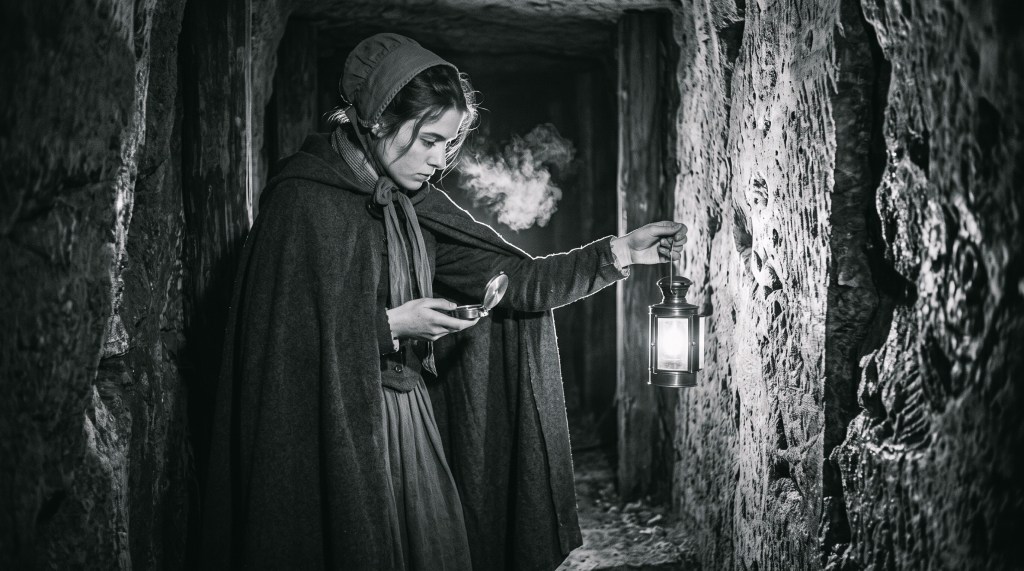
I have made, to date, four expeditions into the galleries. Each has been conducted between the hours of two and five in the morning, in the interval between the deepest hour of sleep and the first movement of the kitchen staff. I carry a shuttered lantern, a ball of waxed cord that I unwind as I advance and rewind upon my return, after the manner of the old Greek legend, and a set of surveying instruments obtained through the diligent application of studied flattery upon a young man of the Inspection Générale des Carrières who frequents the same salons as I do and who believes my interest in his department’s work to be purely intellectual. He is, in one sense, entirely correct.
The cold underground is of a kind that concentrates the mind with extraordinary efficiency: it is the cold of a world indifferent to human affairs, to the Consulate and the Revolution and the Peace of Amiens alike, a cold unchanged since the first quarryman broke through from above and saw that the dark was without end. One’s breath makes small clouds in the lantern-light. The smell of it is ancient: stone and standing water and the slow mineral exhalation of the earth. There is, occasionally, the muted reverberation of the city above, the distant toll of a bell at the hour, the faint rumble of a late cart on the road. More often there is nothing but the deep silence of the stone, which is not quite silence but a kind of breathing, the slow and steady exhalation of a city resting upon its own foundations, unaware of what contemplates it from below.
I sketch my findings in the margins of a household account book, worked over with columns of domestic figures so that any cursory examination discovers nothing beyond arithmetic. The galleries extend considerably further than the official surveys concede. The Inspection’s maps are incomplete; their surveyors have not followed certain of the deeper passages, where the ceiling lowers and the limestone weeps moisture and the fear of sudden collapse would deter any man not driven by a purpose sufficient to override the common instinct of self-preservation. I have not been deterred. I have measured the angles of every junction with the compass, paced the distances, noted the composition of the stone, catalogued the points at which ancient workings intersect the more recently quarried sections, and observed where the rock betrays the signs of stress that the weight of five centuries of the city above imposes upon it. It is, I may say without qualification, the most genuinely satisfying intellectual labour I have undertaken in my life. There is no performance required of me underground. There is only reason, applied to the material world with the precision of an instrument.
The stone is beautiful. This I had not expected. It is the pale cream limestone of the Paris basin, threaded here and there with flint and the fossil shells of sea creatures whose age I cannot calculate, incised in places with the marks of quarrymen long dead: their dates, their names, their small private notations, as legible in lamplight as the morning the chisel made them. I have found chapels of a sort: low-ceilinged spaces where someone, a quarryman of an earlier century or perhaps a priest in the worst years of the Terror keeping his faith below a city that had forbidden it above, has carved a rough cross into the wall and hollowed a niche for a candle. I have found passages that connect, by my calculation, to foundations that predate the Revolution by four centuries and more. I have found the deep arteries of a city that was old when the Valois first sat upon their throne.
And I have found, at last, what I was searching for.
There is a chamber whose precise location I shall not commit to these pages, save that it lies, by my reckoning, in close proximity to the foundations of the Basilica of Saint-Denis. I am well acquainted with what was done at Saint-Denis in the Year Two. I know that the sacred vaults were broken open and the remains of France’s kings, interred across thirty generations, were treated as an encumbrance of the ancien régime to be cleared away with the other debris of the old order. The republicans despoiled what stood above ground. They did not descend to what lay below.
The chamber is vaulted, supported by four pillars cut from the living rock. Its walls hold niches of the kind I associate with reliquary work. They are empty. I believe they have been empty since before the memory of any soul now living in this city. They will not remain so.
My father’s remains, the grey powder and fragments of bone that are all the state left to us of a man of honour and of ancient name after it had concluded what it pleased to call the administration of justice, are concealed in a sealed tin box within the lining of a travelling cloak at the bottom of my wardrobe. They arrived sewn into the hem of a petticoat, carried to me by our old maid from the estate in Brittany during the one visit she has been permitted. The soldiers of the Republic searched her at the gate with such thoroughness as their orders required. They did not search a petticoat hem.
When my map is complete, when I have charted every gallery and measured every passage and committed to paper the full extent of what lies beneath this city, I shall carry that box down the narrow stair and along the cord’s familiar path to the vaulted chamber. I shall set my father’s remains within the eastern niche, which faces, if my compass holds true, in the direction of Jerusalem. I shall seal the niche with limestone mortar, of which the galleries furnish an ample supply. I shall say what prayers the occasion demands, without a priest, without the sacraments, without any sanction beyond that of the Almighty, whose understanding of what constitutes a proper Christian burial extends rather further than that of a Jacobin lieutenant with a list of names and a loaded musket. My father will rest in the earth of Paris, beneath the stones the Valois quarried, in the ancient dark of the city that killed him. The Republic has taken the surface of France. It has not taken what lies below.
But I have said this is a record of method, and method is not discharged by piety alone. The burial is for my father, for the dead, for the settling of a debt that Heaven has registered in its own ledger. The forgeries are for the living.
I have spent six weeks composing, revising, and perfecting a series of documents. They are written in the hand of no person who exists. They bear the seals of a network of correspondents entirely of my invention, reproduced from impressions I took in wax from authentic examples found in the ground-floor library and, on one singularly fortunate evening, from an unattended correspondence tray in the anteroom of a minister’s wife at whose salon I had been received with much apparent warmth. The language of these letters, their references, their modes of address, their deliberate errors of phrasing, have all been calibrated with care to represent the educated Breton gentleman who has spent two years evading the gendarmerie in a farmhouse on the Armorican plateau: the man who distrusts paper but trusts his correspondents, who writes in haste and seals with attention.
The cabinet noir intercepts private correspondence as a matter of regular practice. This is no secret to anyone of intelligence in Paris, and I regard it not as a scandal but as an advertisement of the state’s apprehensions. A letter sealed in a private room and posted through the ordinary mail to a provincial address is, for every practical purpose, a letter addressed directly to the Minister of Police. He will read it before its named recipient does. I had considered this an obstacle. I have since revised my assessment considerably. It is, in fact, a convenience of the highest order.
The letters speak of an armoury. They do so with the imprecision of men who know its whereabouts but dare not commit the details to paper: a cache of weapons and powder, concealed in the quarried galleries beneath Paris itself, accessible by a route known only to the initiated, awaiting the day when Brittany rises again. They speak of a map, to be conveyed separately, the key to the whole enterprise, to be guarded above all things.
The map is a considerable work of invention. I have drawn it on properly aged paper, prepared across three evenings of careful soaking in a cold solution of tea and lampblack, then dried slowly over the stove. The galleries depicted are, in their general structure and bearing, consistent with the true geology of the arrondissement in question: a man who knows the Inspection’s surveys would find them entirely plausible. They lead, however, to a chamber that does not exist, by a route that any surveyor may follow for three hours underground and at the terminus of which he will find nothing but undisturbed limestone and, I trust, a dawning conviction that a considerable portion of the Republic’s administrative energy has been consumed in the service of a fiction.
The letters will be introduced into the postal stream by means I have been developing these several weeks past, and which I shall not describe even here. The map will follow by a separate channel. The cabinet noir will read everything. The Minister of Police’s apparatus, or that of whatever officer comes to hold that office in the fullness of time, will be presented with a royalist conspiracy calibrated to excite that species of anxiety most natural to the present government: a network of correspondents, an armoury in the city’s very foundations, a Breton rising awaiting only the appointed signal.
They will excavate. They will commission surveys. They will send men below ground with lanterns and orders and the full weight of the Consulate behind them. They will tear open the foundations of the Paris they claim to govern, following a road I have drawn in the small hours of a July morning at an escritoire in a room I am not permitted to leave, a road that leads, at its termination, to nothing whatsoever. And above ground, the citizens of Paris will observe their government engaged in the systematic excavation of its own city’s foundations in a state of organised consternation.
I do not deceive myself that this will unseat the Consul. Bonaparte survived Cadoudal. He survived the rue Saint-Nicaise and the long years of the Breton pacification. He will not be brought low by a forged seal and a well-drawn counterfeit map. But a government that digs up its own foundations in a condition of organised alarm has demonstrated, in the most public manner available, the precise geometry of what it most dreads. And a government whose dread can be read plainly is a government that history will read plainly in due course, whatever monuments to prudence and reason it raises above its anxieties in the meantime.
I return, in these last minutes before dawn, to the question.
My greatest dream?
In my girlhood, before I understood what the world was capable of, I might have answered as my station required: a husband of good character, a household in proper order, the untroubled continuation of a life whose terms had been set long before my birth. Later, when the killings began, I would have said simply: that my brothers remain alive, and my father be given Christian ground. These desires I have not surrendered. They are the foundations upon which the larger construction is raised.
But the dream that sustains me now, the one that draws me from my bed at two in the morning and sends me into the dark below a city that believes it has safely reduced the last daughter of a finished house to decorative compliance, is of an altogether different order. I dream of a Paris that does not know it is haunted. I dream of prefects and ministers and secretaries of state dispatching real men with real lanterns into real galleries, filing real reports, drawing real salaries, conducting real interrogations, all in earnest service of a fiction composed at this gilded escritoire. I dream of the Republic’s magnificent machinery of surveillance turned inward upon itself, consuming its own fears in the dark, and I dream of my father lying in the eastern niche of the limestone, undisturbed and at rest, whilst the sound of their searching echoes somewhere in the ancient stone above him.
This is not vengeance of the common sort. I have no taste for blood, nor any interest in the theatre of the scaffold and the public declaration. This is the restoration of a proper order: the dead accorded their ground, the living accorded what they have earned, and the record made straight by a hand that the Ministry of Police never once troubled itself to examine.
I hear the first birds. The sky beyond the window is the colour of old pewter, neither night nor yet morning. The footstep in the corridor has resumed its more waking rhythm. In a moment I shall seal these pages in the compartment beneath the false bottom of the writing box, behind the second panel, where they will not be found by any search that seeks only what it already expects to discover.
I think of my brothers, wherever they are keeping themselves in Brittany at this hour, in whatever farmhouse or borrowed rectory affords them shelter this season. I think of them with the precision I give to all things I love: they are alive; they are armed if necessity should one day demand it; and they are held still, at this present moment, by the knowledge that I am here in the capital as the Republic’s surety against their movement. They believe this to be my imprisonment.
After four months and twelve days of close observation, I have arrived at a rather different reading of the matter.
The Almighty, in the dispensation of His design, does not always choose the most direct road. He gave Joseph the pit before He gave him Egypt. He sent Judith into the tent of Holofernes before He placed the blade in her hand. He has given me, in the place of the liberty I am owed, a position of proximity: proximity to the city I intend to unsettle, to the society I am studying, and to the galleries through which I shall one day carry my father to his rest. I am close to everything I require. This is not a constraint. This is a vantage.
I am not a prisoner in this house.
I am the most dangerous person in it.
Bob Lynn | © 2026 Vox Meditantis. All rights reserved.


Leave a Reply