Who are you most inspired by?
I: The Shop as a Self-Portrait
You came in for a reason, I think. People who wander in without one, they look at the clocks and they leave. You stopped at the threshold and you looked at me first. That tells me something.
Sit, then. There is a stool by the counter if you don’t mind the dust on the cushion. I won’t pretend to have tidied for you.
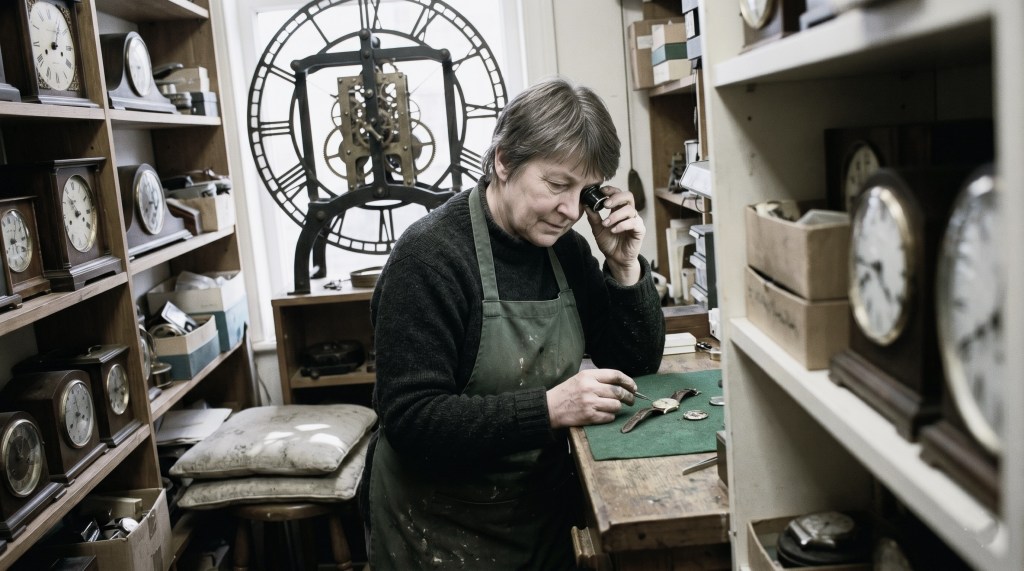
Let me describe this place before you form your own impression, which will be wrong in some pleasant way. It is narrow: two people walking abreast would find themselves apologising to each other. The walls are shelved from floor to ceiling on both sides, and every shelf holds clocks in various states of being. Some run. Some wait. The ones at the top wait longest; they need parts I sometimes have to make myself, filing down a blank of brass until it resembles what I need, which is slow and meditative work. The light comes in from a single window that faces north, which means it never flatters anything, which suits me. Flattery is for things that need hiding.
On the wall directly behind me there is a clock I made myself, over the course of one winter, mostly to see if I could. It is oversized to the point of absurdity, the full movement exposed behind a frame of bent iron, every gear and escapement visible and turning. People look at it the way they look at a heartbeat on a hospital monitor: slightly unnerved that something so interior is on open display. But I find it companionable. It breathes. There is no other word for the rhythm of it.
The smell is what people remark on first, when they remark at all. Brass polish, machine oil, something older underneath, old paper or the wood of the shelves themselves, which I have never once replaced since I took on this lease thirty-four years ago. Someone told me once it smells like a storm about to break, and that is closer to the truth than anything else I have heard. There is something electrical in old mechanisms. Something that hasn’t quite discharged.
I repair clocks. Watches, mostly, though I will look at anything that ticks if the person asking has a reason I find convincing. I am not a museum restorer, and I am not interested in antiques as investments. If you want an appraisal, there is a man on the other side of the old district who will tell you whatever you want to hear for a reasonable fee. What I do is simpler and, I think, harder. I make things run again. Things that have been told, sometimes by people who should know better, that they are beyond repair.
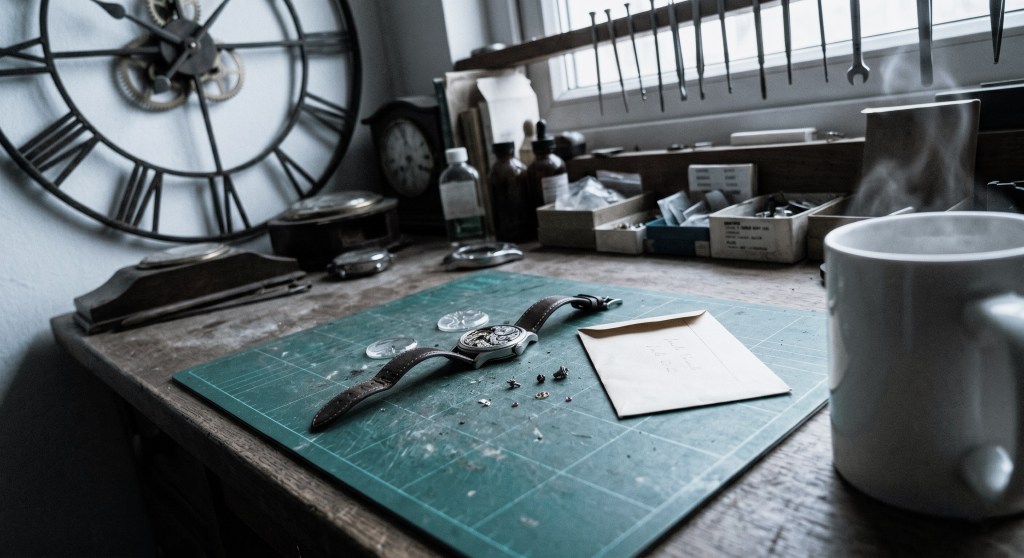
They bring them to me in boxes, in velvet pouches, wrapped in handkerchiefs, carried loose in trouser pockets as if they are frightened to formalise the errand. A man last week arrived with a wristwatch inside a sealed envelope; I did not ask why. The watch had belonged to his wife, who died two years ago in September. The movement was rusted solid, the crystal cracked across in a long diagonal like a scar, and two of the cannon pinions had sheared clean off, which is not supposed to happen to a watch that was simply worn and not abused. He placed the envelope on the counter and said, without looking at me, “She wore it every day for forty years.” Then he left, because there was nothing else he needed to say.
That is the kind of thing that comes through my door.
A mother’s pocket watch, green with neglect, the hands fused to the dial face. A boy’s wind-up toy, the last thing he touched before the accident; the spring inside had snapped with such violence at some point that it had pierced the casework from the inside, which is mechanically very nearly impossible. A wedding anniversary clock with a cracked suspension spring and a note attached that said only: forty-three years. No instruction, no name, no number. The woman who left it never came back for it, and I keep it on the shelf by the window, where it runs. I could not throw it away.
I do not tell you these things to earn your sympathy. I tell you because you should understand what kind of work this is before you ask me what you came here to ask.
My hands. You are probably looking at them; people do. They are not elegant hands. The knuckles are large from years of cold winters in a workroom I have always been too stubborn to heat properly, and there is always a shadow of oil under the nails no matter how carefully I clean them. But they are steady. A watchmaker’s hands have to be steady, or there is no point at all. The screws I work with most often are smaller than a grain of rice. The jewels set into the movement of a fine watch, the tiny rubies that reduce friction on the arbours, are smaller than the head of a pin. You move wrong, you breathe wrong at the wrong moment, and the thing you have been coaxing back to life for three hours is scattered across the bench and you begin again.
I do not make things perfect. I want to be clear about that, because people sometimes come in expecting a kind of resurrection, and I am not in that business. What I can do, with a rusted mainspring or a worn barrel, is make the mechanism run again. For a while. Perhaps for years, perhaps for months, depending on what the damage was and what the person is willing to have done. But the watch a woman wore every day for forty years is not going to become the watch it was on the morning she first put it on. That watch is gone. What I can give back is something that ticks, something that, when it sits on the wrist of the man who brought it to me in a sealed envelope, will run and warm and become, over time, an object that has known two people.
That is enough. That has always been enough.
And now you ask me who I am most inspired by.
This is not a question people usually ask in a clock shop. They ask can I fix this, and how long will it take, and how much will it cost, and occasionally they ask how I learned this trade, which is a long answer I usually shorten out of mercy for us both. But who inspires me. That is a different sort of question. It assumes something: that there is someone worth naming, that my life has a shape to it, a source. Which is kind of you, even if you said it without thinking.
I am going to answer you honestly. It will not be the answer you expect.
Pull up that stool a little closer. Leave the door; the latch sticks, you have to lift and push at the same time, and if you let it close we’ll be here all evening.
Now. Let me tell you about a lighthouse keeper.
II: The Lighthouse Keeper
My brother’s name was Tomás. He was twenty-six when he died, and I was twenty-three, and I am not going to tell you more than that because the how of it does not change the after. What I can tell you is that I could not stay where I was. The town I had grown up in had grown strange overnight, the way a room looks wrong after you have moved one piece of furniture. Everything in its place and nothing where it should be.
So I drifted. That is the only honest word for it. I had a small amount of money, a canvas bag, and no plan, which is a combination that will take you surprisingly far if you don’t resist it. I went south and west into the oldest part of Spain, Galicia, which is where I was from originally, though I had been away long enough that it felt both mine and not mine, the way a language feels when you dream in it but stumble over it when you wake. It is a country of granite and fog and very old sorrows. It does not pretend at cheerfulness. That suited me.
I was moving along the coast of Finisterre. The name means end of the earth, in Latin, and the people there say it without irony because from the cliffs it really does look like the world runs out. The coast is not hospitable. It is all black rock and cold water, and the wind comes off the Atlantic with a kind of impersonal force: not angry, just indifferent, which is sometimes worse. There were small fishing ports along that stretch, and I moved between them, staying a night here, three nights there, not looking for anything, which is perhaps why I found something.
The ferry was not supposed to run that day. I knew that when I got on it. The harbourmaster, or someone who carried himself like one, had said so that morning: something about the swell, the look of the sky. I had nodded and walked to the jetty anyway. There was a ferryman who had clearly decided that the official position on the swell was open to interpretation, and a few crates of supplies that needed crossing, and I climbed aboard because the boat was there and going and I had no reason not to. That was the logic of that period of my life. Motion for its own sake. Not because I thought it would help, but because stopping felt worse.
The island was small enough that I could have walked its perimeter in twenty minutes on a calm day. There was no village, no shop, no café, nothing at all except the lighthouse itself and a low stone building attached to it that served as the keeper’s quarters. Black rock, as I said. Salt-stripped wood on the door frames and window shutters, weathered to the colour of old bone. The smell was cold iron and seaweed and something faintly biological I chose not to investigate. When the ferry disappeared back into the grey and the sea went wrong behind it, the way the sea goes wrong when it has decided to mean business, I stood on the jetty with my canvas bag and understood that I was staying.
The keeper came out eventually. He did not seem surprised to find me there, which told me either that the ferryman had sent word by radio, or that strangers occasionally washed up and he had made his peace with it. He was old. I say old: he was perhaps seventy, perhaps less, though the work and the weather and whatever the years had done to him privately made it difficult to calculate. He was not tall. His hands were larger than you would expect for his frame, scarred at the knuckles, deeply tanned even in that grey coastal light. He looked at me for a moment the way you look at a new instrument before you understand what it does, then he nodded and went inside, leaving the door open. I followed. That was all there was by way of introduction.
His name I never learned. I want you to understand that this was not unusual for him; he was not withholding it, he simply never offered it, and I did not ask, because in that place and that silence the question would have felt wrong, like speaking loudly in a room where something is sleeping. I will call him the keeper, because that is what he was.
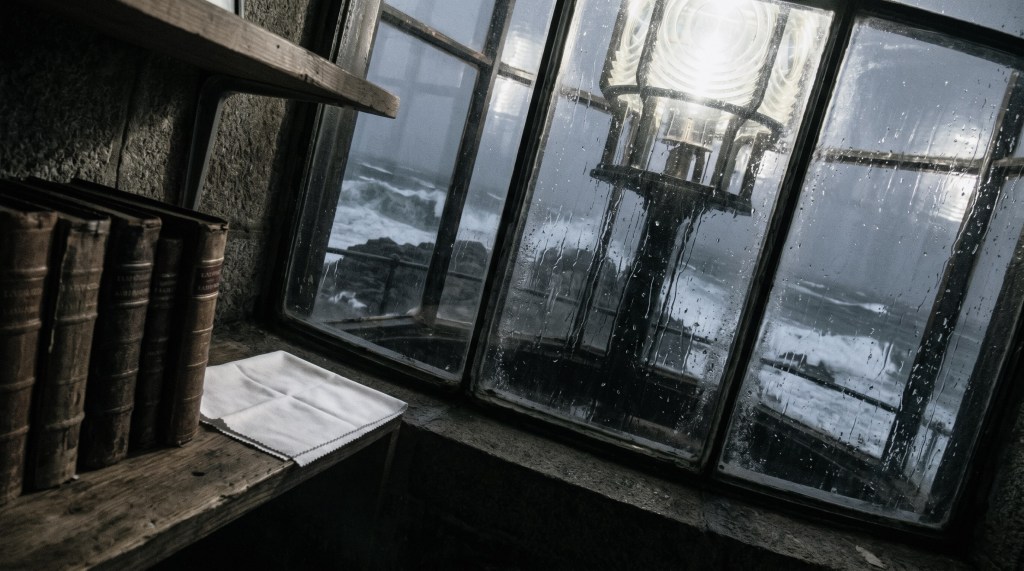
The lighthouse was his entire world, and he had arranged it with a kind of austere precision I recognised even then, with my untrained twenty-three-year-old eye, as the precision of someone who has thought very carefully about what matters. The lamp room at the top held a Fresnel lens: if you have never seen one, it is a stacked arrangement of glass prisms, rings within rings, designed to gather and concentrate light, and when it is clean and running it is one of the more beautiful things a human being has made. His was immaculate. He polished it every morning with a dedicated cloth he kept folded in a square on the shelf beside the lamp mechanism, and the ritual of it was so practised and exact that watching him was like watching a surgeon prepare an instrument. Not one motion wasted. Not one corner of glass left wanting.
Below the lamp room he kept a logbook. Every flash recorded, every entry written in a hand so level and controlled it could have been typeset. The weather, the visibility, ships sighted if any, hours of lamp operation. He had been keeping it for years, perhaps decades; the older volumes were stacked on a low shelf, their spines faded to near-illegibility. I did not ask to read them. They were not for me.
What I remember most from those first two nights is the sound. The lamp turning overhead while I lay on a cot in the spare room: a steady mechanical revolution, a faint clicking of the drive mechanism, then the long sweeping silence as the beam went out over the water and came back again. It was the most organised sound I had ever heard. In the months since Tomás died, every sound had felt chaotic to me, unmeasured, random. A creak in the floorboards, a car outside at night: they would arrive without warning and land badly. But that lamp was a clock. It divided time into even portions and offered them up one at a time, and something in me that had been wound very tightly began, I think, to ease slightly. Not to mend. Just to ease.
We ate together in the evenings. He cooked simply and well: fish, bread, something with chickpeas once. He spoke almost not at all, and I was grateful for it. When he did speak, it was practical. The weather tomorrow. The condition of the jetty. A mention that there was hot water if I wanted it. Once, over the chickpeas, he told me he had lost his family in the civil war when he was a child. He said it the way he might have said the fog was coming in: a fact, fully processed, no longer in need of discussion. I did not offer condolences, and he did not appear to expect any. His wife, he added a moment later, had died of cancer fourteen years ago. Then he attended to his food and said nothing else on the subject. The gulls outside, which in the mornings he could be heard addressing in a low conversational tone, as if briefing colleagues before a shift, made a sound like the wind tearing fabric. The lamp turned overhead. That was the evening.
The storm came on the third night. It had been building since morning; you could see it coming if you knew where to look, which he did. He spent the afternoon checking and re-checking: the mechanism, the fuel, the condition of the lens, the vents. He did not appear anxious. He appeared methodical, which in someone who had survived the kind of life he had, is perhaps a form of courage all its own.
By evening the sea was something different from itself. Waves like cathedrals collapsing is how I have always described it when I have tried to describe it at all, though that does not fully answer. There is a scale to an Atlantic storm on that coast that resists ordinary language; the water lifts to a height that seems structurally impossible and then falls with a weight you feel in the floor of the building, in the soles of your feet, in somewhere behind the sternum. The wind found every gap in the stonework and played them like instruments. The lamp continued to turn.
I went up to the lamp room because I could not sleep, and because I thought, I suppose, that being near the light was safer than being away from it. He was there already, standing at the glass, looking out at the storm. His hands were at his sides. And he was weeping.
Not the collapsed, gasping sort of weeping that announces itself. Just tears, running steadily into his beard, as if the weather outside had found a small way in. He heard me on the stairs and turned, and he saw me, and he did not wipe his face or look away. He met my eyes with complete composure, as if the tears were simply present and he saw no pressing reason to address them. No embarrassment. No explanation offered.
Then he said, quietly, in the Galician Spanish of that coast, which is not quite either language and carries in it something of the Atlantic itself: “The light doesn’t need me to be whole. It only needs me to be here.”
He said it the way you state a measurement. A fact arrived at through careful testing, written down once and not revised.
Then he turned back to the glass, picked up his cloth, and began wiping the salt spray from the panes, working in the same steady arcs he used on the Fresnel lens, unhurried and even. And he began to hum. A lullaby, I thought, though I did not know it: something in a minor key, older than anything I could place, the kind of melody that seems to have always existed rather than ever having been composed. The lamp turned. The storm threw itself against the glass and retreated and came back.
I stood there for a while. Long enough to understand that something had just been placed in my hands without ceremony, without explanation, without any signal that I was supposed to know what to do with it. Then I went back downstairs and lay on the cot and listened to the mechanism turning above me, dividing the night into clean equal portions, and I held what he had said in my mind the way you hold a small gear up to the light to examine whether the teeth are worn.
The sea calmed on the fourth morning. The ferry came back, businesslike, as if it had never been away. The keeper was outside when I left, attending to the seaward face of the lighthouse wall, scraping away a crust of salt and lichen with a short-handled tool. I said goodbye. He raised his hand without looking up. That was the whole of our farewell, and it was right; anything more would have been less.
I did not go back. I want to say clearly that this was not neglect, nor fear, nor ingratitude. It was simply that the thing was complete. He had not sought to teach me anything. He had only been himself, in his storm, doing his work. That I had been there to witness it was an accident of a ferry that was not supposed to run. Some things do not need a sequel.
I walked back up the jetty to the mainland and kept walking, and carried the grief of my brother with me, and it was the same grief it had been four days earlier: I will not pretend otherwise. But it had a location now. It was somewhere I could find it, somewhere inside the ribcage, settled and still. Not gone. Never gone. Just somewhere I knew.
III: The Philosophy of the Present Tense
I came to this trade the way water comes to a low place: not by choice exactly, but by the logic of the ground. After I left Finisterre, I kept moving for another year, working where I could find work, living cheaply, carrying Tomás and the keeper both in the same interior pocket where I kept things I was still working out. I ended up in Porto for a winter, and through a sequence of events that were entirely ordinary I found myself sweeping floors in a clock repair workshop run by a man called Ferreira, who was bad-tempered and technically brilliant, which is a combination I have since learned to respect.
He did not teach me, not formally. He repaired watches and I watched, and when I asked questions, he answered them without looking up, which was all the invitation I was going to get. I taught myself by repetition, by patience, by making small errors on cheap movements and understanding why they were errors. The dexterity came with time; the steadiness of hand is something you either cultivate or you do not, and I cultivated it the way you cultivate silence, by learning to value it and then by practising it daily. After three years with Ferreira, I could do most of what he could do, and a few things he found unnecessary, but I found essential, which was enough of a disagreement that leaving became the obvious conclusion. I was twenty-eight. I rented a small workroom, bought second-hand tools, and put a card in the window.
I did not think: I am answering a calling. I thought: mechanisms need someone to show up for them. That is a thing I can do.
Let me tell you what showing up looks like, in this workroom, on an ordinary day.
I arrive early, while the morning light is still undecided. I make coffee and I sit at the bench, and I look at whatever is waiting. I do not rush to begin. The looking is part of the work; you must see a mechanism clearly before you touch it, because the hands know where they are going if you let the eyes lead them properly. Then I open the casework and I find the fault, which is sometimes obvious and sometimes not, and I begin.
There is always a moment, in the repair of a badly damaged watch, when the problem reveals its full extent. You think you are dealing with a worn crown wheel, and you find, underneath, that the barrel arbour is cracked and the mainspring has been running against a damaged surface for years and the wear is throughout the whole train. In those moments I have learned to do a very simple thing: I note what I find, I set it aside, and I decide what can be addressed today. Not everything. Just what can be addressed today. Then I address it.
That is the keeper’s lesson, translated into the language of a workbench. You do not wait to be whole before you do the work. You do not demand that the storm resolve itself before you pick up the cloth. You sit down with the broken thing, and you give it your full, steady attention, and you do what you can with what you have and what you know, and then you do the same thing tomorrow.
It sounds modest because it is modest. I have never pretended otherwise.
The watches people bring me, as I told you, are almost never simply broken watches. They are the last physical record of someone who is gone: something that was warm against a wrist for decades and is now cold and stopped and sitting in a drawer, because the person left behind cannot bring themselves to throw it away, and cannot bring themselves to look at it either, so they bring it here instead. As if I am somewhere between the drawer and the decision.
I understand this. I am not a grief counsellor, and I do not try to be one. I do not say much when they put the watch on the counter, because there is nothing useful to say that the watch itself does not already say more clearly. What I do is take it seriously. I look at it carefully, I note what is there, and I get to work, and I do not give up on it because the damage is worse than I hoped or the parts are harder to source than I would like. I stay with it.
And when I hand it back, running: that is not a miracle. I want to be plain about that. The person they lost is not less lost. The years that watch measured are still gone. What I have done is something smaller and, I think, true. I have made a narrow bridge between that person and this one, a bridge of ticking, and I have suggested by the act of making it that the past is worth the present’s attention. That is all. But people hold the watch when I give it back, and they look at it the way the keeper looked at his lens, and I know that it is enough.
I should tell you something I have not told you yet.
I am not a repaired person. I say this not to invite sympathy, which I do not want, but because it is relevant to everything I have just said and it would be dishonest to leave it out. My brother has been dead for thirty-four years and I have never fully made sense of it. There are still mornings when the grief is as immediate as a cracked crystal, sitting right on the surface of things, and I must set it to one side to do the work and carry it home again in the evening. That is not a failure of healing or processing or whatever word we are currently using. It is simply the shape of that loss. Some losses do not close. They become, over time, liveable. There is a difference.
What the keeper gave me was not a cure. I want to say that plainly. He did not stand in that lamp room and show me how to mend myself. He showed me something more useful: that mending yourself is not the precondition. You can be in pieces and still turn the lamp. You can have tears running into your beard and still wipe the glass in steady arcs and hum to yourself in the dark. The work does not require your wholeness. It only requires your presence.
I have said that to myself more times than I can count. In the early years I said it aloud, at the bench, quietly, the way he said it: a measurement, a fact arrived at and no longer in need of revision. Later it became internal. Now it is somewhere below thought, a kind of ground note I stand on without hearing anymore, the way you stop hearing a clock that has been in the room long enough.
The light doesn’t need me to be whole. It just needs me to be here.
It belongs to me now as much as it ever belonged to him. Perhaps that is what he intended. Perhaps he said it to himself every day for decades before I arrived, and had learned by then to say it aloud when it was needed, to whoever happened to be on the stairs. Perhaps there was nothing deliberate in it at all; perhaps he was simply talking to himself, and I was in the way of it, and the accident of a ferry that should not have run meant that it landed somewhere it could take root.
I prefer that version. It is more like how useful things actually travel.
She pauses here. Not for effect; she simply pauses, and her eyes go to the clock on the wall behind her: the oversized, iron-framed thing with its exposed gears, its breathing rhythm, its interior made entirely public. The hands read twenty past four. Every gear visible, turning, the escapement lifting and releasing in its even, patient count. The whole mechanism at work, nothing hidden, keeping time in a room full of other mechanisms doing the same.
She looks at it the way she looks at everything: one beat longer than necessary, listening for something underneath the sound.
Then she looks back at you.
I have been asked, once or twice, whether I feel sad that he is forgotten. This man who shaped thirty-four years of my working life without knowing it, who has no plaque, no entry in anything, whose name I cannot even give you. And I find that I do not. The world forgets most people, and most people do their best work anyway. He did not need to be remembered by the world. He needed to keep the lamp turning, and he did that, every night, fog or clarity, storm or still, whole or otherwise. He showed up. The ships that did not wreck on those rocks because of that light did not know his name either, and they were saved regardless.
That is the kind of inspiration I have room for. Not the grand illuminating figure, not the giant whose name you learn in school and whose lesson arrives pre-digested and approved. The person in the lamp room, weeping without shame, wiping the glass, humming something in a minor key, keeping the mechanism running in the dark. The person whose devotion is witnessed by no one in authority and recorded nowhere that matters. The person who simply, steadfastly, shows up.
She reaches for the loupe on the bench. Settles it against her eye. Draws the watch she has been neglecting back to the centre of her attention: the man’s wife’s watch, the one that arrived in a sealed envelope, the one that should not be fixable.
The room is quiet. The clock on the wall breathes. Somewhere in the mechanism under her hands there is a fault she has not yet located, and the locating of it will take time and patience and steady hands and the willingness to stay with it until it yields.
She bends to the work.
She is here.
Bob Lynn | © 2026 Vox Meditantis. All rights reserved.


Leave a comment