What are your top 10 travel destinations?
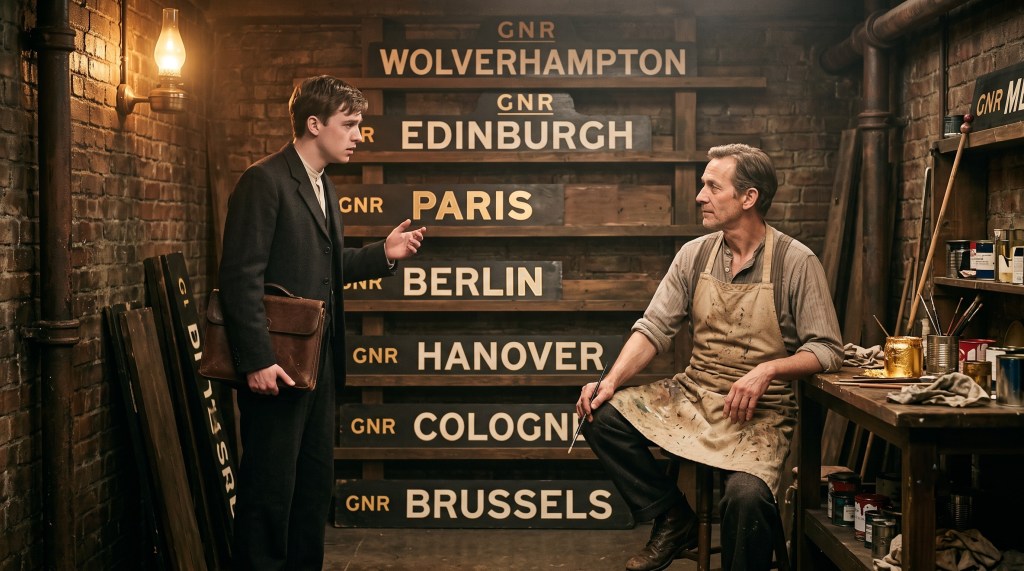
The sign-painting workshop beneath the northbound platforms, King’s Cross Station. Tuesday the fourth of August, 1914. Late afternoon.
A single gas lamp burns in the corner, its flame already turned amber by the thickening air. Half-finished destination boards stand in wooden racks along the walls: BERLIN, BRUSSELS, PARIS, HANOVER, COLOGNE, EDINBURGH, WOLVERHAMPTON. On the workbench: enamel tins arranged in rows, a mahlstick, a range of brushes from broad to fine, an open pot of gold leaf, squares of sandpaper. A cold coal stove in the corner. The smell is linseed oil, turpentine, dry wood.
THE SIGN-PAINTER sits at the bench, his back to the door, lettering the final strokes of WOLVERHAMPTON on a fresh board. His hand is very still.
From above: the muffled, shifting roar of the concourse. Voices. A guard’s whistle. The low groan and sigh of a departing train.
The door opens. THE CLERK enters, stooping beneath the lintel. He carries a leather dispatch case. His suit is slightly too large for him. His elbow catches the doorframe; he steps back, rights himself, adjusts the jacket.
CLERK: I beg your pardon. I was directed down here by – that is, the assistant stationmaster sent me down. I have papers from the Railway Executive Committee. If you are the sign-painter for the Great Northern –
The sign-painter touches the brush once to the board, completing a letter. He lays the brush across the enamel tin.
SIGN-PAINTER: Aye.
CLERK: Good. (He opens the dispatch case and removes a sheaf of folded papers.) I have here a requisition order – reference REC stroke seven stroke nine, dated today, the fourth of August – formally placing this station under Committee authority for the purpose of military transport. The order covers all platform facilities and associated signage. I expect you’ll have heard the announcements above –
SIGN-PAINTER: I hear it.
CLERK: Yes. (He unfolds the third sheet and smooths it against his palm.) New boards are required. Departure indicators, marshalling notices, troop-train identification boards. There is a full list on this sheet here. The Committee’s preference would be to begin tonight, if that’s –
A sound from above: louder now, a crowd pressing somewhere, voices sharpening into something that is not quite panic but is close to it. A guard’s whistle, twice. A long, descending hiss of steam.
The sign-painter does not stir.
SIGN-PAINTER: Can’t tonight.
CLERK: I understand. Tomorrow morning, then – first light, if it can be managed –
SIGN-PAINTER: It can.
CLERK: Good. (He looks back at the list, frowning.) There are seventeen items on the primary sheet and a further nine supplementary, though the supplementary won’t be needed until –
He stops. He has looked up. His eyes have found the boards in the racks.
BERLIN. BRUSSELS. PARIS. HANOVER. COLOGNE.
CLERK: Those boards. The Continental ones. They’ll want to come down, I should think.
SIGN-PAINTER: Aye.
CLERK: There’s a line in the order about it. (He turns through the sheets.) “All former Continental destination boards to be withdrawn from service and held in store pending further instruction.” The wording is the Committee’s, not mine. I imagine it won’t be long before –
SIGN-PAINTER: I’ll see to it.
He picks up the brush again. He dips it. He does not paint.
CLERK: I had – I had thought to visit Paris myself, at some point. I’d been reading about it. The hotel guides, the – I know that’s nothing to do with anything. I mention it only because –
He stops himself. He adjusts the jacket.
CLERK: It doesn’t matter. The main list is on the third sheet. (He holds out the paper towards the bench.) If there are materials required, the Committee has funds –
SIGN-PAINTER: How old are you?
CLERK: (surprised) I’m – twenty-two.
SIGN-PAINTER: Aye.
A silence. The sign-painter dips the brush and touches it to the board. One stroke. Two.
CLERK: Have you been in this workshop long?
SIGN-PAINTER: Twenty-five years.
CLERK: Twenty-five. (He looks at the racks again.) Then you’ve painted all of those. BERLIN. PARIS. COLOGNE. All of them.
SIGN-PAINTER: And the ones before.
CLERK: You know them all.
SIGN-PAINTER: I know their letters.
CLERK: (slowly) Only their letters?
The sign-painter lifts the brush from the board.
SIGN-PAINTER: PARIS is five letters. Short board, fits neat. BERLIN is six. COLOGNE has a tricky middle – the O wants to be too wide if you’re not watching it. HANOVER is seven and the H wants to pull left. (pause) That’s what I know of ’em.
CLERK: And beyond that – you’ve never –
He hesitates. The sound from above has shifted: lower now, sustained, as though the whole concourse has just received the same piece of news and is holding it in.
CLERK: I’m sorry. I don’t mean to detain you with it. (He turns the papers in his hands.) It’s only that you’ve spent twenty-five years with those names on the wall. You know BERLIN and HANOVER and PARIS as well as any man at the Foreign Office today. And it seems – I don’t quite know. It seems –
SIGN-PAINTER: Seems what?
CLERK: (quietly) Strange. That the names should be here and the places there, and a man should spend his whole working life with one and never –
He stops.
The sign-painter looks at him. Not unkindly. Not kindly either.
SIGN-PAINTER: Say it, then.
CLERK: (after a moment) You’ve held all those names in your hands for twenty-five years. (He looks at the racks.) If someone were to ask you – your ten most wished-for destinations. The ten places you’d choose above all others, if a man could simply go. What would you say?
A silence.
The sign-painter sets down the brush.
SIGN-PAINTER: (unhurried) That’s an odd question to ask a sign-painter.
CLERK: I know. Forgive me.
SIGN-PAINTER: Nay, don’t. (He wipes his hand on the cloth at his side.) I’ll think on it.
He looks at the board. He looks at the rack. BERLIN. BRUSSELS. PARIS.
SIGN-PAINTER: I can’t answer it the way you mean it. They’re boards to me. Always have been. I’ve not thought on those places as somewhere a man walks in and stands and puts his hand to a wall. (pause) I shan’t call that a loss.
CLERK: No?
SIGN-PAINTER: No. It’s the shape of it.
A sound from above: boots, many of them, moving in formation across the concourse. A low, organised thunder. Then silence.
Neither man speaks.
The clerk looks at the board labelled PARIS. He looks for a long time.
CLERK: I had saved a little. Not much. Enough for a week. I thought – after the summer –
He does not finish.
SIGN-PAINTER: Aye.
CLERK: (quietly) It seems a small thing now.
SIGN-PAINTER: Aye.
The gas lamp dips. The amber deepens. Long shadows move across the racks of boards.
The clerk looks at his papers. He reads the line again.
CLERK: “Held in store.” It doesn’t say destroy them.
SIGN-PAINTER: No.
CLERK: Only store.
SIGN-PAINTER: Aye.
CLERK: There might come a time when they’d be wanted again.
The sign-painter looks at him. A long, level look.
SIGN-PAINTER: There might.
The clerk nods. He folds the papers and replaces them in the dispatch case. He fastens the clasp.
CLERK: First light, then. I’ll send word if there are additions to the list.
SIGN-PAINTER: Aye.
CLERK: Good evening.
He turns. He takes two steps towards the door.
SIGN-PAINTER: Lad.
The clerk turns.
SIGN-PAINTER: Twenty-five years I’ve been down here. Made every one of those names fit the board it was given. Made ’em legible from thirty feet in gas-light and fog and all the rest of what this station throws at a man. Made BERLIN sit right, and COLOGNE, and PARIS, and every name between here and Edinburgh and back. (pause) But I’ll tell you what those places are to me. They’re the weight of the brush. The tooth of the board. The way the gold leaf takes the light in this room. The sound a train makes when it goes out above my head. That’s what I know of Berlin. That’s what I know of Paris. (pause) And I reckon that might be enough. I reckon a man can hold a thing his whole life without ever going to it, and it’s still his.
Silence.
The clerk stands in the doorway. He is still.
Above, the concourse roars and stills and roars again. A guard’s whistle, long and thin.
CLERK: (almost nothing) Yes.
He goes.
The door closes.
The sign-painter turns back to the bench. He picks up the brush. He looks at WOLVERHAMPTON – the whole long name of it, finished, bright and certain in the failing light.
He does not move.
The gas lamp burns.
Above, somewhere, a clock is moving towards eleven.
Bob Lynn | © 2026 Vox Meditantis. All rights reserved.

 Vox Meditantis
Leave a comment