What’s a book, movie, or TV show that you wish you could experience again for the first time?
I: The Gardener
Before I tell you about the book, I need to tell you about the brushes.
I kept them in a tin that had once held imported Chinese tea. Fourteen brushes, arranged by width, the way a careful person arranges knives. Every morning in my studio in Pyongyang I would open that tin and hold the smallest one between my fingers the way a doctor holds a pulse. Not pressing. Just resting. Feeling whether the day was steady or not. If my hand was calm, I could begin. This was my ritual for thirty-one years and I am not embarrassed to tell you I loved it. I loved my work. I need you to understand that first, because everything that comes after only makes sense if you believe it.
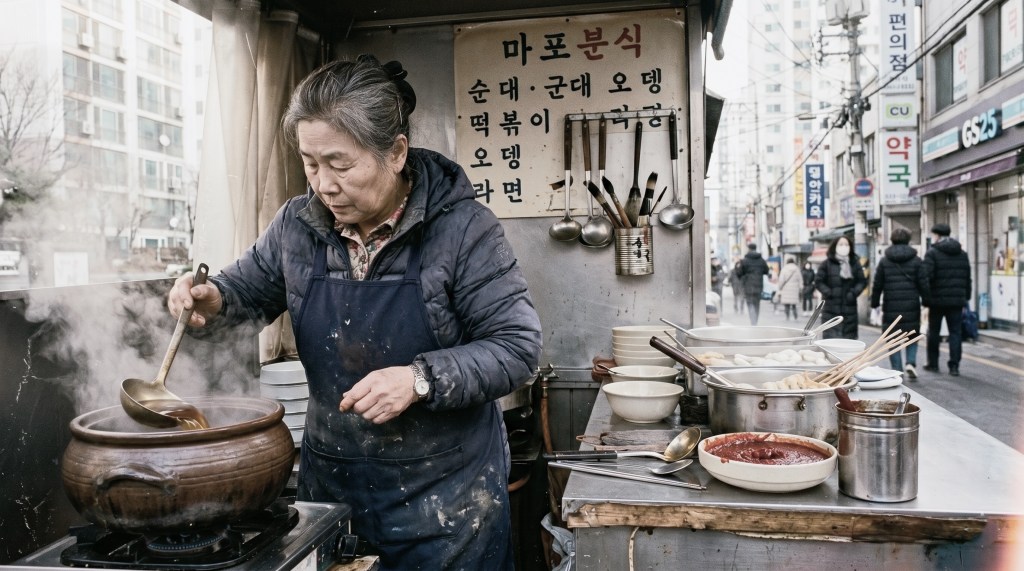
My name is Chun-ja. I am sixty-seven years old. I run a sundubu-jjigae stall in the Mapo district of Seoul, which means I sell soft tofu soup to office workers who eat it too fast and do not taste it properly. Before this, I lived in Pyongyang, in the Democratic People’s Republic of Korea, and I was a painter of portraits. Not of ordinary people, you understand. In my country there was only one face worth painting, and it belonged to two men, and those two men were Kim Il-sung and Kim Jong-il, the father and the son, the Great Leader and the Dear Leader, eternal as mountains, smiling down from every wall in every building in every city in a country where, if you were unlucky, there was nothing to eat but the sight of their smiles.
I painted that face for three decades. I was good at it. I was, without false modesty, one of the best.
The technique was an exacting thing. The jaw had to sit at a precise angle, chin tilted just enough to suggest authority without arrogance, which in our system were considered to be the same gesture made at different volumes. The eyes had to be warm but never soft, the way you might describe a fire that is useful rather than dangerous. The eyebrows I painted with a brush no wider than a matchstick, slow strokes following the grain of the hair, each one like a small mountain ridge rising from the forehead. I spent three weeks once on a single pair of eyebrows for a mural commissioned for a textile factory in Hamhung. Three weeks. The foreman told me the workers had begun arriving early in the mornings to watch me paint. He said this as a compliment. I received it as one.
What you must know, and what took me many years in Seoul to be able to say plainly, is that I painted from approved imagery and from memory and never, not once, from life. The face I painted ten thousand times was a face I had never been in the same room with. I had studied it the way an astronomer studies a star, through instruments and at a great distance, inferring warmth from a kind of light that might have left its source long before I was born. This seemed normal to me. It seemed, in fact, like a form of devotion. You do not need to touch something to love it. I knew this because I had loved my mother from across a river she forbade me to swim in, and I had never once doubted the love was real.
The Ministry minders came on Tuesdays. Two of them, usually, sometimes three. They wore grey suits and carried clipboards and they would stand behind me the way a supervisor stands behind a student, and they would look at whatever I was working on with a kind of professional blankness that I now recognise as the expression of a man being careful not to react before his colleague does. They spoke in the language of corrections, which is a language that sounds like suggestions but is not. “The shadow on the left cheek may be creating an unintended effect.” “The warmth of the smile could perhaps be amplified by adjusting the highlight here, and here.” Once, a minder told me that a given fall of light across Kim Il-sung’s forehead was ideologically incorrect. I remember looking at the painting for a long moment, genuinely trying to see what he was seeing, the way you try to see a constellation someone is pointing at in the sky. Then I picked up my brush and I fixed it. I felt satisfied when I did. The painting was better, I told myself. The painting was always better after.
I did not think of this as surveillance. I thought of it as collaboration.
Here is the metaphor I used then, the one I have since had to bury: I believed I was a gardener. Not a propagandist, not a servant of the state, though those words existed and I knew them in the abstract the way you might know the word for a disease in a country you have never visited. I was a gardener, and the portraits I painted were a kind of food, spiritual nutrition for the people, and if I tended them carefully enough, if the brushstrokes were true and the colours warm and the eyebrows rose like mountain peaks above eyes that promised safety, then a hungry person standing before the mural at the textile factory in Hamhung would feel, for one moment, less hungry. I believed this. I want to be very clear with you: I believed this the way I believed in weather and in gravity, as a fact that required no investigation because the evidence of it was everywhere I looked.
The eyes of the people when they looked at the portraits. The way a room’s posture changed when you hung a large canvas in it. The foreman in Hamhung with his workers arriving early. What was that, if not proof?
There is one memory I have been turning over for many years now, the way you turn over a stone to find out what has been living underneath it. A colleague of mine, a painter named Sung-ho, disappeared in the spring of 1994. He was not arrested in a dramatic way; he was simply not there one Tuesday morning, and by the following Tuesday no one was using his name in sentences anymore, the way you stop using a word when you are no longer certain of its pronunciation. The reason I heard, in the corridor, in the way things were heard in corridors, was that a portrait he had submitted for review had one of the Dear Leader’s ears positioned three millimetres too low. Three millimetres. Less than the width of my finest brush.
I heard this and I thought, very briefly, something that did not form itself into words. A flash of something, cold, like the shadow of a cloud crossing a courtyard. And then I turned back to my canvas, and I mixed a new shade of ochre, a warmer one than I had been using, and I kept painting, and the minders came on Tuesday and told me the cheek was excellent, and I thanked them, and I believed I was a gardener.
That is who I was. I need you to hold her in your mind as I keep talking, this woman with the brushes in their tin and the ritual and the thirty-one years and the absolute, tended, well-watered certainty. Hold her, because what comes next is the story of how she was handed a book inside a hollowed-out baguette in a park in Pyongyang, and how she went home and did not open it for three days, and how the gardener died at four in the morning on page 97 with shaking hands and a torn page and the ceiling coming down.
Hold her, because I cannot hold her myself anymore. And she deserves at least that much from someone.
II: The Ice
The missionary did not look like a missionary. I want to say that first, because when people in Seoul hear this story they always picture someone conspicuous, a foreigner in pale linen with a Bible balanced on one knee like a nervous bird. He was not that. He was a Korean man of about sixty with a plain face and the kind of hands that have done outdoor work, and he sat on the bench in Moranbong Park eating half a baguette with the concentration of a man who has nothing else on his mind. A baguette was not unusual in Pyongyang by 2008. We had a French bakery by then, which the government was very proud of, because a country with a French bakery is a country that is clearly flourishing, and if you believed this you did not look too carefully at who could afford to buy bread from it.
He set the other half on the bench between us without looking at me. I had been told there would be half a baguette. That was all I had been told, by a woman at the water’s edge whom I had spoken to for four minutes and whom I never saw again. I picked it up. It was heavier than bread should be. I wrapped it in the cloth I used to carry my smaller brushes and I walked home through the park while the Taedong River caught the afternoon light the way rivers do when they are indifferent to everything happening on their banks.
I put it on my workbench when I got home and I covered it with a clean cloth and I did not touch it for three days. Not because I was calm. Because I was afraid, and the fear was a particular shape I did not want to look at directly, the shape of a woman who already knows, on some level below language, what the weight of a thing means. I had spent thirty-one years not looking directly at certain shapes. I was practised at it. I made tea. I worked on a background study I had been commissioned to do, a landscape of rolling hills the colour of ideology, which is a sort of confident green. I ate. I slept badly. I did not touch the cloth.
On the morning of the fourth day I got up before light and I unwrapped it.
The baguette had been hollowed from the inside, the soft crumb scooped out and the book fitted into the crust like a patient thing that had learned the shape of its own hiding place. It was a paperback. The cover was plain, no illustration, just the title and the author’s name in a font with no ambitions. I could read the title because my English was, by that point, the English of someone who has been shipwrecked on an island of American films and built a hut out of whatever washed ashore.
I should explain this, because it matters to the story.
I had been learning English in secret since 2001, from black-market DVDs that I bought from a man who sold them out of a canvas holdall near the train station, who would name a price with his fingers without opening his mouth, who I paid and never acknowledged and who I am certain never acknowledged me. The films were American, mostly, action films and comedies and three episodes of a medical drama I never saw the rest of, and I watched them with the sound very low and a cloth along the bottom of the door. I did not always understand what was being said. But I watched each one so many times that I could eventually feel the shape of the language before I understood it, the way you can feel the shape of a room in the dark before you find the light. I knew the word “chocolate” before I knew the word “freedom.” I knew “I’ll be back” before I knew “democracy.” I knew every line of one film about two men escaping from prison, which I watched perhaps forty times and which taught me, without meaning to, a great deal about wanting to leave the place you are in.
So my English was a salvaged thing. Functional in strange patches. Confident about breakfast foods and car chases and not much else. And here was a book, which is a very different creature from a film, patient in a way that a screen is not, full of sentences that do not move until you move them.
I read it slowly. I kept a pencil beside me and I wrote Korean translations in the margins in handwriting so small I needed to lean close to read them back. This made the whole enterprise twice as long and I did not mind. I was in no hurry to finish it. I did not yet know what I was reading. I knew only that it was forbidden, and that forbidden things in my country were forbidden for reasons that had always been explained to me as protective, the way a mother forbids a child from touching a hot stove. For the child’s own good. Because the mother knows better. Because the fire does not care about the child and the mother does.
I had accepted this logic for forty-nine years. It fit neatly inside me. It took up no more space than breathing.
Then I read five words.
Big Brother is watching you.
I put the book face-down on the workbench. I looked at the wall above my easel. There was a camera above the door, a small one, which had been there for as long as I had worked in that studio. I had always understood it to be a security measure. Every building had them. They were as unremarkable to me as the locks on the door or the logbook I signed each morning, a standard blue notebook in which I recorded my arrival time and my current commission and my expected hours for the day. A bureaucratic habit. An administrative comfort. The kind of paperwork that proves a system is organised and organised systems are, by definition, looking after you.
I sat there and I looked at the camera and I looked at the logbook and I looked at the camera again, and I felt something that I will try to describe accurately because I think accuracy matters more here than poetry, though I am a person who has always reached for poetry first: it was not like a light being switched on. It was not a revelation in the bright sense, the sense the word suggests, of veils lifting and trumpets and sudden clarity. It was more like hearing, from somewhere above you, a sound you cannot name, a creak, a settling, and knowing, without being able to explain how you know, that the ceiling is about to come down.
I picked the book up again. I kept reading.
Page 97. I will not tell you what is written on page 97 of Nineteen Eighty-Four by George Orwell, because I believe you should find it yourself, and I believe you should find it in your own time when you are not expecting it to land the way it lands. What I will tell you is that I was forty-nine years old and I had spent three decades painting a face from approved imagery at a distance, and when I reached that page I understood something so suddenly and so completely that my hands shook as though I had grabbed a live wire. My right hand spasmed and I tore the page, a clean tear down the left margin, the kind of tear that cannot be un-torn. I made a sound. I do not know what sound. The kind that does not come from the throat.
I sat for a while doing nothing. Then I went to the kitchen and I mixed a paste of rice flour and water and I came back and I taped the page together, very carefully, pressing the edges flush. I still have it. It is the most honest piece of paper I own, because a page you have repaired tells the truth about what reading it cost you.
The realisation, when it came fully, did not arrive as anger. I expected anger; anger would have been clean, would have had a target and a heat and a direction. What arrived instead was something quieter and worse: I was not a gardener. I had been telling myself for thirty-one years that I was a gardener, tending the souls of the people, growing belief the way you grow cabbages, and it was not true. I was a brush. A good brush, a well-maintained one, held in a hand I had never once turned around to look at.
The worst part of this I will tell you plainly, because I have had seventeen years now to find the plain words for it: the brushstrokes were still beautiful. I could look at my own work, at the eyebrows I had painted with the patience of someone who loves what they are doing, at the warmth I had mixed into the flesh tones, at the gentle authority of the smile I had calibrated over decades, and I could see that it was genuinely skilled. I was not a bad painter who had been deceived into thinking she was good. I was a good painter who had been deceived into thinking she was free. These are different humiliations. The second one takes longer to put down.
I finished the book at four in the morning.
I had hidden it inside a large canvas I was working on, a background study propped face-out on the easel so that if a minder came early the painting was what they saw, and the book was behind it, pressed against the stretcher bars. I read the final pages by the light from my desk lamp turned to its lowest setting, hunched over the canvas as though I were working on a stubborn passage of sky. When I turned the last page I closed the book and held it closed with both hands on top of it, as though it might try to return to the beginning.
I did not sleep. I sat until the light through the studio window changed from black to the certain blue that comes just before dawn, the colour I had always thought of as the most honest hour, when the city has not yet decided what it is going to pretend to be that day. I sat and I thought about Sung-ho and his three millimetres. I thought about the minder who told me a shadow was ideologically incorrect and how I had thanked him. I thought about the foreman in Hamhung and his workers arriving early and whether they had come to watch the painting or to be in a room where, for one hour before the shift began, they were allowed to look at something other than the facts of their lives.
The feeling of finishing that book was a sudden, violent thing. Like falling backward through ice. Cold entering from every direction at once, the kind of cold that does not feel like absence of warmth but like the presence of something real that warmth had been hiding. My lungs full of something that was not water but was not air either.
I was not the same woman who had opened that baguette four days earlier. She was gone, neatly and permanently, the way a painting is gone when you paint over it. The canvas remains. The shape of the brushwork remains, just barely, if you hold the new surface to the light at the right angle. But the first image is gone and it does not come back.
I wrapped the book in the brush cloth again. I put it under the floorboard beside the cold wall where I kept the few things in my life that were only mine.
Then I picked up my brushes and I began, for the first time, to think about leaving.
III: The Stall
People in Seoul, when they hear that I defected, want to ask about the crossing. They want the river and the cold and the guards, the drama of it, because the drama makes it into a kind of story they recognise, a story with a shape they can hold. I understand this. I was a painter; I know that people reach for the image that has a frame around it. But I will not give you the crossing in that way, not because it was not dangerous and not because I am protecting anyone, only because that is not the part that weighs anything when I lift it now. The body remembers the cold. The soul remembers what it carried.
I want to tell you what I brought.
I had a padded jacket, the kind with a quilted lining, and I had unpicked a section of that lining with an embroidery needle over the course of two evenings, working by lamplight with the steadiness of a woman who has spent thirty-one years making very small, very precise movements with her hands. Into the lining I folded the book, the taped page facing inward, and I sewed the seam back with stitches that I will not pretend were invisible, because they were not. They were the stitches of a person in a hurry who is also trying very hard. I wore that jacket across the border in January 2009 and I was cold in the way that you are cold when the temperature has an intention behind it, and I did not think about anything except the next step and the one after that, and the book pressed against my ribs like a second heartbeat, which is not a metaphor I choose lightly.
In Seoul, the resettlement people asked me what I had brought with me. I told them a jacket and some practical items. This was partly true. They gave me a room in a resettlement facility and a list of things the government would help me with and I sat on the edge of the bed in that room and I took the jacket off and I pressed my palm flat against the lining and felt the shape of the book through the fabric and I thought: good. It made it. Now we find out what comes next.
I will tell you what came next, and it was not what I expected, which is its own kind of lesson.
I expected freedom to feel like a colour. Vivid, saturated, the way a canvas looks when the primer is right and the first wash goes down clean. Seoul was colour, certainly, more colour than I had the vocabulary for after a life spent in a city where the visual landscape was rationed as carefully as everything else. The signs, the advertisements, the shop fronts arguing with each other across every street in typefaces that had no interest whatsoever in hierarchy or order or a single guiding message: it was like standing inside a room where everyone is talking at once and none of them are talking to you. In Pyongyang every image served one story. Every portrait pointed in the same direction, every mural carried the same freight, every colour was in conversation with the same fixed idea of what the country was and what you were inside it. I had not realised, until I stood in a Seoul street in February 2009 and looked at an advertisement for a brand of yoghurt that was apparently able to change your life, how much of my painter’s eye had been organised around that single story. The absence of it did not feel like freedom. It felt like a grammar I did not have. It felt like trying to paint without knowing where the horizon was supposed to go.
It took me two years to stop finding Seoul ugly. I say this without embarrassment, because I think it is honest and because I have met other people who came the same way I did and they always nod when I say it, that slow nod of someone recognising a place they thought only they had been. The ugliness was not really ugliness. It was the feeling of a person whose eye has been trained to see one kind of order suddenly confronted with another kind, which is not order but choice, and choice, when you have not practised it, looks exactly like chaos.
I tried painting for a while. Still lifes, mostly, bowls of fruit, a window with rain on it, the kinds of subjects that ask nothing from you politically and give you somewhere to put your hands. I was technically proficient. The fruit looked like fruit. The rain looked like rain. I would finish a canvas and stand back and look at it and feel nothing, not pride and not shame, just a blankness, the way a sentence feels when all the words are correct but the thing you meant to say has gone somewhere else entirely.
I stopped painting in 2012. I do not say this as a tragedy.
The stall came about because of a woman named Park Eum-hee, who ran a restaurant near the resettlement centre and who fed me sundubu-jjigae one winter evening when I had almost no money and told me I was eating it too fast. I told her I was eating it at the speed it deserved. She looked at me for a moment and then sat down across the table and asked me if I had ever cooked it myself. I had not. She taught me over four Sunday afternoons in her kitchen, and she was a good teacher in the way that the best teachers are good, not because she simplified things but because she refused to. The tofu must tremble when you tilt the bowl, she told me. If it does not tremble it is not ready.
I opened my stall seven years after arriving in Seoul and I have run it every day since, six days a week, in a small covered space in the Mapo district where the morning light comes in from the east and turns the broth a colour that, if I am being honest with you, is very close to the light over the Taedong River in autumn. I try not to think about this. Sometimes I cannot help it. Memory is not well-behaved.
I chose cooking for a reason I understood only after I had been doing it for some time, which is that it is the most honest craft I have ever practised. A good bowl of sundubu-jjigae feeds a person. A bad bowl does not. There is no Ministry of Tofu to tell you the shadow in the broth is ideologically incorrect, no minder with a clipboard to stand behind you while you stir and suggest, in the language of suggestions that are not suggestions, that the heat could perhaps be amplified here and here. The proof is in the eating and the eating is in front of you and the person doing it either comes back tomorrow or they do not. I find this arrangement deeply satisfying in a way I did not have the word for until I had been free long enough to know what I had been missing, which is accountability, honest and uncomplicated and faced in the right direction.
My regulars are office workers mostly, young men and women who eat quickly and look at their phones and do not, as I mentioned at the beginning, taste it properly. I have made my peace with this. You cannot make people slow down. You can only make the thing worth slowing down for and then let them decide, which is also something I have had to learn to do and which is harder than it sounds when you have come from a place where the concept of letting people decide was considered a form of negligence.
There is a young woman who comes on Wednesdays and Fridays who always asks for less gochujang and always changes her mind halfway through and asks for more. I have started putting the extra portion in a small dish on the side without being asked. She has not mentioned that I do this. I have not mentioned that I do it. This is, I think, what it feels like when freedom and care are pointed at each other correctly.
But I want to tell you about the book. I promised you I would come back to it and I will, because it is the reason I am talking to you at all.
I can read whatever I like now. This is a sentence I am still not tired of. I can read on the bus, openly, the book face-out, the cover visible to anyone who wants to see it, and no one looks and no minder takes a note in a logbook and no colleague disappears the following Tuesday because of the position of an ear. I have a shelf in my room above the stall with forty-one books on it and I know the number because I counted them last week, not out of anxiety, just out of the quiet satisfaction of knowing what you have. Forty-one books, including three by Orwell, including the one with the taped page that I have read four more times since 2009 and which lives at the far left of the shelf, the position of the oldest and the most important, the place you put the thing that started everything.
Freedom tastes like this: being able to carry a book in your hands instead of the lining of a jacket. Being able to underline a sentence without hiding the pencil marks. Being able to say the title out loud, in public, in the clear air of a city that will not punish you for it.
I know this. I am grateful for it every day in the way that you are grateful for something that you came close enough to losing to understand its weight.
And yet.
There is a thing I have tried to explain to people and have never quite managed, and I want to try again now because you have come this far with me and I think you are the kind of reader who does not need things to be tidier than they are.
I would give up ten years of this small, free life in Seoul, the stall and the forty-one books and the woman who changes her mind about the gochujang, just to sit on that bench in Moranbong Park again and feel the weight of the bread in my hand and not yet know what it is. To walk home through the park with the river indifferent behind me. To sit for three days not opening the cloth. To be, one final time, the woman who does not yet know what she is about to find out about herself.
Not because ignorance was better. I need to be very clear with you about this: ignorance was not better. Ignorance was the ceiling coming down and not knowing it was coming down, which is its own kind of terror once you understand what was above you. I do not want the life I had. I do not miss the minders or the logbook or the thirty-one years of painting a face I was never in the same room with.
But the moment of the crack, the cold flood entering from every direction, page 97 and the shaking hands and the ceiling sound, the feeling of being broken open by something true after a lifetime spent sealed: that was the most alive I have ever been. Before the stall and before Seoul and before the forty-one books and before every small, honest, trembling bowl of tofu I have made since 2015. The most alive. Nothing before and nothing since has come close to the feeling of a lie dissolving in your hands at four in the morning while the city outside decides what it is going to choose to be.
You only get that once. The first truth, the one that cracks you open, is not a door you can walk back through. It is a wall that no longer exists. You cannot un-know what you know. You can only stand in the room that used to have a wall in it and try to remember exactly how it felt when it came down, and the memory is always, always, a smaller thing than the moment was.
I still keep brushes. A tin, the same kind, imported Chinese tea, though I bought this one at a market in Seoul and it has a dragon on the lid that I find excessive. Fourteen brushes, arranged by width. I do not paint portraits. I do not paint anything that requires a minder or a logbook or a camera above the door or a set of eyebrows at the precisely correct ideological angle. What I paint is the menu board for the stall, in Korean calligraphy, each character as slow and deliberate as any stroke I ever made in the studio in Pyongyang. I change the board with the seasons and with whatever I am making that week, and I take the same care over the character for “tofu” as I once took over the bridge of a Leader’s nose, because care is not something you give to a subject. Care is something you bring with you, a quality of attention, and it belongs to you regardless of what it is pointed at.
A paintbrush is not guilty and it is not innocent. It is only ever a question of whose hand is holding it, and whether you are brave enough to turn around and look.
I turned around. It cost me everything I thought I was and it gave me everything I actually am, and on most days, standing over my stall in the morning light with the broth coming up to colour and the first customers arriving already looking at their phones, I think that is a trade I would make again.
On the days I am not sure, I open the tin and I hold the smallest brush between my fingers the way a doctor holds a pulse.
Not pressing. Just resting.
Checking whether the hand is still mine.
Bob Lynn | © 2026 Vox Meditantis. All rights reserved.

 Vox Meditantis
Leave a comment