What’s the best advice you’d give to someone younger than you?
I: The Room Nobody Talks About
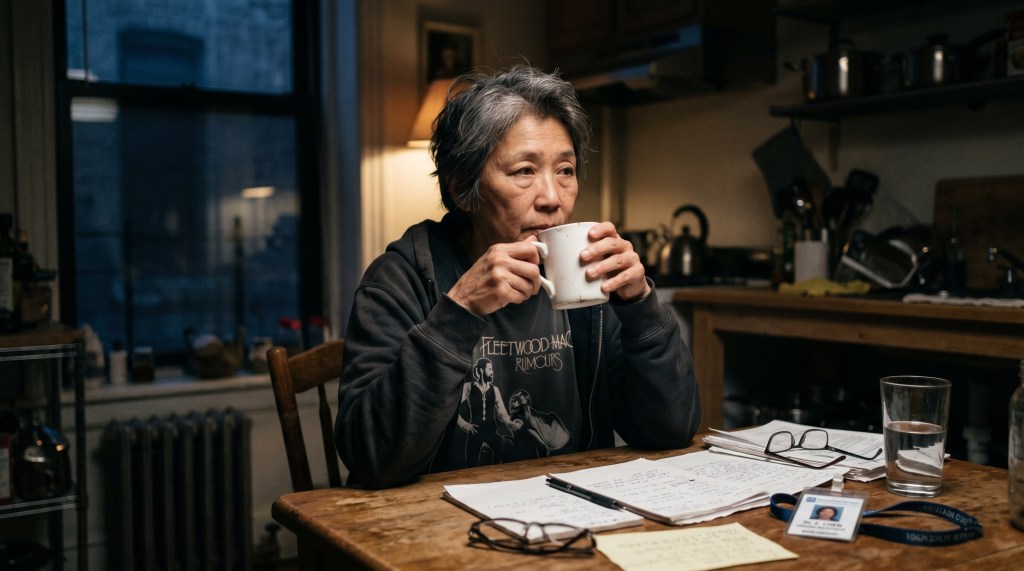
The coffee’s bad. I know it’s bad before I even take the sip, but I take it anyway, because thirty years of 2 a.m. helicopter rides will teach you to be grateful for anything hot that isn’t a body.
Right. That’s probably where I should start.
I was an organ recovery surgeon for three decades. Not the surgeon who sewed you back up afterward, not the one your family hugged in the corridor at dawn with tears running down their faces. I was the one who flew in. I was the one they called when someone, somewhere, had just stopped being a person and started being an opportunity, and I say that without cruelty, because I mean it as the most hopeful word I know. Opportunity. Someone else’s second act. Someone else’s morning.
The work had a rhythm to it that I think would surprise most people. They imagine it as dramatic, all urgency and shouting and running through corridors. They’ve watched too much television. The truth is it was precise. Quiet, almost. You land, you’re met, you scrub in with a team you’ve likely never worked with before and probably won’t again, in a hospital you’ve never visited, in a city you might not be able to find on a map at four in the morning. And you do the job. Methodically. Reverently, if I’m honest, though I’d have told you to piss off if you’d used that word in front of me back then.
There’s a moment, and you feel it in the room without anyone needing to announce it, when the body on the table shifts in everyone’s perception. The paperwork has been signed. The family has said yes. And that yes is so enormous, so costly, that the least you can do is be worthy of it. So you are. Every time, without exception, you are.
I expected the hardest part to be the death. That’s what everyone assumed when they found out what I did for a living. They’d wince, say something like, “I don’t know how you do it,” and they meant: how do you look at death that many times without it breaking something in you? The honest answer is that I never really did look at it, not the way they imagined. By the time I arrived, the dying was finished. Someone else had held that vigil. Someone else had made the calls. The grief was already in the building, moving through it like weather, but I wasn’t its centre. My job started after the worst had already happened. I was, in a strange way, the beginning of the next thing.
So death wasn’t the worst part. Not even close.
The worst part was a drawer.
Not a metaphorical drawer. An actual one, in the office of a donor family liaison I’d become friends with over the years. She had a deep filing cabinet, second drawer from the bottom, and it was stuffed, genuinely stuffed with no room left, with thank-you cards. Unopened. Still sealed. Cards sent by recipients’ families to donors’ families: the woman whose son had received a liver, writing to the parents of the boy who didn’t need his anymore. The man who could see out of both eyes again, writing to the wife of the man who’d stopped seeing anything at all.
And they were never opened.
Not because the donor families didn’t know they’d arrived. Not because they were ungrateful for the thought. But because grief is loud, and gratitude, even the most genuine gratitude in the world, can’t always be heard over it. So the cards just sat there. All that warmth, all those words someone had agonised over at a kitchen table at midnight, sealed in envelopes, in a drawer, waiting for a day that for some of those families simply never came.
That still gets me. Even now, with the lanyard retired and the pager long gone and nothing left to prove to anyone. That drawer still gets me right in the chest.
Which, given my CV, is saying something.
II: The Inventory
So here’s where I stop telling you about my job and start telling you why any of it matters to you.
Bear with me. I promise I’m going somewhere.
If you are younger than me, and the bar for that is fifty-eight, so there’s a reasonable chance you qualify, then someone at some point has probably sat you down and given you The Speech. You know the one. Live in the moment. Cherish the people around you. Life is short and fragile and et cetera, et cetera, world without end, amen. And you’ve nodded, because you’re not a monster, and then you’ve gone home and done nothing differently because The Speech has no teeth. It’s soft. It asks nothing of you that you can actually hold in your hands.
I’m not going to give you The Speech.
First things first. Are you on the organ donor registry? If not, get on it. Today. I’m not asking, I’m telling, and I say that as someone who has held a human heart in both hands and can report that it is smaller and more shocking than you think, and that the idea of it going to waste because you never got around to ticking a box on a government website is the kind of thing that should keep you up at night. So. Registry. Done. Good.
Now. The rest of it.
I’ve been thinking about this for a while, in the way you think about things when the career’s over and the body keeps waking you up at 3 a.m. out of sheer professional habit. And what I keep coming back to is this: everything I saw on that table, all of it, was a lesson in what people saved up for too long.
Think about what the body actually does. Think about it in terms of what you carry around every day without acknowledging what it’s for.
Your kidneys. You’ve got two. The whole genius of that design is the redundancy: you can lose one and continue to function perfectly well, because nature, in a rare moment of generosity, gave you a spare. Now apply that to your time. You are walking around with more hours than you realise, and a good portion of them are banked in activities that amount to nothing more than waiting. Waiting to feel ready. Waiting for a better moment. Waiting until you’re less tired, less busy, less afraid of what it costs you to show up for someone else. You have a spare kidney. You have the time. Give it. Sit with the friend who is going under. Return the call you’ve been rehearsing for three weeks. Stop banking the hours like they’re drawing interest, because I promise you they are not.
Your liver. People forget what it actually does: it filters. Day in, day out, it takes the toxins and processes them so they don’t poison the rest of you. Now I want you to think about what you’re currently storing instead of filtering. The grudge from four years ago that has calcified into something you call a boundary but is really just calcified hurt. The bitterness towards the person who got the thing you wanted. The low-grade resentment you carry at everyone who seems to be doing it better than you. A liver that stops filtering doesn’t preserve anything. It poisons everything. So do the work. Process it. Let it move through. You were not designed to be a long-term storage facility for other people’s damage to you. That is not what you’re here for.
Your corneas. This one I feel most strongly about, and I’ll tell you why. I have sat across from donor families who agreed to corneal donation and then said, with this bewilderment, “But they were the one who could always see things clearly. That was their thing.” As if the gift was too precious to release. As if giving away the way someone saw the world would unmake the person. But here’s what I know: the way you see the world, the angle you’ve earned through everything you’ve lived through, is useful to someone who is standing in the dark right now. Your perspective, the one you’ve quietly decided is probably too much or too strange or too hard-won to share, is someone else’s corrective lens. Give it away. Tell people what you actually see when you look at the situation. Be honest about the view from where you’re standing. Don’t die with your corneas still in your head and someone else squinting in the wrong direction.
And then there are the lungs.
I held a woman’s lungs once. Sixty years old. Non-smoker. They were pink, healthy, pristine; lungs that had functioned perfectly and would go on to function perfectly inside someone else. And I remember thinking, with absolute clarity, that she had not used them to laugh enough. I don’t know why I thought it. I didn’t know her. I had nothing to base it on except some quality in the room, something her family carried, a kind of careful quietness. But it has stayed with me for fifteen years and I believe it the way I believe in the sternum and the scalpel and the necessity of showing up when the helicopter lands. Laugh enough. Not performatively, not to make other people comfortable, not the polite little exhale you do at work. The real thing. The kind that uses all of your lung capacity and makes you slightly alarming to strangers. You were given the equipment. Use it.
Now. Here’s the part where I say the thing that sounds spiritual, and I want you to know it makes me uncomfortable too, but I’ve earned it, so.
The best parts of you were never entirely yours. I don’t mean that in a you-owe-the-world sense, because I have no patience for guilt as a motivational tool and it doesn’t work anyway. I mean it anatomically, almost. You were put together out of everything that was handed to you: the people who gave you language, the experiences that gave you judgement, the losses that gave you depth. And that accumulated, aggregated, hard-won version of you is already on backorder for someone you probably haven’t met yet. Or someone you see every Tuesday and have been keeping yourself from.
People hoard themselves because they’re afraid of running out. I understand the instinct. I do. But I have stood in operating theatres at ungodly hours of the morning and I can tell you with clinical certainty that nobody on that table ran out of themselves by giving too much. Every single one of them ran out by stopping. The stopping was the loss. Not the giving.
Be a walking inventory of things you’re ready to hand over while the other person can still use them, while you can still see the look on their face when they receive it. That receipt, the stranger’s tears, the friend’s exhale, the child finally understanding they were worth showing up for, that is the only accounting that will ever matter.
The rest is just a drawer full of envelopes nobody opened.
III: Write the Note Now
Let me go back to the drawer. I’ve earned the right to go back to it.
Those cards were not foolish. The people who wrote them were not wasting their time finding the words, sealing the envelope, tracking down an address, sending something out into the world without any guarantee it would land. They did the right thing. Every one of them.
The cards weren’t useless. They were just late.
Not by much, in the grand scale of things. But in grief, late is a country with no border crossing. The window was open and then it wasn’t, and all the warmth in all those envelopes couldn’t change that, because warmth, real warmth, has a shelf life. The families receiving them were still in the middle of losing someone. They didn’t have the capacity to take on someone else’s relief. The gratitude was genuine on both sides. The timing was off. And timing, I cannot stress this enough, is almost everything.
Almost.
Because here’s the thing about almost. Almost leaves room. Almost means there are cases where the timing was terrible and the card landed anyway. Where the phone call came six months too late by any reasonable measure and the person on the other end wept with relief regardless, because the alternative was never. Almost means you haven’t necessarily missed it. But almost also means you should not press your luck.
So. Write the note.
I mean that as literally as you need me to mean it. If there is a person in your life, and there is, there is always a person, who is owed words from you, who has been waiting, whether they know it or not, for you to close the distance between what you feel and what you’ve actually said out loud, then write it down. Not when you’ve figured out how to phrase it perfectly. Not when the moment feels right, because I can save you some time: the moment will not feel right. It will feel exposing and ill-timed and slightly ridiculous, and you should do it anyway. Now. In whatever voice comes out when you stop trying to sound like someone who has it all sorted.
Say the thing. Give the time you’ve been rationing like it’s a finite resource that will somehow stretch further if you keep it to yourself. Hand over the honest word you’ve been holding back because it felt like too much. Offer the second chance you’ve been deciding whether they’ve earned, and let me tell you, as someone who has presided over more second chances than most people know exist, the deciding is usually the wrong part to linger on. Give it and see what happens. The worst outcome is that you are exactly where you are now, except you tried. Most people I know would take that deal in a heartbeat. Forgive the phrasing.
In my world, warm means viable. That’s the clinical reality: a warm organ still has a chance. You are still warm. The people you love are still warm. The relationship you’ve been letting go cold on the counter because you don’t know how to reheat it without burning yourself, it might still be warm too. Go and check. Go and put your hand to it before you assume it’s too far gone.
I know how this sounds. I know that to someone who hasn’t spent thirty years flying to hospitals at hours that have no business existing, this might all sound like a lot to ask. Like I’m telling you to restructure yourself entirely based on the opinions of a retired surgeon with bad coffee and a faded t-shirt and an expired ID she’s too stubborn to take off her rearview mirror. And maybe I am. I’ve never been accused of underselling a point.
But I’ve held a human heart in both hands. Not metaphorically. Actually. With gloves on and a team around me and a helicopter still cooling on a rooftop somewhere. And it was smaller than you’d think and more shocking than you’d think, and the thing that struck me every single time was that it had been doing its job without being asked. Without recognition. Without anyone stopping to say: look at that, look at what this thing is doing, quietly and reliably and without complaint, for decades. The heart just works until it doesn’t. And the ones in the best condition when they came to me were never the ones that had been most carefully protected. They were the ones that had been fully used.
Use yours.
Right. I think that’s the lot.
So I have the expired hospital ID on my rearview mirror that I keep meaning to take down. I’m not sentimental about it. I just haven’t got round to it. That’s my story and I’m sticking to it. I have a Fleetwood Mac t-shirt that is older than some of my former colleagues’ children, and a hoodie that has seen better decades, and coffee that has gone cold while I’ve been talking. I’m not that surgeon any more. The helicopter goes to someone else now, at some other 2 a.m., in some city I couldn’t find on a map by torchlight. Good. They should be younger than me. The job needs fast thinking and steady hands and the ability to eat a sandwich in a moving vehicle without it becoming a philosophical event, and I’ve done my time.
But I’ve still got two functioning lungs.
I used them today.
I pick up the coffee. It’s cold. I drink it anyway.
Bob Lynn | © 2026 Vox Meditantis. All rights reserved.


 Vox Meditantis
Leave a comment