What app eats up most of your screen time — and do you even feel bad about it?
THE LADY (without lifting her gaze from the vellum page before her): Hast thou ever looked upon a thing made with such skill and such love that it diminished thee? That made thee feel, for the breadth of a single breath, a lesser creature altogether?
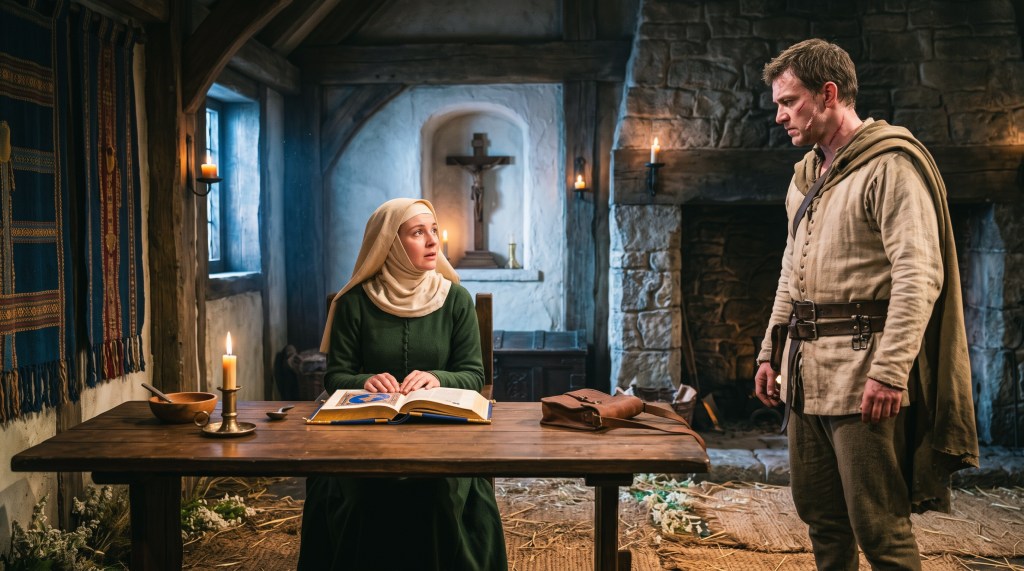
The solar of a stone manor house. High summer; a narrow window dressed with scraped horn stands open, and through it the warm air carries the distant rhythm of scythes and the calls of villeins at their haying. Rush matting strewn with dried meadowsweet covers the floor, and two tallow candles burn upon the board table, their wax pooling slow as sap. An open psalter lies before the Lady, its vellum pages illuminated in gold leaf and the deep blue of crushed lapis. Above the small oratory alcove to her right, a wooden crucifix hangs from the whitewashed wall, and a tablet-woven hanging of undyed wool stirs in the window’s breath. On a three-legged stool across the table, legs stretched wide toward the cold summer hearth, the Sell-sword waits with the patience of a man who has endured a great deal and expects more of the same.
THE SELL-SWORD: I observed men dying at Evesham. ‘Twas a thing of some considerable note. I felt, chiefly, cold.
THE LADY (looking up at last, her expression neither wounded nor reproachful – for she is of a sanguine complexion, warm and yielding as new bread, and absorbs small cruelties with the ease of warm earth absorbing summer rain): Thou knowest I speak not of battle. I speak of grace. Of that which a man makes with his hands when his hands are guided by love of God and mastery of his craft. (She rests her palm gently upon the open page, her fingers pale against the brilliant pigment.) This psalter was sent hither from the brotherhood at Saint Alban’s for my lord’s keeping, before the war consumed all order. Three years I have possessed it, and three years it has unmade me with its beauty each time I open it afresh. See how the gold leaf holds the candle’s light. See the blue here, in the wings of the seraphim – ground from lapis by a man who gave a year of his life, perhaps more, to this one page. It is as though God’s will itself found a dwelling in the friar’s hand.
THE SELL-SWORD (turning from the window with the slow deliberation of a man conserving his energies for emergencies that have not yet presented themselves): The friar was beaten when the blue ran poorly and rewarded with a scrap of salt fish when it ran true. God’s will had little part in it. The abbot’s rod and the abbot’s coin were the instruments at work. They ever are.
THE LADY (softly): Thou art a hard man.
THE SELL-SWORD: I have served in three armies and been paid, in full, by two of them. Hardness is what remains when all else has been stripped away. (He stretches his arms behind his head; the rough linen of his pourpoint draws tight across shoulders that carry the record of old violence in raised white lines.) What wouldst thou have me say, my Lady? That the world is a garden, and the friar’s brush a testament to divine grace? I have been face-down in too many ditches for such a philosophy to find purchase on me.
THE LADY: And yet the ditches did not kill thee.
THE SELL-SWORD (a short, dry sound, nearly a laugh): Three times they ought to have done. Once outside Kenilworth, once on the Shrewsbury road. (He pauses; briefly, and without theatre, he touches the raised scar that crosses his jaw with one finger, then lets the hand fall, as a man might touch a familiar boundary marker without thinking of it.) I served a lord at Lewes and a different lord at Evesham, the two of them set hard against each other. Between their causes, and their equal indifference to the survival of the men in their train, they gifted me with that. God’s will, I make no doubt. The stars were most industrious upon my behalf.
THE LADY (flinching – not dramatically, but perceptibly, like a candle flame touched by cold air – and glad to be spared the account of the third occasion): I do not say the world is without its grief. I am not so simple in my humours as that. I have buried a husband and three servants taken by the sweating fever, and one child who never drew breath. I know that sorrow is real and as certain as harvest. But I say – I hold it as a truth of my very soul – that goodness also is real. That it does not arise merely by accident, as weeds in untended ground, but is planted, and tended, and –
THE SELL-SWORD: And what? Rewards its gardener?
THE LADY (very quietly, her gaze dropping again to the gold of the open page): Matters. I meant only to say that it matters.
THE SELL-SWORD (and now his voice loses its contempt for something quieter and more conclusive – the voice of a man reciting a truth so often confirmed that inflection has worn smooth from the telling of it): I have seen a man weep over his dead horse, and before the same hour was gone, pull the boots from his dead comrade’s feet. I have seen priests bless the banners of two armies set against each other, both sets of priests equally certain the Almighty’s design favoured their own side. I have seen the Dictum of Kenilworth offered to disinherited men as mercy, the mercy priced at five years’ annual value, so that mercy and ruin were indistinguishable one from the other in the accounts. (He leans forward, elbows to his thighs, and his gaze upon her is without warmth but also without theatre – the gaze of a man who does not perform his convictions because he has no audience in mind.) Goodness. It is a tale the living tell one another to make the dark feel shorter. I cannot fault it as a practice. But I will not pretend I share it.
THE LADY (quietly, and the quiet costs her something – for she will not contest a point that requires confrontation, even here, even in the safety of her own solar): The man whose boots were taken. Was there no one to pray for his soul?
THE SELL-SWORD: There was not. There rarely is.
THE LADY: (after a moment): That is precisely the point I cannot accept.
THE SELL-SWORD: It is precisely the point thou must accept. Unless thou intendest to follow every army into every ditch in the kingdom with a psalter and a good intention.
THE LADY (and now she makes that characteristic retreat – small, inward, the retreat of a creature that draws its shell closed rather than extend its claws): Perhaps. Perhaps thou art right in thy fashion. (Then, more quietly still, as though the confession is addressed to the vellum rather than to the man) And yet I cannot surrender it. Even were thou wholly right – which I will not grant thee, I will not – it is the one thing I hold to when all else grows slippery beneath me.
A silence settles. Outside, a dog barks twice in the yard below and is not answered. The candles flicker in a breath from the window.
THE SELL-SWORD (easing back upon his stool, resuming his air of magnificent and practised indifference): Thou didst summon me, my Lady. I take it the matter was not the quality of the friar’s lapis.
THE LADY (straightening, composing herself with visible effort – and this small struggle to reclaim her bearing is, for those with eyes to read it, touching): Yes. Forgive me. I wished to speak with thee concerning the southern road. My hayward came to me two days past with word of armed men moving through the demesne without banner or lord known to us. Torches were seen upon the ridge two nights gone. I had thought – (the hesitation is brief, but it is unmistakable, a crack in the surface of her resolve, the kind of crack that widens with weather) – I had wondered whether some manner of approach might resolve the matter without requiring…
THE SELL-SWORD: Blood.
THE LADY (with the faint relief of one who has been spared from completing a distasteful act herself): Blood. Yes. I would sooner have a peace I may live with than a victory whose cost I cannot reckon.
THE SELL-SWORD: That choice cannot always be composed in such terms. (He looks at her levelly.) Those men on the ridge are not seeking absolution, my Lady. I know the sort – I have been the sort. They are men disinherited under the Dictum’s conditions, or men in service to such, who have not accepted the king’s terms because the terms would beggar them for the length of their sons’ lives. They fought three years beside the Earl of Leicester and they did not do it to end their days paying five years’ value to the Exchequer’s men. (A pause, and then, with the candour of one who finds truth merely the shortest available route) They are of a temper that will not be moved by words alone. I offer this as testimony, not counsel.
THE LADY (and again she retreats – the hands folding upon the psalter as upon a prayer, the gaze lowering – her care for those men already visible in the soft distress of her expression, and her inability to act upon that care equally visible): I will pray for their souls, then. And for thine, as I do each morning.
THE SELL-SWORD: Save thy prayers for the hour of my death, my Lady. I am alive enough this afternoon, and the living have little use for intercession.
A longer silence. The candles have burned another half-inch. Outside, the rhythm of the haying continues without any opinion on the matter.
THE LADY (after some time, as one releasing a thought that has been held perhaps too long in keeping): I have a question for thee. A curious one, and perhaps impertinent to thy station.
THE SELL-SWORD: Impertinence has never concerned me. Ask.
THE LADY: I have wondered, since thou camest into the service of this household – what it is that claims the greatest measure of thy waking hours. Not thy duties here, nor sword-work of any kind, but what thou turnest to when the candlelight is thine own and the hours fall at thine own ordering. What habitual pursuit or devotion consumes the most of thy candlelit hours, and dost thou harbour any guilt for what it steals from the earthly duties that God and thy nature have appointed thee?
The Sell-sword looks at her for a moment without answering. Not because the question troubles him – nothing in his choleric blood is easily troubled – but because he is faintly, and not unpleasantly, surprised to find it asked in earnest, as one might be surprised to find a sparrow reading a deed of conveyance.
THE SELL-SWORD (flatly, without prelude): Hazard.
THE LADY: I beg thy pardon?
THE SELL-SWORD: The dice. The game of hazard. I play it as a man drinks who has taken a long and honest account of his capacity for drink and found it satisfactory. Not for want of wit enough to cease, but for want of sufficient cause to trouble myself with ceasing. I have played from vespers to the first cock-crow in the tents of men whose names I cannot now recall, for stakes I could not sustain, and lost them, and returned the following night with not a grain of regret. I have played in the antechambers of lords greater than any who have held this house, and in the mud before a ditch with men who would be dead before sunrise. The game is no respecter of blood or rank or the colour of the banner beneath which a man has lately fought. That evenness of temper, I have always found, recommends it above all other recreations available to me.
THE LADY (faintly aghast, and yet – for in her sanguine nature there is a helpless fascination with all that is frank and unguarded – also, strangely, compelled): And the guilt? The hours that ought, by every right, to have been given to God and to thine obligations in this world?
THE SELL-SWORD (and his tone is now the tone of a stone wall – flat, entire, and without any aperture through which apology might pass): None. Not the shadow of a grain. I do not lie wakeful in anguish over how I have spent the darkness. I spend it at hazard, which is a considerably more satisfying occupation than anguish.
(He holds her gaze without flinching, without any quality of shame – with the same steady, reckless stillness he might maintain before an armoured horse and its rider.)
THE LADY (looking down at the open page, and something loosens in her expression – a loosening of something held too tightly, an admission she had not fully intended to make): I think – I think I understand thee in this matter better than is comfortable to me. (She is quiet for a moment, and the quiet is not performative but genuinely reflective.) Were that same question turned upon me, I should answer thus: this page. This psalter. I have sat with it when I ought to have been in the hall attending to the assize of the alewife’s measures. I have sat with it when my reeve awaited me with the tallies from the spring sowing. I have bent over it in the small hours, the candle burned down to the rushlight, no longer capable of distinguishing the letters, capable only of staring at the gold and the blue as one stares into a fire, waiting for it to speak a thing that it will not speak. (She lifts her head, and there is in her gaze something rueful and unguarded.) I spend hours upon it that belong, by every right of my station and my obligation, to the ordering of this house and to those within it. To the men and women of this demesne who are sick, or cold, or poorly fed, and who depend upon my attention for their relief.
THE SELL-SWORD (watching her with the expression of a man conducting an inventory – neither moved nor unmoved, merely assessing): And thou feelest the guilt I do not.
THE LADY: Every grain of it. Every last measure.
THE SELL-SWORD (in a tone whose contempt is so level as to be almost philosophical): Then thou art the greater fool of the two of us.
THE LADY (without anger – for anger, too, requires a kind of courage she cannot presently summon): Am I?
THE SELL-SWORD: To pursue a pleasure and suffer for the pursuing of it at one and the same moment is a doubled tax upon a single indulgence. I take mine freely and pay no toll. Thou takest thine and payst twice – once in the taking, and again in the repentance. Even the king’s men of the Exchequer could not devise a more efficient instrument of self-inflicted misery.
THE LADY (and this, perhaps, is the most honest thing she will speak in all the exchange – the thing beneath the retreat and the avoidance and the gentle piety, the thing she holds most truly): The virtue lies not in the pleasure, nor in the guilt. It lies in knowing that the hours carry weight. That how I spend the daylight God appoints to me is of consequence – not to me alone, but to those souls whose wellbeing is wound up in the governance of this house and this demesne. (A pause, small and undefended.) Thy dice do not depend on thee, Sell-sword.
THE SELL-SWORD (and something passes across his face – not regret, for regret is too near the melancholic humour and his blood runs hot and choleric, always choleric – but the faintest trace of what might, in a less armoured creature, become recognition): No. (Flatly, and with the finality of a man closing an account.) That, I have always found, is the finest thing about them.
A silence falls, distinct in quality from all the silences before it. The candles have burned lower by the clear measure of a quarter-inch. Outside, the day pursues its work without consulting either of them.
THE LADY (after a long moment, very quietly): The men on the ridge. Is there truly no hope of resolution by any means other than violence?
THE SELL-SWORD: Beyond all hope? No. Beyond thine? Yes.
THE LADY: What dost thou mean by that distinction?
THE SELL-SWORD (standing, smoothing down the linen of his pourpoint with unhurried economy): I mean that the reasoning those men will hear is done with the body, not the tongue. Thou hast goodwill enough for a full chapter of Franciscans, my Lady, and courage enough for a wren. (He says this without malice – and that absence of malice makes it more final than any cruelty.) A man of settled faith and a proven arm might reach those men and bring them to terms. I am such a man, if the coin be settled fairly between us. But thou wilt not give the order, not today and not on the morrow. Thou wilt compose letters to those with greater power than thyself and wait upon their reply. Thou wilt pray, and hope, and in the time it takes thy conscience to reach a reckoning with necessity, the matter will resolve itself one way or another – and in neither case by any will of thine.
(He does not move toward the door. He stands where he has risen, looking at her with the steady, dispassionate attention of a man who has already taken his measure of every last thing in the room.)
THE SELL-SWORD (continuing): And if the ridge proves quiet of itself, thou wilt attribute that quietness to the Almighty’s design made plain. And if it does not, thou wilt grieve, and pray, and send coin to the priest for masses over whatever souls my blade is called upon to settle.
The Lady says nothing. There is nothing in her face that is anger, nor resistance. There is only the helpless, clear recognition of a woman who has looked upon a true reflection and cannot dispute the likeness, though she finds no pleasure in it.
THE LADY (at last, in a voice reduced to something bare and without ornament): I am afraid of them. I confess it without dignity, because it is simply the truth of my nature. I am afraid, and I know that fear makes me less than my people deserve in a mistress of this house. I know it as surely as I know the words of the Pater Noster. And knowing it has never, in my experience of myself, been sufficient to cure it.
The Sell-sword stands in the doorway. He does not bow – for he is not, at his marrow, a man given to forms of courtesy that cost him something. He is silent for the space of a breath. When he speaks, it is in the voice of a man who does not deal in comfort but who, upon occasion, has no objection to the truth.
THE SELL-SWORD: Fear is honest. I have encountered few things as honest as fear, in a man or in a woman. It does not lie and it does not dissemble and it is not improved by prayer alone. (A pause, brief as the space between two heartbeats.) What makes thee less than thou shouldst be is not the feeling of it. It is the sitting with the psalter whilst the feeling waits unanswered.
He leaves. He does not look back.
The Lady does not move. The tallow candles burn. The gold leaf of the open page holds the candle’s light, as it held it before she came to the table and as it will hold it after she has risen from her chair – indifferent, beautiful, silent. Below the horn window, the scythes of the villeins draw through the summer grass with the unhurried certainty of all things that have no need of her permission, and the day goes on.
Bob Lynn | © 2026 Vox Meditantis. All rights reserved.


Leave a Reply