What’s a movie or book that inspired you to travel?
Friday, 20th July, 2001
I’ll note the date because I have always noted the date. It becomes a habit when you’ve kept a ship’s log for long enough, this marking of days, this small insistence on where you are in the calendar and the tide tables and the reckoning of the world. You bring it ashore with you whether you intend to or not, like salt in the seams of your jacket.
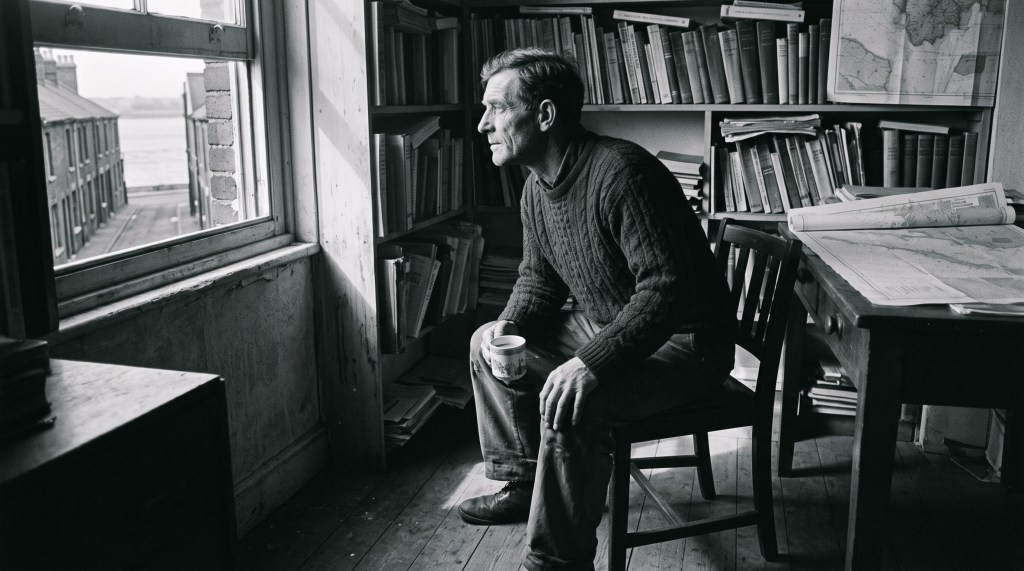
It’s gone half past eight in the evening, and the light outside is still going. That slow, reluctant July gold that sits on the estuary and won’t quite let go. I can see a strip of it from this chair if I crane my neck between the houses opposite, grey-green water with the ebb setting well out now, running south with a purpose that I recognise and envy. I am sitting in what my sister calls the study, and what I call a form of punishment. A chart table without a chart on it. A bookshelf with more sea-going titles than a chandlery. A cup of tea that was hot when I made it.
I had a telephone call this morning from the port health authority. Another delay. Another form to be countersigned, another stamp to be collected from an office that is only open on certain mornings and closed for lunch and apparently indifferent to the existence of tides. I won’t elaborate, because elaborating would require me to think about it for longer than I already have, and the whole business already sits in my chest like something I’ve swallowed wrong. I have never been any good at waiting, not here, not in rooms, not at desks. The irony is that the sea makes you wait constantly; it’s one of the few things the sea and the bureaucracy have in common. But at sea you are waiting in it. You are hove-to in weather that has its own momentum and you hang on and you prepare and you watch, and the waiting has a quality of alertness to it that is almost indistinguishable from action. Waiting in a chair in July with a cooling cup of tea is something else altogether.
My eye keeps going back to the bookshelf, as it tends to on evenings like this. Reed’s Almanac from several years running, spines cracked with use. Bowditch, bought second-hand from a chandlery in Cape Town in 1979 and still carrying, if you put your nose to it, the faintest suggestion of diesel oil from the engine room of the vessel I was serving on at the time. An Admiralty chart for the Western Approaches that ought properly to be in a drawer and has never quite made it there. And then, near the end of the second shelf, a battered old hardback with the spine faded to near-nothing, the lettering almost gone, the cover soft with years of handling.
That book. I would know it across a darkened room.
Monsarrat’s The Cruel Sea. I must have read it first when I was eleven or twelve, borrowed from the library in Salford and renewed twice before I finally handed it back, reluctantly, as though I were giving up something I’d earned. My father was not a sea-going man. He worked at a printing press and his relationship with open water began and ended with the Manchester Ship Canal, which, God love it, smells of old iron and other things you wouldn’t want catalogued. But he never once complained about my library renewals, and he never asked why I came to the supper table with my head still half out in the Atlantic, barely present for the lamb chops. He understood, I think. He could see something had taken hold.
That book is not comfortable reading, and it makes no pretence of being so. It does not offer you the sea as adventure, not in any clean, gleaming sense. It gives you the North Atlantic in wartime, in winter, in the dark, with oil on the water and men doing what has to be done because there is nobody else to do it and no prospect of relief. The captain at the centre of it, the one who holds everything together through year after year of convoy duty while the ocean and the enemy both do their level worst, he is not a heroic figure in any theatrical sense. He doesn’t make speeches. He endures. He goes back out. He does his job with the kind of worn, steady persistence that doesn’t look like anything much from the outside and from the inside is probably the hardest thing in the world.
I was twelve years old, and I read about that man keeping watch on the bridge in January seas, and something in me said, quietly and with complete certainty: yes. That. Not the glory. Not the romance. The necessity of it. The idea that the sea asked something from you and you either had it or you didn’t, and all the talk in the world was worthless when the weather made up its mind.
They made a film of it a year or two after the book came out. I saw it eventually, years later, when I was already sailing and already committed. The actor who played the captain did it well, very well, with a kind of quiet that suits that role, but by then I’d spent years with the man in my own imagination, and no casting was ever going to displace that. The book is the thing. It always was.
It took me six more years after reading it to get myself to sea in any real capacity. Six years of school and then the merchant navy college at Fleetwood and more waiting than I care to reconstruct, filling in applications and sitting examinations and standing on quaysides watching other men’s ships come and go while I stood on the dock with my hands in my pockets feeling as useful as a shore-side cleat. I was not, and have never been, a patient young man. Ask anyone who knew me then. The waiting was like a low-grade fever that I couldn’t shake. But I passed my certificates and I got my berth, and the first time I stood watch as a junior officer, in the Irish Sea in November on a small general cargo vessel that moved in a heavy swell like a wet dog shaking itself, I thought of the captain in that book. Who asked for nothing and expected nothing and simply went on. And I thought: that’s the idea. That’s the whole idea right there.
The sea teaches you, if you stay with it long enough, to distinguish between the delays you can beat and the ones you cannot. A headwind in the Channel, a neap tide at a narrow entrance, a fog that is in no hurry to lift: you wait for these things with as much grace as you can manage, and while you wait you prepare, and the moment the conditions shift you move without hesitation. You do not rail at the weather. You have seen too much of it to waste the energy.
I made my career in the merchant navy through the late seventies and the eighties, general cargo first and then bulk carriers, running between the UK and West Africa for much of that decade, then across to the Far East. Singapore, Yokohama, Hong Kong. I had my master’s certificate by 1986 and a persistent knee that still reports back on cold mornings, a souvenir of a deck incident in the Bay of Biscay that happened faster than I could do anything sensible about it. I left the merchant service in the early nineties, not because the sea was finished with me but because the economics of the British fleet had grown tired of all of us, and I moved across to yacht delivery and offshore passage-making, which is a different life but still, thank heavens, a life afloat.
Navigation is a different art now than it was when I started. I came up with paper charts and sextants, working noon sights by hand, running the figures through in pencil, entering the position in the log as a small, definite cross on the chart. I don’t say that’s superior, but the discipline of it stays in you. When you’ve taken a noon sight in a beam sea with the swell rolling so heavily that the sextant mirror keeps losing the horizon, and you’ve worked the numbers through to a position you can trust, you’ve earned that cross on the chart in a way that pressing a button on a GPS plotter hasn’t quite replicated for me yet. I still carry the tables. I still take sights when the sky permits it. You can call it habit, call it stubbornness, call it what you like. I call it not relying on something I can’t independently verify.
The GPS is far more accurate now than it was a year ago, I’ll grant it that. Ever since they turned off the deliberate degradation on the civilian signal in May last year, the accuracy is what the military was getting all along, and the electronic chart plotters are becoming more common aboard commercial vessels, though the smaller yachts I deliver still mostly run on paper and compass sense and the kind of instinct that accumulates quietly over years of making passages. Fine by me. A chart spread on the table gives you the whole picture in one glance. A screen, you scroll through. Scrolling takes your eyes off the water.
The strip of estuary between the houses is nearly dark now. If I were out there, I’d be running south on the ebb, standing well off the headland, picking up the long westerly swell that comes in off the Atlantic in July. Easy and slow and deep-running, that swell; you can feel the distance in it, the thousands of miles of open water it has crossed to get here, and it lifts the bow of a small boat with a kind of steady, immense gentleness that never quite stops surprising me, however many times I’ve felt it.
That’s the thing nobody quite catches in the books, not even Monsarrat, not entirely. They describe the violence of the sea, and the beauty, and the loneliness, and the cold, and the solidarity of men in difficult places. They describe it very well. But what they can’t quite transmit is what it feels like to be a small, purposeful, considered point in the middle of something so completely indifferent to your presence. The ocean doesn’t know you’re there. It doesn’t care whether you make port or founder. And somehow, for me, that has always been the most grounding feeling I know. Because it means that everything depends on you: on your preparation, your judgement, your ability to hold on when things go badly and keep thinking clearly when everything around you is trying to make clear thinking impossible.
The paperwork will resolve itself. It always does, in the end, if you don’t let it see that it’s beaten you. A week, perhaps ten days, and I’ll be standing off some harbour mouth in the small hours with the tide tables spread on the chart table and a fresh cup of tea at my elbow, going cold again because they always do, watching the lights on the headland and feeling the ebb beginning to slacken as the water turns, and I will feel, as I always feel in that moment, entirely and unreservedly right with the world.
For now, there is the chair, and the bookshelf, and that strip of dark water through the gap in the houses.
And there is old Monsarrat on the shelf, holding the place he’s held since I was twelve years old, telling me what the sea costs and what it gives back and why a man keeps going out to meet it anyway.
He was right about all of it. He knew something true about perseverance, that man, about the way it isn’t a grand thing at all, but just the quiet, daily choice to go on. The tide goes out. You follow it. That’s the whole of it. That has always been the whole of it.
Bob Lynn | © 2026 Vox Meditantis. All rights reserved.


Leave a Reply