Sunday, 11th October 2026 (Ghatasthapana, the first day of Dashain): the hour before dawn, ending at first light
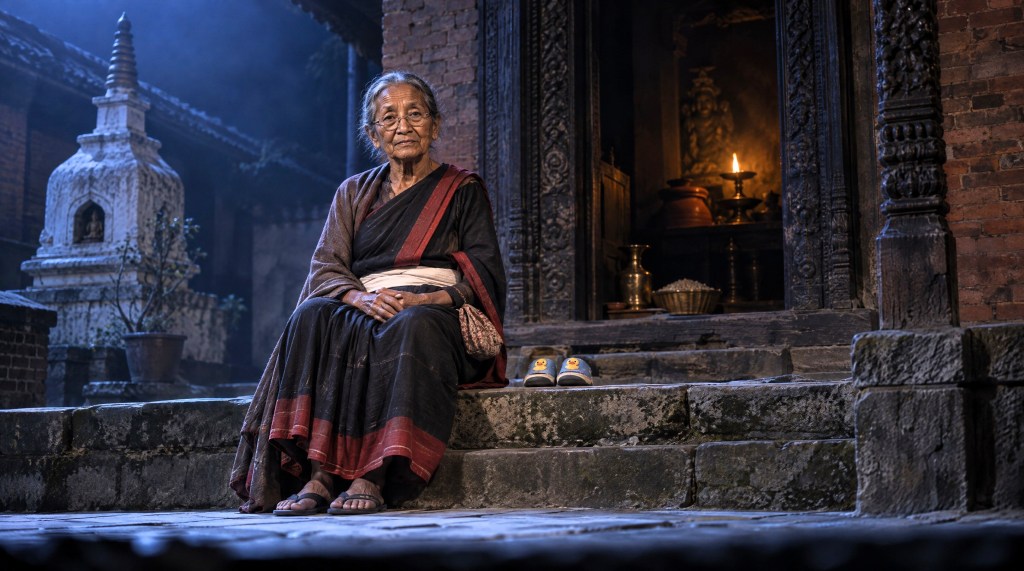
A stone courtyard behind an old Buddhist monastery in Patan (Lalitpur), Kathmandu Valley, Nepal
[Darkness. A temple bell rings once, far away, then stops. A small oil lamp is lit inside the open doorway of the puja room. Its light shows a clay vessel, a mound of sand, a brass jug of water and a basket of barley seed. DYAH MAYA SHAKYA kneels before them with her back to us. She is sixty-seven, small and narrow. Her black haku patasi sari with its red border was made for a broader woman. Wire spectacles sit low on her nose. A cloth pouch hangs at her waist. She is completely still. Her shoulders, neck and the line of her head look carved. She is not praying. She is waiting.]
[The cold blue light before dawn rises over the courtyard: brick, stone, a small whitewashed stupa, carved wooden lintels. At the edge of the steps sits a pair of tiny rubber slippers, each with a yellow duck on the strap.]
[She lifts a handful of sand and lets it fall into the vessel. Then a second handful. She shapes it with the side of her palm.]
Sand from the river. Soil from the field. Water from the river again.
[She pours a thin stream of water from the brass jug. She watches it soak in.]
You do it in the dark. Always in the dark. The seed must not see the sun. If it sees the sun it grows green, like grass, like any field. Then it is only barley. You want it yellow. Pale, pale yellow, like the inside of a ripe mango. For that, it must grow without knowing there is a sky.
[She takes a pinch of seed from the basket and scatters it with small, exact movements of the wrist.]
Ten days. Then on Dashami we pull it up and tuck it behind the ears of everyone we love. They go out into the lanes with yellow grass in their hair and red rice on their foreheads, looking like fools. Blessed fools.
[A pause. She scatters another pinch.]
Nobody asks the barley.
[She sets the basket aside. She reaches for the door frame and begins to rise. Her upper body goes up smoothly, but her feet search, slip and search again in their plastic slippers. She steadies herself with one hand on the carved wood. She turns to face us. Her face is calm.]
You are awake. Good. I thought you were awake. You always pretend to sleep and then you watch. You watch the way a cat watches.
[She steps out over the threshold, testing the stone with each foot before trusting it.]
You are four. Small enough to carry. That is what they want. They lift you up and you never come down.
[She lowers herself onto the edge of the step. She folds her hands in her lap.]
Today is Nalaswane. Mohani begins. In the old palace they are waking Taleju. Let me tell you who she is, since nobody will.
When the Malla kings ruled this valley, a king used to play dice with the goddess. Every night, in a locked room. Tripasa. A king and a goddess on a mat, throwing dice like porters at a teashop. [A small dry lift of the eyebrow.] Then one night he looked at her the way a man looks at a woman. And she left. She said: “If you want me again, look for me in a little girl.”
So. They look for her in a little girl.
[She adjusts her spectacles with one finger.]
They check you for thirty-two perfections. A neck like a conch shell. Thighs like a deer. Eyelashes like a cow’s. A voice soft and clear like a duck’s.
[Her eyes go to the slippers with the yellow ducks. Something almost like a smile.]
A voice like a duck’s. I never knew what that meant. Ducks are loud.
[A dog barks somewhere beyond the courtyard wall, twice. She turns her head toward the sound, then back.]
They paint your eye. Here. [She touches the centre of her forehead with one fingertip.] A fire-eye. They put you in red. They twist your hair up on top like a little pot. Then you sit.
You sit.
When the old women come and bow, you look at them. If you cry, someone in their house will fall sick. If you rub your eyes, someone will go blind. If you shake, someone will die. So you do not cry. You do not shake. You learn to have a face like still water in a brass bowl. Nothing moves on top. Underneath, who knows.
[A pause.]
I had that face for eight years. I have it still. Your Aju used to say he married a wall with good cooking.
[Beat.]
He was not wrong about the cooking.
[She leans forward slightly. Her voice drops.]
Do you know what I did? When no one was looking? There was a priest. Old Buddhi Raj, with hairs coming out of his ears like a pig’s. He was carrying me down the steps one day and I looked at him. Just looked. I did not blink. I looked until his hands began to shake and he nearly dropped me. [A breath that is almost a laugh.] Afterwards he did a whole puja to clean away whatever sin he thought he had done. For three days the whole bahal believed the goddess was angry with him.
The goddess was eight years old and bored.
[She draws one foot out of its slipper and, very slowly, presses the tip of her bare big toe to the stone. She holds it there a moment, then draws it back into the slipper.]
And when nobody was carrying me, I did that. Like a thief. Just the toe. To feel whether the floor was still there.
[The light grows a little bluer. Far off, a motorbike starts, coughs, and fades away.]
[She looks toward the house behind her: a dark carved window on the upper floor. She looks at it for a long moment.]
Your mother has cold hands. Have you noticed? She cannot help it. Her mother was the same. When she holds you on the eighth night, her hands will be cold, and you will think she is afraid. She will be afraid. But the cold is just her hands.
[The audience may feel the ground shift. She does not.]
And Kalu. [She nods toward the wall where the dog barked.] That stupid black dog. After the eighth night he will not be allowed to lick your fingers. A dog’s mouth is impure for a goddess. He will not understand. He will sit at the bottom of the stairs and whine, and somebody will throw a shoe at him.
I will try not to let them throw the shoe.
[She reaches down and moves the tiny slippers so that they sit exactly side by side, toes pointing outward, ready for small feet.]
Rasila.
[Silence. Her hand stays on the slippers.]
Rasi. That is your name. Your Aji knows your name.
[She straightens. The stillness returns to her shoulders, but her hand stays on her knee.]
Three weeks ago the priests came. They looked at your neck and your eyes and your teeth. They asked your horoscope from your father and took it to the astrologer, and he wrote and wrote and said it was good. Very good. Rare. They said they had not seen such signs in a girl of this bahal for years.
[A pause. Her face does not move.]
They had not seen such signs because nobody had told them where to look.
[She takes off her spectacles. She folds them carefully and holds them in both hands.]
Buddhi Raj had a son. Gyan Bahadur. Old now, older than me, with the same ears. His father carried me. He carried me too, when his father’s back went. A man does not forget that he once carried a goddess. In his old age it is his whole pride.
So I went to him. In Bhadra, in the rains. I took him bara and a bottle of aila, the good one from my brother’s house. We sat. We talked about the earthquake. About how the temples in the Durbar Square came down like sand castles, and how long they took to put back. About his knees. About my knees.
Then I said: “My son’s girl has a neck like a conch shell.”
[She puts the spectacles back on.]
That is all. One sentence. In this bahal, one sentence from me is still enough. Old women still lower their eyes when I go past to buy vegetables. Some still bend to touch my feet. I tell them to stop. They do not stop. Fifty-five years since the goddess left me, and they still think something of her is stuck to me, like smoke in a shawl.
I used it. I used it once. For you.
[She looks down at her hands.]
For you.
[She says it a third time, more quietly, testing whether it is true.]
For you.
[A long silence. A pigeon somewhere shakes out its wings. Grey light now edges the stupa.]
I told myself: better the goddess come to a house where someone knows. Better me than some poor mother who has never seen it from inside. I know the stairs. I know which priest is kind and which is greedy. I know how long the eighth night lasts. I know what happens at the end. I told myself this was dharma. A grandmother’s duty. Merit.
[Her voice is still low, controlled.]
The Buddha said a person can sit under a tree for seven weeks and still not know her own mind. He sat under the tree. I sat at Gyan Bahadur’s table with a bottle of aila. Which of us knew more?
[She stands. It takes effort. Her hand goes to the door frame again. Her feet search the stone and find it.]
Since the priests came, I have been asking myself one thing, every night, lying on my mat with my eyes open like a fish.
Did I do this to save you?
Or did I do it so that I could finally sit beside the throne instead of on it? So that this time, I would be the one who knows? So that there would be a goddess in this house who belongs to me?
[A pause.]
And on the eighth night, I will kneel to you. Your Aji. Every morning. I will put tika on your feet. I will feed you. I will dress you in red. I will be the one who carries you. Here, in Patan, the goddess lives at home. She does not go away to a temple. They do not take her. She stays in the same house where she ate rice and played with the dog. Someone in the house must serve her.
That someone is me. I made sure of that also.
[Her face is still, but her voice lifts and thins toward a child’s pitch.]
I wanted to kneel to someone I had made.
[She stops. She presses her lips together. When she speaks again, her voice has come back down.]
There. Now the goddess has heard it. If she wants to punish me, she knows where I live.
[She shuffles to the door of the house. She lays her palm flat on the wood. The audience can see her deciding.]
I could wake them. Your father. Your mother with her cold hands. I could say: go to the priests, say there is an error in the horoscope, say the girl has a fever, say anything. There is still a week.
[Her hand stays flat on the door.]
And then? Then the whole bahal will say the family refused the goddess. That kind of thing is not forgotten. They will say it at weddings. They will say it when your father’s shop does badly. They will say it when someone in this house falls sick: well, what did you expect? They threw Taleju back like a fish that was too small.
And they will say: that one, the old Kumari, she put the girl forward and then took her back. Because she is jealous. Because she could not bear another goddess in the house.
[A dry breath.]
They would be half right. That is what makes gossip dangerous. It is always half right.
[She takes her hand from the door. She turns back to us.]
And there is something else. The goddess has already looked at you. Whatever I did, whatever I said to Gyan Bahadur, the astrologer read your stars and the stars said yes. Perhaps I only opened a door that was already open. Perhaps it was written on your forehead before I ever bought that aila. A grandmother is a big thing in a house. She is not so big in the sky.
[She shuffles back to the step, more slowly this time, and sits.]
And it is not my time any more. When I was the goddess, they gave me no books. A teacher came twice a week, if he remembered. Now the court has said the Kumari must go to school. A teacher comes to the house. Children sit exams with the fire-eye on their foreheads. When she is finished, the government sends her money every month for the rest of her life.
[Beat.]
I get it too. For having been a god. It is not much. It buys the lamp oil.
[She looks at the oil lamp in the puja room.]
So perhaps I know nothing. Perhaps everything I am afraid of belongs to 1971 and not to you. Perhaps you will sit your exams and laugh at your Aji and her old stories.
[A pause.]
But one thing has not changed. They have not found a way to change it. One day, maybe in eight years, maybe in six, there will be blood. A little blood, the ordinary blood that comes to every girl. And the priests will say: she has gone. Taleju has gone. They will take off the red. They will wash off the fire-eye. And a new girl, with a new neck like a conch shell, will be carried down the stairs.
[Silence.]
When it happened to me, I went home to my mother’s house in the same red clothes, carried for the last time. They put me down on the floor and I fell. Twelve years old, and I fell on the floor of my own house like a baby, because my legs did not know what floors were.
My mother cried. I did not cry. A goddess does not cry. But there was no goddess. So who was not crying? I did not know.
[She looks at the audience directly.]
That is what nobody told me.
[A long pause. She puts both hands flat on her knees.]
You will want to know what I would say to that girl, the one sitting on the floor in her red clothes, if I could go back. People like to ask such questions. It is a good question for television.
I would not tell her the ground is hard. She found that out. I would not tell her the husband would live. She found that out too, forty years later, when he died of an ordinary cough at an ordinary age, like half the men in this lane who smoke.
[Her voice is level.]
I would tell her one thing. Only this.
The goddess goes. The girl stays.
[A long pause.]
They tell you, when you are chosen, that the goddess is coming into you. They never tell you that you will still be there. Underneath. All eight years. They never tell you that the one who looked at Buddhi Raj until his hands shook was you, not Taleju. That the toe on the floor was yours. That when the goddess walks out of you at twelve, the girl was there the whole time, waiting, the way barley waits in the dark.
No one told me. So for fifty-five years I thought: when she left, she took the best part, and what stayed behind is only the husk. A wall with good cooking.
[Her voice lifts toward treble and catches.]
If someone had told me. Just once. Rasi, you are still there.
[She stops. She takes the spectacles off and wipes them on the edge of her sari. Her face stays dry and calm. Her hands are not quite steady. She puts the spectacles back on.]
So. That is the thing I know now.
[The light grows: no longer blue, but the first grey-gold before sunrise. A temple bell sounds in the distance, then another. The day has begun.]
[She stands, without the door frame this time. Her feet find the stone slowly, but they find it.]
I will not wake them. The eighth night will come. The priests will come. They will put you in red and paint your eye, and the old women will bow, and I will bow too. I will kneel and put tika on your feet, because the goddess is real enough that I will not throw her back like a small fish. I am an old woman of this bahal. I know what I owe.
[She takes the pouch from her waist and opens it. She dips one fingertip into the red powder.]
But every morning, after the tika, when the door is shut and only your Aji is there, I will say your name. Rasila. Not Dyah. Not Taleju. Your name. In your ear, so quietly the goddess will think it is a fly. Every morning for as many years as she stays.
[She touches her red fingertip to her own forehead, at the fire-eye’s place.]
And before the blood comes, long before, I will tell you. Plainly. Not with stories. I will say: one day she will go, and you will still be here, and you will not be the husk. You will be the barley.
[She closes the pouch and ties it back at her waist.]
And inside this house, where no one is watching, you will walk. Up and down the stairs. Barefoot. On the floor. Every day. I do not care what Gyan Bahadur says. He will not see. If the goddess does not like it, she can bring it up with me. [Dryly.] We will play dice.
[She turns to the puja room. She looks at the vessel of damp sand where the seed lies hidden. The lamp has burned low.]
Grow yellow, then. In the dark. It is not so bad, the dark, if somebody is waiting outside the door.
[She draws the door closed. The lamplight disappears. Only the grey-gold dawn is left on the courtyard.]
[She goes to the edge of the step, to the tiny duck slippers. She nudges them one finger’s width so they sit perfectly side by side, ready.]
[Then she looks down at her own feet. Slowly, she steps out of one plastic slipper, then the other. She stands barefoot on the cold stone of the bahal. She does not reach for the door frame. Her upper body is perfectly still. Her feet, for the first time, are still as well.]
[She breathes in.]
There.
[A temple bell. The first direct ray of sun crosses the top of the stupa. She stands in it. Lights fade slowly until only the two pairs of slippers are visible at the edge of the step, the small and the large. Then darkness.]
END
Bob Lynn | © 2026 Vox Meditantis. All rights reserved.


Leave a Reply