What’s the most underrated life skill?
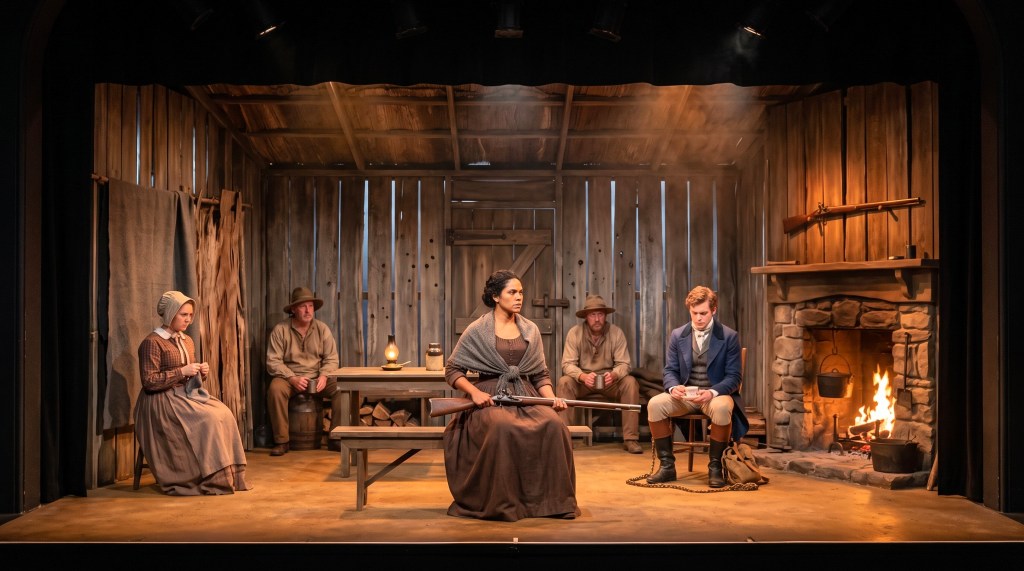
[Van Diemen’s Land. The evening of Monday, the sixth of October, 1834. Inside a slab hut at Dairy Plains, under the Great Western Tiers. A wide fireplace of fieldstone and clay, burning high, gives most of the light. On the rough table is a single slush lamp, its rag wick smoking in a saucer of fat. The floor is beaten earth. On the left, a partition of stringy-bark and old grey blankets hangs from a pole; behind it, now and then, a child stirs. Above the mantel a musket rests on two wooden pegs. Near the door, the slabs are pocked with a scatter of small dark holes, some plugged with clay and some not.]
[Two SHEPHERDS sit on a bench against the back wall with tin pannikins. On an upturned keg by the woodpile sits a TICKET-OF-LEAVE MAN, his hat on his knee. On a stool nearest the partition, knitting, is the NEIGHBOUR’S WIFE. None of them speak.]
[In the best chair, close to the fire, sits EDWARD LACEY, about two-and-twenty, in a good blue coat now spattered with river mud. At his boot lies a surveyor’s chain, its brass tallies glinting, coiled on top of a canvas bag of sharpened pegs. A field book rests on his knee. He holds a chipped china cup with a faded pattern of roses.]
[DOLLY JOHNSON, about six-and-twenty, stands at the hearth with an iron pot-hook in her hand. She wears a plain stuff gown with the sleeves pushed up, and a shawl knotted at the waist. She lifts the lid of the camp oven, looks in, and lets it fall with a clank. Then she turns to EDWARD, as though he has just finished speaking.]
DOLLY: What art or knack is least prized, that ought to be prized most.
[She sets the pot-hook against the stones.]
That’s a schoolroom question, Mr Lacey. That’s a question for a young lady at a pianoforte with a governess behind her. You’ve brought it a long way up the Meander to ask it in a hut.
[A SHEPHERD laughs into his pannikin. DOLLY lifts the kettle from the fire, crosses, and fills EDWARD’s cup to the brim.]
Drink that while it’s hot. It’s the last of the tea till Tom comes back from Launceston. You’re drinking his share, so you may think of him kindly.
[She fills the SHEPHERDS’ pannikins, then the TICKET-OF-LEAVE MAN’s. He nods. She does not fill her own cup, a horn beaker on the mantel.]
That cup you’ve got came from Mrs Mountgarrett’s dresser at Port Dalrymple. Surgeon Mountgarrett’s lady. She gave it me when the handle broke, and I stuck the handle back with a paste of my own making, and it’s held since. That was before your time in the colony, I’ll wager. Everything was before your time. You’ve the face of a man who still gets letters from his mother.
[The NEIGHBOUR’S WIFE smiles over her knitting. EDWARD sets the cup down carefully on the arm of the chair.]
The least-prized knack.
[She sits on the edge of the table, her arms folded.]
Well. There’s making damper without a camp oven. Any fool can do it with one. Without one you want ashes of the right age, not too young and not too old, like a husband.
[A laugh from the bench.]
There’s knowing which end of a government man to trust. Neither end, mostly. Begging your pardon, Mr Marsh.
[She nods to the TICKET-OF-LEAVE MAN. He raises his pannikin to her, unoffended.]
There’s getting a cow to stand. There’s getting a shepherd to stand, after the rum.
[Louder laughter. DOLLY doesn’t smile. She watches EDWARD. He looks down at his field book, opens it, and closes it again.]
But you didn’t ride up from Deloraine in this weather for my receipts and my sauce. No. You’ll want a proper answer, with a moral at the tail of it like a tract. I’ll give you one. Only let me feed the fire first. A story told on a cold hearth comes out mean.
[She kneels, sets two lengths of split peppermint on the coals, and blows. The fire rises and the light on the walls grows warmer. She speaks with her back to him.]
You still have the bay mare, Mr Lacey?
[EDWARD’s hand stops on the cover of the field book.]
The one with the white off hind. She had a trick of throwing her head at a ford. She did it at the Meander crossing, and you came off into the water to your middle. You were a deal wetter then than you are tonight.
[She stands and brushes the ash from her hands. The SHEPHERDS look at each other. The NEIGHBOUR’S WIFE stops knitting.]
Oh, I know the mare. I watched her come up the plain. I’d a good long while to watch, you see. I was at the loophole by the door with nothing else to look at.
[She turns and looks straight at him for the first time.]
You’ll not have told them the mare threw you. No. A man doesn’t tell that part.
[Silence. A log shifts in the fire. EDWARD meets her eyes, then looks at the chain at his feet.]
[DOLLY crosses to the door and lays her palm flat against the pocked slabs.]
You’ll have heard the story, all of you. Everybody between here and Hobart Town has heard it. The Governor heard it and wrote it down in a fair hand. Twenty acres at Perth, for the woman who held her hut against the natives. And Tom his freedom on the strength of it. His Excellency’s thanks, and a sermon about it at St John’s in Launceston. I’m told the parson wept. I wasn’t asked.
[She runs a finger round one of the holes.]
Mr Lacey was there. He’s too modest to say so in my house, but he says it well enough in others. One of the men who saved Dolly Dalrymple. I’ve had it read to me out of the Advertiser. I’ve had it told me by a carter at the Deloraine ford, word for word, and he’d had it from a man who’d had it from Mr Lacey’s own lips at the Cornwall. A good story, the carter’s. In his there was a deal of smoke, and a brave young gentleman carried the children out through it.
[She takes her hand from the door.]
Nobody carried my children anywhere. Nobody touches my children.
[EDWARD shifts in his chair. His mouth opens and closes. DOLLY lifts a hand, not sharply, the way one stills a dog.]
No. You’ll not need to say anything, Mr Lacey. I’m doing the talking tonight. You did yours at the Cornwall.
[She walks back to the hearth, slowly, and looks down at the chain coiled by his boot. She stirs it with the toe of her shoe. The links clink.]
That’s a Gunter’s chain. A hundred links, sixty-six foot. Ten chains square to the acre. You see, I listened to the gentlemen at Dr Mountgarrett’s table, when I was clearing it. And those are your pegs. And that’s your field book. And somewhere in it there’s a line, drawn in the Survey Office in Hobart Town by a gentleman who’s never smelt this river, for Mr Whitcombe’s grant. It runs from the blazed peppermint at the creek up to the foot of the Tiers.
[She crouches by the chain, takes one end in her fingers, and lays it in a straight run across the earth floor. It passes under the table, by the hearth, and stops short of the partition where the children sleep.]
And this hut stands on it.
[She lets the chain fall. It drops in a slack heap.]
My twenty acres are at Perth, on paper, with the Governor’s name to it. This ground I hold by sitting on it. Sitting on it, and bleeding on it a little, and once by lying on it with a musket for the best part of a day. That’s not a title they know in Hobart Town.
[She rises. To the room, lightly:]
So that’s what’s brought our young gentleman up the Meander. Not my damper.
[Nobody laughs. The NEIGHBOUR’S WIFE sets her knitting down in her lap.]
[DOLLY takes the horn beaker from the mantel, turns it in her hands, and puts it back without drinking.]
Now. You asked me a question, and I’ve not answered it, and I was brought up better than that. Mrs Mountgarrett would have my ears.
The knack least prized, that ought to be prized most.
[She takes the musket down from its pegs. She doesn’t point it anywhere. She holds it across her body as a woman holds a broom, comfortably, and sits on the bench by the hearth with it across her knees.]
It’s holding.
[A pause.]
Holding your fire. Holding your water. The cask kind, Mrs Parry, you needn’t colour. Holding your ground. Holding your tongue.
[She runs her thumb along the stock.]
I’ll tell it you plain, the way it was, and not the way the carter tells it. You may judge the moral for yourselves.
[The fire burns lower. She speaks quietly and steadily.]
Tom was off at the far run with the cattle. I’d the children in. The youngest at the breast, then. I’d been at the washing. I heard nothing. That’s the first thing to know. You never hear them. You hear the dog stop.
[She glances at the door.]
The dog stopped. I had the door barred before I’d thought to bar it. The first spear came through that gap there, between the slabs. It stood quivering in the bedpost a hand’s breadth from where the baby lay. I took it out and put it in the fire. It burned well. It was a good straight spear.
[She looks at the musket in her lap.]
I had this, and the powder horn, and in the pouch eleven balls. I counted them. I counted them a deal of times that day. Eleven balls, and a party of men outside who could throw a spear further than you’d credit, Mr Lacey, and through a gap no wider than your wrist.
Now here’s the knack.
[She lifts a finger.]
Any fool can fire a musket. Any fool can fire all eleven before the sun’s moved a hand’s width, at shadows, at the noise of wind in the wattles. Then he’s got an empty gun and a barred door, and the door won’t hold. And they know he’s empty, mind. They count too. They’re not fools. They were never fools.
So you hold. You load by touch in the dark corner, with the children behind you. Powder, patch, ball, ramrod. You don’t look down at your hands, you look at the gap. And you don’t fire. You wait till there’s a man at the door with a firestick, near enough that you can see the grease on his arm. And then you fire once.
[She lowers the finger.]
And then you load again.
[Behind the partition a child coughs. DOLLY’s eyes go to the blanket. She waits until the coughing stops.]
They put fire on the roof. The bark took. I’d the water cask, and I’d been washing, mind, so it was half drawn down. You learn to measure water by the sound when you knock the stave. I knocked it a deal of times. A pannikin at a time up through the roof hole, and not a drop wasted, because if the cask ran dry before they tired, we’d burn. So you hold your water too. You don’t throw a bucket at fire because you’re frightened. You throw a cupful where the fire is, and keep the rest.
And all the while I counted the children’s breathing. Like this.
[She lays her palm on the musket stock and taps it slowly, four times.]
One, two, three. And the little one, quick, against my back. So long as the count was right, I could hold.
[The taps stop.]
The best part of a day. The sun went right round the hut. And when they went, they went quiet as they came, the way the light goes. I’d fired five balls. I had six left.
[She looks up at EDWARD.]
And then, Mr Lacey, the bay mare came up the plain, throwing her head.
[EDWARD sits very still. His hand rests flat on the field book.]
You came up with Mr Hollis’s men from the station, and the sergeant, and you were all very loud. You fired your pieces at the tree line where they’d gone. A great deal of firing, for men with nothing in front of them but trees and backs.
[A pause. She says the next line softly.]
You hit something. I heard it. You’ll recall I’d been listening very close, all day.
[EDWARD looks away, into the fire.]
And then you came to that door, and I unbarred it, and you stood there.
[She points to the threshold.]
There. With your boot in the ash from the roof. Wet to your middle from the ford. And you said, “Is anyone hurt?”
And I said, “Not in here.”
[Silence. The fire hisses. The TICKET-OF-LEAVE MAN looks at EDWARD for a long moment, then down at his own hands.]
[DOLLY stands, carries the musket back to the mantel, and settles it on its pegs. She keeps her hand on it.]
That’s the true story. You may tell me if I’ve told it wrong, Mr Lacey.
[He doesn’t move.]
No.
[She takes her hand from the musket.]
Now, I could tell that at the Cornwall. I could tell it to the parson at St John’s, who weeps so readily. I could get Mrs Parry here to write it out fair, for she writes a better hand than I, and send it down to the Advertiser, and they’d print it. Mr Fawkner prints anything if it’ll vex a gentleman. And by Christmas there’d not be a drawing room in Launceston where you could take your hat off without someone smiling behind a fan.
[She turns and faces him fully.]
I’ve had three years to tell it. And I’ve not told it.
[She lets that settle.]
That’s holding your tongue. That’s the last of the four, and the hardest. Fire you can see. Water you can hear in the cask. A tongue gives no warning before it’s run dry.
There’s a psalm Mrs Mountgarrett had me learn by heart. Set a watch, O Lord, before my mouth; keep the door of my lips. I used to think it a dull verse. Now I think the man who wrote it had a hut once, and a door, and something outside it.
[She crosses back to the chain, gathers it, and coils it neatly in her hands, link over link.]
Mrs Mountgarrett had me read Ruth to her as well, of an evening, when her eyes were bad. Whither thou goest, I will go; and where thou lodgest, I will lodge; thy people shall be my people. A pretty verse. She cried at it. I read it very nicely, I’m told.
[A pause. Her hands stop on the chain.]
I went where I was taken.
[She finishes coiling the chain and holds it out to EDWARD. He doesn’t take it at once.]
There’s another verse, Mr Lacey, since we’re at Scripture, and you a Christian gentleman from a good home. Cursed be he that removeth his neighbour’s landmark. And all the people shall say, Amen. Deuteronomy. I can find it for you. I can read that much.
And there’s Naboth, that had a vineyard by the king’s house, and the king wanted it for a garden of herbs. And the king’s wife wrote letters in the king’s name, and sealed them with his seal. Fine letters. Lawful as you like.
[She lays the coiled chain in his lap, on top of the field book.]
I’m not asking you to remove any landmark, Mr Lacey. I’m not asking you to cheat Mr Whitcombe of a rood. I know this ground. I’ve walked it with a child on my hip every day these four years. The blazed peppermint they’ve marked in Hobart Town is the wrong tree. The true one’s a chain and a half further up the creek, past the bend, and the blaze has grown over. Find it. Run your line from the true tree, and measure true.
That’s all I ask. Measure true.
[She steps back.]
You came for a story tonight. You’ve had one. Now I’ll have mine.
[A long pause. The fire burns low. The room watches EDWARD.]
[EDWARD lifts the chain from the field book and sets it down at his feet. He opens the book and finds a page. He takes a pencil from his waistcoat and a small grey lump of India rubber from his coat pocket. He rubs out a line, carefully, and blows the crumbs from the page. He draws a new line with a short ruler, then writes a figure beside it. He turns the book round and holds it out to DOLLY.]
[She takes the book and tilts the page toward the slush lamp. She traces the new line with one finger, slowly, from one edge to the other. Her lips move silently over the figures.]
[She closes the book and hands it back.]
Yes. That’s the tree.
[EDWARD takes the book and puts it inside his coat. He reaches into the canvas bag and draws out a single sharpened peg. He holds it a moment, then sets it upright on the table between them.]
[DOLLY looks at the peg for some time. She doesn’t touch it.]
[Then she turns to the room, takes the stone jar of rum from the shelf, and pulls the cork. She moves along the bench, pouring a measure into each pannikin. For the first time, she pours into her own horn beaker. Last, she pours into the chipped china cup, on top of the cold tea, and puts it into EDWARD’s hand.]
[She lifts her beaker to the room.]
Mr Marsh. Mrs Parry. Gentlemen.
To Mr Edward Lacey of the Survey Office. One of the men that saved Dolly Dalrymple.
[A pause. The SHEPHERDS raise their pannikins and drink. The TICKET-OF-LEAVE MAN raises his slowly and drinks. The NEIGHBOUR’S WIFE drinks.]
[EDWARD looks at the cup in his hand. He looks at DOLLY. She holds his eyes and waits. He drinks.]
[DOLLY drinks hers in one swallow and sets the beaker on the mantel beneath the musket.]
There. Now it’s the truth. His Excellency’s put his name to it, and so have I.
[To EDWARD, quietly, under the murmur of the room:]
We’re square, Mr Lacey. You’ll not come up this river again with your hat in your hand, and I’ll not ask you to. Let neither of us owe the other a thing.
[She takes the peg from the table, crosses to EDWARD, and puts it into his hand. She closes his fingers over it.]
Drive it in yourself, at first light. Where it’s true.
[She leaves him and goes to the door. She lifts the bar and opens it. The cold blows in. The flame of the slush lamp lies flat, and the firelight jumps on the walls. Outside, a blue dark lies over the plain; the Tiers stand black against it. Far off, a plover cries, then another.]
[DOLLY stands on the threshold, on the same spot she pointed to. She looks out, not toward the Tiers, but away to the north-east, down the long valley toward the sea and the islands beyond it. She stands for a long time. The room is silent.]
[She lifts one hand and lays it flat against the pocked slabs by the door, over the holes. She keeps it there.]
[Very low, not to the room, and not quite to EDWARD:]
My mother could sit so still the birds forgot her.
[A pause.]
She had a word for it. I’ll not say it in this house.
[She takes her hand from the wall. She draws a breath of the cold air and lets it go. Then she closes the door, drops the bar into its brackets, and turns back into the room.]
[She kneels at the hearth, rakes the coals together with the pot-hook, and banks them with ash from the edge of the stones, so that the fire goes low and red and will keep till morning. She rises. Behind the partition a child murmurs in its sleep. DOLLY stands still and listens. She taps her fingers four times against her skirt, slowly, without a sound.]
[She looks at EDWARD, who sits with the peg in his hand, the chain coiled at his feet.]
The count’s right.
[She pinches out the slush lamp. Only the red of the banked coals remains, low across the earth floor, the foot of the table, and the dark shape of the musket on its pegs. Somewhere out on the plain a mopoke calls twice. The coals dim to black.]
END
Bob Lynn | © 2026 Vox Meditantis. All rights reserved.


Leave a comment