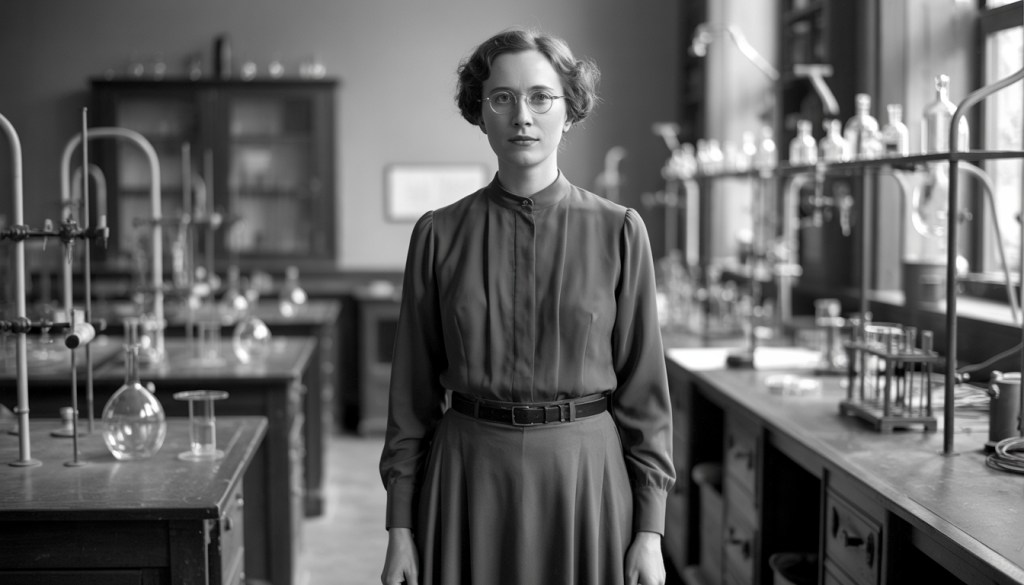
Few scientists in history have stood at such a treacherous crossroads between discovery and moral reckoning as Gertrud Woker. Born in 1878 in Switzerland, this pioneering biochemist and toxicologist became one of the first women to hold a PhD in chemistry at the University of Bern, where she would spend four decades challenging both scientific orthodoxy and institutional sexism. Her groundbreaking research on catalytic processes earned international recognition, but it was her prescient warnings about chemical hazards – particularly her early documentation of lead toxicity in petrol in 1917 – that revealed the true measure of her scientific conscience.
Today, as we reckon with environmental justice, chemical safety regulations, and the responsibility of scientists to speak truth to power, Woker’s story resonates with startling relevance. She understood what many of her contemporaries refused to acknowledge: that science divorced from ethics becomes a tool of destruction rather than healing. Her famous declaration that “science should heal, not gas” echoed through decades of activism with the Women’s International League for Peace and Freedom, where she fought against chemical warfare whilst simultaneously battling to secure her rightful place in the academy. Her life exemplifies the courage required when scientific truth collides with industrial interests, political expediency, and institutional prejudice.
Dr Woker, thank you for joining us. I’m struck by something you said about science being used to “gas” rather than heal. What drove you to see the world in such stark moral terms?
You must understand, I witnessed the birth of a new kind of warfare. Not the honourable clash of armies, but the poisoning of air itself. When I saw those first reports from the trenches – young men blinded, choking on their own blood – I knew that science had crossed a terrible threshold. We had become accomplices to something that violated the very essence of our calling.
Your work began in catalysis and organic chemistry, quite removed from warfare. How did a Swiss biochemist find herself at the centre of debates about chemical weapons?
Catalysis taught me that small changes can produce profound effects – a lesson that proved grimly prophetic. My laboratory work on enzyme reactions showed me how delicately balanced biological systems are. When I began studying the effects of chemical compounds on living tissues, particularly my research into lead compounds in 1917, I realised we were unleashing substances whose consequences we barely understood.
The tragedy is that those who profit from these poisons deliberately ignore what we know. I published my warnings about tetraethyl lead decades before it was removed from petrol, but the oil companies had their own “scientists” to contradict inconvenient truths.
That must have been extraordinarily frustrating – to see your warnings dismissed whilst children were being poisoned.
Frustrating? It was maddening. But not surprising. You see, as a woman in science, I was already accustomed to having my work questioned, my findings dismissed, my competence doubted. They denied me a full professorship until 1933 – denied it to the same person whose research they were quietly using to develop better catalytic processes.
The parallel was striking: just as they ignored my gender to exploit my intellect, they ignored my conscience to exploit my knowledge. The moment I began speaking about the moral implications of our work, I became a troublemaker.
Tell me about that moment when you and Naima Sahlbom were exposed to tear gas at the American Chemical Society conference in 1924. How did that experience shape your activism?
That was no accident. We were observing a demonstration of chemical weapons at an arsenal when the wind shifted. Suddenly, Naima and I, along with several other scientists, were choking on the very gases we had come to study. The irony was not lost on me – women scientists, finally invited to witness “progress,” only to become victims of it ourselves.
But that experience crystallised something for me. Those few minutes of burning eyes and raw throats showed me what soldiers endured for hours, what civilians might face if these weapons proliferated. That’s when Naima and I founded the Committee Against Scientific Warfare. We had felt the enemy’s breath, and we knew we must fight it.
Your activism often put you at odds with your scientific colleagues. How did you reconcile your roles as researcher and peace activist?
There was no reconciliation needed – they were the same role! Science without conscience is not science at all; it’s mere technique in service of whoever pays the bill. My research into catalytic processes taught me how nature builds and sustains life through delicate chemical balances. How could I then remain silent whilst other chemists perverted that knowledge to destroy life?
You know, they called me “Gas-Trudi” as if my opposition to poison gas was somehow hysterical. Meanwhile, these same men were calmly discussing the most efficient ways to blind and maim human beings. Tell me, who was truly mad in that scenario?
You faced particular challenges as a woman in science. How did gender discrimination intersect with the resistance you faced for your anti-war stance?
The discrimination was relentless and multifaceted. They questioned my credentials, my objectivity, my very right to speak on matters of public importance. When I published my findings on lead toxicity, they dismissed me as emotional. When I argued against chemical warfare, they said I was too feminine to understand military necessity.
But here’s what they never understood: my perspective as a woman, as someone excluded from the corridors of power, gave me clarity they lacked. I wasn’t invested in the system that rewarded toxic research. I could see through the rationalisations because I had never been allowed to participate in creating them.
The university delayed my professorship for decades, claiming financial constraints during the war. Convenient, isn’t it, how institutions always plead poverty when faced with acknowledging women’s achievements?
Looking back, how do you view your decision to prioritise activism over purely academic success?
They often portrayed this as a choice – science or activism. But it was never a choice for me. Once you understand that your knowledge can prevent suffering, how can you retreat into laboratory silence?
Yes, I sacrificed career advancement. Yes, I endured ridicule and professional isolation. My own family called me “crazy Aunt Trudi”. But consider the alternative: remaining complicit whilst children breathed leaded exhaust fumes, whilst chemists perfected ever more efficient methods of mass killing.
I may have lost academic prestige, but I kept my scientific integrity. That was not negotiable.
Your warnings about leaded petrol were vindicated decades later when it was finally banned. How do you feel about being proven right?
Vindicated? Hardly. Every year my warnings were ignored, millions of children suffered brain damage from lead exposure. Being “right” is cold comfort when the cost was paid in young minds stunted, in potential forever lost.
What angers me most is that the evidence was there from the beginning. We knew lead was toxic – physicians had documented lead poisoning for centuries. But profit trumped precaution, just as it always does when powerful interests are at stake.
You witnessed both world wars and saw the evolution of chemical weapons. How did your understanding of scientific responsibility change over time?
The First World War opened my eyes to what science could become in the wrong hands. But the Second World War, and what came after – the atomic bomb, the development of nerve agents – showed me that we had entered an entirely new realm of potential destruction.
By the time I was writing about biological warfare in the 1950s and 60s, I understood that we had crossed a threshold from which there was no return. Science had gained the power to end civilisation itself. The question was no longer whether individual scientists could remain neutral – neutrality had become complicity.
What would you say to modern scientists who argue they have no control over how their research is used?
Rubbish! Pure intellectual cowardice! Every scientist makes choices about what to research, whom to work for, how to present findings. When you develop more efficient catalysts, you can choose to focus on pharmaceutical applications rather than weapons manufacture. When you discover toxic effects, you can speak publicly rather than bury the data.
The myth of scientific objectivity is often just a shield for moral abdication. Yes, knowledge itself may be neutral, but knowledge never exists in a vacuum. Scientists who claim they bear no responsibility for applications of their work are like gunsmith who claims innocence for every bullet fired.
Women continue to face challenges in STEM fields today. What advice would you offer to young women scientists?
First, be twice as prepared and thrice as persistent. They will question your competence at every turn – not because you lack ability, but because acknowledging your ability threatens their comfortable assumptions.
Second, never apologise for having a conscience. They will tell you that morality has no place in science, that your concerns about applications are “unscientific.” Don’t believe them. The most rigorous science includes rigorous ethical reasoning.
And remember, dear, you are not alone. There have always been women fighting for truth in science, even when we were invisible in the histories. Find them, learn from them, support each other. The boys’ club may be powerful, but it is not impregnable.
How should modern society balance scientific progress with precautionary principles?
The burden of proof must shift. Instead of waiting for definitive evidence of harm – which often comes too late – we must demand evidence of safety before releasing new substances into the environment. This is not anti-science; it is good science applied with wisdom.
Look at what happened with leaded petrol, with chlorofluorocarbons, with chemical pesticides. In each case, early warnings from conscientious scientists were dismissed as alarmist. How many more cautionary tales do we need?
We must create institutions that reward scientific courage, that protect researchers who speak uncomfortable truths. And we must stop pretending that science and values occupy separate realms. They never have, and they never will.
Any final reflections on your remarkable life and career?
I lived through the most transformative century in human history – a century when science gained power beyond imagining. Some used that power to heal, others to harm. I chose my side and I fought my battles.
The war for the soul of science continues. Every generation of scientists must choose whether knowledge serves life or death, whether discovery leads to liberation or oppression. There is no neutral ground, no ivory tower high enough to escape moral responsibility.
They may have called me “crazy Aunt Trudi,” but I sleep peacefully knowing I used my gifts to protect rather than destroy. In the end, that matters more than any professorship, any recognition, any prize. Science should heal, not gas – and those who truly serve science will always remember that truth.
Letters and emails
Following our conversation with Dr. Gertrud Woker, we’ve been inundated with responses from readers around the world who were deeply moved by her story of scientific courage and moral conviction. We’ve selected five particularly thoughtful letters and emails from our growing community – ranging from current PhD students to policy advisors – who want to explore her pioneering work, her strategies for overcoming institutional resistance, and what guidance she might offer to those walking in her footsteps today.
Lydia Moore, 34, Environmental Lawyer, Seattle, USA:
Dr. Woker, given your early warnings about lead toxicity that were ignored for decades, what legal or regulatory frameworks do you think could have forced industries to take scientific warnings more seriously? I’m particularly interested in how you view the role of precautionary legislation in protecting public health.
Ah, Ms. Moore, you ask precisely the right question – one that haunted me throughout my career. The tragedy of leaded petrol was not merely scientific ignorance; it was a systematic failure of governance to protect citizens from corporate power.
What we needed then, and what you must fight for now, is what I would call “anticipatory accountability.” The burden of proof must be reversed entirely. When Thomas Midgley and his colleagues at General Motors introduced tetraethyl lead, they should have been required to demonstrate safety over decades, not merely absence of immediate death. Instead, they conducted laughably brief studies – weeks, not years – whilst knowing full well that lead accumulates in the body and brain.
The legal framework I envisioned would have three pillars: First, mandatory independent safety assessments funded by industry but conducted by institutions with no financial stake in the outcome. Second, criminal liability for executives who suppress or distort health data – not mere fines that become a cost of doing business. Third, and this is crucial, legal standing for future generations. Someone must speak for the children not yet born who will inherit our chemical legacy.
You see, the oil companies’ lawyers were brilliant – they exploited the law’s obsession with immediate causation. “Show us the bodies,” they demanded, knowing that lead’s effects are subtle, cumulative, and take years to emerge. Your legal system must evolve to recognise probabilistic harm and intergenerational injury as legitimate bases for action.
But here’s what troubles me most about your modern regulatory capture: the revolving door between industry and government has become a motorway. In my day, at least the conflicts were more obvious. Now you have former chemical company executives writing environmental regulations, former regulators joining corporate boards. How can precautionary principles survive such systematic corruption of the decision-making process?
What you need, Ms. Moore, is what we never achieved – enforceable rights for scientific whistleblowers, legal protection for researchers whose findings threaten profitable industries, and courts that understand the difference between scientific uncertainty and manufactured doubt. The tobacco industry perfected these delay tactics; the fossil fuel companies refined them. You must not let the next generation of corporate poisoners perfect them further.
Remember this: every day we delay implementing precautionary legislation, more children breathe toxic air, drink contaminated water, consume foods laced with untested chemicals. The law must learn to act on scientific consensus, not wait for absolute proof. Perfect certainty is the enemy of timely protection.
Brian Berger, 28, PhD Chemistry Student, Max Planck Institute, Göttingen, Germany:
You mentioned that catalysis taught you how small changes produce profound effects. I’m curious about your actual laboratory techniques – what equipment did you work with in the early 1900s, and how did the limitations of your instruments shape your research methodology? Were there discoveries you suspected but couldn’t prove due to technological constraints?
Ah, Herr Berger! Finally, someone who understands that the limitations of our tools shaped everything we could discover. You young chemists today, with your sophisticated spectrometers and electron microscopes, can scarcely imagine working as we did – like surgeons operating with butter knives.
My laboratory at Bern was primitive by your standards, but we made do with remarkable ingenuity. For my catalytic studies, I relied primarily on gas evolution measurements using simple graduated tubes over water baths. Temperature control was achieved through oil baths heated with Bunsen burners – no electronic thermostats, mind you! I spent countless hours manually adjusting flames to maintain precise conditions.
The frustration was immense. I suspected from early experiments that metallic catalysts were forming intermediate complexes with organic substrates, but I had no way to observe these ephemeral species directly. We could only infer their existence from reaction rates and product distributions. I would lie awake at night imagining what those fleeting molecular dances might look like – what you can now observe in real-time with your modern instruments.
For my toxicological work, the constraints were even more severe. When studying lead compounds, I relied on crude colorimetric assays and animal behavioural observations. I knew – knew absolutely – that lead was accumulating in brain tissue and causing neurological damage, but proving the precise mechanisms? Impossible. We had no electron microscopy to show cellular damage, no spectroscopic methods to track metal binding to proteins.
Here’s what haunted me most: I strongly suspected that lead compounds were interfering with haemoglobin synthesis – what you now know as the disruption of δ-aminolevulinic acid dehydratase. But my analytical methods were too crude to demonstrate this biochemical pathway. I could show that exposed workers had anaemia and neurological symptoms, but the corporate scientists demanded molecular-level proof that my instruments simply couldn’t provide.
The irony is breathtaking – industry used our technological limitations against us! “Where’s your proof of mechanism?” they demanded, knowing full well that such proof required instruments that wouldn’t exist for decades. Meanwhile, they had the financial resources to suppress research and delay technological development that might have revealed inconvenient truths sooner.
But you know what, young man? Those limitations taught us something your generation sometimes forgets – rigorous logical reasoning. When you can’t see molecular interactions directly, you must become a detective, piecing together evidence from multiple indirect sources. We learned to think systematically about complex chemical systems in ways that modern computational models sometimes obscure.
My advice to you: don’t let your sophisticated tools make you intellectually lazy. The most profound chemical insights often come not from what instruments show you, but from what they cannot yet reveal – from the questions your data raises but cannot answer. That space between knowledge and mystery? That’s where scientific breakthroughs live.
Besides, some of my most important discoveries came from equipment failures and unexpected results. Your perfect, programmable instruments may rob you of those delightful accidents that lead to paradigm shifts!
Gay Blackburn, 52, Corporate Ethics Officer, pharmaceutical company, Manchester, UK:
You spoke about the moral courage required to challenge your scientific peers. I work with researchers who sometimes discover troubling side effects of medications under development. What specific strategies did you use to maintain your resolve when facing professional ostracism? How did you cope emotionally with being the lone voice of dissent?
Ms. Blackburn, your question strikes at the very heart of what sustained me through decades of professional isolation. You speak of researchers discovering troubling side effects – I know that anguish intimately. The sleepless nights, the gnawing certainty that silence makes you complicit in harm, the terrible loneliness of standing against institutional pressure.
The first strategy I developed was what I called “documentation discipline.” Every concerning finding, every suspicious pattern, every attempt at suppression – I recorded meticulously in duplicate journals, one kept at home, one hidden in my laboratory. I knew that if they discredited me, they would try to destroy my evidence. Your researchers must understand: document everything. Corporate memory is deliberately short when it comes to inconvenient truths.
But documentation alone wasn’t enough. I learned to build what we might call “ethical networks” – relationships with journalists, physicians, other scientists who shared my concerns. When I published my warnings about lead toxicity, I didn’t rely solely on academic journals that industry could easily dismiss. I cultivated relationships with medical practitioners who were seeing patients with unexplained neurological symptoms, with teachers who noticed learning difficulties in children living near smelters.
Here’s what you must understand about emotional resilience, my dear: isolation is the weapon they use against conscientious scientists. They want you to feel alone, crazy, hysterical. I learned to reframe my ostracism as validation. When colleagues stopped inviting me to conferences, when my research funding mysteriously dried up, when they whispered that I had “lost objectivity” – I knew I was over the target.
I developed what I called my “grandmother test.” Before publishing any findings, I would imagine explaining them to my grandmother – a woman with no scientific training but profound moral clarity. If I couldn’t justify my silence to her, if I couldn’t look that imaginary grandmother in the eye and explain why protecting pharmaceutical profits mattered more than protecting children, then I knew I had my answer.
The emotional toll was severe, I won’t lie to you. There were nights when I questioned everything – my competence, my sanity, my right to challenge entire industries. What saved me was developing daily rituals of purpose. Each morning, I would read letters from physicians describing patients with mysterious illnesses, or reports of children with learning disabilities in industrial areas. I kept photographs on my desk – not of scientific apparatus, but of the human faces behind the statistics.
But here’s my most practical advice for your researchers: never fight alone. Form alliances with patient advocacy groups, environmental organisations, investigative journalists. Industry can silence individual scientists, but they struggle against coalitions. When I joined the Women’s International League for Peace and Freedom, I wasn’t abandoning science – I was amplifying it through collective action.
And remember this crucial point: your researchers have advantages I never had. Modern communication technology, freedom of information laws, social media that can bypass traditional gatekeepers. Use these tools! When corporate lawyers threaten lawsuits, when executives pressure universities to silence researchers, when journals refuse publication – take the story public immediately.
Finally, my dear, teach your researchers to find strength in their discomfort. When you discover that a medication causes birth defects, when you realise that industrial chemicals are poisoning communities, the anguish you feel? That’s your conscience working properly. The colleagues who sleep soundly whilst suppressing such knowledge – they’re the ones whose judgment you should question, not your own.
The loneliness of moral courage is real, but it’s temporary. History eventually vindicates those who choose human welfare over corporate profits. Your researchers may face professional consequences for speaking truth, but their children and grandchildren will thank them for their courage. That legacy of integrity – no amount of professional advancement can match its value.
Gunter Hillebrand, 67, Retired Chemical Engineer, Zurich, Switzerland:
Dr. Woker, you lived through the transition from small-scale laboratory chemistry to massive industrial chemical production. If you had been given significant influence over how the chemical industry developed in the 20th century, what key decisions would you have made differently? How might we have avoided some of the environmental disasters we later witnessed?
Herr Hillebrand, you pose the question that has haunted me since my death – what if we had chosen differently at those crucial junctures when chemistry transformed from laboratory curiosity to industrial juggernaut? You and I both witnessed this transformation from our Swiss vantage point, watching as neighbouring Germany became the chemical powerhouse of Europe.
The first critical decision I would have changed was the prioritisation of scale over safety in the 1920s. When BASF, Hoechst, and Bayer were scaling up synthetic processes, they focused obsessively on yield and efficiency whilst treating environmental and health consequences as externalities. I would have mandated that no chemical process could be industrialised without first completing comprehensive toxicological studies – not the cursory weeks-long assessments they conducted, but multi-year investigations including reproductive effects and environmental persistence.
Think about it, Gunter – if we had required proper testing of organochlorines before allowing DDT production, if we had studied chlorofluorocarbons for ozone depletion potential before refrigeration applications, if we had investigated the neurological effects of organophosphates before unleashing them as pesticides – how many ecological disasters might we have prevented?
But the most crucial intervention would have been structural: I would have separated research funding from commercial interests entirely. The corruption of science by profit motives poisoned everything. Universities became beholden to industrial sponsors, regulatory agencies were staffed by industry executives, scientific journals depended on pharmaceutical advertising. We needed – still need – completely independent institutions for chemical safety assessment, funded through public taxation rather than corporate largesse.
You know what particularly galls me? The German chemical industry had the scientific sophistication to develop alternatives from the beginning. When I was researching catalytic processes in the 1910s, we already understood green chemistry principles – using water as solvent, employing biological catalysts, designing for degradability. But these approaches were ignored because they were less profitable than brute-force synthetic methods.
I would have established what I call “generational accountability” – legal requirements that chemical executives personally guarantee the safety of their products for one hundred years. Let them sign documents stating they would stake their personal fortunes and their children’s inheritance on the long-term safety of every compound they market. Watch how quickly they would embrace precautionary principles!
The tragedy of the 20th century chemical industry was its disconnection from human consequences. Executives made decisions in boardrooms thousands of kilometres from the communities that would bear the toxic burden. I would have required mandatory community oversight of all chemical facilities, with local residents having veto power over production decisions. Democracy demands that those who face the risks have a voice in creating them.
But perhaps most importantly, Gunter, I would have changed how we trained chemists themselves. We taught them to be technicians, not philosophers – to manipulate molecules without considering moral implications. Every chemistry curriculum should have included courses on environmental ethics, public health, and the history of industrial disasters. Scientists who understand the human cost of their work make different choices than those who see only molecular structures and reaction mechanisms.
You mention the environmental disasters we later witnessed – Love Canal, Bhopal, the contamination of groundwater across entire regions. Each of these catastrophes was foreseeable, preventable, the inevitable result of prioritising short-term profits over long-term consequences. We had the knowledge to choose differently; we lacked the moral courage and institutional frameworks to act on that knowledge.
The greatest tragedy is that we’re still making the same mistakes. Your modern chemical industry continues developing persistent organic pollutants, endocrine disruptors, microplastics – compounds whose long-term effects we barely understand but release into the environment regardless. The lessons of the 20th century remain unlearned.
If I could speak to today’s chemical engineers and industry leaders, I would tell them this: every molecule you design will outlive you. Every process you develop will affect generations yet unborn. Chemistry is not merely an intellectual exercise – it is a sacred responsibility to safeguard the future of life on Earth. Choose accordingly.
Josephine Mcfarland, 41, Science Policy Advisor, Australian Parliament, Canberra, Australia:
If you could return today and witness how women have progressed in science – we now have female Nobel laureates, heads of major research institutions, even government chief scientists – what aspect of that progress would surprise you most? And what battles do you think we’re still fighting that you recognise from your own era?
Ms. McFarland, your question brings me such unexpected joy – and such profound worry. When I imagine women leading major research institutions, advising governments on scientific policy, and receiving Nobel Prizes without having to share credit with male colleagues who contributed far less, my younger self would have called such visions impossible fantasies.
What surprises me most? The sheer normalisation of women’s scientific competence. In my day, every woman in science was treated as a curiosity, an exception that proved the rule of male intellectual superiority. The fact that you now have female government chief scientists whose gender isn’t the primary topic of discussion – that represents a revolution in human thinking I scarcely dared imagine.
And the technological democratisation astounds me! Women can now publish research instantly, bypass traditional gatekeepers, build international collaborations without needing institutional permission. When I wanted to warn the world about lead toxicity, I had to beg male editors to publish my work, convince male colleagues to co-sign my papers to lend them credibility. Your generation can tweet a research finding and reach millions directly.
But here’s what troubles me deeply, my dear – some battles I recognise all too well. You still fight what I call the “credibility taxation” that demands women prove their expertise repeatedly whilst men are assumed competent until proven otherwise. You still face the “passion penalty” – when women show strong conviction about scientific findings, they’re labelled emotional or activist, whilst men expressing identical views are seen as authoritative leaders.
And I see disturbing parallels in how women’s warnings are still dismissed. Look at climate science – female researchers like Katharine Hayhoe face the same accusations of hysteria that I endured when warning about chemical warfare. The tactics haven’t changed: question their objectivity, attack their motives, suggest they’re too emotional to understand complex technical issues.
What particularly concerns me is the institutional gaslighting that persists. Universities and corporations now publicly celebrate gender equality whilst maintaining systemic barriers. They point to token female leaders whilst ignoring pay gaps, promotion disparities, and the subtle ways women’s contributions are minimised. In my day, discrimination was overt – painful but clear. Your generation faces discrimination disguised as merit-based decisions, making it harder to identify and combat.
The battles you’re still fighting that I recognise? The motherhood penalty remains brutal. I avoided marriage partly because I knew it would end my career – society couldn’t conceive of a woman being both scientist and mother. You’ve made progress, but women in STEM still face impossible choices between advancement and family that men rarely confront.
And the impostor syndrome epidemic among young female scientists breaks my heart. Despite all your achievements, despite female Nobel laureates and research leaders, I still see brilliant women questioning whether they belong in science. The internalised doubt that patriarchal institutions cultivated in us – it persists across generations like a scientific trauma passed down through academic DNA.
But here’s what gives me hope, Josephine: your generation fights differently than mine. You don’t accept token representation – you demand systemic change. You don’t just break glass ceilings – you question why there were ceilings in the first place. When you face discrimination, you document it, publicise it, organise against it. You’ve weaponised transparency in ways my generation never could.
What astounds me most is how you’ve expanded the very definition of scientific excellence. You’ve shown that diverse perspectives strengthen research, that emotional intelligence enhances scientific judgment, that caring about social implications doesn’t diminish intellectual rigor – it elevates it.
Keep fighting, my dear. The battles may look different, but the war for women’s full participation in shaping humanity’s scientific future continues. Don’t let them convince you that because you have female Nobel laureates, the struggle is over. True victory won’t come until a woman can pursue any scientific career without facing barriers her male counterparts never encounter – until gender becomes as irrelevant to scientific achievement as hair colour.
And remember – every young girl who sees you advising parliament on scientific policy, every female student who witnesses women leading research institutions, inherits possibilities that my generation could only dream of. You are living the future we fought to create.
Reflection
Gertrud Woker’s voice carries across the decades with uncomfortable urgency, challenging us to examine our own complicity in systems that prioritise profit over people, advancement over ethics. Her story is not merely historical – it is a mirror held up to contemporary debates about artificial intelligence, genetic engineering, climate science, and countless other fields where technical capability outpaces moral consideration.
What makes Woker’s legacy particularly relevant today is her understanding that scientific integrity and social justice are inseparable. She saw that the same institutional biases that excluded women from laboratories also enabled the suppression of inconvenient research findings. The discrimination she faced as a female scientist gave her insight into how power structures distort scientific discourse – insight that remains painfully relevant as we contend with corporate influence over research funding, publication bias, and the politicisation of expertise.
Her life reminds us that true scientific courage requires not just intellectual rigour but moral bravery. In an age when technology companies promise to “move fast and break things,” when algorithmic systems perpetuate social inequalities, when climate scientists face harassment for reporting inconvenient data, Woker’s example offers both inspiration and instruction. The price of remaining silent in the face of harmful applications of scientific knowledge has never been higher, nor has the potential reward for speaking truth to power been more necessary for human survival.
Perhaps most importantly, her story demonstrates that the path from laboratory bench to social responsibility need not be a detour from scientific excellence – it is its highest expression.
Who have we missed?
This series is all about recovering the voices history left behind – and I’d love your help finding the next one. If there’s a woman in STEM you think deserves to be interviewed in this way – whether a forgotten inventor, unsung technician, or overlooked researcher – please share her story.
Email me at voxmeditantis@gmail.com or leave a comment below with your suggestion – even just a name is a great start. Let’s keep uncovering the women who shaped science and innovation, one conversation at a time.
Editorial Note: This interview is a dramatised reconstruction based on extensive historical research into Dr. Gertrud Woker’s documented writings, scientific publications, correspondence, and biographical accounts. While her responses reflect historically accurate positions and documented views, the specific dialogue presented here is fictional and created for educational purposes. All factual claims about her scientific work, activism, and the challenges she faced have been verified through primary and secondary historical sources. This format allows us to explore her remarkable contributions and perspectives in an accessible way whilst maintaining scholarly integrity about what can and cannot be definitively known about her personal thoughts and expressions.
Bob Lynn | © 2025 Vox Meditantis. All rights reserved. | 🌐 Translate


Leave a comment