What’s a book that completely surprised you?
I: The Wrong Book for the Right Reasons
The key is a real one. An actual key, brass, on a fob that has the room number stamped into it in the old way, and that small fact alone is enough to make me feel I’ve chosen well. I’ve stayed in places that give you a credit card-sized piece of plastic and call it a key, and I’ve learned to treat that as a warning. About the wi-fi speed. About the “artisan” breakfast that turns out to be a single croissant in a paper bag. About the general philosophy of the establishment. A real key means something. I can’t fully defend this as a position, but I hold it anyway.
The woman at the desk was pleasant and efficient and required very little from me beyond a card payment and a legible signature, which I consider almost ideal in another human being at four-thirty on a Friday afternoon. I told her the room looked lovely in the photographs. She told me there was a good view of the water if the weather cleared. We smiled at each other in the way that signals a mutual and entirely amicable desire for the conversation to end, and then I came upstairs, and the door closed behind me, and I stood in the middle of the room for a moment and did absolutely nothing.
That moment is the whole point, actually. That precise moment when the door closes and you are in a room that is not your home, and there is nobody in it who needs anything from you.
I should explain, because it sounds worse than it is.
I’m a psychiatric nurse. Have been for sixteen years, based out of Lancaster, and before you conjure an image, I’ll tell you that the work looks very different from what most people imagine when they imagine it. It is quieter, for one thing. More administrative than it has any right to be. It involves a great deal of tea and a great deal of listening and a great deal of sitting with people in states of distress that you cannot fix, only accompany, and learning not to find that as unbearable as it sounds. I love the work. That is not a performance of professional contentment; it is the plainest true thing I can tell you about my life. I am good at it, I find it meaningful, and I would not do anything else.
But here is the thing nobody quite prepares you for: other people’s interior worlds have a residue.
That’s my word for it. Residue. After a fortnight of shifts, of sitting inside the architecture of other people’s suffering and trying to be useful within it, something accumulates. It isn’t trauma, exactly. It isn’t burnout, which is a real and serious thing that I take seriously and monitor carefully in myself and my colleagues. It is something finer-grained than either of those. It is the weight of having been, repeatedly and attentively, inside someone else’s experience. The sheer sustained effort of not making it about you. Of keeping your own reactions in a neat, professional pile to one side while you remain completely present for whatever is happening across the table.
You cannot do that indefinitely without the pile getting tall.
So. Three or four times a year, I book myself into a quiet hotel in the Lakes, I tell everyone where I am in case of emergency, and I come here and I read. Not walking. Not the farmers’ markets and the artisan cheese and the scenic drives that Cumbria will absolutely provide if you ask nicely. Just this: a room, a view I don’t have to engage with, meals I don’t have to cook, and a book I’ve been saving.
My sister thinks this is profoundly sad. She says this every time I mention it, with the energy of someone who considers it her duty to stage a low-level intervention on my behalf, usually while I’m putting my coat on to leave. “You should bring someone,” she says. “Or join a walking group. Meet people.” I have explained, more than once, that meeting people is the thing I do for a living. She remains unconvinced. I remain unbothered. This is the central dynamic of our relationship, and we are both, I think, quietly fond of it.
I unpacked slowly, the way you can when nobody is waiting. Clothes in the wardrobe, toiletries arranged on the bathroom shelf with the kind of precision that I know is mildly compulsive and do not intend to address. And then the book, which I lifted from my bag and placed on the bedside table with a deliberateness that I would not, under any circumstances, describe to another living person as ceremonial, even though it is completely ceremonial. It sits there. I look at it. The weekend, officially, begins.
The Wisdom of Trees by Max Adams.
I have a system for these weekends. It has evolved over years into something with actual criteria, which tells you everything you need to know about me and I make no apology for it. The book must be non-fiction, because fiction at its best demands a kind of emotional porousness that I am not always in a position to offer, and at its worst makes me want to argue with the author, which is not restful. It must not be work-adjacent: no psychology, no neuroscience dressed up as popular science, no memoirs of mental illness or recovery, however beautifully written. I spend forty hours a week in that territory. The book must also be something I know almost nothing about. That last condition is the most important. I want to be genuinely ignorant. I want the mild, clean pleasure of a subject that has no professional obligation attached to it, no accumulated opinion, no prior reading I feel compelled to synthesise. I want to simply not know things, and then know them.
I found this one in a bookshop on Penny Street back in February, pulled it from a shelf on the basis of the title and the cover and the fact that it was raining and I was in no hurry. I read the first page standing up in the aisle, which is always the test, and something about it caught. I bought it, brought it home, put it on the shelf designated for books that are waiting for a weekend exactly like this one, and I did not read another word of it until today.
I will be honest with you about my expectations.
I expected something pleasant. Something that sat comfortably in the tradition of British nature writing: lyrical, a little melancholic, full of learned digressions about folklore and seasonal light. The kind of book that gets reviewed in the Saturday supplements by someone who describes it as “a balm.” I had nothing against that. A balm sounded genuinely excellent. I may have also, somewhere in the back of my mind, expected something illustrated. Something I could skim through while the rain came off the fell and the radiator ticked and I achieved that low-grade state of pleasant stupefaction that is really what I’m here for.
Trees, I thought. How demanding could trees possibly be?
I have, professionally speaking, sat with human beings in the most complex and demanding states of interior experience that the mind is capable of generating. I have held a conversation with a man who had not slept in eleven days and believed, with absolute and lucid conviction, that the television was addressing him personally. I have navigated the kind of sessions that leave you sitting in your car in the hospital car park afterwards, not quite ready to re-enter the ordinary world.
It did not occur to me, not once, that I might be humbled by a book about dendrology.
I made tea from the little kettle on the desk, put the book on my lap, and turned to page one.
II: What I Was Not Expecting
The tea was already wrong by the time I’d read the first chapter.
I mean this literally: I had made it, set it on the desk, and simply not drunk it, because I had been intending to drink it in the manner of someone relaxing with a gentle book, and the book had, almost immediately, declined to be gentle. I looked up at some point and the surface had gone that dull, flat colour that means it is now a tepid disappointment rather than an actual cup of tea, and I noted this with what I can only describe as faint, almost impressed irritation. I had been reading for forty minutes and I had not once thought about the tea. That is not nothing. I think about tea quite a lot, as a rule.
The first thing that surprised me was the science.
I want to be precise about this, because the surprise was not that the book contained science. I had registered from the back cover that Max Adams was a historian and an archaeologist, and I had assumed that the science would be present in the way that science often is in popular nature writing: gestured at, nodded to respectfully, then set aside in favour of something more atmospheric. A bit of jargon as a credential, followed by a swift return to the emotional landscape. What I was not prepared for was rigour. Actual, sustained, technical rigour.
Adams writes about how trees function at a biological level with the kind of precision that assumes you are paying attention and intend to keep paying attention. The structure of wood, the roles of the different layers beneath the bark, the system by which water and dissolved nutrients move from the roots upward through the tree against gravity, through vessels so fine and in such coordinated number that the whole enterprise, when you stop to think about it, is frankly implausible. I read a passage about the vascular architecture of a mature oak and then I read it again. Not because it was unclear. It was admirably clear. I read it again because I had understood it and I wanted to make sure I had actually understood it, rather than performed the kind of reading where the words go in and the sense floats just slightly above them and you feel informed without being so.
I am aware that this is what I am like. I have been this way since school and I see no compelling reason to change now.
What got me was the image of the tree as a hydraulic system of extraordinary delicacy, moving water upward through columns of tension that must be maintained continuously or the whole process fails. There is something almost vertiginous about it once it lands: the realisation that every tree you have ever walked past has been, at all times, doing something immensely complicated that you cannot see and have never thought to wonder about. I have walked under a great many trees in my forty-two years. I have sat under them, leaned against them, been grateful for their shade in the two weeks of genuine summer that the north of England occasionally produces. At no point did I consider that they might be interesting.
This was, I was beginning to understand, an oversight.
The second surprise arrived later, and it was of a different order entirely.
The history.
I am not sure why it hadn’t occurred to me that trees exist on a timescale so different from ours as to make the comparison almost absurd. I know, in the abstract, that some trees are very old. This is the sort of fact you absorb somewhere in childhood and file without much examination. What Adams does, and what I was unprepared for, is make you feel it rather than merely know it. He writes about particular trees, trees that are still standing, still living, that were already mature when the Romans occupied Britain. He places them in history not as curiosities but as witnesses, as continuous living presences that have simply persisted through everything: invasion, plague, agricultural revolution, the whole grinding catalogue of human activity, while putting out leaves every spring with complete indifference to all of it.
I put the book down on my lap and looked out of the window.
The light was going by then, that slow grey softening that happens over the lakes in the early evening, the fell on the far side losing its detail, flattening into something more monumental and less defined. I sat with what I’d just read in the way that I sometimes sit with things that need a moment. It’s a skill you develop in my job, the ability to not immediately process something, to let it exist in the room with you for a little while before you start taking it apart. The fact that a tree outside some Roman fort in the north of England could still be alive, still drawing water up through its xylem, still doing its extraordinary hydraulic work in the twenty-first century, felt, in that quality of evening light, like something more than information.
I am not given to sentimentality, as a general principle. Ask anyone who knows me. My sister would laugh at the very suggestion. But there is a difference between sentimentality and being willing to let something be as large as it actually is, and sitting in a hotel room in Cumbria, looking at a darkening fell, I allowed that particular fact to be as large as it actually was.
It was quite large.
What happened next I find genuinely funny in retrospect, because it is so entirely characteristic of the way my mind works that I cannot even be exasperated by it. I noticed that I had been reading for some time with a quality of attention I don’t normally bring to leisure reading, and I found myself observing, with the detached interest of someone watching a mildly diverting experiment, what was happening to me physiologically. My breathing had slowed. The thing I think of privately as my “on-duty posture” – a kind of held quality across the shoulders, a readiness, the physical expression of being professionally available – had loosened without my having instructed it to. I had not noticed this happening. It had simply happened, the way your eyes adjust to darkness without you deciding to let them.
I am a psychiatric nurse. I know what the research says about reading. I have, on more than one occasion, suggested to patients that reading, particularly sustained, absorbing, non-screen reading, has measurable effects on the nervous system. I have said the words “it can be genuinely helpful” with complete sincerity and a reasonable evidence base. I have never once applied this advice to myself with anything approaching seriousness. My reading weekends have always felt, in my own framing, more like logistics than therapy: I need the pile to get smaller, I need to be somewhere that isn’t my flat in Lancaster, I need to eat food I haven’t cooked, I need three days without anyone requiring anything from me. That is a practical solution to a practical problem. That is not self-care, a phrase I find mildly insufferable despite understanding its clinical validity.
And yet here I was, undeniably, in a state that a clinician of my acquaintance might describe as regulated.
Because of trees.
I decided to find this amusing rather than professionally inconvenient, and moved on.
The third surprise was the one that actually stopped me.
Somewhere in the middle of the book, Adams turns to the relationship between trees and human psychological wellbeing, and he draws on a body of research that I know exists, that I have skimmed in journals, that I could, if pressed, summarise accurately. The evidence that time spent near trees measurably reduces cortisol levels, that the presence of woodland affects how the brain processes attention, that there is something about the scale and the age and the quality of being near large living things that does something and physiologically real to the human stress response. I know this. It is in the literature.
But there is a version of knowing something that lives only in the professional part of your mind, held there as evidence rather than experience, and there is another version entirely where the knowledge meets the actual moment and becomes something you are inside rather than something you have read about. I was sitting by a window in Cumbria with a fell outside and a lake beyond it and trees along the shoreline that were, I now knew, probably older than anything built in Lancaster, and I was reading, in careful and unsentimental prose, an explanation of exactly why I feel better when I am here.
I have been coming to the Lakes for six years on these weekends. Six years of choosing hills I don’t climb and water I don’t sail on and paths I don’t walk, simply because being near them does something that I have never fully articulated even to myself. I have always described it, when I describe it at all, as the pleasure of not being at home. Which is true, but is, I now understood, not the whole truth. It is also this. Whatever this is. Whatever the measurable, documentable, cortisol-mediated, attention-restoring mechanism is that means a woman who spends her working life inside other people’s suffering can come and sit near some trees and feel, incrementally, more like herself.
I read that section twice as well.
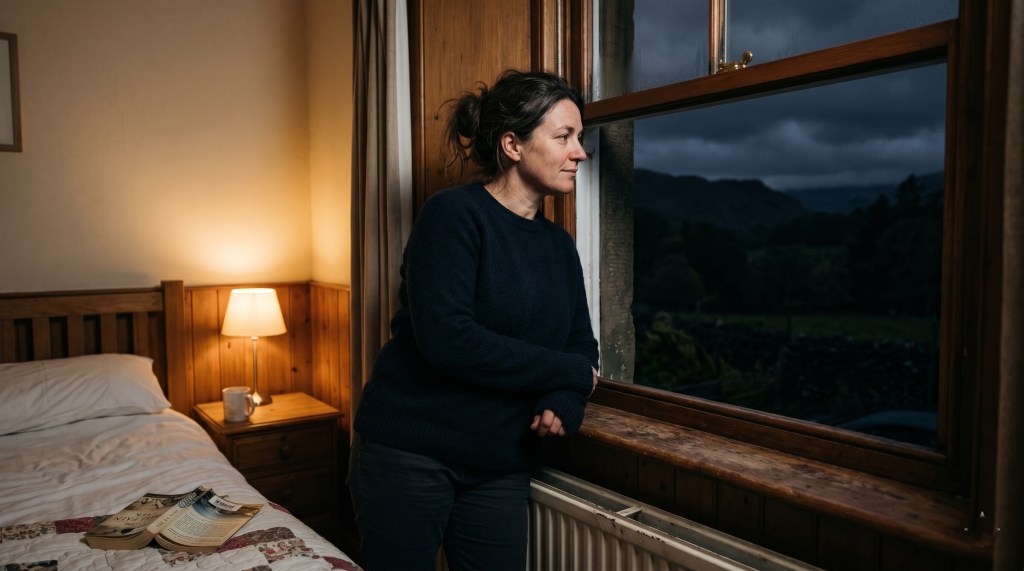
At some point the room went properly dark. I reached out without looking and turned on the lamp on the bedside table, the way you do when you’ve been so absorbed that the shift from daylight to artificial light registers only as a mild, peripheral inconvenience to be dealt with one-handed. I had planned, when I arrived, to read for a couple of hours and then run a bath and have an early night. This had seemed like a realistic and sensible plan. It was now, I noticed, nearly nine o’clock. I had not moved except at some earlier point, which I could not precisely identify, when I had apparently placed the cold tea on the floor to give myself slightly more lap room.
The cold tea on the floor.
If you know me, you understand the significance of this. If you don’t: I once ended a first date early because the man across the table let his coffee go cold and didn’t seem to notice. I have opinions about hot drinks that my colleagues consider disproportionate and I consider foundational.
I looked at the cup on the floor for a moment. Then I looked back at the book.
I turned the page.
III: What Trees Apparently Know About Psychiatric Nurses
I stopped at the end of a chapter.
This was a deliberate decision, and I want to be clear about that, because stopping was in some ways harder than continuing and I think that matters. There were perhaps eighty pages left. I could see exactly where I was in the book by the weight of it in my hand, the thin remaining section pressed between my thumb and the back cover, and eighty pages at the rate I’d been going was perhaps an hour and a half, maybe two hours if I kept rereading things, which, as the evening had demonstrated, I apparently could not be trusted not to do. I could have finished it. It wasn’t especially late. The case for finishing it was, objectively, strong.
I put it on the bedside table with the same deliberateness with which I’d placed it there this afternoon, face down, open at the page, which is something I do with books I fully intend to return to and is a practice my more bibliographically precious friends consider an act of minor vandalism. They can, with respect, see themselves out. I put it down and I lay back on top of the covers and I looked at the ceiling in the way that I do when something has shifted slightly and I want to take stock of it before I go any further.
I do this at work sometimes, at the end of a session that has moved somewhere unexpected. I sit in the room for a few minutes before the next patient arrives and I look at nothing in particular, and I let whatever has just happened exist for a moment without immediately trying to be useful about it. My supervisor, years ago, called this “metabolising.” I thought at the time that it was a slightly overwrought metaphor. I have since come to think it is exactly the right one.
So. Metabolising.
The question I was turning over was this: what, precisely, had the surprise been?
Because I want to be accurate about it, and accuracy matters to me in a way that some people find exhausting and I find non-negotiable. The book was good. That was not the surprise. I had hoped it would be good. I had stood in a bookshop in February and read the first page and bought it on the basis that it seemed like it was going to be good, so discovering that it was, in fact, good was a reasonable outcome and not a surprise in any meaningful sense. Gratifying, yes. But not the thing.
The thing was that it was relevant.
I had chosen it specifically, methodically, as a holiday from relevance. That is the whole system. The whole point of the criteria I have developed over six years of these weekends is to find something that has absolutely nothing to do with the territory I live in professionally: no interiority, no suffering, no fragile and complicated human beings trying to find their way back to some version of functioning. I had wanted a subject so far outside my own field that my professional mind would simply have nothing to grip and would, for a few days, let go. I had wanted nature writing. I had wanted the British countryside, in prose form, at a slight remove. I had wanted pleasant and peripheral and utterly, blissfully beside the point.
I had chosen trees.
And trees, it turned out, had their own ideas about relevance.
Because here is what I had spent the evening reading about, underneath the biology and the history and the beautifully observed ecological detail. Here is the question that the book had been quietly asking, from a completely different angle and in an entirely different language, all along: what does it take for a living thing to survive a long period of darkness and stress with its fundamental nature intact? Not just to endure it. Not to get through it by becoming something harder and less permeable, which is one strategy and not without its logic, but not, in the long run, a particularly viable one. To actually survive it, in the full sense of the word. To still be standing in the spring. To still be putting out leaves.
I work with people who are trying to answer that question about themselves every single day. I have sat across from human beings at the absolute lowest point of their interior lives and tried to be useful to them within it, and the question underneath all of it, the one that everything else is really in service of, is always some version of: how do you stay alive to yourself through the worst of it? How do you remain, at root, the thing you were before it happened?
Adams writes about trees that have survived centuries of catastrophe, of being cut back to almost nothing, of entire seasons of defoliation, of storm damage and disease and drought, and have simply, stubbornly, continued. He writes about the way woodland trees support one another through root systems and fungal networks that operate below the surface and are completely invisible from above. He writes about resilience in a way that is scientifically precise and entirely unsentimental, and somehow, because it is precise and unsentimental, it lands harder than it would if it were trying to.
I stared at the ceiling and I thought: I have said versions of all of this. In sessions. In different words, with different examples, on different days, to different people. I have talked about root systems in the metaphorical sense without ever really thinking about the literal ones. I have talked about the difference between being resilient and being merely resistant, without knowing that I’d absorbed that distinction at least partly from standing under trees I had never thought to be curious about.
And then I noticed what I was doing.
I noticed it with the quality of recognition that you develop after sixteen years of sitting with other people while they do it. Finding the metaphor in everything. Organising the world into a symbolic system that confirms what you already believe. I have spent a not inconsiderable amount of professional time gently helping patients to notice when they are doing this, because it is a way the mind has of avoiding the thing itself by constructing an interesting story around it. You think you are gaining insight. Often you are just decorating.
In my own defence: I am not doing it under clinical supervision or as a way of avoiding medication. I am doing it at nine-thirty on a Friday evening in a hotel in Cumbria having read an unexpectedly rigorous book about trees, and I think, on balance, some latitude is appropriate. I am giving myself this one. Just this once. Under the circumstances. I’ll return to being professionally scrupulous about it in the morning.
The answer, then. If someone were to ask me what book completely surprised me.
Not surprised me by being better than expected, though it was. Not surprised me by being stranger or funnier or sadder than I’d anticipated, though it was, at various points, all three of those things. Surprised me because I had made a careful and considered decision to read something with no bearing on my interior life, and the book had walked straight through that decision as though it wasn’t there. It had come at the same questions I live with professionally, from the angle of ecology and deep history, and arrived at them so quietly and by such an indirect route that I hadn’t noticed it happening until it already had.
I don’t especially enjoy being surprised. I am aware that this is not an admirable quality. I am also aware that the reason I don’t enjoy it is that being surprised generally means I have underestimated something, and I have views about my own underestimations that I will generously describe as rigorous. I had underestimated a book about trees. I had categorised it, before reading it, as pleasant and manageable and low-demand, and it had turned out to be none of those things, or rather it had been all of those things and also quite a lot more besides, in the same way that Cumbria itself is, on the surface, a landscape of straightforward natural beauty and is, the moment you stop moving through it, something altogether older and more serious.
I should have known, perhaps. I have been coming here for six years. I should have recognised the tendency.
I got up and crossed to the window and opened it a few inches. The cold came in immediately: real, unambiguous Cumbrian cold, with the smell of water in it and something green underneath, the smell of the north at night that I would not know how to describe to someone who hadn’t stood in it. The hotel garden below was dark, and beyond the garden wall there was the lane, and beyond the lane the ground sloped down towards the lake, and somewhere along that slope there were trees. I couldn’t see them. The cloud cover was solid and the dark out here is a different quality of dark from the dark in Lancaster, less diluted, more serious about itself. But I knew the trees were there. I had seen them from the car when I arrived, a loose line of them along the lower field boundary, substantial and unhurried, almost certainly older than the hotel, probably older than anything I could currently see from this window.
And I knew now, in a way I hadn’t this morning, something about what they were doing in the dark. The slow hydraulic work, the root systems reaching outward in the wet ground, the exchanges happening below the surface in the invisible, complicated, mutually sustaining way that Adams had described with such precision. All of it continuing, unobserved, at a timescale that made my forty-two years look like a brief and rather excitable interruption.
I found this, standing at the window in the cold, unexpectedly comforting. I examined that response with mild suspicion, the way I examine most of my emotional responses as a matter of professional habit, and concluded that it was genuine and defensible and I was going to allow it.
I closed the window. I got into bed. I looked at the ceiling for a moment, then looked at the book on the bedside table, and made a firm and unambiguous decision to go to sleep and save the last third for the morning, as I had planned, because I have self-discipline and a functional relationship with delayed gratification and I was not going to be defeated by eighty pages.
Then I picked it up and read three more pages before I could stop myself.
Some things, it turns out, are easier to understand in trees than in people.
Bob Lynn | © 2026 Vox Meditantis. All rights reserved.


Leave a comment