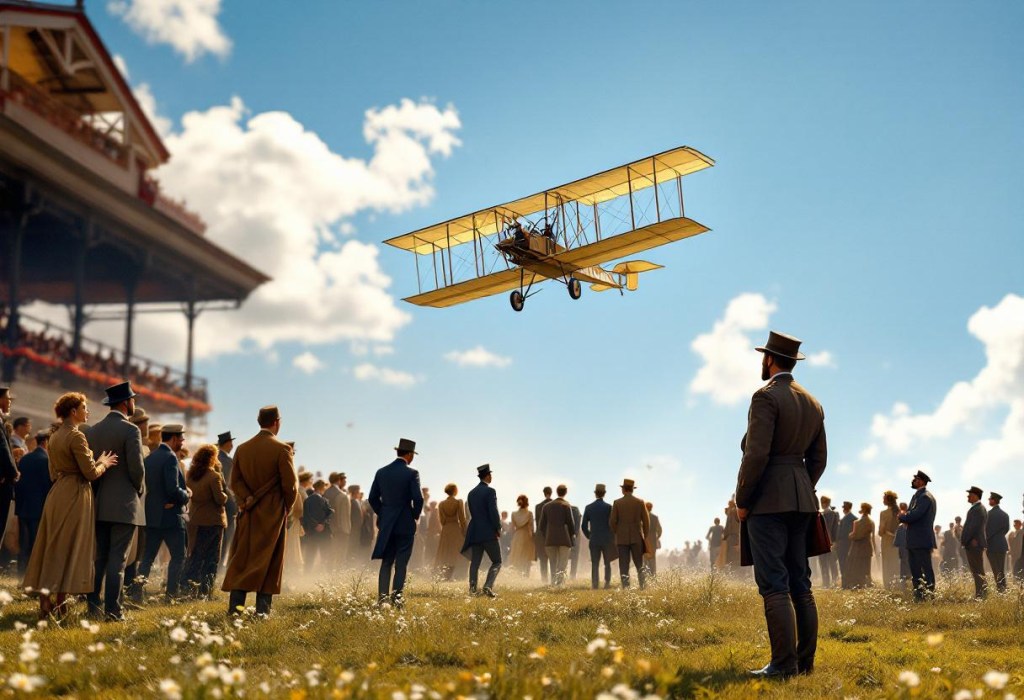
Le Mans Racecourse, France – 8th August 1908
Part I:
The Doubter
The morning mist clung to the meadows surrounding Le Mans like a shroud over yesterday’s certainties. Henri Delacroix shifted uncomfortably on the hard wooden bench as the local train wheezed to a halt, its steam mingling with the pale August dawn. Through the carriage window, he glimpsed the modest station platform where a handful of other passengers—farmers clutching market baskets, a gentleman in a silk top hat, two fellow journalists he recognised from the Parisian press corps—descended with varying degrees of enthusiasm for the day’s promised spectacle.
Henri remained seated a moment longer, his leather satchel heavy across his knees. Within its worn confines lay three months’ worth of articles he’d penned for Le Figaro, each one more scathing than the last regarding the Wright brothers’ outlandish claims. “American Charlatans and Their Flying Fairy Tales” had been his personal favourite, though “The Great Aeronautical Deception” had garnered more letters from readers. He’d built his reputation on sharp wit and harder facts, and the notion that two bicycle mechanics from Ohio had somehow achieved what the greatest minds of Europe had deemed impossible struck him as precisely the sort of sensationalist nonsense that sold newspapers to the gullible masses.
Yet here he was, having spent his own francs on a third-class ticket to this provincial racecourse, ostensibly to witness Wilbur Wright’s first public demonstration of powered flight in Europe. The irony was not lost on him—he’d come not to see history made, but to watch mythology crumble.
The walk from the station to the Hunaudières racecourse took Henri through streets where the ordinary rhythms of provincial life continued undisturbed. A baker’s boy wheeled his cart past shuttered shop fronts; early church bells chimed the hour across red-tiled rooftops; somewhere, a woman sang whilst hanging washing in her garden. The mundane beauty of it all reinforced Henri’s conviction that this day would end much as it began—with the world unchanged and his cynicism vindicated.
The racecourse itself proved less impressive than Henri had anticipated. No grand pavilions or ceremonial bunting marked the occasion. Instead, he found himself approaching a collection of ramshackle wooden structures that might have housed farm equipment rather than the supposed marvel of modern engineering. The famous Wright Flyer—assuming it actually existed beyond newspaper sketches and fevered imaginations—was nowhere to be seen.
“Monsieur le journaliste!” The voice belonged to a portly gentleman with magnificent whiskers who emerged from what appeared to be a converted stable. “You must be here for the demonstration. I am Léon Bollée—perhaps you’ve heard of my motor cars?”
Henri had indeed heard of Bollée’s automobiles, which lent the man’s presence here an uncomfortable credibility. “Henri Delacroix, Le Figaro,” he replied, extending his hand whilst studying Bollée’s face for signs of the charlatanism he expected to find. “I understand you’ve been… assisting… the Wright brothers?”
“Assisting?” Bollée’s laugh was genuine, unforced. “Mon dieu, no! I’ve been privileged to witness genius at work. Come, you must see for yourself.”
Before Henri could demur, Bollée had grasped his elbow and was steering him towards the largest of the wooden structures. The doors stood open, revealing what lay within, and Henri felt his first moment of genuine surprise since arriving in Le Mans.
The Wright Flyer was nothing like the crude contraption he’d imagined from press descriptions. Even partially disassembled, it possessed an elegant, purposeful quality that spoke of meticulous engineering rather than mere tinkering. The wooden framework was joined with mathematical precision; the canvas surfaces stretched taut as drumheads; the engine—a compact marvel of mechanical ingenuity—gleamed with the sort of finish Henri associated with Swiss timepieces.
“Extraordinary, isn’t it?” Bollée whispered, as though they stood in a cathedral. “Four cylinders, developing nearly thirty horsepower. Wilbur designed much of it himself, you know. The propellers alone represent innovations that our finest engineers are only beginning to comprehend.”
Henri found himself leaning closer, his journalist’s eye cataloguing details that refused to align with his preconceptions. The machine’s construction betrayed no evidence of haste or amateurism. Every joint, every wire, every component suggested not merely competence but genuine mastery of principles he didn’t fully understand.
“Where are the… brothers?” Henri asked, hating how the question emerged more curious than accusatory.
“Wilbur is taking measurements,” Bollée replied, gesturing towards the racecourse itself. “Wind speed, air pressure, temperature—he records everything. His methodical nature quite puts our European scientists to shame, I’m afraid.”
Through the hangar’s rear door, Henri glimpsed the racecourse proper, where early spectators were already gathering despite the hour. The crowd was more diverse than he’d expected—not merely sensation-seekers and newspaper readers, but men and women whose presence suggested genuine scientific interest. He recognised Professor Cailletet from the Sorbonne, deep in conversation with what appeared to be a delegation from the Aéro-Club de France. Near the makeshift grandstand, a group of military officers studied the field through field glasses with the sort of attention Henri associated with strategic reconnaissance.
“Monsieur Wright!” Bollée called towards a solitary figure methodically pacing the field’s length. “Come meet Monsieur Delacroix from Le Figaro.”
The man who approached bore little resemblance to Henri’s expectations of an American showman. Wilbur Wright was tall and spare, with intelligent grey eyes and a quiet manner that suggested deep reserves of concentration. His handshake was firm but brief; his attention seemed partly elsewhere, as though some portion of his mind remained focused on calculations Henri couldn’t begin to fathom.
“Monsieur Wright,” Henri began, deploying his most penetrating journalistic manner, “many of my readers remain… sceptical… regarding claims of sustained, powered flight. What would you say to those who suggest this demonstration is merely elaborate theatre?”
Wright considered the question with the same methodical attention he’d been giving the wind direction. “I’d say they’re wise to demand proof,” he replied quietly. “Extraordinary claims require extraordinary evidence. That’s precisely why we’re here.”
The response disarmed Henri completely. He’d expected bluster, defensiveness, perhaps even anger. Instead, Wright’s calm acknowledgement of reasonable doubt suggested a man utterly confident in his abilities—not the brittle confidence of a fraud, but the quiet certainty of someone who had tested his convictions against reality and found them sound.
As the morning progressed and more spectators arrived, Henri found himself observing not just the preparations but his own evolving reactions to them. The professional cynic within him continued cataloguing potential explanations for what might prove to be an elaborate deception. Yet something deeper—perhaps the frustrated idealist who’d first drawn him to journalism—began to wonder if he’d travelled to Le Mans to witness not the collapse of a hoax, but the birth of a new world.
Part II:
The Reckoning
By midday, the August sun had burned away the morning mist, revealing Le Mans racecourse in sharp, unforgiving detail. Henri found himself increasingly uncomfortable, though the weather could hardly be blamed. The crowd had swollen to several hundred souls, their conversations creating a low hum of anticipation that seemed to vibrate through the warm air itself. What disturbed Henri was not their number, but their composition—this was no gathering of credulous yokels come to gawk at American trickery.
He approached a cluster of spectators near the makeshift grandstand, his journalist’s instincts compelling him to understand what had drawn such diverse observers to this provincial field. An elderly woman in elegant black silk stood beside a farmer whose soil-stained hands suggested recent labour; they conversed with the easy familiarity of shared wonder rather than social equals thrust together by circumstance.
“Madame,” Henri ventured, removing his hat with practised courtesy, “Henri Delacroix, Le Figaro. Might I enquire what brings you to Le Mans today?”
The woman’s eyes, sharp despite her years, studied him with obvious intelligence. “Madame Beaumont,” she replied. “My late husband was an engineer—bridges, you understand. He always said that when men learned to fly, they would first have to understand the wind.” She gestured towards Wilbur Wright, who continued his methodical measurements at the field’s far end. “That man understands the wind.”
Henri felt an unwelcome prick of curiosity. “You believe it possible, then? Powered flight?”
“Young man,” Madame Beaumont’s voice carried the authority of decades, “I have seen impossible things become inevitable. The railway that brought you here was once deemed impossible. The telegraph that carried news of this demonstration to Paris was once impossible. Why should this be different?”
The farmer beside her nodded gravely. “My grandfather saw the first balloon flights. Said it changed how he looked at the sky forever after. Made him feel… smaller, perhaps, but part of something larger too.”
Henri excused himself, troubled by their quiet conviction. These were not sensation-seekers or newspaper readers hungry for novelty. They spoke with the measured confidence of people who had witnessed human ingenuity triumph over natural limitation before, and expected to do so again.
Near the timing station, he encountered a gentleman whose bearing suggested military experience, despite his civilian dress. The man was studying Wright’s preparations through field glasses with the sort of methodical attention Henri associated with reconnaissance.
“Colonel Ferber,” the man introduced himself without lowering his glasses. “Formerly of the artillery. You’re the journalist from Paris, yes? Here to document another American failure?”
The question’s directness caught Henri off guard. “I’m here to report the truth, whatever that proves to be.”
Ferber lowered his glasses and fixed Henri with a steady gaze. “The truth, monsieur, is that warfare will never be the same after today. Whether Monsieur Wright flies for two minutes or two hours matters less than the fact that he will fly at all. The age of cavalry charges and static fortifications ends the moment that machine leaves the ground.”
“You seem remarkably certain of success,” Henri replied, though his tone carried less scepticism than it had that morning.
“I am a student of engineering, monsieur. I have examined Wright’s patents, studied his methodologies, corresponded with him regarding aerodynamic principles. This is not showmanship—this is applied science of the highest order.”
Henri found himself drawn towards the hangar, where an elderly gentleman in a worn but well-cut coat was examining the Wright Flyer’s engine with obvious expertise. Something in the man’s manner—the way he traced mechanical connections with his finger, the soft murmur of appreciation as he studied the propeller design—suggested profound understanding.
“Professor Langlade,” the man introduced himself when Henri approached. “Mechanical engineering, École Polytechnique. Retired, but not, I hope, too old to recognise brilliance when I encounter it.”
“You find the machine… convincing?” Henri asked, though the question felt increasingly foolish with each repetition.
Langlade’s laugh was rich with genuine delight. “Convincing? My dear fellow, it is revolutionary. Do you see these propellers? Wright has solved problems that our finest theorists have been wrestling with for decades. The pitch, the angle, the relationship between rotation speed and forward thrust—it represents innovations that will transform not merely aviation, but our understanding of mechanical power itself.”
The professor’s enthusiasm was infectious, but Henri found himself grasping for familiar scepticism. “Surely the principles of flight remain theoretical at best?”
“Theoretical?” Langlade gestured towards the sky, where a hawk circled lazily on the afternoon thermals. “Nature solved the problem of flight millions of years ago, monsieur. The Wright brothers have simply applied systematic observation and methodical experimentation to replicate what birds accomplish by instinct. There is nothing theoretical about principles that work.”
As the afternoon wore on and Wright’s preparations intensified, Henri felt his professional certainty beginning to fray. The story he’d planned to write—another dismissive exposé of American charlatanry—no longer seemed to fit the evidence before him. Yet what alternative existed? If Wright succeeded, if powered flight proved possible, then Henri’s months of cynical articles would stand as monuments to his own blindness.
The realisation struck him with uncomfortable force as he watched Wright methodically check each component of his machine: he had not come to Le Mans to report truth, but to confirm prejudice. His articles had been written not to inform his readers, but to validate their existing beliefs—and his own. The question that had launched this assignment echoed in his mind with new urgency: What change would you like your writing to make in the world?
Until this moment, Henri had never seriously considered the question. He wrote to entertain, to provoke, perhaps to establish his reputation as a wit and a sceptic. But what if journalism could serve a higher purpose? What if, instead of confirming what people already believed, it could expand their sense of what might be possible?
The thought was both exhilarating and terrifying. To admit that powered flight was possible would require admitting that his expertise, his cynicism, his entire professional identity might be founded on limitations rather than insights. It would mean acknowledging that he had used his platform not to illuminate truth, but to constrain imagination.
Wright emerged from the hangar, his preparations apparently complete. The crowd began to shift towards the flight path, their conversations taking on the hushed quality that precedes momentous events. Henri remained rooted where he stood, his notebook forgotten in his hands, wrestling with a question that had nothing to do with aviation and everything to do with the sort of man—and writer—he chose to be.
The afternoon sun beat down mercilessly, but Henri barely noticed. In less than an hour, he would either witness the vindication of his scepticism or the collapse of every assumption that had guided his career. More frightening still was the growing suspicion that he hoped for the latter.
Part III:
The Revelation
At precisely four o’clock, Wilbur Wright emerged from his final preparations with the sort of calm deliberation that Henri had begun to recognise as characteristic. The crowd fell silent—not the theatrical hush of an audience awaiting spectacle, but something deeper, more reverent. Even the sceptics seemed to sense they stood at the threshold of something irreversible.
Wright’s machine had been wheeled to the starting rail, its white canvas wings catching the late afternoon sun like a prayer made manifest. The contraption appeared impossibly fragile against the vast French sky, yet Henri found himself studying its lines with new appreciation. What had seemed crude machinery that morning now revealed itself as elegant functionality—every wire, every strut, every surface serving a purpose he was only beginning to comprehend.
The engine’s first cough shattered the silence, followed by a steady puttering that gradually built to a purposeful roar. Wright took his position at the controls with the same methodical precision he had applied to every aspect of the day’s preparation. His hands moved across the machine’s systems with practised confidence, checking tensions, adjusting settings, preparing to attempt what human beings had dreamed of since Icarus.
Henri felt his chest tighten as Wright signalled his readiness. Around him, the crowd pressed forward, their earlier conversations forgotten. Madame Beaumont stood with her gloved hands clasped before her heart; Professor Langlade had removed his spectacles to clean them nervously; Colonel Ferber held his timepiece ready, though Henri suspected the significance of this moment would transcend mere chronometry.
The machine began to move.
At first, it was merely rolling—a curious contraption proceeding along its launching rail with mechanical determination. But then, in a moment that would replay in Henri’s memory for the remainder of his days, something magical occurred. The Flyer didn’t simply leave the ground; it seemed to discover its proper element, rising into the air with a grace that belied its earthbound appearance.
Henri’s breath caught in his throat. Every assumption, every cynical article, every moment of professional certainty crumbled as he watched Wilbur Wright soar above the French countryside at an altitude of perhaps thirty feet. The machine moved with purpose rather than desperation, following a steady path above the racecourse as though flight were the most natural thing in the world.
Mon Dieu, Henri thought, we are witnessing the birth of a new age.
The crowd’s reaction was extraordinary—not mere cheering, but something approaching reverence. Madame Beaumont wept openly whilst applauding; the farmers removed their caps in unconscious gesture of respect; the military observers exchanged glances heavy with implication. Even the journalists scribbled frantically, their usual composure abandoned in favour of desperate attempts to capture the impossible.
For one minute and forty-five seconds, Henri watched as humanity’s relationship with the earth fundamentally altered. Wright maintained perfect control throughout, banking gently, adjusting his altitude with subtle movements that suggested mastery rather than mere survival. When the Flyer finally descended for landing, touching down with surprising gentleness, Henri felt as though he had been holding his breath since takeoff.
The silence that followed was profound—the sort of quiet that follows revelation. Then, gradually, the crowd found its voice. Not in triumphant celebration, but in the subdued murmur of people processing what they had witnessed. Henri remained frozen, his notebook clutched in nerveless fingers, struggling to reconcile what he had seen with everything he had believed possible.
Wright emerged from his machine with characteristic understatement, checking the engine, examining the control surfaces, making notes with the same methodical attention he had shown throughout the day. Henri found himself drawn forward, compelled by journalist’s instinct and something deeper—the need to understand what drove a man to reach so far beyond conventional limitation.
“Monsieur Wright,” Henri’s voice emerged hoarser than intended. “That was… extraordinary. Might I ask what you hope this achievement will bring to the world?”
Wright paused in his inspection, considering the question with typical thoughtfulness. When he spoke, his words were quiet but carried complete conviction. “I hope it will show people that the impossible is often merely the untried. Flight itself is just the beginning—what matters is what humanity does with this capability. Will we use it to explore, to connect distant places, to expand human understanding? Or will we find ways to make war more terrible?” He gestured towards the military observers. “That choice belongs to all of us now.”
The profundity of the response struck Henri with unexpected force. This was not mere mechanical achievement, but a gift offered to humanity itself—one whose ultimate meaning would be determined by choices yet unmade.
The journey back to Paris passed in a blur of rattling carriages and steam-filled stations, but Henri barely noticed the discomfort. His notebook, once filled with cynical observations ready for satirical deployment, now contained hasty sketches and half-formed thoughts about wonder, possibility, and the responsibility of those who witness history. His planned article—another dismissive piece about American pretensions—lay in intellectual ruins.
By the time his train pulled into Gare Montparnasse, Henri had filled seventeen pages with attempts to capture not just what had happened at Le Mans, but what it meant. The technical details mattered, certainly, but the deeper story lay in transformation—Wright’s achievement in conquering the air, but more importantly, humanity’s sudden expansion of what it considered possible.
Seated at his typewriter in his modest apartment overlooking the Seine, Henri confronted the question that had haunted him since morning: What change would you like your writing to make in the world? The answer, he realised, had been demonstrated thirty feet above a provincial racecourse by a quiet American who had transformed human limitation into human possibility.
His new article began simply: “Yesterday, near the city of Le Mans, I witnessed the impossible become inevitable. What I saw there suggests that we have been thinking too small about human potential.”
The piece that emerged over the following hours bore no resemblance to Henri’s previous work. Instead of cynical wit, he offered careful description; instead of dismissive superiority, he provided thoughtful analysis of what flight might mean for human civilisation. Most importantly, he wrote not to confirm his readers’ existing beliefs, but to expand their sense of what might be achieved when ingenuity, persistence, and courage aligned with possibility.
When Le Figaro published Henri’s article three days later, letters poured in from readers across France. Some praised his courage in admitting previous error; others condemned his abandonment of healthy scepticism. But many simply thanked him for helping them see that the world was larger, and more wonderful, than they had dared imagine.
Years later, as aeroplanes became commonplace above European skies, Henri would remember that afternoon at Le Mans as the moment he understood journalism’s highest calling: not merely to report what had happened, but to help readers recognise what might yet be possible. His writing had found its purpose—to serve as witness to human achievement and guardian of human imagination.
In the end, Henri’s writing had changed the world not through grand gesture, but through the simple act of bearing honest witness to wonder. Sometimes, that was enough.
The End
On 8th August 1908, Wilbur Wright kept his Flyer aloft for 1 minute 45 seconds, travelling roughly 2 kilometres around the Hunaudières racecourse near Le Mans, giving Europe its first public proof of controlled powered flight. Approximately sixty witnesses saw that debut, yet crowds of several thousand returned for longer sorties over the next fortnight. The feat triggered a purchase contract with a French syndicate, fulfilled by two 50-kilometre passenger flights on 6th and 11th October, and prompted the U.S. Army to purchase an aeroplane for $30,000 after Orville’s trials beginning 3rd September 1908. Today, commercial airlines carry approximately 5 billion passengers via 38.3 million flights annually, demonstrating how this brief circuit transformed global mobility.
Bob Lynn | © 2025 Vox Meditantis. All rights reserved. | 🌐 Translate


Leave a comment