What’s a classic book that you think is overrated?
Part One: “The Shelf Is a Graveyard and I Am the Judge”
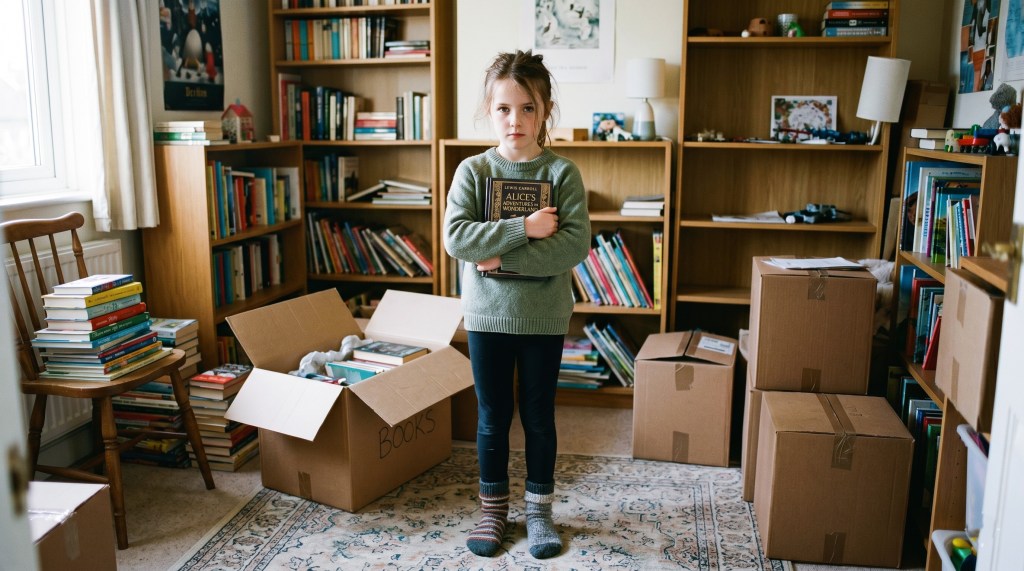
The box is brown and it smells of the garage and I have been standing in front of my shelves for four minutes already, which I know because I counted.
Mum says we have to be ruthless. That was her word. Ruthless. She used it in the same voice she uses for words like budget and compromise and we’ll see, which are all words that mean something is not going to go the way I want it to. She stood in my doorway with her clipboard – she has had a clipboard since we found out we were moving and I think the clipboard is making things worse – and she said, “Clara, some of those books are going to have to go to the charity shop, and I need you to be ruthless about it.” Then she left before I could argue, which was itself quite ruthless, so at least she’s consistent.
I am not ruthless. I am eight and three quarters and I love every single book on these shelves, including the ones I haven’t read yet and the ones I didn’t entirely understand and even the ones that were presents from Auntie Patricia, who has never once got it right. Being ruthless about books is like being ruthless about people. You can’t just put a person in a box because you’re running out of room. That is not how caring works.
But then again.
I look at the shelves properly, the way I look at things when I’m trying to be fair, which is with my eyes slightly squinted and my arms folded. Top shelf: the tall ones, mostly. Second shelf: the ones I reach for without looking, which means I know exactly where they all are in the dark. Third shelf: the messy shelf, where things got put back in a hurry or sideways or, in one case, upside down, which still bothers me. Fourth shelf, near the bottom: the ones I’ve outgrown but haven’t admitted it yet.
I start at the top and I go along slowly, saying each title to myself like I’m calling the register. The Secret Garden. Treasure Island. The Wind in the Willows. Ballet Shoes. The Jungle Book. Swallows and Amazons. Some of these I say the way you say a best friend’s name when you’ve spotted them across a playground. Some of them I say the way you say the name of someone you sat next to in Reception who moved away and you can’t quite remember properly anymore. It is not their fault. But it is still true.
Here is the rule I have decided on, because Mum said ruthless but didn’t say what that actually meant in practice, which was an oversight on her part. The rule is this: a book earns its place in the new house if I have read it more than twice, or if it made me cry at least once, or if I thought about it on a completely different day from the day I was reading it. That last one is the most important, actually. Lots of books are good while you’re inside them. The real ones follow you out.
I am on the third shelf, the messy one, moving things around and quietly rearranging as I go because I cannot help it, when my hand finds Alice’s Adventures in Wonderland.
I know it immediately by the spine. It is one of those books that has a serious spine – gold letters, dark background, the kind of spine that says I am a Classic in a very loud whisper. The cover, when I pull it out, is the same. It looks important. It looks like the sort of book that lives on a shelf so that people who come to visit can see it and think, oh, what a well-read family, without anyone actually having to do any reading. I have two theories about why books like this exist and neither of the theories is very kind to the books.
I do not put it straight in the box. I want to be clear about that.
I am not the sort of person who makes snap decisions. I once spent eleven days deciding whether I preferred blue or green as my favourite colour before concluding that the question was too simple to have a good answer. I think things through. I consider the evidence. I give everything a fair hearing, even things that I have already privately decided about, because that is what being a fair person means.
So I tuck Alice under my arm, and I tell it that it’s getting a trial.
I think that is very decent of me, all things considered.
Part Two: “Everyone Says It’s Wonderful. Everyone Is Wrong.”
I have read this book once. I read it when I was six, which I now understand was my first mistake.
I remember sitting with it in the corner of the sofa, the good corner, the one with the best light and the cushion that hasn’t gone flat yet, and I remember thinking, all the way through, that I must be about to get to the bit where it became brilliant. Everyone had said it was brilliant. Mrs Connor had said it was brilliant. The back cover said it was brilliant, which I know doesn’t count, because the back cover is basically the book showing off about itself, but still. I kept reading and I kept waiting and then I finished it and I sat there for a moment and I thought: was that it?
I was six. I decided I had probably missed something. I was willing to accept that.
I am now eight and three quarters, and I have thought about it on and off ever since, the way you’d press a bruise to check if it still hurts, and I have concluded, after careful and extended consideration, that I did not miss anything at all. The book missed something. The book missed quite a lot, actually.
I flip through it now, standing here with the garage-smell box at my feet, and I try to be scientific about it. I try to give it every chance.
Here is the problem with Alice’s Adventures in Wonderland, and I want to be precise, because I think this matters: nothing in it means anything.
I don’t mean it doesn’t make sense. I’m not saying that. I know it’s supposed to be nonsense. I know that’s the whole point, because adults have told me so extremely many times, usually in a tone that suggests I should find this more exciting than I do. What I mean is: things happen, and then other things happen, and then other things happen after that, and at the end Alice goes home, and nobody has learned anything or become braver or sadder or understood something new about themselves or the world. She just had a very strange dream and then woke up. That’s it. That is the whole book.
A proper story changes someone. Even a little. Even just a crack, like a window opened in a stuffy room. You can feel it when it happens – something shifts, and the person who finishes the last page is not quite the same as the person who started the first one. That is what books are for. This one just spins around making a lot of noise and then stops, and everyone stands there going, “Marvellous! How marvellous!” and I think they’ve confused marvellous with bewildering, which are not at all the same thing.
I stop at the page with the Cheshire Cat.
All right. I will say this: the Cheshire Cat has an extremely good face. If this book were only the Cheshire Cat’s face, slowly appearing and disappearing and appearing again in the tree, I would probably keep it. The face alone is worth something. I have thought about that face on different days, which by my own rules means something, and I’m not going to pretend otherwise just to make my argument neater. I am not that sort of person.
But the things it actually says.
It says things in the voice of something very wise, in the tone of something that knows a great secret and is deciding whether to share it, and then what comes out is – nothing. Or something that sounds like nothing wearing a clever hat. “We’re all mad here.” All right, thank you, that’s very atmospheric, but what am I supposed to do with that? It doesn’t help Alice. It doesn’t change anything. It just hangs in the air looking pleased with itself, which I recognise as a bad habit because I have been told I sometimes do this too, and I am at least trying to improve.
I think I know why adults love this book so much, and I have been thinking about whether to say it because it is quite a blunt thing to think, but I have decided to think it anyway since there is no one here but me and the box.
Adults love this book because it makes them feel clever when they talk about it. That is not the same thing as the book being good. There is a whole category of things that make people feel clever when they discuss them, and it includes this book and also certain films that are mostly just grey and quiet, and modern art that is a plain green square, and I’m sure they’re all very meaningful but I think sometimes “meaningful” is another word like ruthless and we’ll see – it sounds like it means something definite and it actually means whatever the person saying it needs it to mean.
The book gets the box.
I put it in carefully. Face-up, not face-down. I’m not punishing it – it is not the book’s fault that people have been going on about it for over a hundred years in a way that set completely the wrong expectations. It probably would have been perfectly fine if everyone had just been more honest about what it actually is, which is strange and imaginative and sometimes funny and also, if I’m being ruthless about it, a bit of a muddle dressed in good clothes.
I let go of it.
And then I stand there for a second, just one second, and I think about the beginning. The very beginning, before Wonderland, when Alice is sitting by the riverbank and she sees the White Rabbit and she follows it and then she falls.
The falling is good. I’ll give it that. The falling down the long dark tunnel with the shelves of marmalade and the pictures on the walls and not knowing how far down goes – that bit I have thought about on a different day. More than one different day, actually. There’s something in that falling that feels true, in the way that the best bits of books feel true even when they’re impossible, and I noticed it when I was six and I still notice it now.
I do not take the book back out of the box.
The falling is good. The rest of it is not good enough. The verdict stands.
I am, I think, an extremely fair judge.
Part Three: “These Ones Are Coming With Me, No Argument”
Right.
I pull Matilda off the second shelf and I hold it up in front of me, not because there is any question about whether it’s coming, because there isn’t, because obviously it is, because it would come with me if we were moving to a submarine, because it would come with me if we were moving to the moon. I hold it up because I want to look at it. There is a difference.
I look at it for a moment and I feel the thing I always feel, which is a sort of warm solidness in my chest, like when you come inside from a cold garden and stand near the radiator and the heat finds you gradually. That is what Matilda feels like. It feels like being found.
Miss Trunchbull, I want to say – and I have said this before, to my friend Polly, who agreed, and to my dad, who said “she’s certainly something” in a careful voice that meant he was thinking about someone at work – Miss Trunchbull is the best villain in the history of all books. And I have read a considerable number of books, so I want that to carry the appropriate weight. She is not best because she is the most evil, or the most powerful, or the most dramatic, although she is all of those things. She is best because she is believable. Every horrible thing she does is horrible in a way that you can picture, in a way that has a face and a smell and a sound, in a way that makes you go cold and then furious in exactly that order. She is not a monster who lives in a castle. She is a monster who lives in a school, and that is so much worse, and Roald Dahl knew that, and I think knowing that is a sign of a very serious mind.
But actually – and this is the bit I find harder to say out loud, for reasons I haven’t entirely worked out – it isn’t even Miss Trunchbull who matters most.
It’s Matilda herself, before any of the telekinesis, before she can move things with her eyes, back when she is just a small girl in a house full of people who cannot see her properly. She goes to the library. She reads every book in it. She teaches herself things because nobody else is going to bother, and she does all of this without any magic whatsoever, and that is, I think, already a superpower, and I think Roald Dahl thought so too, and I think that is why he gave her the other kind as well: because some people deserve two.
I cannot fully explain why this matters to me. I have tried. The explanation keeps coming out sideways. But it does matter, in the way that some things matter without requiring a reason, the way breathing matters, the way the second shelf matters. I put Matilda carefully on the floor beside me, which is the keep-pile, and I leave my hand on it for just a moment longer than necessary.
The Borrowers doesn’t even get a proper inspection. It goes straight to the keep-pile with a single decisive movement, because some decisions have already been made and going through the motions of deciding would be dishonest. Pod and Homily and Arrietty are realer to me than a large number of real people I have met, which I know sounds like a strange thing to say and I stand by it completely. Arrietty borrowed a cotton reel and used it as a seat and I have thought about that cotton reel on so many different days that I have lost count entirely. Also – and I’m not embarrassed about this – I have checked behind the skirting boards in my current bedroom on at least four separate occasions, very quietly, with a torch, when everyone else was asleep. I found dust and one dead spider and what I believe was a very old raisin. I do not regret any of it.
If there are Borrowers in this house, I hope they find better tenants.
I hope there are Borrowers in the new house.
I pick up A Little Princess and I don’t move for quite a long time.
This one is harder to talk about. Not because I love it less – I don’t love it less, I might love it most, it is difficult to compare things you love when you love them for different reasons – but because what it does is more complicated and I want to get the words right.
Sara Crewe loses everything. That is what the book is about, underneath the attic and the magic and the Indian gentleman next door. She loses her father and her money and her warmth and her status and the basic ordinary dignity of being treated like a person, and she is a child when this happens, and none of it is her fault, and it doesn’t stop happening for a very long time. And she doesn’t pretend it’s fine. I want to be clear about that, because I have read reviews – I read reviews, yes, I am eight and three quarters, I read reviews online when Mum isn’t watching – and some of them say Sara is too perfect, too good, too stoic, and I think those reviews have missed the point so completely that they’ve gone around the other side of it.
Sara isn’t pretending it doesn’t hurt. She isn’t floating above it all on a cloud of niceness. She is in the cold attic, with chilblains, genuinely hungry, genuinely alone, and the choice she makes – every single day, which is the bit that gets me, that it is a choice she has to keep making over and over – is to behave as though she is still herself. As though the worst circumstances don’t get to decide who she is. She calls it being a princess, which I used to think was about dresses and bloodlines, and now I understand it is about something completely different, and I don’t have a better word for it than she does, so I use hers.
I have been practising. The behaving-as-though-you’re-still-yourself when things are difficult. I am not very good at it yet. I cried for quite a long time when I found out we were moving, not in front of anyone, in the bathroom, with the tap running, which I think Sara Crewe would understand even if she wouldn’t have done it herself. But I am practising, and I have this book, and that counts for something.
I add it to the keep-pile with both hands.
Then I stand up straight and I look at the floor.
The keep-pile is large. I’m not going to pretend otherwise. It is, objectively, quite significantly larger than was probably intended when Mum said ruthless, and if she comes in and counts them there may be a conversation about it that I would rather not have. The keep-pile has Matilda and The Borrowers and A Little Princess and also, I can see from here, The Secret Garden and Ballet Shoes and Charlotte’s Web and several others that I dealt with before Alice and didn’t mention because the verdicts were swift and required no deliberation.
The donation-pile has Alice.
It has Alice and a book about horses that I got for a birthday and couldn’t get on with, and a joke book from Christmas that somehow ended up on the shelf, and a pop-up book that I have technically outgrown, though the pop-up mechanism on page seven is still very impressive.
I look at Alice, face-up in the box, gold letters catching the light.
It’ll be all right. That’s what I think, standing here. Someone will find it in the charity shop and take it home and love it in a way I couldn’t, and they’ll feel clever discussing it, and that’s fine. There’s a reader for every book, probably. I genuinely bear it no ill will. I just know, with the same certainty I know which cushion is the good one and which shelf is the important one, that it is not my book. And there is a difference between a book being good and a book being yours, and I think learning that difference might be one of the more useful things I’ve done at eight and three quarters.
I pick up the box.
The donations are settled. The keeps are decided. The rule was applied consistently and without favouritism, and while the keep-pile is larger than anticipated, I would argue that is a reflection of the exceptional quality of the books involved rather than any failure of ruthlessness on my part, and if asked I am prepared to make that case at considerable length.
The trial was fair.
The verdicts are correct.
I have been, I think, extremely reasonable about the whole thing. Mum’s clipboard is going to disagree with me, but that is, honestly, a problem for later.
Bob Lynn | © 2026 Vox Meditantis. All rights reserved.


Leave a comment