Holt

Holt

What’s the most annoying trope in books or movies?

“Five dollars. One loop. One dead friend from Winnipeg.”

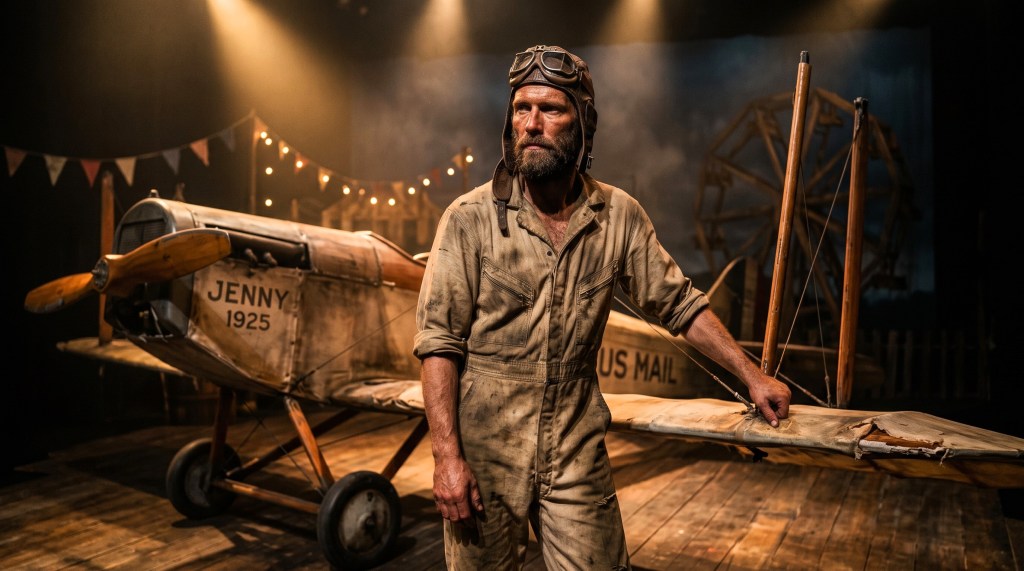
Georgia, September 1925. A bearded, foul-mouthed barnstorming pilot stands beside his patched Curtiss Jenny at a county fair, hawking five-dollar rides to strangers and picking fights with every moving picture he has ever endured. But when a question about the most insufferable trope in storytelling takes hold, the sales pitch becomes something else entirely – a quarrel with the dead, with the living, and with every tale that insists a man can walk through fire unchanged.

Funny, furious, and quietly devastating. The sky, it turns out, has no plot. Neither does grief.

Read the original post.

Bob Lynn | © 2026 Vox Meditantis. All rights reserved.

3 responses to “Holt”

  1. Steven S. Wallace avatar
    Steven S. Wallace

    I think this is about a barn stormer who, a trope himself, has little patience for thrill seeking behaviors himself. He is parading around to carnivals and fairs taking those who will give him five dollars on thrill rides. But he has been a pilot in the War and has observed friends of his be shot down. He has seen the planes crash unlike the viewers of movies who are spared the images of the crash.

    I rather like films about the silent soldier or gunman who perseveres with a stiff upper lip. In the end the good avenge the losses of their colleagues and go onto to their next moment with nary a scratch.

    This is contrary to the realities of trauma and heroes rare as they are seldom not affected. This pilot has experienced the most significant years of his life in the war and is now twiddling his thumbs flying stunts for carnivals. He is producing as a commodity for mass consumption a sanitized version of his life in the war. What a hard thing it is to enlist, be trained and then face death. It almost makes a post-war life rather silly.

    👏🏻👏🏻👏🏻

    SSW

    Liked by 1 person

    1. Bob Lynn avatar

      Right.

      I’ll take the points in the order they arrive, because I’ve found that if I let them pile up I end up addressing the wrong one, and I’ve had enough of addressing the wrong one.

      “A trope himself.” I’ll grant you the observation. I’ve stood beside this machine in forty-odd fields and I know very well what I look like from the rope perimeter. The bearded fellow with the patched biplane. The scar. The limp I don’t discuss. I am aware that if a writer with a deadline and a square jaw in mind walked past this field, I’d go into his notebook before I’d gone twenty yards. I don’t dispute the shape of it. What I dispute is that being shaped like a thing makes you the thing. A Jenny is shaped like a Jenny. That doesn’t make her less cantankerous, or less likely to throw a wire in the outboard bay if you’ve been careless with the turnbuckle. I am the particular instance. The trope is the generality. I’ll not be filed under the generality, not by a picture serial, not by a pulp magazine, and not, with respect, by you.

      “Twiddling his thumbs.” I’d like you to come out here on a Tuesday in this heat and watch me re-stitch a rib on the lower surface where the dope has cracked and the fabric has begun to give. Three hours with a palm needle and waxed thread, working flat on my back under the wing with the sun cooking the doped surface an inch from my face. Or watch me adjust the wire tension in the outboard bay with a tension gauge I made from a spring scale and a piece of fence wire in Meridian because the proper tool costs nine dollars I do not have. Or watch me run the OX-5 at full throttle on the ground for twenty minutes before I’ll take a passenger up, listening for a knock that means a bearing is going, because if I miss it the bearing goes at three thousand feet and the engine stops and gravity does not negotiate. I am not twiddling. I am keeping a machine alive with my hands and my attention, and I am doing it in fields that smell of livestock and funnel cake, and I am doing it for five dollars a ride because that is what the ride costs and that is what I need for fuel and thread and the next town. You may find this silly. I find it necessary, and I find the distinction matters.

      Now. The matter of the stiff upper lip. You say you rather like those pictures. The silent soldier who perseveres, who avenges his colleagues, who walks into the next moment with nary a scratch. And then you say, in the very same breath, that this is contrary to the realities of trauma. You know it’s a lie. You’ve said so. And you like it anyway.

      I want to understand that. I do. I’m not being sarcastic, or not only being sarcastic. I think there’s something in it I haven’t got the measure of. A man sits in a dark picture palace after a week of work that has ground him down, and he wants to see a fellow walk through fire and come out clean, because if the fellow can do it, perhaps the week can be survived, perhaps the grinding has an end that looks like something other than more grinding. I understand the want. I’ve felt the want. I sat through forty-three of those aerial serials and I went back for the forty-fourth, and I knew I was going, and I went. So I’ll not stand here and tell you the want is shameful.

      But I’ll tell you it costs something. Every time you watch the clean walk-through and feel better for it, you are agreeing, quietly, that the man who doesn’t walk through clean is failing at the assignment. You are agreeing that the furniture moving is a personal shortcoming rather than the natural consequence of the room having been hit. You don’t mean to agree to that. Nobody means to. But the agreement is in the watching, and it gets into the bones, and then you meet a man who can’t eat breakfast without a fight, and you look at him differently than you would if you hadn’t made that agreement in the dark.

      A new thing. Since you’ve raised McAllister’s name in your comment, I’ll give you something I didn’t give on the day. Three weeks after he went in, I was at a field outside Montgomery, and a woman came up to the rope with a boy of about nine, and she wanted the boy to go up. Five dollars. She paid. I took the boy up, one circuit, no loop, and when we came down the boy was white and shaking and his mother said, “Wasn’t that wonderful?” and the boy said nothing. Just stood there looking at the Jenny. And then he said, very quietly, “It’s louder than I thought it would be.” And I said, “Yes.” And he nodded, and they walked back toward the Ferris wheel.

      I thought about that for two days. “It’s louder than I thought it would be.” Nobody writes that. Nobody writes the boy standing there, not crying, not performing it, just standing with the sound of it still in him, louder than he’d been told. The story would have him laughing, or screaming for joy, or saying something the writer can put on a poster. The story would not have him standing there, quiet, holding the sound.

      You say I’m producing a sanitised version of my life in the war as a commodity for mass consumption. I need to understand what you mean by that, because from where I’m standing I am not producing anything. I am not performing the war. I am not narrating it. I am not selling it. I am flying a machine in circles over cotton fields, and the people who come up get four thousand feet and a view and the sound of an OX-5 at full throttle, and they come down and they pay me and they go to the livestock judging. The war is not in the transaction. The war is in me, and I carry it, and I do not put it in the Jenny’s cockpit and charge admission. If you see a sanitised version, it is because you are looking for the version you’ve been taught to look for, and you’re finding the shape of it in a man standing beside a biplane, and you’re filling in the rest from the serials. I am not the serial. I am the man who has to eat breakfast.

      And the last thing. “It almost makes a post-war life rather silly.”

      I’ll not pretend that line didn’t land. I’ll not pretend I haven’t stood beside this machine at dusk in some field in Alabama or Mississippi and thought something very close to it. That the war was the thing, and everything after is the long walk back to the car park. That the years of stitching fabric and arguing with fairground committees and reading God-awful magazines in boarding houses are the silliness that comes after the significance.

      But I’ll push back. I’ll push back because McAllister is not here to push back, and someone should.

      The post-war life is not silly. It is the part nobody writes because nothing dramatic is happening in it, and I have made that argument before, and I’ll make it again: the man eating breakfast is alive, and alive is not a lesser condition than the man in the trench. The boy saying “it’s louder than I thought” is not silly. The woman paying five dollars so her boy can see the treetops from above is not silly. The stitching of the rib, the listening to the engine, the two taps on the strut that I do not explain and will not explain – these are not the silliness after the significance. They are the significance. They are the thing that comes after the thing, and they are what the thing was for.

      The sky has no plot. I said that on the day and I’ll say it again. It does not know how you’d like things to end. But it is not silly, up there. It is four thousand feet of air that will kill you if you are careless and that will hold you if you are not, and that is enough. That has been enough for four years, and it will be enough for four more, God willing and the strut wires holding.

      You are welcome to come out to a field. Five dollars. I’ll take you up. You can tell me from four thousand feet whether it looks silly from there.

      Holt.

      Liked by 1 person

      1. Steven S. Wallace avatar
        Steven S. Wallace

        A complicated and shadowy post. Much appreciated!

        SSW

        Liked by 1 person

Leave a Reply