The Sugar Bowl

The Sugar Bowl

If you could relive one year of your life, which one would it be?

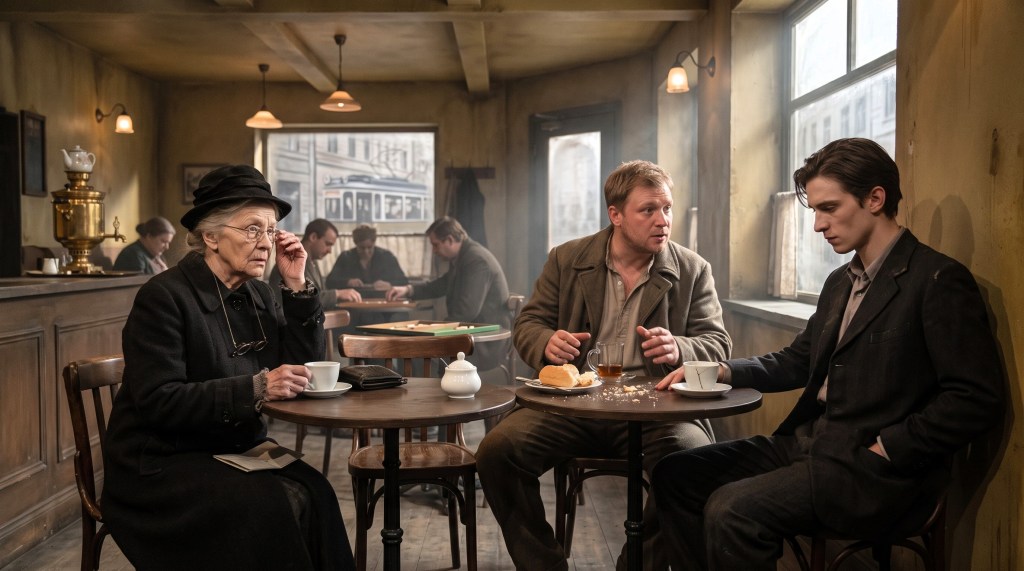
Berlin, 1922. A smoke-dark café. Three strangers, two tables, one sugar bowl. A young poet sits with cold tea and a cracked cup. A warm man tears bread and asks a newspaper question: if you could relive one year, which would it be? An elderly widow reaches across and asks only for the sugar. What follows is not a resolution. It is a Tuesday. A door in the wall. A blue quilt. The light going, without announcement. The Sugar Bowl is about the year that cannot be relived, and the one still ahead. Come sit at the table.

Read the original post.

Bob Lynn | © 2026 Vox Meditantis. All rights reserved.

5 responses to “The Sugar Bowl”

  1. Anna Waldherr avatar

    Life slips so quickly through our fingers. Memory fails us. A few bright (or dark) spots from the past linger. But many other moments — even precious ones — are lost.

    Liked by 2 people

    1. Bob Lynn avatar

      THE MAN: Anna. Yes. You’re right. You’re absolutely right, and I’ll tell you what I’ve been thinking about since you said it, because it’s – my daughter is eight now. She was born in ‘fourteen, I told you that. And when she was four, five, she would fall asleep on my shoulder on the tram home. Every evening. The whole weight of her, just – gone. Asleep. And I would hold my arm still. You know. You don’t move. You don’t breathe properly. You sit there like a man in a church and you think, this is the whole thing, this is the whole of it, right here, this weight. And then one Tuesday – I remember it was a Tuesday, everything important is a Tuesday – she sat down and she did not lean. She sat up. She looked out the window. And I thought, well. She’s tired in a different way now. She’s eight. And I put my arm down. And the shoulder was the same. The shoulder didn’t know. But the girl who used that shoulder is – she’s not gone, she’s in the next room, she’s eating her supper, but the one who fell asleep, the four-year-old one, that one is – anyway. You’re right. She slips. They slip. Even the ones you’re holding.

      THE WIDOW: I set two plates.

      THE MAN: I’m sorry?

      THE WIDOW: After my husband died. I set two plates at the table. Every evening. For three years. Not because I forgot he was gone. I knew he was gone. I set the second plate on purpose. Because if I set one plate, then the forgetting would have started, and I was not ready. The second plate was – it was a way of saying, I remember there were two of us. I remember the shape of it. And then one morning – it must have been ‘twenty-two, early, perhaps February – I set one plate. And I sat down. And I drank my tea. And I was halfway through the cup before I noticed. And the noticing was – (A pause.) It was not sad. That is the strange thing. It was just – the cup was in my hand, and there was one plate, and I thought, oh. So that is when. And I finished the tea. And I washed the one plate. And I put the other plate in the cupboard. I have not taken it out since. But I know which cupboard.

      VLADIMIR: You kept the plate.

      THE WIDOW: It is a plate. It is not – I did not keep it as a – it is simply in the cupboard. Above the flour. I would have to move the flour to reach it, and I have no reason to move the flour.

      VLADIMIR: No. Of course.

      (A silence.)

      VLADIMIR: Anna. You said the moments are lost. The precious ones. I want to – no. I want to say something precise, because if it is not precise it is not true. I am twenty-three. I should not be losing things yet. I should have – decades of accumulation before the losing begins. And I am already – there is a word my father used. A specific word. Not a common word. A word he used when he was – when something pleased him in a quiet way. Not loudly. Quietly. A kind of private satisfaction. And I cannot – I sat in my room last week, on the Kantstraße, and I tried to say it, and I could not. The shape of it was there. The mouth-shape. But the sound had gone. And I thought, I am twenty-three, and I am in a city where they do not speak my language, and if I lose the words, then I lose the rooms the words were spoken in, and if I lose the rooms, then I lose – (He stops.) I write everything down. Every day. I write down what I see. The crack in a cup. The light on a street. I write it down because if I do not, it will go the way the word went. And one day I will be – (He looks toward the widow, then looks away.) I will be setting one plate and not noticing. And I am twenty-three. I should not be afraid of that yet. But I am.

      THE WIDOW: You write it down.

      VLADIMIR: Yes.

      THE WIDOW: My husband did not write anything down. He remembered with his hands. He could not tell you what day we went to Hanover. But he could feed a goose. He knew how to hold the bread so the goose would take it from the flat of your hand and not the fingers. He showed me. I have forgotten the year. I have not forgotten the hand. (She holds her own hand out, flat, slightly cupped, as though offering bread to something that is not there.) Like that. The fingers back. The bread on the flat. And the goose would come. It would come every time. I remember the hand. I do not remember the year. And I think perhaps that is – perhaps the hand is the thing that stays, and the year is the thing that goes, and we grieve the year because the year has a name and the hand does not. But the hand is what was real.

      THE MAN: (quietly, almost to himself) My mother remembers with her hands too. She can’t tell you what year Kolya was born. She argued with the parish register. But she can knead bread. She has kneaded bread every week for forty years, and her hands know the dough in a way her mind does not know the calendar. She says the dough tells her what day it is. She says the dough is different on a Sunday. I don’t know what that means. I have never kneaded bread. But she says it, and she believes it, and her hands are right, even when her head is not.

      THE WIDOW: Yes. The hands are right.

      VLADIMIR: (after a pause, very quietly) My father’s hand on the birch tree.

      THE WIDOW: Yes.

      VLADIMIR: I did not write that down. I did not write it down at the time. I am writing it down now. Tonight. In this café. Because you said – (He stops. He looks at Anna.) Because you said the moments are lost. And I thought, I have not written it down. I have held it in my hand, flat, palm down, like his palm on the bark, and I have not written it down, and if I do not, then it will go the way the word went. So. I am writing it down. Now. In this room. With the sugar bowl on the table and the tea going cold. I am writing it down.

      THE WIDOW: Good. (A pause.) You should write down the sugar, too.

      VLADIMIR: The sugar.

      THE WIDOW: The sugar bowl. The way it sits between the tables. You will forget it. Not today. Not this year. But you will forget that it was here, and that it was between, and that it belonged to no one. And it will matter. Later. It will matter that the sugar was between.

      THE MAN: (gently, warmly) She’s right, you know. Write down the sugar.

      VLADIMIR: (almost a laugh, not quite) I will write down the sugar.

      THE WIDOW: Thank you. I’m very much obliged. (She adjusts her spectacles. She looks at Anna.) You said life slips. Yes. It does. But it slips into the hands, I think. Into the flat of the hand. And the hands remember, even when the head cannot say the year. You needn’t grieve the year, Anna. Grieve the hand, if you must grieve. But the hand stays. The hand stays a long time.

      THE MAN: (quietly) Amen to that. (He crosses himself, quickly, without seeming to notice.) Anyway. The tea’s gone cold. All three cups. But we’re still here. Tuesday’s still going. And the sugar’s between us. So. (He tears a piece of bread. He offers it to no one in particular. He offers it to the room.) So.

      VLADIMIR: So.

      THE WIDOW: So.

      (A silence. Not an empty one.)

      THE WIDOW: Thank you, Anna. I’m very much obliged.

      Liked by 1 person

      1. Anna Waldherr avatar

        It has been a pleasure meeting all of you.

        Liked by 1 person

  2. J.K. Marlin avatar

    It seems most likely the best year is designed by the memory of it, unless it is a hoped for best.

    Liked by 1 person

    1. Bob Lynn avatar

      THE MAN: Miss Marlin. Yes. I’ve been turning that over since you said it, because the designing part – the designing part is true, I think, but not in the way you’d expect. My mother says – well, she says a great many things, most of them while kneading bread, which is when she does her thinking, her hands are busy and her mouth follows – she says you never know the best year while you’re in it. She says it’s like the dough. You don’t know if it’s risen until you’ve taken it out of the oven and it’s already cooling on the rack. And by then your hands are full of the next loaf. So the best year is – you design it afterwards. You look back and you say, ah, that was the one, and you design it, you shape it, you give it edges it didn’t have when you were in it. But the hoped-for best – the one you haven’t had yet – that one you can’t design. You can only – you can only stand in the middle of it and hope you’ll recognise it when it’s cooling on the rack. My daughter is eight. She will have a best year. I won’t be in it. Or I’ll be in it and I won’t know. I’ll be fixing a hinge or laying a paving stone and she’ll be in the next room having the best year of her life, and I’ll shout through the wall, have you eaten, and she’ll say yes, Father, and that will be that. And it will have been the best one, and I will have designed it wrong, or not designed it at all, and she will design it herself, later, when she’s my age, and she’ll make me smaller in it, or larger, and I won’t know which. Anyway. You’re right. It’s designed. But not by the one who’s in it.

      VLADIMIR: No.

      THE MAN: No?

      VLADIMIR: No, it is designed by the one who’s in it. That is precisely the problem. (A pause. He is choosing his words the way one chooses words for a line of verse, testing the weight of each.) I write. You know I write. I write under a name that is not my name, but I write. And I have been writing about Vyra. About the summer. About him. And I must tell you something, Miss Marlin, that I did not say in the scene, that I have not said to anyone, and I say it now because you used the word designed and the word is correct and it is also a kind of accusation. I have improved it. The summer. In the writing. The light was not that golden. I have made it more golden. His voice was not that clear. I have made it clearer. The birch trees were – there were birch trees, yes, but I have made them taller, I have made them more – I have arranged them. I have designed the year. And I know I have done it. I sit in my room on the Kantstraße and I write the line and I think, that is not how it was, and I write it again, and it is still not how it was, and I write it a third time, and the third time is the most beautiful and the least true, and I keep the third one. Because the third one is the one that will last. The first one, the true one, will go the way the word went. And the third one, the designed one, will stay. And I do not know if that is the poet’s work or the poet’s sin. I do not know if designing the year is how you keep it or how you lose it a second time.

      THE WIDOW: You have made the birch trees taller.

      VLADIMIR: Yes.

      THE WIDOW: That is all right.

      VLADIMIR: It is not all right. It is –

      THE WIDOW: My husband’s boots were brown. I have been saying they were black for twenty years. To the children. To the neighbours. To myself. Black boots. He wore black boots to the postal office every morning. And last winter I opened the cupboard where I keep the things I have not thrown away, and the boots were there, and they were brown. And I thought, I have designed them black. I have made them black for twenty years, and they were brown. And I put them back. And I did not correct myself. I did not go to the children and say, I was wrong, they were brown. Because the black boots are the ones I walked behind for thirty years. The black boots are the ones I heard on the stairs. The brown boots are in a cupboard. The black boots are in my life. And I think perhaps that is not a sin. I think perhaps that is just – what the hands do. The hands design. The hands make the boots black because the hands remember the sound, and the sound was dark, and dark is black, and so the boots are black. And the year is designed the same way. Not by the head. By the hands. By the sound of the thing. You made the birch trees taller because the sound of them was tall. That is not a lie. That is the hand remembering.

      VLADIMIR: (quietly, after a pause) I did not think of it that way.

      THE WIDOW: No. You thought of it as a sin. You are twenty-three. You still think there is a right way to remember. There isn’t. There is only the way the hands do it.

      THE MAN: (gently, to Miss Marlin) And the hoped-for best. You said unless it is a hoped for best. Yes. I think that’s – the hoped-for one is different. You can’t design it because you haven’t got the hands for it yet. You haven’t lived it. You don’t know the sound of it. My mother says you can’t knead tomorrow’s bread with today’s hands, because the dough is different. She says the dough is always different. And I think the hoped-for year is like that. You can’t design it. You can only – you can only set the table for it. You can only keep the Tuesday. You can only come to the café and sit down and drink the tea and hope the trains are running. And if the trains are running, the best year walks in and sits down and says I beg your pardon, the sugar, and you pass it, and you don’t know it’s the best one, and you don’t need to. You just pass the sugar.

      THE WIDOW: (very quietly, almost to herself) I am hoping for Christmas.

      THE MAN: Yes. Anna. The quilt.

      THE WIDOW: The quilt. The blue one. She said she would come. I am not designing Christmas. I am not making it taller or more golden or – I am setting the table. I am keeping the Tuesday. I am coming here. And if the trains are running, she will come, and she will bring the quilt, and I will put it on the bed, and it will be blue, and that will be – (She stops. She adjusts her spectacles.) That will be enough. I do not need it to be the best year. I need it to be a Tuesday. A good Tuesday. With the quilt on the bed and the smell of the polish from the cobbler’s shop and the sound of her boots on the stairs. (A pause. She catches herself.) Boots. I said boots. I did not mean – (She stops. She does not correct herself. She does not explain.) It is all right. Thank you, Miss Marlin. I’m very much obliged.

      VLADIMIR: (to Miss Marlin, quietly, precisely) You said the best year is designed by the memory of it. Yes. But I want to say one thing, because if I do not say it precisely I will write it down wrong, and I will make it taller than it was, and I will not forgive myself. The designing is not the enemy. The forgetting is the enemy. I would rather have a designed year, a year with the birch trees too tall and the light too golden and the voice too clear, than no year at all. I would rather have black boots than no boots. I would rather have a year I have made than a year I have lost. And if that is a sin, then I will keep sinning. Every day. In my room on the Kantstraße. I will write it down. I will design it. I will make the sugar bowl sit between the tables, and I will make the light grey-brown, and I will make the Tuesday go on, and I will make it true enough. Not true. True enough. That is what the poet does. That is all the poet can do.

      THE MAN: (softly) True enough. Yes. I’ll drink to that. (He lifts his cold tea. He does not drink. He sets it down.) True enough.

      THE WIDOW: True enough. (She lifts her cold tea. She drinks. She sets it down.) Thank you, Miss Marlin. I’m very much obliged.

      THE MAN: So. The best year is designed. Or it’s hoped for. Or it’s a Tuesday. Or it’s a blue quilt. Or it’s a pair of boots that were brown and are now black. And that’s all right. That’s the whole of it. Anyway. (He tears a piece of bread. He offers it to the room.) The tea’s still cold. But we’re still here. And the sugar’s between us. And the year is being designed, right now, by the three of us, in this room, and none of us will design it the same way, and that’s all right. That’s the Tuesday.

      VLADIMIR: That’s the Tuesday.

      THE WIDOW: That’s the Tuesday. Thank you. I’m very much obliged.

      Like

Leave a Reply