If the salary was the same, what job would you be doing right now and why?
The Thirtieth Day of August, 1573
The Walled Garden Behind the Free Grammar School, Saffron Walden, Essex
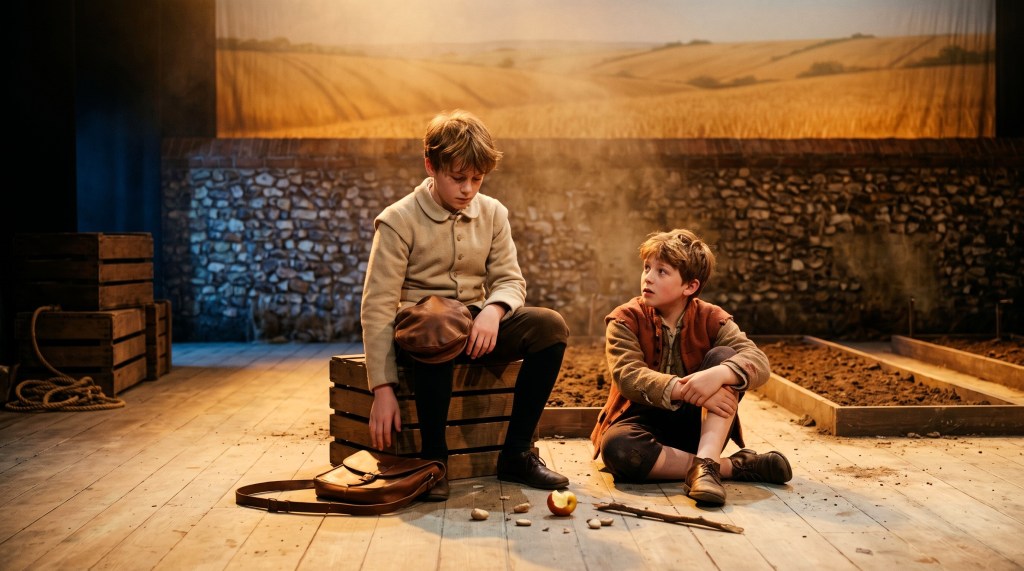
The walled garden. Late afternoon. Beyond the low flint wall at the garden’s northern edge, the stubble fields stretch away under the slanting light; the wheat harvest is in, the land raked bare, going gold. The air carries chalk and clay and the mineral cold of the wall’s shadow. Along the south wall, the saffron beds run in neat rows. Bare earth. The crocuses will not bloom until October. Nothing grows in them now.
In the corner where the north wall meets the east: stacked crates, a coil of old rope, weeds pushing through crumbling mortar between the flints. The corner lies in shadow.
From within the school, faintly, the schoolmaster’s voice: patient and remorseless. Amo, amas, amat. Amamus, amatis, amant.
THE SCHOOLBOY sits on an upturned crate near the centre of the garden. His satchel is at his feet. It has not been opened. His hand rests near the strap. He does not look at anything. He looks at the ground.
In the far corner, behind the stacked crates, barely visible in the shadow: THE OLD WOMAN. She stands with one hand on the flint wall. She breathes in, slowly. She breathes out. She turns her head a little to the left. She breathes in again. She does not know the garden is not the kitchen. She does not know it is August. Her lips may move. Nothing carries.
The gate opens. THE OTHER BOY enters.
THE OTHER BOY: (He is already talking before he is through the gate. He holds a half-eaten apple and gestures with it.) God’s nails, he’ll be at that till Advent. Amo, amas, amas, amas, and on to the Last Judgement. (He sees the schoolboy. He crosses to him and drops himself down onto the ground beside the crate, shoulder to shoulder.) Move your arse, Croft.
(The schoolboy moves. Barely. The other boy settles against the crate and bites the apple.)
THE OTHER BOY: You look like a kicked spaniel.
THE SCHOOLBOY: I am well enough.
THE OTHER BOY: Your Latin?
THE SCHOOLBOY: (pause) No.
(The other boy picks up a pebble. Turns it. He looks at the schoolboy sideways and does not press the point.)
THE OTHER BOY: Your father?
(A pause. The schoolboy’s hand moves to the satchel strap.)
THE SCHOOLBOY: He spoke to Master Letchworth. Yesterday.
THE OTHER BOY: (without surprise) The crocuses.
THE SCHOOLBOY: Aye.
THE OTHER BOY: Michaelmas.
THE SCHOOLBOY: (very quietly) He spoke to Master Letchworth.
THE OTHER BOY: Which means Michaelmas.
(Silence. The other boy throws the pebble at the wall and picks up another one.)
THE OTHER BOY: You’d sooner stay.
(The schoolboy says nothing. His hand tightens on the strap. Releases.)
THE OTHER BOY: (lightly) Cicero’s rubbish, but. Better than picking flowers.
THE SCHOOLBOY: They are not flowers. They are saffron.
THE OTHER BOY: Same thing.
THE SCHOOLBOY: They are not the same thing.
THE OTHER BOY: (grinning) Christ, you’re easy. (He knocks the schoolboy’s shoulder with his own, hard and warm.) Croft. What is it? What’s the face for?
THE SCHOOLBOY: (after a moment) I do not greatly want the crocuses.
THE OTHER BOY: I know that.
THE SCHOOLBOY: I do not greatly want Cicero.
THE OTHER BOY: Nobody wants Cicero.
THE SCHOOLBOY: (a long pause; eyes on the ground) I know what I would want. (He stops.)
(The other boy does not ask. He eats the apple. He waits. This is unusual for him: he fills what can be filled. But he waits.)
THE OTHER BOY: (mid-pebble, casual, as if the thought has just arrived) Say thy father. (He turns the pebble in his fingers.) Say he gave thee the same wages. Whatever the work. The same, (he tries the word carefully, the way one tries a step on uncertain ground) salary. Whether thou pickedst the crocus or didst altogether something else. (He glances at the schoolboy.) What wouldst thou do?
THE SCHOOLBOY: (not answering yet; turning the question over in his mind) Three weeks past. The man who lodged at the Crown. The natural philosopher. The one who came through the market.
THE OTHER BOY: The old fellow with two bags. Aye.
THE SCHOOLBOY: He had an instrument. Brass.
THE OTHER BOY: He pointed it at the church tower.
THE SCHOOLBOY: (nodding once, slowly) He took the altitude of the tower. The angle between the flat ground and the top of the spire. He moved the part that moves, (he pauses) the alidade, that is what it is called, the rod that moves, and when it was in the right place he read the number from the degrees marked in the brass. (pause) And then he wrote it. (longer pause) The tower. Became a number.
THE OTHER BOY: (immediately, before the schoolboy has quite finished) I’d go to London.
THE SCHOOLBOY: (still in his own thought, not quite hearing the interruption) There was a part at the back of it. All brass, cut through in shapes. Stars. Curves. Very exact.
THE OTHER BOY: (eating the apple) Aye, I remember it. The bit like a web.
THE SCHOOLBOY: The rete. (He says the word carefully. It is a word he has carried alone for three weeks.) That is its name. The rete. And the whole thing turns on a pin. And when he turned it, in the sun, the – (He stops.)
THE OTHER BOY: The what?
THE SCHOOLBOY: (very quietly) The light. The light moved with it. All across the brass. (pause) Three weeks. I cannot stop seeing it.
(The other boy has stopped eating. He is looking at the schoolboy. He has the pebble in his hand and is not throwing it.)
THE SCHOOLBOY: (more to himself than to the other boy) There is a man who cut each degree into that brass. Every line, exact. The degrees of the arc, each one set there. They did not arrive by themselves. A man put them there, who knew what each one meant. (He stops. His hand goes to the strap.)
THE OTHER BOY: (after a moment, finishing the thought practically) You want to make one.
THE SCHOOLBOY: (quietly) I want to know how.
THE OTHER BOY: (suddenly loud again, leaning back, full of himself) And I want London. Nash in London. (He says it as a plain fact, the way one states a destination already decided.) Carter’s son or no, there is always work for a quick boy in London and I am quick. Find a merchant, find a guild, start at the very bottom of anything that doesn’t smell of goats and go up from there. That is the whole of it.
THE SCHOOLBOY: (quietly; a small dry smile) It is not so simple as that.
THE OTHER BOY: (grinning, snapping a stick) It is exactly that simple. (He throws the pieces over the wall.) So. Go and find the man. The brass man. What’s stopping thee?
(The silence that follows is different. Not the easy silence of the early minutes, not the comfortable rhythm of the rally. It has weight. It has a shape to it. The schoolmaster’s voice within has gone quiet. The light above the wall has deepened.)
THE SCHOOLBOY: (quietly) My father has spoken to Master Letchworth.
THE OTHER BOY: Aye, I know that.
THE SCHOOLBOY: (pause) Well.
THE OTHER BOY: Tell him.
THE SCHOOLBOY: (very quietly) No.
THE OTHER BOY: Why not? Open your mouth and say, Father, I have seen a brass instrument and I would sooner learn to cut it than ever pick a crocus, and see what he says.
THE SCHOOLBOY: (gently, as if explaining something very plain to someone who has not seen it) Nash.
THE OTHER BOY: What?
THE SCHOOLBOY: My father has decided. (pause) His father grew the crocuses. His father’s father. The crofts, the trade, the – (he looks at the bare saffron beds along the south wall, then away) it is not a matter of telling him. It is the order of the thing. I did not make the order of the thing.
(The other boy looks at him. He wants to argue. But the schoolboy has not made an argument. He has described the world. There is nothing to argue against. The other boy sits. All briskness is gone from him for a moment.)
THE OTHER BOY: (quietly) Croft.
THE SCHOOLBOY: (barely above a breath) I know.
(Silence. The rhythm has stretched until the interval between beats is a gap. The afternoon has gone deep; the amber light leans across the stubble fields beyond the wall, the colour of old brass, the colour of a rete in the sun.)
(The orbit at its most elongated. Its most vulnerable.)
(From the far corner, behind the stacked crates, in the shadow: a sound. Barely a sound. The shape of a sound.)
THE OLD WOMAN: (not to anyone; not in the garden; in a kitchen that is not here) The bread.
(The other boy’s whole body startles, heel to crown, all at once. He is on his feet before he has decided to stand. He spins toward the corner.)
THE OTHER BOY: Christ! (He catches his breath.) There is an old woman behind the crates.
(The schoolboy has not moved from the crate. His head has turned, slowly, toward the sound. His hand has closed on the satchel strap. He watches.)
THE OTHER BOY: (moving around the crates, reaching her, speaking loudly and carefully) Goodwife. Are you well? Are you hurt?
(The old woman does not answer. She turns her head slowly to the left. Her hand is on the wall. She breathes in.)
THE OTHER BOY: (closer now, watching her trembling fingers on the flint) Goodwife. Are you lost? Do you know which street you live in? Your name?
(No answer. She breathes out. She takes a small step to the left, her hand trailing along the wall.)
THE OTHER BOY: (turning to the schoolboy, helpless and managerial at once) She is not answering. She just, she keeps touching the wall, I can take her to the gate, I can find someone who knows her house, (back to the old woman) Goodwife, if you will come with me, I will take you to the street and then,
(He reaches out and touches her elbow. She allows herself to be guided: two steps, three. Then she stops. Her hand finds the wall again. She breathes in.)
THE OLD WOMAN: (murmuring, to the wall, to somewhere behind it) Cold.
THE OTHER BOY: (to the schoolboy) She says she is cold.
THE SCHOOLBOY: (quietly) She is not cold.
THE OTHER BOY: She said cold. I heard her.
THE SCHOOLBOY: She said a word. (pause) It is not the same thing.
(The other boy stares at him. He turns back to the old woman. The schoolboy opens his mouth; he is going to say something about what she is doing, about what she is looking for. The other boy, mid-motion, not meaning to, speaks over him.)
THE OTHER BOY: (to the old woman) Goodwife, shall I fetch the schoolmaster? If you will give me your name, or your husband’s name, I can find someone who knows you, I can go and –
(The schoolboy’s mouth closes. He sits back. His hand returns to the satchel strap. He watches in silence. No one notices he was about to speak. No one notices he has stopped.)
(The old woman breathes in. She turns her head. She is not in the garden.)
THE OLD WOMAN: (murmuring, her head turning slowly) When the purple. (She breathes.) The purple comes.
THE OTHER BOY: (looking between them, opening his hands) What purple? Croft, what is she –
THE SCHOOLBOY: (quietly, not quite to the other boy) The crocus.
THE OTHER BOY: What?
THE SCHOOLBOY: (looking at the bare beds along the south wall) She is looking for the saffron.
(A pause. The other boy looks at the empty beds. At the bare earth. At the old woman’s hand moving on the flint.)
THE OTHER BOY: There is no saffron. (He says it plainly, correcting an error.) It is August still. The beds are bare earth. There will be nothing there until October.
(The old woman does not register this. Her hand moves slowly along the wall. She breathes in.)
THE SCHOOLBOY: (very quietly) I know that.
THE OTHER BOY: (his certainty beginning to loosen) So why is she –
THE SCHOOLBOY: (slowly, carefully) She is not looking for the saffron that is here. (pause) She is looking for the smell of it. Somewhere she had it once. A morning. A room. (pause) Somewhere it was. And it is not there any more. And she knows it is near and she is looking. (He does not finish. He does not finish because there is nothing left to say after that which would make it better.)
(The other boy looks at her. He lowers himself to the ground, knees drawn up. He does not pick up a pebble. He is still.)
THE OLD WOMAN: (murmuring, not in the garden) He turned it. (pause) The bright thing. He turned it and the whole, (her hand trembles on the wall) the whole.
(The schoolboy’s body goes rigid. He stares at her.)
THE OLD WOMAN: He had a cloth. After. He covered it with the cloth.
THE SCHOOLBOY: (leaning forward, barely above a breath) He covered the bright thing.
(The old woman’s hand stills on the wall.)
THE SCHOOLBOY: (barely, barely) The brass.
THE OTHER BOY: (from the ground, quietly, looking between them) Croft. What does she mean? What bright thing?
THE SCHOOLBOY: (one word, flat, without looking at him) Wait.
(The other boy’s mouth closes. His hands rest on his knees. He watches. He does not speak.)
THE OLD WOMAN: (after a long silence, to herself, tracing the mortar between the flints with one finger) And I said to him. (She breathes.) I said. (She stops. She breathes again.) The bread.
THE SCHOOLBOY: (softly, joining her sentence without meaning to, without asking) The bread was warm.
(The old woman’s head turns very slightly. Not toward the schoolboy. But slightly less away.)
THE OLD WOMAN: Warm. (A long breath.) He always. (She does not finish.)
(The schoolboy nods. He does not know why.)
THE OTHER BOY: (whispering, from the ground) What is she saying? She keeps saying the bread. She’s not, she’s – Croft –
THE SCHOOLBOY: (not looking at him, very quietly) She is talking to someone who is not here.
THE OTHER BOY: (looking around the garden) There is no one.
THE SCHOOLBOY: (quietly) No.
(The other boy looks at his own hands on his knees. He does not know what to do with this.)
THE OLD WOMAN: (moving a step, her hand finding the crate and then the wall again) Cold. (She breathes.) The morning was cold. (pause) But then the bread was. (She stops. She breathes in.) Where’s the bread gone.
(The other boy’s mouth opens. He does not speak.)
(The schoolboy looks at the old woman’s hand on the wall. He looks at the wall that cannot answer. He looks at the bare saffron beds, the amber light going across the top of the far wall, the colour of old brass, the colour of a rete when the sun moves on it, the colour of what is not there.)
THE SCHOOLBOY: (softly, to the old woman) When did you last smell it?
THE OLD WOMAN: (surfacing slowly, from somewhere deep) October. (pause) When the purple comes.
THE SCHOOLBOY: (quietly) Aye.
THE OLD WOMAN: (her hand moving on the wall) Is it. (She breathes.) Has it come?
THE SCHOOLBOY: (very gently) Not yet.
THE OLD WOMAN: (barely, the question a murmur) When does it come.
THE SCHOOLBOY: (quietly) October.
(A long silence. The old woman breathes. She makes a small downward motion with her head. She breathes in. She does not find it. She turns her head. She breathes in again. She keeps looking.)
THE OTHER BOY: (after a long while, very quietly) She has been looking for that her whole life. Hasn’t she.
THE SCHOOLBOY: (pause) Or for some part of it. For something that was there in a morning and then was not. (He looks at the old woman.) And she knows it is here somewhere.
THE OTHER BOY: (looking at her hand on the wall) Can’t she – (He stops. He already knows she cannot.)
THE SCHOOLBOY: (quietly) No.
(Silence. The other boy draws his knees up tighter.)
THE OTHER BOY: (slowly, reluctantly, the briskness entirely gone) My grandam knows where she is. What year it is. Who is on the throne. But she doesn’t know – (he pauses, choosing words with unusual care) she doesn’t know where some things have gone. Things that used to be there. (pause) She doesn’t say it. But I can see it.
THE SCHOOLBOY: (looking at him) Aye.
THE OTHER BOY: (looking away) Aye.
(The old woman has drifted to the far corner where the north wall meets the east. She touches the corner. She breathes in.)
THE OLD WOMAN: (to the corner, to the absent door) The door was there.
(They both look at the corner. There is no door. Flint. Mortar. Shadow.)
THE OLD WOMAN: There was a door.
THE SCHOOLBOY: (very quietly, to himself) Was there.
(The old woman’s hand moves over the corner where the door was not. She breathes. She does not find the door. She keeps looking.)
(The other boy and the schoolboy look at each other over the old woman’s bowed head. The exchange is brief. The other boy’s eyes: what do we do. The schoolboy’s eyes: I do not know. They hold this shared helplessness together for a moment, this not-knowing that is the same not-knowing, this being in a garden together and not being able to fix the same thing.)
(Then the old woman murmurs. Cold. Something about the morning. The schoolboy turns back to her. The other boy is alone in his looking. The alignment breaks.)
THE OLD WOMAN: (murmuring, in the kitchen that is gone) Cold. (a breath) But then the – (a breath) Warm.
(The other boy shifts his weight. He looks at the gate. He does not leave. He looks back at the old woman. He looks at the schoolboy, who is leaning toward the old woman and not looking at him. He places his hands flat on his thighs and does not move them.)
(The light goes. Not all at once. The way the August light goes: slowly, and then with a kind of deliberateness, as though it has somewhere else to be. The amber has deepened. The stubble beyond the wall is the colour of old brass, is the colour of a rete in the sun at the right angle, is the colour of something that was once bright and is now the colour of having been bright.)
(No one speaks. The silence is not the pointed silence of the early minutes, not the rhythm of the rally, not the stretched silence before the old woman made herself known. It is not the silence of being unheard, or of standing where the space you fill is not needed. It is the silence of three bodies in a walled garden in the August light, in a town named for a flower that is not yet in bloom. The silence of three different kinds of reaching. Three directions. Three things that cannot be found, and cannot be stopped from being reached for.)
(The old woman’s hand is on the wall. She breathes in. She does not find it. She turns her head. She breathes in again.)
(The other boy is on the ground. His knees are drawn up. He is watching the old woman with an expression he does not have a name for. His hands are at his sides. He is not picking anything up. He is not putting anything down. He is still.)
(The schoolboy is on the crate. His satchel is at his feet. It has not been opened. His hand is on the strap. He is watching the old woman, and he is watching the other boy, and he is watching the light on the wall, and he is holding all three in his eyes at once, and he cannot hold them, and he does not look away.)
(The old woman breathes in. She does not find it. She turns her head. She breathes in again.)
(The saffron is not there.)
(The light goes the colour of brass.)
(No one leaves.)
Bob Lynn | © 2026 Vox Meditantis. All rights reserved.


Leave a Reply