What’s a book you never finished but still think about?
27th August 2021
A French military transit and processing compound on the outskirts of Djibouti City, Republic of Djibouti
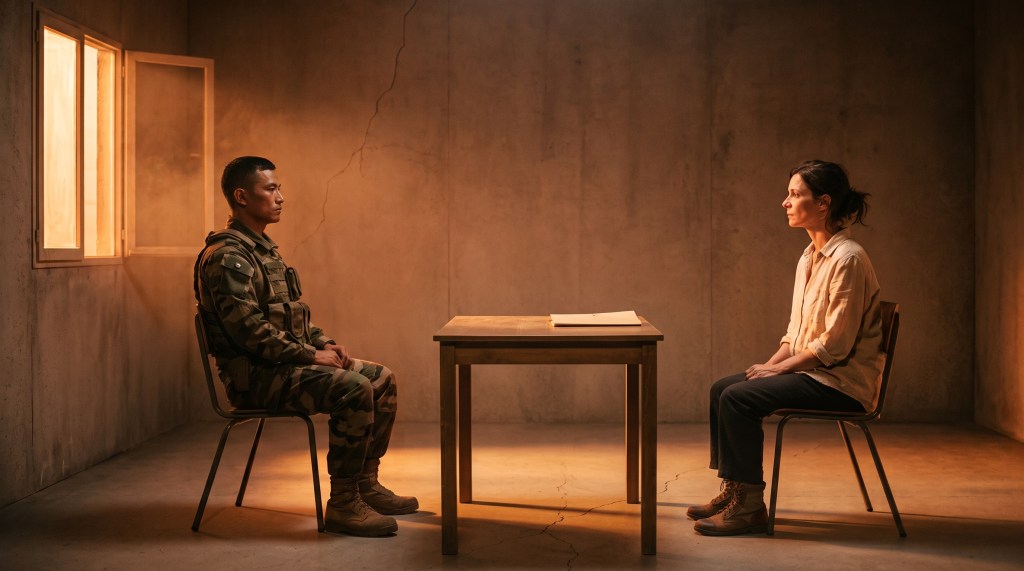
The window let in nothing useful. The air that came through it was the same air that was outside – thick, salted, copper-coloured at this hour, pressing against the skin like a hand that would not lift.
Bishal sat in one of the two chairs. He had not been told to sit. He had not been invited. The room had been quieter than the corridor, and the corridor had been full of people with questions he could not answer in any language they needed, so he had come in and sat down, and that had been forty minutes ago.
He was looking at the wall. The wall had a crack in it that ran from the window frame to the ceiling like a sentence that had not been finished.
Claire came in backwards, as she often did – a shoulder first, then the rest of her, a folder tucked under one arm and a water bottle in the hand that had the door. She managed to close the door and drop the folder and save the water bottle, approximately, in that order.
“Still here,” she said, which was not a question.
“Still here,” he said.
She put the folder on the desk and looked at it as though she was surprised to have brought it. Then she put it to one side and stood at the window, and the amber light came through onto her face and she looked tired in the way that people at this compound looked tired – not depleted, exactly, but used.
“Forty-four today,” she said. “Yesterday it was forty-three.”
“It is always forty-four.” He shifted his weight slightly, boot to boot. “Or it is forty-three. There is no difference.”
“There is a degree of difference.” She turned from the window. Her hands were already moving. “One whole degree. That is not nothing, especially when you are wearing all of that.” She tugged at the shoulder of her linen shirt, which was the colour of old paper and damp at the collar. “I know you have full kit and I don’t want to hear about it.”
“I was not going to say anything.”
“Your face was saying it.”
He looked at her. His face did not change.
She laughed – a short, genuine sound. “You have the most expressive face in the Legion. You know this.”
“No.”
“No, you don’t know it, or no, you don’t have the face?”
He looked at the crack in the wall. “No.”
She shook her head and picked up the water bottle and put it down and picked up a pen from the desk and held it. She was incapable, he had noticed, of being still. She was always holding something, turning it, putting it down and finding something else to hold. It was not nervousness. It was simply how her hands needed to be.
Outside, beyond the window, someone was calling to someone in Dari. A child, he thought – the pitch of it. Then another voice, lower, answering. Then quiet, and the generator’s low hum, and the smell of cooking oil drifting from somewhere in the kitchen block.
“Can I ask you something?” she said.
“You will ask it anyway.”
“That’s true.” She sat on the edge of the desk, which was not the chair but was as close to sitting as she got. “I’ve been asking people today – evacuees, the officers, anyone who stays still long enough – and I asked the woman from the protection team and I asked the padre, though he gave me an answer I’m not sure counts, because he mentioned Job, and I don’t think anyone actually finishes Job, I think people just stop mentioning it.” She looked at him. “What is a book you never finished but still think about?”
He said nothing.
“Not because you have to have an answer – I have plenty of answers, I’ll give you mine first, I always end up giving mine first because otherwise people feel like they have to perform and that’s not the point, the point is just to – ” She waved the pen. “Actually, I should give you mine first anyway, because mine is less one book than a small disaster of books, which I think is more honest, probably.”
She was already off her perch on the desk, already moving. She went to the window and came back. “Right. First: I never finished Middlemarch. Which everyone says is inexcusable, and I agree, it is inexcusable, but I got to the part where – actually, it doesn’t matter why I stopped, the point is I can feel Dorothea in the room sometimes, like a mild reproach, like she is standing just there – ” she pointed at the corner behind his chair ” – not accusingly, just. Present.” She looked at the corner. “And then there was the Perec. La Vie mode d’emploi. I got to the sixty-third chapter and I had to go to Sarajevo for three weeks and when I came back the rhythm was broken and you can’t restart Perec, you just can’t, you have to begin at the beginning and I simply did not have the beginning in me. And then there was a Japanese novel – not Murakami, everyone says Murakami when they mean they want to look as though they read Japanese novels, and I do read Japanese novels, but this one was someone else, someone quieter, and I only remember that it was about a house and that it was very, very slow in the best way, and I left it on a train.” She stopped. “I don’t feel guilty about any of them. Is that wrong?”
He was watching her. She was, he thought, like a river: you couldn’t hold any part of it still without losing the whole.
“No,” he said. “It is not wrong.”
“The padre thought it was wrong. He thought I should feel guilty. Which is very padre of him.” She sat back on the desk edge. “Your turn. And you don’t have to give me a lecture or a confession – just. A book. Something you picked up and put down.”
He looked at the crack in the wall. The light through the window had shifted by a half-shade. Outside, the generator turned over.
“Le Petit Prince,” he said.
She waited. He did not elaborate.
“Saint-Exupéry,” she said.
“Yes.”
“When? Where?”
He shifted his boot. “Nîmes. First year.” He made a small flat gesture with one hand, a kind of levelling. “My French was not enough. It was language exercise.”
“And?”
“I read it.”
“How far?”
A pause. “Chapter twenty-one.”
“That’s most of it.”
“No. Not most of it.”
“It’s not a very long book.”
“It is long enough.” He said it without emphasis, and the emphasis was in the absence of it.
She was looking at him now with the quality of attention she gave to things she did not yet understand – leaning forward slightly, the pen held loosely, not writing, just held. “What happens in chapter twenty-one?”
“The fox.”
“The fox,” she said, and paused, waiting. He did not continue. She said: “The fox who is afraid of hunters. Who wants to be tamed.”
“Yes.”
“And the prince tames him.”
He said nothing for a moment. “The fox asks to be tamed. It is not the same thing.”
“No,” she said slowly. “It’s not.” She looked at him. “And then you stopped.”
“The section deployed. The book went into the kit bag. The kit bag – ” he paused, something adjusting in his expression that was not quite visible, a tightening in the jaw, a small inward movement ” – it went somewhere else.”
“And you never looked for it again.”
It was not a question. He treated it as one. “No.”
She was very still. This was notable. She was, by his measure, almost never still. The pen was not moving. The hands were in her lap.
“Bishal,” she said. Not Corporal. He did not correct her. “Why this one? Why not something you struggled with, something harder – why a children’s book, chapter twenty-one?”
“It is not a children’s book.”
“I know. I know that. I’m just – ” She stopped. Started again. “The fox says something to the prince when they part ways, doesn’t he? I’m trying to remember.”
He looked at the wall. He said, very quietly, almost as though it were not for her at all: “Tu deviens responsable pour toujours de ce que tu as apprivoisé.”
She let the French sit in the air. She did not rush to translate it. “You become responsible for ever,” she said softly, “for what you have tamed.”
“Yes.”
She opened her mouth. He did not look at her. She closed her mouth. The generator hummed. Outside, a woman was singing something low and repetitive to a child. The salt-stink of the Gulf came through the open window and lay against everything.
He said: “A kit bag is not a book. Posting order is not an end. But the fox does not understand this.”
He stopped. The sentence was in the air between them, unfinished – the way the book was unfinished, the way the chapter was unfinished, the way the fox was still waiting in a book in a kit bag in a container somewhere on a continent he had passed through eleven years ago and not returned to.
Claire was watching him. She had not moved. For once, she had not filled the silence, and the silence was doing something she was not entirely equipped for, something that pressed toward a question she did not have the shape of yet, and she leaned forward, elbows on her knees, and she opened her mouth to say –
The door opened.
It opened without a knock. A shoulder came first, then the rest of him – a white chef’s jacket, slightly too large across the shoulders, the collar turned up on one side. He was sixty-odd, lean in the way that men who stand over a stove for forty years are lean, lean in the manner of the worn-down heel of a shoe. Spectacles on a chain around his neck, pushed up into his grey hair. He smelled of garlic and raw fish. He looked at the room with the expression of a man who has opened the wrong door and is not yet ready to admit it.
“I am looking for the secondary stores,” he said. “The mortar. Someone told me past the admin block, second door.”
Claire had straightened. She looked at Bishal. Bishal was looking at the door.
“This is the admin block,” Claire said. “Second door.”
The man looked at the desk, the two chairs, the open window. He pushed his spectacles further up into his hair. “This is not the stores.”
“No.”
He accepted this without apology. He looked around the room once more, briefly, as though the mortar might be there anyway, leaning against the wall behind the desk. It was not. “Someone gave me wrong directions,” he said.
“It happens,” Claire said. “I think the stores are the third door. Or possibly the fourth. The numbering is – ” she waved a hand ” – optimistic.”
The man turned to go.
“Wait,” she said. And then, because she was constitutionally incapable of letting a person leave a room without becoming briefly, entirely her concern: “What do you need it for? The mortar.”
He turned back. He was holding the door frame. “The rouille,” he said.
“You’re the cook?”
“Yes.”
She had already stood up. “From the kitchen block? You made the soup yesterday – the lentil, with the – “
“The cumin.” He said it as though the cumin was not something that required discussion, simply an element of a preparation that had been made. “Yes.”
“It was remarkable. The woman with the three children – she came back for a third bowl, did you know that? She hadn’t eaten properly in days, probably, and she ate three bowls and I watched her and I thought – ” She stopped herself. She had a habit of catching the tangent when she heard it receding from its point. “I’m Claire.”
He looked at her extended hand and took it briefly. “Gérard.”
She looked at Bishal. “This is Bishal. He’s Legion.”
Gérard looked at Bishal. Bishal looked back. Two men in the same room with the same economy of expression, measuring each other with the brevity of people who have nothing to prove.
“Gérard Vial,” the cook said.
“Gurung,” said Bishal.
A beat. Gérard looked around the room once more. “The rouille will not emulsify without the granite. The one in the kitchen is cracked. The hairline goes through the bowl – ” he held up a hand and traced a line diagonally across his palm ” – here. The pestle wobbles. I cannot get the consistency.”
“For the bouillabaisse?” Claire said.
He looked at her as though she had done something right. “Yes.”
“For tonight?”
“The fish will not be fresh tomorrow. I bought rascasse at five this morning. The saffron is steeping.” He said it without drama. A fact about the weather or the position of the sun. “The window is four hours. Less, now.”
Claire picked up the pen and put it down. “The stores – I can find out where they are. Someone in this building will know. Or I can ask the quartermaster – he owes me a favour, which is a very long story involving a case of mineral water and a completely unnecessary argument about requisition forms, but the point is I can ask him.”
“I need the mortar,” Gérard said. “And the pestle. Together. The weights matter.”
“Right. Yes. I’ll – ” She was already at the door, sidestepping Gérard. “Stay there, both of you, I’ll be five minutes.”
Then she was gone. The door was open. The corridor outside was dim and smelled of dust and something underneath the dust – old concrete, old heat. From far away, the sound of children’s voices rose and flattened.
Gérard stood in the doorway. He did not enter. He was looking at the corridor with the expression of a man who has nothing to do but wait and is not good at waiting.
Bishal said: “You need the granite.”
Gérard looked at him. “Yes. The bowl must be heavy. The pestle must be balanced.” He made a small rotating motion with his right hand, as though turning something against a surface. “Ceramic doesn’t hold. It slides. The emulsion breaks.”
“There is a training stores,” Bishal said. “East side. Past the medical tent. You pass the flagpole.”
Gérard’s attention sharpened slightly. “Where?”
“You pass the flagpole. Brown door on the left. Padlocked.”
“And it is not locked?”
“It is locked. But the lock is a number. Three-two-one-four. Someone put the date of something. I don’t know what date.”
Gérard looked at him. There was, in his expression, something that was almost gratitude, but that had been disciplined away from gratitude into simple acknowledgement. “Good,” he said.
Bishal said: “Four hundred and thirty mouths.”
Gérard looked at him.
“She told me this morning. The numbers.”
“Two hundred and nineteen in the last three days.” He said it as a cook states the number of covers for the evening – not casually, but not dramatically. A fact that governs the rest of the day’s decisions. “The fish is enough. The saffron is enough. It is only the rouille.”
Bishal nodded. He understood this. The thing that would hold or would not hold was the thing that mattered. Everything else was preparation.
Gérard came a step further into the room. He was looking at the amber light through the window. He said: “It is the same in the kitchen. One thing is missing. Always one thing.” He turned his spectacles over in his fingers, the chain swinging. “In Lyon I had the same mortar for thirty-one years. My wife bought it in Alsace. She drove three hours for it. She said the granite there is a different hardness.” He paused. He was not being sentimental. He was reporting. “She was right. It was a different hardness.”
Bishal said nothing. He was listening.
“When the restaurant closed – ” Gérard stopped. He looked at his hands. Then: “After, I had to leave the mortar. It was too heavy for what I had left. I thought: someone else will use it. The new people.” He said the new people the way you describe weather, or administration. “They probably didn’t keep it.”
Bishal said: “The quinoa place.”
Gérard looked at him sharply. Then something in his face relaxed – the small relaxation of a man who has been seen. “Yes,” he said. “The quinoa place.”
Claire came back through the door at velocity, clipping the frame with her shoulder. “Right,” she said, breathing slightly harder than the corridor’s length warranted. “The quartermaster says the stores are third door, but he may have meant on the other side, and also there are two admin blocks – did anyone else know there were two admin blocks? I think I may have been working in the wrong one for six days, which would explain – ” she stopped ” – actually, it would explain nothing. But the point is I’m going to take Gérard to find Romain, who is the logistics corporal on the east side and will know where the cooking equipment is.”
She looked at Bishal. He said: “The training stores. East side. Past the flagpole.”
She blinked at him. “You knew this.”
“Yes.”
“And you didn’t say earlier because – “
“You didn’t ask me earlier.”
She put her hands on her hips. “You are an infuriating person.”
He looked at her. He did not appear to find this troubling.
She turned to Gérard. “I’ll take you. I know where the flagpole is.” Then back to Bishal, pointing the pen at him – the pen she had somehow picked up again without anyone noticing: “And you are not leaving this room. I want to come back and – ” She stopped. The sentence had turned toward something she had not intended to make visible in front of the cook. She looked at the wall. She said: “I just want to come back.”
Gérard had already turned toward the corridor. Claire followed him, and for a moment the room was crossed by the smell of garlic and raw fish – clear, sharp, functional, the smell of someone with work to do.
Then they were gone.
Bishal sat. The amber light did not move. The generator hummed. The child’s voice, outside, and then quiet. He looked at the crack in the wall.
The fox. He had thought about the fox in Kandahar, in the Sahel, in the Comoros, in the pre-deployment weeks in Aubagne when the Legion’s logic was most efficient and most empty at the same time. The fox had been in the book in the kit bag in the container in Nîmes, or in a depot in Marseille, or at the bottom of something he would never open again. He had thought, more than once, of buying another copy. He had not. It was not the same book. The act of not finishing it was in that book, in that copy, in the paperback spine going soft from the Nîmes August in the year of his first deployment. You could not transfer it.
He thought: the fox says you become responsible for ever for what you have tamed. The Legion is not a small fox. The Legion does not ask you to take care of it. The Legion takes care of you, which is not the same thing. But there are smaller things. There are smaller things than institutions.
He stopped the thought. He was good at this.
They were gone for eleven minutes. He counted, not deliberately – it was a habit, the way soldiers count without choosing to.
When Claire came back she was alone. She had the look of a person who has been moving fast and is now trying to return to the speed of a room. She closed the door behind her and stood with her back against it.
“He found it,” she said. “The training stores. There was a granite one – large, old, heavy. He picked it up and turned it over and stood there for about thirty seconds not speaking and then he said yes, this is correct and walked back toward the kitchen without another word.” She paused. “I find that very moving. Is that strange?”
Bishal said: “No.”
She peeled herself off the door and came and sat in the chair she never sat in – the other one, not the desk. She sat in it properly, both feet on the floor. She was looking at him.
She said: “Can I ask you something else?”
“You asked me something this morning and got an answer.”
“That’s true. I banked it. Can I spend it?”
He looked at her.
“The fox,” she said. “The kit bag. The posting order.”
He waited.
“The fox is talking about a relationship, isn’t he? When he says you become responsible for ever.” She was not performing this. She was working it out. “He’s talking about the fact that you changed something by paying attention to it. That you made it familiar, made it yours, and now that it’s yours you can’t just leave.” She paused. “And you’re talking about a book. But you’re not talking about a book.”
He was very still. The jaw tightened. He looked at the wall.
She said, quietly, not pressing: “Bishal.”
He said: “The book is the book.”
A silence. She accepted this, or accepted it provisionally, which was different.
Then: “I want to ask Gérard the question.”
“He is in the kitchen.”
“He’ll come back. He’ll need to return the mortar at some point, or he’ll come by.” She picked up the pen. “He strikes me as the kind of man who doesn’t start things he doesn’t finish.”
Bishal said: “He did not finish the book.”
“You didn’t either.” She said it without edge.
“No.”
“So.” She uncapped the pen and then capped it again. “Do you think the answers to a question like that – can they add up to anything? The three of us? Or are they just three things sitting in the same room that don’t belong together?”
He looked at her. He said: “Three things in a room can still be three separate things.”
“I know,” she said. “I know they can.” She was looking at the window. The amber was deeper now, almost russet, the sun’s angle going horizontal. “It just seems – I don’t know. I started asking people today because I thought it would be a way in. To something. To the day. And now I’ve heard about Dorothea, who nobody has asked about, and the fox, who someone has been carrying for fourteen years, and Gérard’s lentil soup, and I’m not sure it adds up to a way in. I’m not sure it adds up to anything.”
He said: “It does not need to add up.”
She looked at him. “That’s very Zen of you.”
“It is very Nepalese of me.”
She laughed – the short, genuine sound. And then she was quiet again, and the quiet between them was different from the quiet before Gérard had come in, slightly less pressurised, the orbit a little wider, the two of them not at their closest point but at some longer, steadier position in the arc.
Gérard came back twenty minutes later. He knocked this time – a single knock, perfunctory – then opened the door. He was holding a small bowl. He set it on the edge of the desk without preamble.
“The first rouille,” he said. “To check the emulsion.”
Claire stood immediately. She looked at the bowl. It was the colour of deep amber, darker than the light through the window, a rust-orange that smelled of saffron and garlic and something beneath both of those – something oceanic, something old. She picked up the spoon resting in it and tasted. Her face changed the way faces change with food, not the performed expression of a person eating at a restaurant but the private face of someone encountering a thing that is simply what it should be.
“Yes,” she said. She looked at Gérard. “Yes.”
He nodded once. He accepted it as information, not as praise.
She held the spoon toward Bishal. He shook his head slightly.
“Will you sit?” she said to Gérard.
He considered the two chairs. He sat on the edge of the desk instead – Claire’s position, in the way that people take, without knowing it, the position of whoever last occupied a space. He looked at the room with the abstracted air of a man who is partly present and partly in a kitchen.
Claire said: “Can I ask you something?”
“You can ask,” Gérard said.
“What is a book you never finished but still think about?”
He looked at her. Then at the bowl. “Why?”
“I’ve been asking everyone. It’s a way into the day. A way into a conversation. It doesn’t have to mean anything.”
He thought about this. He pushed the spectacles up into his hair. “I don’t remember the title,” he said.
She waited.
“I bought it at the Part-Dieu station. In Lyon. A Thursday – I know it was Thursday because I was going in for the evening service. I had forty minutes on the train. I read – ” he made a small levelling motion with his hand, the same gesture Bishal had made, which in both men signified something like an honest estimate ” – forty pages. Perhaps a little less.”
“And then?”
“The service started.” He said it simply. The service started. The sentence did not need completion because the logic inside it was complete. “I put it in the coat pocket. The coat stayed in the back.” He shook his head, not with grief but with the precision of a man counting backwards. “After the service there was the mise en place for the next day. The deliveries.”
“The fish at five,” Bishal said.
Gérard looked at him. “Yes.”
“And the book,” Claire said. “After all that?”
“It was on the nightstand. Thirty-four years.”
“You don’t remember the title.”
“No.” He did not appear to find this troubling. He turned the spectacles over in his hands.
“But you think about it?”
He looked at the bowl of rouille. He said: “I think about the forty pages. Not the book. I think: there was a train, and forty minutes, and forty pages.” He paused. “The soufflé would not wait.” He said it without irony, without apology. “The soufflé would never wait.”
A silence entered the room and arranged itself differently from the earlier silences – wider, less shaped, the silence of three people rather than two.
Bishal said: “The soufflé does not care about the book.”
Gérard looked at him. For the first time, his face moved toward something that was not quite amusement but was adjacent to it. “No,” he said. “It does not.”
Claire was looking between the two of them. She said: “But Bishal thinks about the fox. Fourteen years later, he thinks about the fox.”
Gérard looked at Bishal.
Bishal looked at the wall.
“The fox,” Gérard said.
“Chapter twenty-one,” Claire said. “The fox who asks to be tamed. The fox who says – ” she looked at Bishal.
He said it again, quietly: “Tu deviens responsable pour toujours de ce que tu as apprivoisé.”
Gérard listened. He held his spectacles. He said: “And the soufflé fell?”
Bishal looked at him. The question was so unexpected, so oblique, and so precisely aimed that for a moment neither of them spoke.
“The soufflé,” Gérard said, “would have fallen. In the kitchen, when someone leaves a thing half-done. It falls.” He turned the spectacles over. “The fox also falls, no?”
“The fox waits,” Bishal said. He said it tightly, quietly. “The fox waits at the same place. Five o’clock. Because you taught him you come at five o’clock.”
“Yes,” Gérard said. “And then you don’t come.”
“Yes.”
“And the fox – “
“The fox is disappointed. The fox says it would have been better not to tame him at all.” Bishal stopped. His jaw was tight. He was looking at the wall. He said, very quietly, to no one in the room exactly, or to someone in the room who was not there: “But the wheat fields are still beautiful. Because of the colour.”
Claire was not moving. She was sitting in the chair with both feet on the floor and her hands in her lap and she was not filling the silence and she was not turning it over and she was not reaching for the pen. She was sitting in it.
Gérard stood. He picked up the bowl. He stood for a moment, turning it in both hands, checking it, checking the surface. He said – to Bishal, she thought, though he was looking at the rouille: “The kit bag. The container.” He paused, choosing the words with the economy of a man who for forty years has cooked without waste. “The fox does not care where the kit bag went. The fox cares only that you remember the colour of the wheat.”
He moved toward the door.
Claire tried: “My grandmother had a mortar, actually – a beautiful thing, she brought it from Provence when she married, olive wood, and she used it for – “
“Olive wood is too soft,” Gérard said, not unkindly. He said it the way you correct a measurement. A fact about the material, nothing more.
“Right,” she said. “Yes. Of course.”
He was at the door. He paused with his hand on the frame. He said: “The bouillabaisse will be ready at eight.” He said it to both of them – a straightforward statement of fact, an invitation that did not announce itself as one. “You should eat.”
Then he was gone. The door closed. The smell of garlic and saffron lingered briefly, and then the heat absorbed it.
The room was quiet. The amber light through the window had reached its deepest point and was beginning, almost imperceptibly, to go. The generator turned over. The woman outside had stopped singing. In the compound somewhere, a door opened and closed.
Claire looked at the empty place on the desk where the bowl had been.
She said: “Do you think he ever finished a book? In thirty-four years?”
Bishal said: “No.”
“Why not?”
“The fish at five.”
She nodded slowly. She said: “And you?” She was not asking whether he would finish a book. She was asking something adjacent to that, something she was not naming, something that had been in the room since before Gérard arrived and was still in the room now that he had left, changed in shape, changed in pressure, but still there.
He looked at her. She was looking at him, not as a question she needed answered but as a statement she was making and he was receiving.
He said: “The posting order always comes before chapter twenty-two.”
She was quiet. Then she said: “Bishal – “
And from somewhere in the compound, from the east side past the flagpole and the medical tent, came the sound of a pestle against granite – slow at first, deliberate, rhythmic, the sound of someone beginning the work that must be done before the window closes, before the fish is no longer fresh, before the saffron has steeped too long. The sound was small and regular and absolute. It was the sound of a man who has found the right tool and has no time to waste.
Claire turned toward the window.
Bishal did not turn. He was looking at her – at the side of her face turned toward the sound, at the line of her jaw, at the way the last of the amber caught her profile and made it briefly, uselessly beautiful. He was looking at the wall. He was looking at something fourteen years old and still open. The chapter was still in the air between them, and the fox was still waiting at five o’clock by the wheat field, and the three answers sat in the room like three objects of different shapes that shared only the quality of being present, being unresolved, being here.
The light was going.
The heat was not.
Bob Lynn | © 2026 Vox Meditantis. All rights reserved.


Leave a Reply