The Flat Note

The Flat Note

How did you meet your significant other?

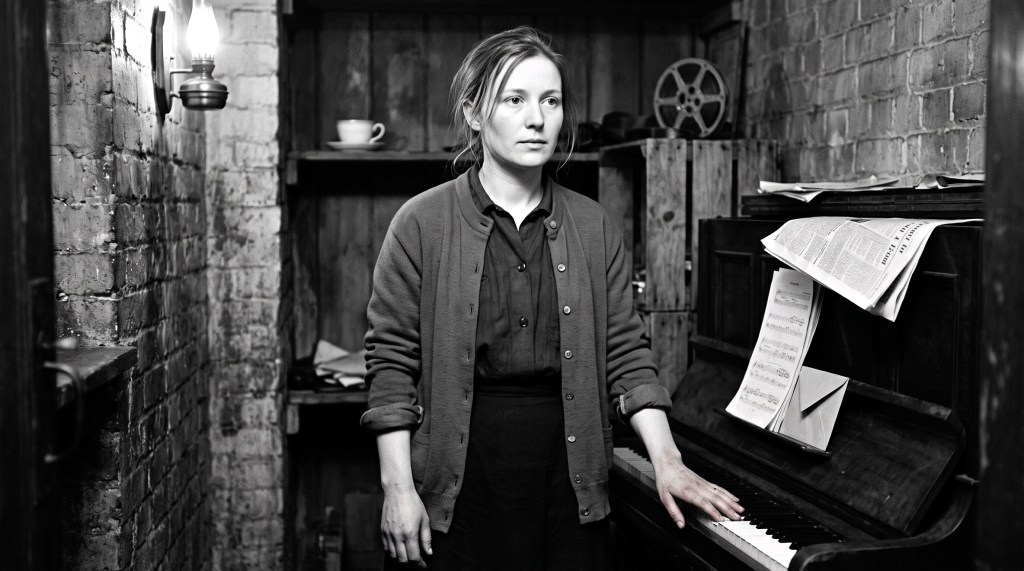
August 1918. A picture palace on the Yorkshire coast. A woman stands at her piano, chalk on her fingers, a telegram folded in with the cue sheets. Four days since the news. Two hours until the doors open. One question to answer: how did you meet him?

The answer is eleven minutes. A broken projector. A penny seat. A young soldier singing flat in the dark because he couldn’t let a silence go unfilled.

About the smallness of how love begins. The enormity of how it ends. The notes we miss and carry anyway. Sitting down, again, at the keys.

Read the original post.

Bob Lynn | © 2026 Vox Meditantis. All rights reserved.

5 responses to “The Flat Note”

  1. Anna Waldherr avatar

    You capture beautifully the tenuous beginnings of love and the tragedy of its loss. The line “You can make a great deal out of four bars if you’ve no other choice. You can make four bars last a very long time.” is very poignant. We hope for permanence, but are not guaranteed it. We may have to live on memories.

    Liked by 1 person

    1. Bob Lynn avatar

      Anna, thank you for this. And for reading it properly – which is a bigger gift than you might realise, given what the piece asks of a reader’s patience in those opening stretches where she won’t sit down and won’t get to the point.

      You’ve pulled the line I worried about most, actually. The four bars. I kept thinking while I was writing it: is this too much? Will the reader feel the weight of it, or will they feel they’re being told what to feel? Because the sentence is doing triple duty – it’s about the piano, it’s about the marriage, it’s about grief. She’s talking about music and she’s talking about making do with what little you’re given, and I needed all three registers to be there without announcing themselves. So the fact that you found it poignant rather than heavy-handed – well, that’s a relief I won’t pretend isn’t a relief.

      And you’re right about the permanence. I think that’s what the four bars are really about, underneath the mechanics of the music. You get four bars. You get eighteen months. You get two leaves. You get one November evening in a picture palace that smells of kippers. And you build the whole of a life inside that, and you call it enough because it has to be enough, and then it’s gone and you’ve still got the four bars and you’ve still got to play them. I wanted her to say “make a great deal” rather than “make do.” There’s a difference. There’s a stubbornness in it I wanted to honour. She’s not resigned. She’s resourceful.

      The memories part – yes. That’s the whole terror underneath the passage where she talks about the sound going first. Not the loss itself, but the slow erosion of the loss. The thing you’re clutching going soft at the edges, like the telegram. I think that’s why she tells the story aloud, to whoever’s asked. She needs it said once while it’s still the thing itself and not the memory of the thing. And you’ve done her the kindness of reading it while it was still fresh, still warm. That’s not nothing.

      Thank you, Anna. Properly. For sitting in that room with her for a while, and for telling me what you found there.

      Bob

      Liked by 1 person

  2. Steven S. Wallace avatar
    Steven S. Wallace

    A woman tells of how she met the man she loves and how her love is both short and timeless. Very much enjoyed setting in the theatre. It seems like a story that many of the era would relate to. You are going off to war and now for the first time you have something to lose… beyond yourself. It is painful to think how she saw herself in her last days. I would think about how long he had been deceased before I heard. This is a really heavy piece. 👏🏻👏🏻👏🏻

    Liked by 1 person

    1. Bob Lynn avatar

      Thank you for this. And for the hands – I’ll take the claps!.

      You’ve put your finger on something I was turning over a good deal while writing it: that idea of having something to lose beyond yourself. Before her, he’s a lad with three days’ pass and a wet coat and nowhere particular to be. After her, he’s a man who’ll be missed in a specific room, in a specific row, third from the front. The war was always going to take what it took. But the taking is a different thing when there’s someone left standing in the space where you used to be. I wanted that in the piece without saying it in so many words. You found it, so I didn’t need to.

      The gap you mention – how long he’d been gone before the telegram got to her – yes. That was in my mind throughout. Amiens began on the eighth. The telegram arrives on a Monday, and she doesn’t tell you which Monday. I wanted that not-knowing to sit in the piece, unspoken. She doesn’t know either. She’ll never know. And I think that’s its own quiet cruelty – whether he was already gone on the Tuesday she chalked her fingers and played the matinee and queued for a bread roll. The ordinary day you had while the world had already changed and simply hadn’t told you yet.

      On her “last days” – I think I see what you mean, but I’ll say gently that I tried not to look past this one afternoon. She’s twenty-five. She’ll sit at those keys tomorrow. And the day after. The piece is the Friday, not the rest of it. Not a correction – just a note on where I drew the line.

      And yes. It’s heavy. I don’t think there was a way to write it that wasn’t. But I’m glad it was heavy in your hands and not just heavy on the page. There’s a difference, and I think you felt which side of it you were on.

      Thank you for reading it, and for sitting with the weight of it for a while.

      Bob

      Liked by 1 person

      1. Steven S. Wallace avatar
        Steven S. Wallace

        No it’s heavy in a good way. It’s a great love story. Is she a romantic. Is this a romantic story. I’d say no and no. It’s tragic. It’s the story of an ordinary couple who clicked at a time of tragedy. WWI was really really bad. Great job!

        Liked by 1 person

Leave a comment