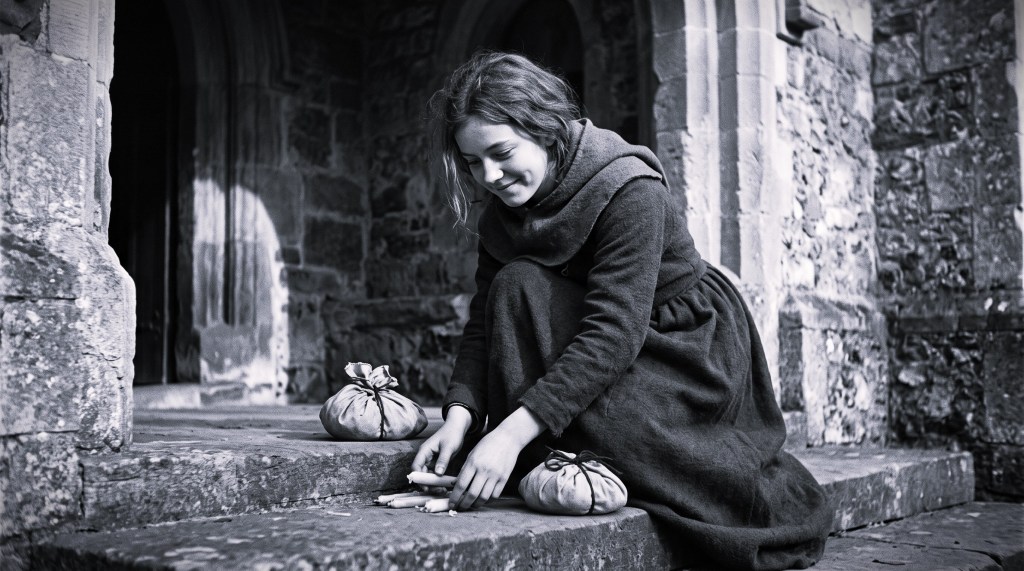
What’s the funniest misunderstanding you’ve ever been part of?
Saturday, 22nd July 1284 (The Feast Day of St Mary Magdalene)
Oh, you would ask me that. Of all the questions you might have set before me upon this, the Feast of St Mary Magdalene, you choose the very one most suited to colour my cheeks a fine and proper crimson. Very well. I shall tell it. But I pray you take your laughter with a portion of Christian charity; for I did not set out to make a fool of myself. I set out to do a kindness. That, I have come to understand across the course of my fifteen years, is precisely where my trouble always begins.
It was upon a market day near the Feast of St George, not three months past. The town was bright and loud, as it always is when the road-traders come in: cloth merchants from the south, potters, sellers of dried fish and salt, and those wandering fellows who carry a little of everything in a great pack upon their backs and who look, if you are foolish enough to trust your first impression of them, like honest men of God.
And I, being what I am, which is to say a creature well governed by the sanguine humour, warm of heart and quick of faith and quicker still to believe the best of any face set before me, was foolish enough. The blessed Apostle tells us that charity believeth all things; and I confess I have always taken that counsel perhaps somewhat more literally than holy writ intended.
There was such a man among the crowd that morning: a small fellow with sharp eyes and a voice like warm honey poured over stone. He wore a grey travelling cloak, much mended at the hem, and about his neck he bore a leather case of the kind that pardoners carry, with a small painted image upon the lid. Others passed him by without a glance. But I stopped.
“Young mistress,” said he, bowing so low I thought he might scrape his nose upon the cobbles, “have you a care for the souls of those you love?”
Now, what right-minded girl of this parish could say nay to that? My poor grandmother had been these forty years in purgatory, or so my mother always held, and my mother herself complained daily of a pain in her left side that no herb nor warm poultice had yet touched. I had a great many souls upon my heart, and I told him so freely, and at some length.
He nodded gravely, as a physician nods when he has heard enough of a patient’s symptoms and is already reaching for his preparations. Then he drew from the leather case a small bundle wrapped in yellowed linen, tied about with a red thread. He held it before me as reverently as though it were the Host itself, and his voice sank to a whisper that seemed, somehow, to fill the whole of the market square.
“I carry with me,” said he, “a fragment of the knuckle-bone of a blessed martyr of great antiquity, a confessor of the faith whose intercession is of proven virtue against all manner of ailment and temporal misfortune. A single procession to the church door, this relic carried in right good faith, and the priest shall acknowledge it and pronounce a full blessing upon all who walk therein. The indulgence attached to this act is of no small measure.”
I ought to have asked him a great many questions. I ought to have fetched my father, or sought the counsel of the manor’s reeve, or done anything other than what I did, which was to open my eyes very wide and say: “How much?”
He asked for my best linen kerchief. I had it folded into my girdle, clean-laundered that very morning, and I gave it to him without a moment’s hesitation.
Do not look at me thus. I know. I know it now. But I trow that had you seen the steadfast, quiet holiness in that man’s face, you might have been moved as I was. Or perhaps you would not have been. Perhaps that is why you are smiling already, and I am not.
He placed the small bundle into my hands and disappeared into the crowd with such swiftness that I might have thought he had never existed at all, had I not been standing in the market square holding a linen-wrapped object and feeling the most righteous warmth I had ever known in all my born days.
Now here is where my folly truly began to flower.
For I did not merely go to the church door myself. That would have been a modest enough embarrassment, the sort a girl might confess on a Tuesday and forget by Wednesday. No. I was seized by a great and burning caritas, a desire that all my neighbours should share in this mercy. I went from stall to stall about the market and began to tell people. I told the baker’s wife, who told her husband’s boy, who ran and told three of the women at the linen stall. I told the tanner’s daughter, who fetched her elderly mother, who could not walk fast but began to shuffle in my direction with great and solemn determination. I told the apothecary, who looked sceptical but followed nonetheless, for he was a man of piety and would not willingly miss a genuine indulgence even on the chance that it might otherwise prove counterfeit.
By the time I reached the church porch, I had behind me what I can only describe as a procession of the credulous and the hopeful. Several of the market women had purchased candles from the wax-chandler and were carrying them, lit. The baker’s boy was singing a hymn, albeit not quite the right one. The old woman had been helped onto a cart and was being wheeled along by her son, who had come merely to collect her and found himself swept up entirely in the general fervour.
I walked at the head of this company with the bundle held upon both open palms, as I had seen relics borne in procession at the feast of our parish saint. I confess I felt something very like glory.
Then the priest came to the church door.
He was a small, round man of middling years, with a brow like a bank of cloud gathered before rain and a habit of pressing his lips very tightly together before he spoke, as if each word were a coin he was reluctant to part with. He looked at me. He looked at the bundle. He looked at the company assembled behind me: the women with their lit candles, the apothecary with his arms folded and his expression carefully composed, the old woman now peacefully dozing upon her cart, the baker’s boy who had abandoned the hymn and was simply staring.
He held out his hand.
I placed the bundle in it with all the solemnity I felt the occasion deserved.
He unwrapped the linen slowly, with two careful fingers, the way a man unwraps something he already suspects. He examined what lay within. He looked at me.
“Child,” said he.
“Father,” said I, very devout and proper.
“This,” said he, and he held the object aloft so that all might see it clearly in the morning light, “is the knuckle of a sheep.”
Silence.
Then the baker’s wife said, with very great kindness: “Are you quite certain, Father?”
And the priest looked at her with the expression of a man who has served thirty years in holy orders and has, in that time, examined a great many things presented to him as relics of the blessed saints.
“Quite certain,” said he.
And so ended my glory.
Now I shall tell you what followed, for it is the one portion of this tale that does not make me wish to pull my hood over my face and live the rest of my days in a ditch. The priest, God keep him, is a man of much patience and no mean wit. He looked at me in my shame and I think he understood that I had not sought to deceive any soul in that procession, that I had been the one deceived and had acted out of earnest goodwill rather than craft or cunning. That, he seemed to judge, was a very different matter. He surveyed the assembled company: some beginning to laugh, several beginning to edge quietly backward as though they had merely been passing by and had not been singing moments before.
He raised his hand for silence.
“You have all of you,” said he, “been led by the nose by some wandering rascal. His instrument was your trust. There is a difference between foolishness and trust, though the distance between them may be hard to measure from where you are standing.” He looked steadily at me as he said this. “But you have come, at the last, to the house of God. And that is never a wholly wasted errand.”
He gave a blessing then: a genuine one, freely given out of his own goodwill. He prayed for the souls of the dear departed of all the families gathered there, and for the health of the old woman in the cart, who slept through the whole of it and woke only when it was done, remarking cheerfully that she felt greatly improved.
The procession dissolved. Some people laughed; some shook their heads and went about their business; the apothecary returned to his stall in dignified silence, which I thought very restrained of him indeed. I stayed behind to gather in the candles the baker’s boy had left at the church porch, for it seemed the very least I could do.
“You meant well,” the priest said to me, as I collected them.
“I meant very well,” I agreed. “I simply did not think very well.”
“Certes,” said he, not unkindly. “But there are worse faults in a soul than trusting too readily and wishing too eagerly to share a good thing with all who pass within reach of your voice.”
I have been turning those words over in my heart ever since, I confess. On this feast day of the blessed St Mary Magdalene, who was herself a woman of great sin and still greater repentance, it seems a fitting day to own one’s follies freely and without dissembling. She, at least, came bearing precious ointment when she went to do honour at the door of God. I came bearing a sheep’s knuckle and a procession of bewildered market-goers.
But I meant well.
And I do dearly wish I had my kerchief back.
Bob Lynn | © 2026 Vox Meditantis. All rights reserved.


Leave a Reply