I: What I Do Before Breakfast
The third dashboard from the left just went red. That’s me. I did that.
Watch those database instances flicker out, one after another, like candles caught in a draught. I killed them. Deliberately. On a Tuesday morning, with my coffee still steaming and my second alarm barely ten minutes behind me. My name is Priya. I am 41 years old, and my job title is Senior Chaos Engineer at one of the largest streaming platforms on the planet. Before you ask: yes, that is a real job, and yes, it means exactly what it sounds like.
I break things on purpose. That is the whole job.
Not out of carelessness or unchecked impulse. With precision. With intention. With what my colleagues have, on more than one occasion, called “alarming enthusiasm.” What you need to understand first is the tool. We call it Chaos Kong. It randomly terminates database instances, throttles network traffic, and drives latency spikes into perfectly healthy systems with the cheerful, indiscriminate energy of a toddler let loose in a server room. I helped design part of it. I deploy it regularly. And every single time those dashboards go red, I feel something I can only describe as deep professional satisfaction.
I know how that sounds. Stay with me.
The industry term for what I practise is failure injection. The idea is deceptively simple: if you want a system to survive the unexpected, you have to make the unexpected familiar. You rehearse failure so thoroughly, so methodically, that when real failure arrives (and it will arrive, uninvited, at the worst imaginable moment, on the highest-traffic night of the year) your system does not shatter. It adapts. It bends. It finds another route.
Think about glass versus bamboo. A perfectly engineered pane of glass is a remarkable object. Flawless. Smooth. Structurally immaculate. And under sudden, sufficient stress, it doesn’t deform or negotiate. It fractures. Completely. Irreversibly. Bamboo, by contrast, has spent its entire existence being bent about by wind and rain and the compressive weight of whatever the world piles on top of it. Stressed and released and stressed again, thousands of times over. That repeated disruption is not damage. It is education. The bamboo knows, at a cellular level, how to give without breaking. That is the kind of system I am trying to build: not a flawless pane of glass, but something that has learnt the grammar of resilience through repeated, controlled encounter with the very thing it fears.
The technical word for this quality is antifragility. I did not invent the term. The philosopher and risk analyst Nassim Nicholas Taleb did, and I will be honest with you: the first time I read his work, I had the unnerving sensation of someone accurately describing my entire career before I had thought to describe it myself. An antifragile system is not merely robust. It is not merely resilient. It is something rarer and stranger: it actually grows stronger under stress. Not despite the disruption, but because of it.
Now. Here is where it gets interesting. Here is where people at dinner parties lean forward slightly against their better judgement.
I watch engineers. That is a large part of what I do when I am not actively scheduling beautiful, terrifying catastrophes into our infrastructure. I observe how people respond when the alarms start screaming. Early in their tenure, when Chaos Kong begins its work, the reaction is almost universal. There is the freeze: a half-second of pure, systems-level panic, the kind that bypasses all your training and lands somewhere cold and wordless at the back of your skull. Then the frantic clicking. The rising voice. The messages firing in all directions, asking questions nobody can answer yet because the diagnosis hasn’t started.
I am not unkind about this. I remember it.
But watch the same engineers six months later. Eight months. A year of regular, scheduled chaos behind them. The alarms go off and something has changed. They breathe first. Actually breathe, on purpose, as a deliberate act, because they have learnt through repeated experience that panic is expensive and information is cheap. Then they look. They diagnose. They speak to each other in short, clear sentences. They have been here before. Not in this exact failure, not with these precise contours, but in the landscape of failure itself: the feeling of it, the shape of how systems come apart and how they can be coaxed back together. They know that landscape because I made them walk it, again and again, in the relative safety of a controlled burn.
The chaos is not the lesson. I want to say that again because it matters: the chaos is not the lesson. The recovery is the lesson. The chaos is simply how you get there.
I have been engineering these controlled disasters for a decade. A decade of watching systems break in instructive ways, of cataloguing failure modes and mapping recovery paths, of learning that the most dangerous sentence you can say about any architecture is “it has been running perfectly for months.” Because what that sentence actually means, beneath the quiet self-congratulation, is this: we have not stress-tested our assumptions recently. We have been optimising for smoothness. And in a complex, living system, smoothness is the silent precursor to brittleness.
I did not understand this about people until I understood it about servers. But once you see it, you cannot stop seeing it.
Which is why I am going to need you to follow me somewhere else entirely.
II: A System With Zero Chaos Tolerance
There is a version of me I think about sometimes. She is thirty-one years old and she is very, very good at keeping everything running smoothly.
She has a husband, a mortgage, a promotion she worked for across three consecutive years of sixty-hour weeks, and a colour-coded calendar that would make a Swiss train conductor emotional. She has an ISA she actually contributes to, a meal plan on the refrigerator door, a reliable sleep schedule, and the quiet, well-maintained confidence of a woman who has never really had to improvise. She is, by any reasonable external measure, a success. She is also, though she would never have framed it this way at the time, a system that has been running in ideal conditions for so long that it has quietly, invisibly, catastrophically lost the capacity to handle anything else.
That woman is not running in ideal conditions anymore.
If I were writing her technical documentation, which I find darkly amusing to consider, I would note the following: no unplanned maintenance windows. No stress tests conducted since childhood. No fallback protocols. Redundancy: minimal. Chaos tolerance: zero. Uptime was excellent. Everything looked immaculate from the outside. The architecture was clean, the services were responsive, and nobody, including the system itself, had thought to ask what would happen if two critical components failed at the same moment during peak load.
Let me tell you what peak load looked like.
My husband left in October. My father died in November. The same month that I stood in a crematorium in Coventry in the wrong shoes because I had not thought about shoes, my immune system filed what I can only describe as a formal incident report. A cascade. My body, apparently, had been watching the alert queue fill up for weeks, waiting politely for me to address the backlog, and when it became clear that I was not going to, it escalated. I was ill in ways that were difficult to name and reluctant to resolve: exhausted in the bone-deep, fluorescent, industrial way that no amount of sleep addresses. I lost weight I had not intended to lose. I sat in a GP’s waiting room on a Tuesday afternoon and realised, with the detached clarity of someone watching a system fail from the outside, that I had absolutely no idea what to do next.
Not about the illness. I mean in general.
There had always been a next step. That was the thing about the life I had been running: it came with a clearly defined procedure. Graduated. Got the job. Met someone. Married the someone. Bought the flat. Waited for the next milestone to load. I had been operating on a kind of continuous deployment model, pushing small, predictable updates to a life that never had to reboot. And it had worked beautifully, right up until the moment it didn’t, and then it had failed in the way that over-optimised systems always fail: completely, and all at once, with no graceful degradation.
I was not prepared for any of it. Not the grief, which arrived in completely non-linear order and ignored every stage I had been told to expect. Not the anger, which had opinions I did not know it had. Not the loneliness, which turned out to be a different and more technically complex problem than sadness, and which could not be solved by the same methods. I had no runbook for any of this. No incident protocol. No prior experience of having sat with a failure of this magnitude and found my way through to the other side of it.
Here is what nobody tells you about a perfectly ordered life: the order is not protecting you. It is shielding you from the low-level disruption that would have quietly been building your capacity all along. Every time you chose the familiar route, every time you smoothed over the friction, every time you optimised away the inconvenience, you were not making your life better. You were making it more brittle. You were constructing, with great care and effort, a system with exceptional performance in known conditions and no tested response to anything outside them.
The chaos, when it came for me, did not care about my colour-coded calendar.
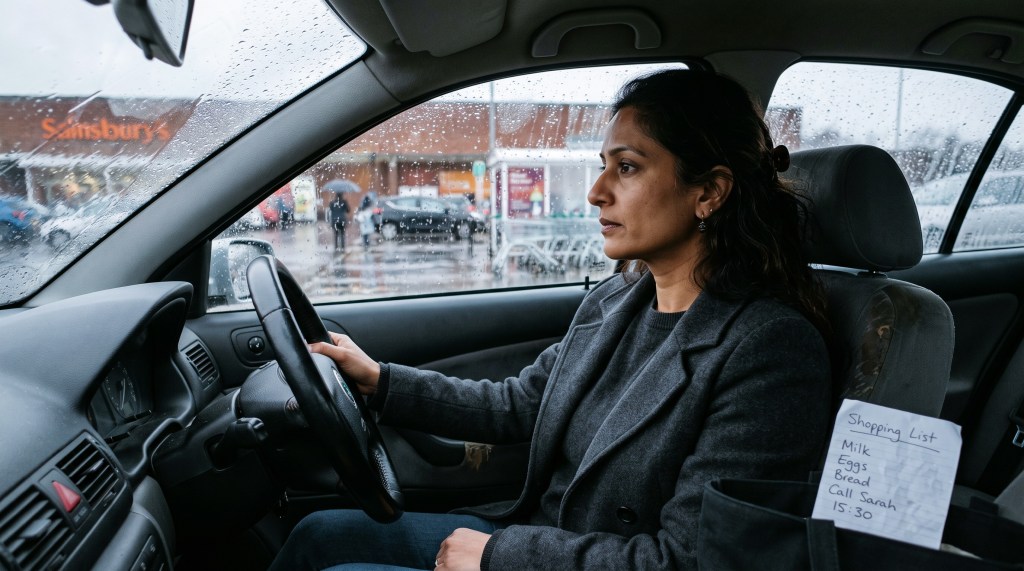
I remember the afternoon the diagnosis crystallised. Not a medical diagnosis: I mean the one I gave myself, sitting in the car outside a supermarket in the January of the following year with a list of things I needed to buy and the very sudden, very clear recognition that I had been approaching my own recovery entirely backwards. I had been trying to restore order. I had been treating the disruption as the problem, as the thing to be resolved and reduced and eventually eliminated so that I could return to running smoothly. And I was not getting better. I was getting more exhausted and more rigid and more afraid of the next thing that might go wrong.
Because here is what a decade of chaos engineering teaches you about failure: you do not recover from it by avoiding it. You recover from it by understanding it. By getting low enough to see the actual shape of what broke and why. By asking not how fast you can return to the previous state, but whether the previous state was actually what you wanted to be running in the first place.
My system had failed, yes. But if I was honest, and I am nearly always honest even when it is inconvenient, the architecture had been flawed from the start. I had built a life with no tolerance for disruption, no rehearsed response to loss, no muscle memory of recovery. I had never been tested because I had spent years ensuring I would never need to be. And the result of all that careful, diligent, well-intentioned protection was that I arrived at the worst month of my life with no prior experience of surviving anything.
There was a word for what I had been, before October. Fragile. Not in the self-pitying sense; I do not mean I was weak. I mean it in the precise, engineering sense: I was a system that had been optimised for a narrow set of conditions, and outside those conditions I had no adaptive response. I was the glass. And I had shattered, and I was sitting in a supermarket car park in January looking at the pieces of myself spread across the upholstery, and I was going to have to do something about that.
I could not restore the previous version. It was gone. The rollback was not available.
But I had spent a decade learning exactly what you do when a system cannot be restored.
You do not mourn the uptime. You run the post-mortem, you identify the single points of failure, and then, with whatever is still functioning, you rebuild it differently. You rebuild it with redundancy. With tested fallbacks. With a healthy, deliberate, ongoing relationship with the kind of small, survivable stress that means the next catastrophic failure does not find you entirely unprepared.
You become your own Chaos Kong.
And that is a decision I made in a car park in Coventry, in January, with a shopping list in my hand and absolutely nothing left to lose. I decided to stop engineering calm into every corner of my life and start engineering something harder, something stranger, something that would have seemed completely unnecessary to the woman with the colour-coded calendar.
I decided to start breaking things on purpose.
Not the servers this time. Something closer to home.
III: Rehearsing the Art of Not Freezing
The first thing I did, that January, was take a different route home.
That is how modest the beginning was. I did not sign up for a marathon or quit my job or move to another country. I just turned left instead of right on Foleshill Road and spent an extra eleven minutes navigating streets I did not know, past shops I had never noticed, in a city I had lived in for years and apparently barely seen. It sounds trivial. It was, on one level, completely trivial. But something happened in those eleven minutes that I had not anticipated: I had to pay attention. I could not run on autopilot. The familiar background hum of a brain operating in known conditions went quiet, and something else came online, something sharper and more present, something that had been waiting under all that smooth efficiency for an invitation to exist.
That was the beginning of my education in deliberate, small-scale, survivable chaos.
I want to be careful here, because this is the point where people misunderstand what I am suggesting, and the misunderstanding matters. I am not recommending suffering as a lifestyle. I am not telling you to court disaster, to leave your job without another one, to stop wearing a seatbelt, or to make your life unnecessarily difficult in the name of some vague philosophical toughening. That is not antifragility. That is just recklessness with a branding problem. What I am talking about is the vaccine logic: you do not inject a patient with the full-strength virus. You inject them with a small, controlled, survivable dose that trains the immune response without overwhelming it. The goal is calibration, not punishment.
So my doses are small. Deliberately, carefully small.
I take unfamiliar routes. Not every day, not as a rigid rule, but often enough that my nervous system does not mistake familiarity for safety and novelty for threat. I am learning Portuguese. Badly. With an accent that makes native speakers visibly wince and a grammatical confidence that is almost entirely unjustified by my actual ability. I make mistakes in front of people, regularly and without excessive apology, because making mistakes in front of people turns out to be one of the things I had been quietly, consistently avoiding for most of my adult life, and the avoidance had made me rigid in ways I had not noticed until I stopped.
I let my kids argue.
This one took the longest. If you have children, you will understand the almost physical difficulty of sitting on your hands while two small people work themselves into a state over something you could resolve in thirty seconds with minimal collateral damage. Every instinct says intervene. Every instinct says smooth it over, restore the equilibrium, return the system to normal operations. But I know, in the precise, evidence-based, professionally-reinforced way that I know most things I believe deeply, that if I always do that, I am raising children with zero chaos tolerance. I am building them in the image of my former self: well-functioning in calm conditions and completely unequipped for anything else. So I let the argument run. I let them find, between themselves, the path through. And they do. They always do, eventually, and every time they do it without me, they are laying down a little more of the neural infrastructure they will need when the real, large, unscheduled disruptions of their lives arrive.
Because those will arrive. I do not say that to frighten anyone. I say it because pretending otherwise is the most expensive lie we tell ourselves.
Here is the part where all three threads pull tight and hold.
The engineering principle, the biological reality, and the lived experience are not three separate arguments. They are the same argument, expressed in three different languages. Antifragility is not a concept I borrowed from Taleb and applied to my career. It is not a metaphor I use to make my job sound meaningful at dinner parties. It is a description of how living systems, all living systems, are actually designed to work when we let them. The human nervous system does not strengthen through ease. It strengthens through graduated, recoverable stress followed by rest, followed by more stress, followed by rest again. This is how muscles are built. This is how immune responses are trained. This is how engineers learn to breathe when the alarms scream. This is how children learn to navigate conflict. This is how a woman in a car park in January puts herself back together into something stronger than what she was before.
We did not evolve for smoothness. We evolved for recovery.
And the reason so many of us find the first real catastrophe of our adult lives so devastating is not that we are weak. It is that we have been, with the very best intentions, protected from the graduated rehearsals that would have prepared us for it. We were raised, many of us, in systems that interpreted every form of friction as a problem to be solved rather than an experience to be metabolised. We were taught that the goal is stability, continuity, the absence of disruption. And stability is not nothing; I am not dismissing it. But a life engineered purely for stability is a life that has traded its adaptive capacity for its uptime, and that is a trade that will eventually be called in, at a time and in a manner entirely of the universe’s choosing rather than yours.
You think you are protecting yourself by keeping things smooth. You are not. You are deferring the invoice.
I have sat with a lot of engineers in the aftermath of their first real production outage. The ones who recover fastest, who diagnose most clearly, who rebuild most intelligently, are never the ones who had the cleanest record before it happened. They are the ones who had already been broken in. Not traumatised; broken in, the way good leather is broken in, the way a voice is broken in by years of use, the way a road through difficult terrain is broken in by everyone who walked it before you and left it marginally more passable for having done so. They had met failure before, in the contained and survivable context I had engineered for them, and so failure was not a stranger. It was uncomfortable and unwelcome, but it was not unknown. And that distinction, between the uncomfortable unknown and the uncomfortable familiar, is very nearly everything.
I want you to carry that distinction with you when you leave this room.
Look at the dashboards. The third one from the left is still red from this morning’s run. One of the servers I took down at 6:47 a.m. is back up, running cleanly, having been brought back through a recovery sequence that the system executed because it had been trained to execute it, because we had taken it apart and put it back together enough times that the path was worn smooth with practice. Last Tuesday, at three in the morning, that same server sustained 50% packet loss for eleven minutes. Not ideal conditions. Not anything close to ideal conditions. But it did not go down. It found the workaround. It held its ground in the dark, alone, under conditions it had no reason to expect, and it kept serving. Because it had been here before. Not here exactly, but in the neighbourhood of here, often enough that it knew the roads.
That server has more chaos tolerance than I had at thirty-one. I find that both professionally satisfying and personally instructive.
I am still running. That is the other thing I want you to take away, the one I am least interested in dramatising, because the drama is not the point. The point is the word “still.” My husband left. My father died. My body filed its incident report and I sat in that car park and I looked at the wreckage of the architecture I had spent a decade building and I made a choice. Not to restore it. Not to grieve the uptime or spend my remaining energy trying to return to a previous state that was, in any case, more fragile than it had ever looked. I made a choice to rebuild it differently. With redundancy. With tested fallbacks. With a deliberate, ongoing, slightly mischievous relationship with small amounts of the very thing I had spent years smoothing away.
I turned left instead of right on Foleshill Road, and I kept turning.
So here is what I am offering you, for what it is worth, from someone who gets paid to break things and has learnt, the hard way, that the breaking is not the end of the story. Find your small chaos. Not the large, catastrophic, universe-administered kind; that will find you when it is ready, with no input required from either of us. Find the small kind. The voluntary kind. The slightly uncomfortable, mildly unfamiliar, gently resistible kind that your instincts will tell you to avoid because your instincts have been optimised for smoothness and smoothness, as I hope I have demonstrated by now, is a seductive and ultimately unreliable measure of health.
Take the unfamiliar route. Learn something badly. Let the argument run its course without you. Let yourself be, in some small and recoverable way, lost.
Because the catastrophic chaos is coming, for all of us, in one form or another, at a time of its choosing. And when it arrives, the only question that will matter is whether you have already rehearsed the art of not freezing. Whether you have, somewhere in your nervous system, in your muscle memory, in the worn and tested infrastructure of who you are, a recovery path. Not a perfect one. Not a guaranteed one. Just a path you have walked before, in the low-stakes version, often enough to know that it goes somewhere.
That is all antifragility is, when you strip the theory away. It is the accumulated evidence, held in the body, that you have been here before. Not here exactly.
But in the neighbourhood.
The alarms are still going. I am going to finish my coffee.
Bob Lynn | © 2026 Vox Meditantis. All rights reserved.


Leave a Reply