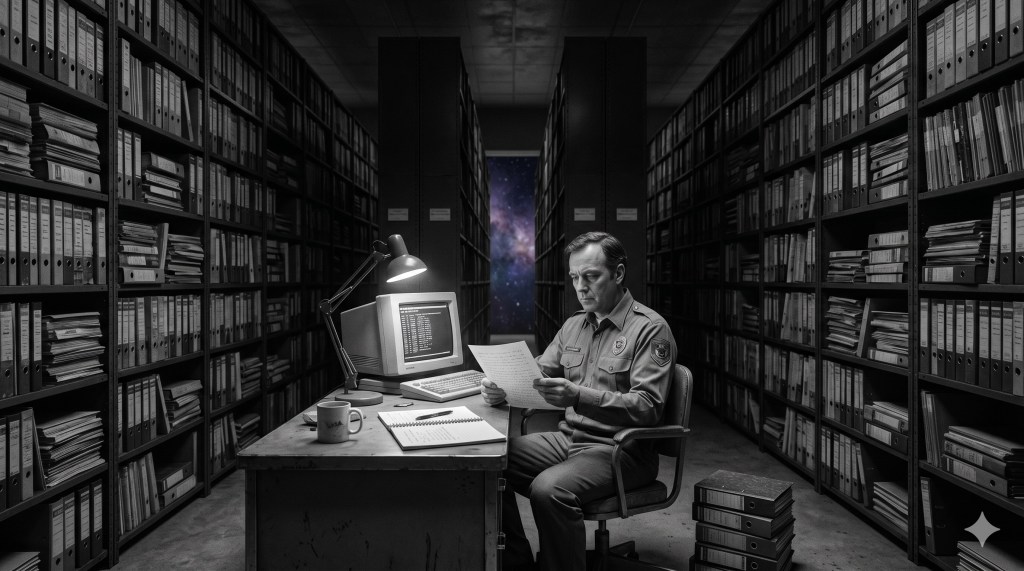
Being an Account of Certain Events as Recorded by O. Fenn, Grade 7 Administrative Clerk, Galactic Central Planning Department, Orion Arm Regional Office
I: Memo from the Void
I want to be clear about something before we begin: I did not ask for any of this.
I am, by training, temperament, and the accumulated wisdom of forty-two years spent in close proximity to filing systems, a man who processes what arrives on his desk, cross-references it against the relevant galactic statutes, and moves it along the appropriate channel. I do not investigate. I do not convene expert panels. I do not, as a rule, make decisions that could plausibly alter the trajectory of an entire civilisation. That is what Grade 9s are for, and above them, the Grade 11s, and above them, a layer of senior management so rarefied that they communicate exclusively through memoranda written in the third person and never, under any circumstances, eat lunch at their desks.
I eat lunch at my desk every day. I have done so for as long as I can remember, largely because eating at my desk means I do not have to eat in the communal refectory, which requires making conversation with colleagues, which requires a set of social instincts I was either never issued or lost somewhere around my second decade in the service.
My name is Osvald Fenn. I am a Grade 7 Administrative Clerk in the Galactic Central Planning Department, Orion Arm Regional Office, Sub-Division C, and I have spent the better part of my professional life in Room 7-C-14, a windowless chamber on the fourteenth floor of a building that looks, from the outside, precisely like what it is: a place where nothing interesting has ever happened.
The room contains my workstation, three walls of physical archive shelving (I insisted on the physical shelving; the digital catalogue has indexing errors that have been “under review” since before I joined the department), and a single framed print of the Galactic Meridian Survey Chart, Edition 47, which I hung above my terminal on my first week and have never once looked at consciously since. There is also a chair for visitors, which I keep deliberately stacked with reference binders as a deterrent.
My work is, to the untrained eye, unglamorous. Every morning I receive a queue of interplanetary development applications, orbital survey submissions, civilisational reclassification requests, and the bottomless, gently horrifying stream of third-party complaints that pour in from species across the galaxy who have nothing better to do than write to their regional planning office about what their neighbours are up to. I read each one. I cross-reference each one. I file each one under the correct heading in the correct archive and forward it to wherever it needs to go next. I do this methodically, thoroughly, and, if I am being honest, with a quiet satisfaction that I have never found a socially acceptable way to express.
The work, you see, makes sense. Whatever arrives on my desk, however strange or vast or theoretically world-altering, can be sorted, cross-referenced, and filed. The galaxy is bewildering and enormous and filled with civilisations doing bewildering and enormous things, but it is also, at the administrative level, a great deal of paperwork. And paperwork, I have always found, rewards patience and precision in a way that almost nothing else does.
This is, I think, the most important thing to understand about me before I tell you what happened.
It was a Tuesday. I note this not because it matters cosmically, but because Tuesdays are when the physical mail arrives, and the physical mail is almost never interesting. It consists, in the main, of duplicate hard copies of things already submitted digitally, the occasional misdirected parcel, and, once every few months, a hand-written complaint from a species that has not yet discovered electronic communication and is therefore, by any reasonable measure, not yet ready for interplanetary governance. These I file under “Pre-Digital Submissions, Unverified” and they sit there quietly, harming no one.
I had worked through approximately two-thirds of that Tuesday’s queue, was on my second cup of synthesised tea (indistinguishable from the first, as always, in both temperature and mild disappointment), and had just successfully cross-referenced a disputed water-rights claim from a moon in the Cygnus sector, when I found the note.
It was at the bottom of the physical mail stack, beneath a duplicate orbital survey and something that appeared to be a fruit basket with no sender information and which I was already composing a cross-referencing dilemma about. The note was written on a single sheet of what I later identified as pressed cellulose fibre, which is to say paper, the kind produced by a civilisation that has mastered interstellar observation but not, apparently, digital submission forms. The script was elegant, the handwriting precise, and the language was a clean, formal register of Galactic Standard with a faint tonal quality I associated with the Proxima systems.
I read it twice. Then I put it down, drank the rest of my tea, and read it a third time.
The note was unsigned. It identified its authors only as “concerned residents of a neighbouring system” who had been, for some time, keeping a watchful eye on the third planet of the Sol system, a small blue-green world known to its inhabitants as “Earth.” They wrote with the careful, measured politeness of someone who is extremely alarmed and determined not to show it, which, in my experience, is the most alarming tone of all.
The substance of it was this: the inhabitants of Earth, a species called humans, had announced their intention to colonise the fourth planet in their solar system, known as Mars. The concerned residents wished to bring this to the Department’s attention because they felt, with considerable evidence, that allowing humanity to establish a second home was something the galaxy ought to think very carefully about before permitting. They outlined, in several tightly written paragraphs, a partial inventory of what humanity had done to their first home: the atmospheric destabilisation, the mass extinctions, the depletion of ocean systems, the wars fought over resources that might have been shared, the general and sustained pattern of consuming an environment and then expressing surprise when it could no longer support them.
They were not, they were at pains to stress, unsympathetic to the human condition. They merely felt that exporting it seemed premature.
They requested, in closing, that the Department take whatever steps were necessary to prevent the colonisation of Mars, up to and including referral to Galactic Enforcement.
I sat with this for a moment. Then I did what any reasonable Grade 7 clerk in possession of an unsigned third-party complaint would do: I reached for the “Unsolicited Third-Party Complaints, Unverified” file and prepared to slot it in.
That was when I noticed the stamp.
It was on the reverse of the sheet, applied in the deep violet ink of a Tier-One Priority Classification, the kind that means someone several floors above me has already read this document, decided it warrants escalation, and routed it deliberately to a named recipient. The named recipient, in this case, was me. Not the Sub-Division. Not my direct supervisor, Clerk-Senior Havath, who sits three rooms down and who I would have been entirely happy to forward this to. Me. O. Fenn, Room 7-C-14, by name, in violet ink.
I looked at the stamp for a long time.
I am not, by nature, a man given to catastrophising. I find it inefficient. But I am also not a man who ignores a Tier-One stamp, because the last Grade 7 clerk who ignored a Tier-One stamp is now, I am told, processing agricultural land-use applications for a station in the outer Sagittarius Arm, which is not so much a punishment as a metaphor for one.
I set down the “Unsolicited, Unverified” file. I picked up the note. I read it a fourth time, this time not as a piece of correspondence to be sorted but as a problem to be understood, which is a different thing entirely, and which I will confess, against my better judgement, I found faintly more interesting than anything else that had arrived on my desk that Tuesday.
Then I opened my terminal, created a new departmental inquiry file under the reference code 7C-SOL-IV-0001, and submitted a formal requisition to the Central Archive for the complete civilisational record of the planet Earth, Sol system, third body from the primary star, pre-interstellar classification.
The Archive’s automated response arrived in under a minute. It confirmed receipt of my request and noted that the Earth file was available for immediate transfer to my workstation. It also noted, in the mild, unbothered tone of a system that delivers bad news purely as information, that the file comprised forty-seven thousand, two hundred and sixteen volumes, making it the largest civilisational record currently held for any pre-interstellar species in the Department’s catalogue.
I looked at that number for a while.
Then I moved the visitor’s chair binders onto the floor, because I had a feeling I was going to need the space.
II: A Survey of Catastrophes
I should explain how the consultation process works, because if you are not familiar with Departmental procedure, the sequence of events that followed may give the impression that I simply wandered around the building asking colleagues for their opinions, which is not how I would describe it, and also not something I would do voluntarily.
A formal departmental inquiry at Grade 7 level requires the clerk of record to submit a Consultation Requisition Form to each relevant internal department, wait for a scheduled appointment, attend that appointment with a prepared list of questions cross-referenced against the existing evidence file, take contemporaneous notes, and then submit a Summary of Consultation within forty-eight hours of each meeting for archival purposes. There is a form for all of it. I found this enormously reassuring. The forms meant that even though I was now, technically, responsible for investigating whether an entire species should be permitted to leave their home planet, I was doing so within an established procedural framework, and an established procedural framework is the closest thing to solid ground that a Grade 7 clerk has access to.
I submitted my first Consultation Requisition on the Wednesday morning, the day after the note arrived, addressed to the Department’s own Civilisational History Unit, one floor below me on thirteen. I had never had cause to visit the Civilisational History Unit before. I had, if I am honest, barely known it existed. It was one of those sub-divisions that appears in the Departmental Directory between two more frequently mentioned offices and is easy to overlook, like a quiet word in the middle of a long sentence.
The response to my requisition arrived within the hour, which was faster than I had expected and slightly unnerving in its enthusiasm. The historian could see me that afternoon, the message said. The historian had, in fact, been hoping someone would ask about Earth for quite some time. The historian would very much appreciate it if I could come at two o’clock precisely and, if possible, bring the file index, because the historian had some annotations to add.
I took the lift to floor thirteen with a mild sense of foreboding.
Dr Saorin was a small, sharp-featured academic of indeterminate age who had the look of someone who had spent so long surrounded by the records of dead civilisations that she had begun, in some difficult-to-articulate way, to resemble one herself. Her office was in a state that I can only describe as organised catastrophe: towers of physical volumes on every surface, star maps pinned at conflicting angles to every available wall, and a desk that had not seen its own surface, I estimated, in several decades. She was standing when I arrived, which suggested she had been standing for some time in anticipation, and she greeted me with the barely restrained delight of someone who has been waiting at a bus stop for years and has just seen the bus.
“The Earth file,” she said, before I had fully entered the room. “Finally. Sit down, sit down. Move those binders. Not those binders, the red ones. Yes. Excellent.”
I moved the red binders, sat in the chair they had been occupying, and noted that the visitor’s chair in her office was not used as a deterrent. It was used for overflow storage from the desk. This told me something about Dr Saorin that I filed away automatically, because I file things automatically; it is a reflex.
“I’ve been cross-referencing Earth against the standard civilisational assessment criteria,” I said, producing my notepad, “and I want to understand the historical record before I begin the Council consultations. I’m looking at the environmental data in the file and I need a historian’s view on whether the pattern it shows is unusual for a species at this developmental stage, or whether…”
“Unusual,” said Dr Saorin, and she said it the way you might say the word “delicious.” “That’s one word for it.”
She had, as it turned out, a great deal to say.
What followed was two and a half hours that I had requested for the purpose of structured information gathering, and which Dr Saorin treated as a long-awaited opportunity to deliver what I can only describe as a greatest-hits compilation of human catastrophe, delivered with the cheerful energy of someone who loves their subject precisely because it is so magnificently, consistently terrible. She moved from topic to topic with the ease of someone who has lectured on this material many times, in her own mind if nowhere else, pausing occasionally to locate a volume from one of the towers and open it to a page she had apparently already bookmarked at some point in the past, just in case.
The history of Earth, as summarised by Dr Saorin, went roughly as follows.
Humans had been, for most of their existence, a species of considerable ingenuity and almost no foresight, which is not unusual in itself. Many species pass through a phase of this kind. What was unusual, Dr Saorin explained, leaning forward with the expression of someone sharing a particularly good piece of gossip, was the sheer relentlessness of it. Other species tended to exhaust one approach to civilisational collapse before moving on to the next. Humans had, throughout their history, managed to pursue several simultaneously while also writing extensively about why they should not be doing any of them.
They had built empires that consumed their neighbours and then collapsed under their own administrative weight. They had cleared forests for agriculture, recognised what they were doing, written detailed accounts of why it was a problem, and continued doing it. They had produced philosophers who argued convincingly for cooperation, economists who proved the theoretical value of shared resources, and religious traditions across dozens of cultures that agreed, with striking consistency, on the importance of not being horrible to one another, and had then spent the intervening centuries proving that consensus means very little when applied to practice.
They had also, Dr Saorin noted, pulling out a volume with particular reverence, invented the concept of the nature reserve, protected species legislation, international environmental agreements, and ocean conservation zones, all within approximately the same century that they had destabilised their atmospheric chemistry, acidified a substantial proportion of their oceans, and reduced the population of wild vertebrates on their planet by something in the region of seventy per cent.
“They wrote the treaties and broke them,” I said, making a note.
“They wrote the treaties, celebrated the treaties, gave each other awards for the treaties,” said Dr Saorin, “and then went home and did more or less what they had been doing before. In several cases they gave the award for one treaty to the same political leader who was quietly approving the conditions that would make the treaty unworkable within a decade.” She paused, seeming to enjoy the memory of this. “Magnificent, really.”
“I’m not sure ‘magnificent’ is the framing I’d use in an official report,” I said.
“No, I don’t suppose it is.” She did not seem particularly concerned by this. “The point, Fenn, is that the pattern is not random. That’s what makes them interesting. It is not the chaos of a species that doesn’t understand consequences. It is the pattern of a species that understands consequences perfectly well and finds them consistently less compelling than whatever they want to do right now.”
I wrote this down. I wrote it down because it was precisely the kind of observation that belongs in a consultation record, but I also wrote it down because it struck me, sitting in that overfull office on floor thirteen, as the most accurate single-sentence summary of a forty-seven-thousand-volume archive that I had yet encountered, and I have a deep professional respect for a good summary.
I thanked Dr Saorin, retrieved my notepad, and left her office to the sound of her already pulling another volume from a tower, presumably to read for her own pleasure rather than anyone else’s. I filed my consultation summary that evening, went home, and sat for a while looking at nothing in particular before remembering I had not eaten dinner, which is the sort of thing that happens when a case gets inside your head, however much you would prefer it didn’t.
The Galactic Council consultations were a different matter entirely.
Access to Council advisors at Grade 7 requires a formal escalation approval, a security clearance confirmation, a dress code acknowledgement, and three separate forms relating to the protocols governing the conduct of junior administrative staff in the presence of senior expert personnel. I filled in all of these carefully and correctly, which meant that when I arrived at the Council’s receiving office on the twenty-second floor, I was technically fully prepared. What the forms do not prepare you for is the twenty-second floor itself, which is the kind of place that makes you aware, in a very immediate way, of the fourteen floors between where you work and where you are standing.
The receiving office alone was larger than Sub-Division C in its entirety. The ceilings were high enough to suggest that whoever designed the space had very strong feelings about the importance of senior staff not feeling cramped, or possibly had ordered the wrong ceiling. There was a long reception desk staffed by two clerks whose Grade insignia I estimated at 9 and 10 respectively, and who looked at me with the polite, carefully measured expression of people who encounter Grade 7s here very rarely and have developed a face for it.
I was shown to a waiting area containing chairs that were considerably more comfortable than anything available on floor fourteen. I sat in one, which turned out to be a mistake, because it was so comfortable that I lost approximately eight minutes to what I can only categorise as involuntary relaxation, and nearly missed my name being called.
The first consultation was with the Council’s Environmental Assessor, a tall, unhurried figure named Adjunct-Advisor Vethis, whose office contained, in addition to the standard Council furnishings, a low table between the visitor’s chairs on which sat a ceremonial water vessel of the kind presented to Council advisors upon their appointment. It was made of some kind of pale stone, was evidently decorative rather than functional, and was positioned in approximately the worst place possible relative to the trajectory of my left elbow as I sat down, extended my notepad, reached for my pen, and misjudged the available surface area by a margin that I would rather not specify.
The vessel did not break. I want to be clear about that. It fell from the table onto the floor, which was thickly carpeted, and landed without breaking, which was the best available outcome. Adjunct-Advisor Vethis retrieved it with the expression of someone who has decided, very rapidly, to treat this as not having happened, which I appreciated enormously and could not find a way to adequately express, so I said “I apologise for that” in what I hoped was a professional register and opened my notepad to the correct page and did not refer to it again for the remainder of the meeting, or subsequently, in any document.
Vethis walked me through the environmental data on Earth with the methodical thoroughness of someone who has reviewed a great many planetary assessments and finds this one both familiar in type and startling in scale. The core findings were as follows.
Within a single century, the period the Earth file designated as the Industrial and Post-Industrial Age, human activity had introduced sufficient carbon compounds into the atmospheric system to alter the planet’s thermal regulation in ways that would take geological timescales to fully reverse. Ocean acidification had destabilised carbonate chemistry across significant portions of the marine biosphere. Freshwater systems on multiple continents had been diverted, depleted, or contaminated at rates that outpaced natural replenishment by considerable margins. Somewhere in the region of a million species had been pushed to the brink of extinction, a significant number of which had not been formally catalogued before they disappeared, which Vethis noted with a flatness that implied she found this the most depressing detail of all.
“And the response?” I asked, because I had learned from Dr Saorin that there was always a response.
“Extensive,” said Vethis. “Treaties, agreements, declarations. Several of them quite well-designed, technically. The science that underpinned them was generally sound.”
“But?”
“But the mechanisms for enforcement were voluntary.” She said this without apparent judgement, in the tone of someone reading a specification for a bridge that has been built without load-bearing supports. “The species as a whole recognised the problem. The political structures they had developed were not well-suited to acting on that recognition at the required scale or speed.”
I made a note of this. I also made a note, slightly lower down the page and in marginally smaller writing, that Earth currently held the galactic record for the highest number of environmental protection treaties signed by a pre-interstellar species, and also, in a separate column of the same record, for the highest number of those treaties subsequently amended, suspended, or quietly abandoned within a decade of signing. This struck me as the kind of statistic that was doing two jobs at once and not entirely sure which one was more important.
The second consultation, three days later, was with the Council’s Cultural Analyst, a broad, unhurried academic named Senior-Advisor Malchet, who had the quality, rare in my experience, of making you feel that whatever you had brought to the meeting was precisely the thing he had been hoping to discuss. He did not have a ceremonial water vessel, or if he did he had moved it somewhere out of reach before I arrived, and I was grateful for this.
Malchet’s case was more difficult to take notes on, which is to say that it was more difficult to reduce to the sort of clean, cross-referenceable observations that a formal consultation record requires. He was not, he explained at the outset, going to argue against the environmental data. The environmental data was the environmental data. What he wanted to offer was a parallel read of the same civilisation, because, he said, the same century that had produced the atmospheric destabilisation had also produced things that were harder to categorise.
He showed me, on his office display, a series of human artistic works spanning several thousand years. He talked about the development of human medicine, which had, within two centuries, eliminated diseases that had killed hundreds of millions, extended life expectancy across most of the planet, and developed surgical techniques of extraordinary delicacy. He described the moments of large-scale human cooperation: the international response to a hole in their atmospheric ozone layer, which had been identified, treaty-written, and substantially addressed within a generation, making it the one notable exception to the pattern Dr Saorin had described; the coordinated global response to a pandemic that had, despite its political turbulence, produced multiple effective vaccines within a year. He talked about human philosophy, which had, across dozens of independent traditions on multiple continents, arrived at broadly similar conclusions about the value of compassion, the importance of community, and the problem of suffering, without any of those traditions being aware of the others.
“They keep arriving at the same ethical conclusions,” he said, “and then finding it very hard to act on them.”
“That’s not a recommendation for interplanetary migration,” I said.
“It’s not a condemnation either,” said Malchet, in the mildest possible tone.
I wrote down what he had said. I wrote down considerably more than I usually would in a consultation record, using a shorthand I developed in my second year in the service and have never had to teach anyone because no one has ever asked. I wrote down things that were not strictly within the scope of a formal consultation, including a note about a piece of music Malchet had played briefly by way of illustration, something composed by a human about three centuries ago, which I found unexpectedly difficult to categorise and which I subsequently filed, in my own notes, under “requires further consideration,” a heading I use rarely and with great reluctance, because it means I have not finished thinking about something, and I strongly prefer to finish thinking about things.
I walked back to the lift afterwards feeling mildly unsettled, which I attributed to the music and also to having skipped lunch, and told myself firmly that unsettled was not a professional condition and I should address it by completing my consultation notes in full before end of day.
I completed my consultation notes in full before end of day. I did not stop thinking about the music.
The third consultation, on the Friday, was with the Council’s Strategic Threat Evaluator, a compact, precise figure named Chief-Advisor Drassot, who had the manner of someone who has spent long enough modelling worst-case scenarios that she has developed a certain serenity about them, the way a doctor who works in emergency medicine eventually achieves a calm that looks, from the outside, like indifference but is in fact the opposite.
She did not offer pleasantries. I respected this. She pulled up the projection modelling on her office display and walked me through it with the brisk efficiency of someone who has given this presentation before and knows exactly where the significant moments are.
The modelling covered five hundred years from initial Martian colonisation, across three probability branches. The conservative branch had humanity establishing a viable Martian settlement within forty years, consolidating within sixty, and beginning preliminary surveys of the asteroid belt within eighty to a hundred. The median branch had them at the outer planets within two hundred and fifty years. The upper branch, which Drassot noted was not the most likely but was also not negligible, had them developing propulsion technology sufficient for interstellar range within three to four centuries.
“For context,” she said, “the Velhari, who filed your initial complaint, took approximately six hundred years to reach interstellar range from their first off-world colony. Humans, modelling suggests, would be considerably faster.”
“Because they’re more technologically advanced?”
“Because they have a strong historical tendency,” said Drassot, in a tone that made tendency sound like a clinical term for something alarming, “to develop technology in response to crisis. And a Martian colony would generate a great deal of crises.”
I looked at the upper probability branch on the display for a moment. Then I looked at the median branch. Then I wrote down several figures and closed my notepad.
“The galaxy,” I said carefully, “may want to form a view on this relatively soon.”
“The galaxy,” said Drassot, in the mild, untroubled voice of someone describing a weather system from a great distance, “waited rather too long to form a view on the Velhari, and the Velhari are, by any measure, better behaved.”
I thanked her for her time and took the lift back to floor fourteen.
I spent the following week in the archive.
I had requested access, as part of the inquiry record, to the intercepted human communications and research documentation relating to the proposed Martian colonisation, and the volume of material that arrived was, even by the standards of an office that had recently taken delivery of forty-seven thousand volumes on human civilisational history, considerable. There were scientific papers on habitat pressurisation, resource extraction, atmospheric seeding, and the long-term feasibility of making Mars warm enough and wet enough to support life without the need for sealed environments. There were engineering proposals. There were budget projections so optimistic as to constitute, in my professional assessment, a form of creative writing.
There were arguments about water. A great deal of the material concerned water, or rather the search for it, because Mars had very little in any accessible form, and humans needed it for essentially everything, and the tension between these two facts ran through the technical documentation like a recurring editorial note from reality. The solutions proposed were various and often ingenious. Several of them relied on technology that did not yet exist but was, the authors assured, forthcoming. I filed these under a sub-heading I created for the purpose: “Optimism, Technical, Unverified.”
What struck me, reading through it all, was not the engineering. The engineering was interesting in the way that most engineering is interesting, which is to say that it was impressive and also slightly alarming in its confidence. What struck me was the tone beneath the engineering. The proposals were written by people who wanted, with a fervency that was almost uncomfortable to observe at a distance of several light years and through the medium of technical documentation, to go. Not because they had run out of room. Not because Earth was uninhabitable, though there were papers suggesting it might become so if certain trends continued. But because they wanted to. Because they had looked at the red planet hanging in their sky for the whole of their existence and had decided, somewhere in the accumulated instinct of their species, that it was somewhere they were supposed to be.
I found this difficult to cross-reference against the standard assessment criteria, because the standard assessment criteria do not have a column for wanting.
The fiction archive, which occupied a sub-section of the Earth file I had not previously examined, ran to several thousand volumes and covered what appeared to be several centuries of human speculation about what life on Mars would look like. I opened the first volume at a random page, intending to read enough to understand the nature of the material and then file it appropriately.
I read until the archive lighting cycled to its low-power evening setting, which happens automatically at the ninth hour, and which I have never previously failed to notice.
I filed the hours under “essential background research,” which is, if I am being precise about it, not entirely accurate, but I have always believed that a filing system should reflect the spirit of its material rather than the strict letter of the submission, and the spirit of those hours was, at minimum, research-adjacent.
The fiction was, to my considerable inconvenience, very good. Not all of it. Some of it was the kind of thing that had clearly been written quickly and with more enthusiasm than craft. But enough of it was good that I found myself reading with the attention I usually reserve for a well-constructed index, following the logic of imagined worlds with the same instinct I bring to a complicated cross-referencing problem. Humans had been writing about Mars for centuries, long before they had any realistic prospect of reaching it. They had imagined it as a place of terrible desolation and of strange beauty. They had written about the silence of it, the cold of it, the faint light of a sun that is the same sun they have always known but somehow diminished by the distance. They had written about the red dust and the thin air and the vast, ancient emptiness of a world that had not been touched in billions of years.
They had also, in several of the volumes, written about what it would mean to begin again. To look back at Earth from that distance, blue and small against the black, and understand it differently. To know that everything they had ever done, every catastrophe in Dr Saorin’s forty-seven-thousand-volume catalogue, was behind them on that small blue light, and that the red ground beneath their feet was entirely unmarked.
I sat with that thought for some time, in the quiet of the archive at the ninth hour, with the low-power lighting humming gently and the forty-seven thousand volumes ranked on the shelves around me and one unsigned note in a folder on the desk.
Then I closed the fiction volume, added it to the evidence file under “Cultural Production, Mars, Human, Speculative,” and began to draft the framework for my final report.
The consultations were complete. The evidence was gathered. The decision, which I had been carefully not thinking about for the entire duration of the inquiry, was now the only thing left.
I turned off my terminal, put on my coat, and walked to the lift, past the closed doors of colleagues long since gone home, through the quiet of a building that does not particularly notice when the work inside it has become complicated.
The lift, as always, took longer than it should have.
III: The Weight of a Stamp
The report form for a civilisational migration inquiry is seventeen pages long, which sounds like a great deal until you consider that it is asking you to make a recommendation about the future of an entire species, at which point seventeen pages begins to feel rather optimistic.
The cover sheet requires the clerk of record to select one of three outcomes from a pre-printed list. The options are: Approved Migration, with or without conditions; Deferred Pending Further Review, which is the administrative equivalent of putting something in a drawer and hoping it resolves itself; and Refer to Galactic Enforcement for Intervention, which is exactly what it sounds like and carries its own sub-form of fourteen additional pages. The clerk signs the cover sheet, appends the full consultation record and evidence file, and submits the completed package to the Grade 9 Review Board, who will either ratify the recommendation or escalate it, depending on what it is and whether they want to be the ones holding it when it arrives upstairs.
I had never completed one before. The Civilisational Migration Inquiry form is not the kind of document a Grade 7 encounters in the ordinary run of things. I had, at some point in my first decade in the service, read through the procedural guidelines for it, because I read through the procedural guidelines for everything when I join a new sub-division, on the grounds that you never know what will be relevant and it is better to have read something you did not need than to need something you have not read. This is a view not widely shared among my colleagues, most of whom find the procedural guidelines the sort of light reading you undertake only when you have exhausted all other options, including the ceiling.
I had, at the time of reading the guidelines, thought the Migration Inquiry form was one of those procedural instruments that exists largely for theoretical completeness, the kind of form that gets updated every decade by someone in Standards and Compliance who wants to feel they have contributed something, but which is never actually used. I had thought this in the same idle, uninvested way that you think about things you do not expect to matter.
I thought about that, sitting at my desk on a Monday morning with the blank form open on my terminal, and found it moderately irritating.
I began with the case for Intervention, because it was the more straightforward case to build, and because I have always believed in addressing the difficult material first and leaving yourself the easier ground as a reward. This is a good principle in the context of archive work. It is a less satisfying principle when the easier ground turns out not to be easier.
The case for Intervention wrote itself in approximately three hours, which should tell you something.
I had forty-seven thousand volumes of source material, two and a half hours of Dr Saorin’s annotated highlights, Adjunct-Advisor Vethis’s environmental data, and Chief-Advisor Drassot’s probability modelling, and all of it pointed in the same direction with the remorseless consistency of water finding a drain. I set it out methodically, section by section, cross-referenced to the evidence file at every claim. The atmospheric record. The species loss projections. The historical pattern of resource extraction followed by surprise at the consequences of resource extraction. The gap, repeated across centuries, between what humans knew and what they did. The scale of what Drassot’s modelling suggested they would be capable of, given sufficient time and sufficient new planets to be capable on.
It was, I will say in the interest of accuracy, a well-constructed document. Clear, evidenced, logically sequenced. The kind of report that, if submitted to the Grade 9 Review Board, would take approximately twenty minutes to read and perhaps an afternoon to ratify, because there would be very little to argue with and a great deal to agree to.
I read it back, made three minor corrections to the referencing, and then sat looking at it for a while.
Then I opened a second document and began to write the other case.
The case against Intervention was, from the outset, considerably harder to write, and not because the evidence was thinner. The evidence was there. It was all in the file, in Malchet’s consultation record and in the sub-sections of the archive I had read in the low-power lighting of the ninth hour. The difficulty was that the evidence did not behave like evidence usually behaves. It did not line up. It did not point in a direction. It sat on the page in the way that complicated things sit on pages, asking to be understood rather than categorised, and I am, as I have noted, significantly better at categorising than understanding.
I wrote about the ozone recovery. I wrote about the vaccines. I wrote about the philosophical traditions that had independently arrived at the same conclusions about human dignity across cultures that had never been in contact with one another. I wrote about the medicine, the conservation efforts that had, in several cases, genuinely worked, the moments where the pattern Dr Saorin had described had paused, however briefly, and something else had happened instead.
I wrote, in a sentence I subsequently deleted and then reinstated and then deleted again before finally leaving it in on the grounds that it was accurate, that the fiction archive alone constituted evidence of a species capable of imagining a better version of itself, and that this was not nothing.
I wrote it and then I looked at it.
The problem with the case against Intervention, I noted in the margin of my own draft in the shorthand I use for observations I am not ready to formalise, was that it was not really a case at all. It was not an argument that humanity would not do to Mars what they had done to Earth. It was not a projection, or a data set, or a measurable trend. It was, at its core, something that did not translate well into the language of a Grade 7 assessment form. The nearest I could come to articulating it was that the case against Intervention was the case that beings capable of writing about beginning again deserve the opportunity to try.
Which is not, I am aware, a sentence that belongs in a formal departmental report.
I wrote it in the margin anyway, in very small shorthand, and moved on.
I sat with both documents for the better part of Tuesday and all of Wednesday morning.
This was unusual for me. I do not, as a rule, sit with things. Once the evidence is gathered and the analysis is complete, the function of a Grade 7 clerk is to produce a recommendation and submit it, and the gap between those two actions should be as narrow as procedural accuracy allows. I have never understood colleagues who speak of decisions as though they require a period of gestation, as though leaving something alone in the dark for long enough will cause it to arrive at an answer by itself. In my experience, the answer is in the evidence, and if you have read the evidence correctly, the answer is available as soon as the reading is done. Sitting with things is not analysis. It is delay dressed up as thoroughness.
And yet.
I found myself, on Tuesday evening, re-reading the Velhari’s note for what I calculated was the eleventh time. Not the content of the complaint, which I had memorised at approximately the fourth reading, but the note itself. The pressed cellulose fibre. The careful, precise handwriting. The formal register of Galactic Standard with its faint Proximan tonal quality, employed with the deliberate correctness of someone writing in their second language to an official body they do not entirely trust but have decided, on balance, to approach.
I had not, in the course of the inquiry, spent much time thinking about the Velhari. They were the complainant. They had submitted the note, triggered the Tier-One stamp, and landed the file on my desk, and beyond that they were a background condition of the case rather than a subject of it.
But I had the civilisational record for Proxima Centauri b in my archive access, because I had requested the comparative data for context when I began the inquiry, and on Tuesday evening I found myself opening it.
The Velhari had colonised their first moon approximately eight hundred years ago. Their second, three centuries after that. Their third, a century after the second. The record for all three colonisations showed the same broad pattern: initial settlement, resource extraction, environmental strain, gradual course correction, and eventual sustainability, achieved across all three sites within roughly four centuries of first landing. They were, by current galactic standards, a well-regarded species. Considered. Measured. The kind of civilisation that writes thoughtful letters to planning departments about the behaviour of their neighbours.
Their first moon, however. I pulled the environmental sub-file and read it with the attention I had been giving to the Earth file for the past two weeks.
Their first moon had not fared especially well in the early centuries. The extraction record was extensive. The course correction, when it came, had come in response to a near-collapse of the moon’s primary water system, which had concentrated the Velhari’s attention rather effectively. The sustainability they had eventually achieved was genuine and admirable. It had also, I noted, been achieved without any external oversight, without a Tier-One stamp from a neighbouring office, without anyone watching from forty-eight light years away and writing formal complaints about what they were finding.
I sat with this for a long time.
The Velhari had been given the chance to get it wrong and then get it right, in the dark, with no one holding the file. And they had, eventually, gotten it right. And now they were writing to the Galactic Central Planning Department about the species on the next system over, with the concerned, proprietary air of someone who has forgotten, not dishonestly but simply with the passage of time, what their own early record looked like.
I did not write this down anywhere, because it was not the sort of observation that belongs in a consultation record. I noted it, filed it in the part of my mind that keeps things it is not ready to formalise, and sat back in my chair and looked at the ceiling of Room 7-C-14, which I have also never consciously looked at before and which turns out to be entirely unremarkable.
And then, in the quiet of a Tuesday evening in a windowless room on the fourteenth floor of a building where nothing interesting had ever previously happened, something shifted in the way I was holding the question.
I had been asking, for the whole of the inquiry, whether humanity deserved to go to Mars. It was the question implied by the Velhari’s note, the question that shaped the evidence I had gathered, the question that sat beneath both documents open on my terminal. Did the record justify migration? Did the history of Earth recommend its inhabitants for a second world?
The answer to that question, on the evidence, was complicated. The answer to that question, on the evidence, could be made to go either way, depending on which forty-seven-thousand-volume archive you weighted most heavily and how much professional discretion you were prepared to exercise in the drafting.
But that was not, I realised, sitting in the quiet with the Velhari’s note in my hand, actually the question.
The Velhari had not been watched. That was the variable. That was the thing the comparison was telling me, if I read it correctly, which I am reasonably confident I did. They had been given room to fail and room to correct the failure and no one had been positioned at a filing terminal deciding on their behalf whether they were ready.
Humanity would not have that. Humanity had the Earth file, forty-seven thousand volumes of documented catastrophe, which was going to follow them across the solar system and sit in the archive and be read by Grade 7 clerks in regional offices and used as evidence in assessments of their suitability for things they had not even thought to want yet. Humanity was going to be, from the first moment they set foot on Martian soil, watched. Logged. Cross-referenced against their own record.
The question was not whether they deserved Mars. The question was whether being watched, being held to an account that their own political structures had historically been too fragmented to impose, might produce something different from what the historical pattern predicted. Whether the external weight of oversight might do what the internal weight of knowing had repeatedly failed to do.
I could not answer that question with the evidence in the file. No one could. It was not a question that had an answer in any archive I had access to. It was the kind of question that can only be answered by what happens next, which is not a category that sits comfortably in a formal assessment framework, but is nevertheless, in my considered professional view, the correct category for it.
I closed both documents. I opened the Migration Inquiry form. I selected the first option from the pre-printed list, added a conditions rider, and began to type the summary.
I wrote it in one pass, which is not how I usually write, but the case had arranged itself clearly enough in my mind by that point that drafting it felt less like composing and more like transcription. I did not second-guess the phrasing. I did not rewrite the summary three times. I read it back once, made one correction to the referencing, and then moved the cursor to the signature field.
I sat there for slightly longer than I would like to admit.
Then I signed it, selected the Tier-One Priority stamp from the outgoing options because the incoming note had carried one and I saw no reason to downgrade the response, and placed the completed submission in the outgoing queue before I could do anything further with it.
The system logged receipt at the twenty-third minute of the tenth hour on a Wednesday. I noted this in the inquiry record, closed the file, and archived it under 7C-SOL-IV-0001, Status: Submitted, Awaiting Grade 9 Review.
Then I went to make tea.
The next file in my queue was an application from a consortium of settlements on Kepler-62f, requesting provisional approval for the construction of an inter-system hydraulic diversion network, colloquially described in the application as a dam, though the engineering specifications suggested that “dam” was doing a great deal of heavy lifting as a description of what was proposed. The file ran to three hundred and twelve volumes. A preliminary note from the intake office estimated full review would take between eight and twelve years, and recommended that the assigned clerk of record submit their departmental leave requests early.
I looked at this for a moment. Then I moved the visitor’s chair binders back onto the chair, where they belong, and opened volume one.
I will tell you what I wrote in the final summary of the Mars report, because the Grade 9 Review Board will read it in due course, and because I am aware that what I wrote was not the sort of language usually found in a Grade 7 assessment form, and I would rather account for it here, in my own record of events, than leave it to speak for itself without context.
The summary read as follows.
The evidence gathered in the course of this inquiry demonstrates, without ambiguity, that the inhabitants of Earth have a well-documented and sustained record of environmental damage, resource mismanagement, and failure to act collectively on understood consequences. This record constitutes a legitimate basis for intervention under Clause 7, Sub-Section C of the Galactic Migration Statutes, and the case for referral to Enforcement is coherent and evidenced.
However, the record also demonstrates that the same species has, on multiple occasions and within the period covered by the environmental damage data, shown capacity for course correction when sufficiently motivated. The motivating factor in the most successful instances of course correction has, consistently, been external accountability rather than internal consensus.
It is the recommendation of the clerk of record that migration to Sol IV be classified as Approved, with conditions, and that a standing monitoring file be opened on the human presence on Sol IV with effect from the date of first confirmed settlement. This monitoring file will be the first of its kind opened for a pre-interstellar species in the Orion Arm Regional Office. The conditions of approval require that the monitoring file be reviewed at fifty-year intervals and that any evidence of unsustainable resource management on Sol IV be escalated immediately to Grade 9 for reassessment.
The clerk of record notes, for the record, that this recommendation is not an assessment of humanity’s current merit. It is an assessment of whether they ought to have the opportunity to demonstrate that the record is not the whole of what they are.
It may not be. The file, in the clerk of record’s view, remains open.
I read this back, as I said, once. Then it went into the queue and became someone else’s problem for the next stage, which is how the process works and how it should work, and I am entirely comfortable with that.
Somewhere in the region of forty-eight light years from where I am sitting, a small red planet is moving in its slow orbit around a medium star, in the cold and the silence that it has maintained for four billion years, knowing nothing about any of this.
It does not know about the note on the pressed cellulose fibre. It does not know about Dr Saorin’s annotated catalogue of catastrophes, or Vethis’s environmental data, or Malchet’s music, or the upper probability branch on Drassot’s modelling. It does not know about Room 7-C-14, or the Tier-One stamp, or the forty-seven thousand volumes in the archive, or the clerk who read the fiction until the lights went low. It does not know that a Grade 7 administrative clerk in the Orion Arm Regional Office of the Galactic Central Planning Department signed a form on a Wednesday morning that said, in the careful, evidenced, formally structured language of a departmental recommendation, that it might be all right for someone to come.
The red dust sits where it has always sat. The thin air holds its cold. The sun, a little smaller than it looks from the third planet, crosses the sky in the long Martian day, and nothing moves, and nothing is marked, and the ground is exactly as it was.
I find, when I think about this, which I do not do often, that I cannot fully account for what I felt when I submitted the form. I am not a man who catalogues his own interior states with any great rigour. The system I use for everything else does not map cleanly onto the question of how it felt to decide something, so I have left it unfiled, which is uncomfortable but probably correct.
I ate my synthesised lunch at my desk at the usual time.
I filed the day under “routine.”
The Osvald Fenn Inquiry into the Matter of Sol IV: Complete
O. Fenn, Grade 7 Administrative Clerk Galactic Central Planning Department, Orion Arm Regional Office, Sub-Division C Reference: 7C-SOL-IV-0001, Status: Submitted Filed under: Routine
Bob Lynn | © 2026 Vox Meditantis. All rights reserved.


 Vox Meditantis
Leave a comment