I: The Phrase
People have been talking at me my entire life.
I don’t mean that the way most people mean it – that weary complaint of the overlooked, the interrupted, the chronically talked-over at dinner parties. I mean it with a degree of precision that would satisfy a lexicographer. At me. Not to me. The preposition matters. It is the whole point, in fact, and if you’ll grant me a little patience, I’ll explain why.
My name is Ralph Mander. I am thirty-five years old. I was born in Ipswich on a Tuesday in October, the second child of Graham and Pauline Mander, neither of whom had the faintest idea what to do with me. I have never spoken a single word aloud in my life, not because I have nothing to say – God, not that – but because the architecture of my throat simply never acquired the relevant machinery. Mute from birth. Congenitally, comprehensively, irreversibly mute. The doctors had a longer phrase for it. I prefer the short one. It has a certain clean finality that I’ve come to appreciate.
What I am not, and this bears repeating because the world has an extraordinary resistance to the information, is deaf.
I hear everything.
Every whispered aside in a restaurant when the waiter thinks I haven’t noticed him mouthing “what does he want?” to my companion. Every stage manager clicking their fingers in front of my face as though testing whether the lights are on. Every well-meaning stranger who, upon realising I cannot reply, increases their volume by thirty percent, as though the problem were atmospheric rather than anatomical. I hear the lot. I catalogue it. I have been cataloguing it for thirty-five years and the archive is, at this point, considerable.
I am telling you this because tonight, in the third-floor dressing room of the Grand Opera House in York – red velvet walls the colour of old burgundy, a mirror framed in bulbs that hum when the heating kicks on – a young woman named Cara said it to me.
She is the assistant stage manager. Twenty-two, perhaps twenty-three, terrifyingly competent in every other respect, the kind of person who colour-codes her cables and knows where everything is before anyone asks. During the afternoon’s technical rehearsal, I had been trying to convey to her that the follow-spot in Act Two was tracking a half-beat late – ruinous for the piece, which depends on shadow the way a sonnet depends on its final couplet. I was gesturing. I was being, I thought, extremely clear. I had mimed the movement, indicated the timing, drawn the arc of the light in the air between us with both hands.
She watched me with the expression people wear when they are waiting for something they recognise to begin.
Then she said it.
“I’m sorry, Ralph, I just – could you use your words? I can’t quite follow what you mean.”
She caught herself immediately. The colour came into her face like a tide. “Oh God, I’m so sorry, I didn’t mean -“ and then the apology compounded itself into something worse, a breathless spiral of correction that I had to stop with a raised hand and a look that I hope communicated: it’s fine. It is, genuinely, fine.
And it was. Cara is not cruel. Cara is twenty-two and tired and the lighting board had been misbehaving since ten o’clock that morning. I bear her nothing but goodwill.
It is the phrase I cannot stand.
There is a difference, and it matters to me, between resenting a person and resenting the thing they have just said. The phrase use your words did not originate with Cara. It did not originate with any one person, which is precisely what makes it so difficult to put down. It exists in the language the way certain odours exist in old buildings – absorbed into the walls over decades, sourceless, pervasive, and apparently indestructible. It is what you say to a toddler mid-tantrum when they are gesturing wildly at the biscuit tin. It is remedial. It is corrective. It presupposes that words are the destination and that everything else – every gesture, every expression, every piece of physical intelligence the human body has been accumulating since long before anyone scratched a letter into a clay tablet – is merely a frustrating detour on the way there.
I have been hearing it since I was three years old.
I heard it from my mother, who meant it kindly, which didn’t help. I heard it from a succession of primary school teachers who were not unkind either, simply baffled, and bafflement in a position of authority has a tendency to present itself as instruction. I heard it from a college tutor who specialised in performance and really ought to have interrogated his assumptions before opening his mouth, but there we are. I even heard it, once, from a therapist – a therapist, paid by the hour to understand the nuances of human communication – who said it mid-session and then spent the remaining forty minutes excavating the error. I didn’t go back. Not out of anger. I simply felt that I had, in that one exchange, learned more about the limits of her practice than the preceding six sessions had revealed about mine.
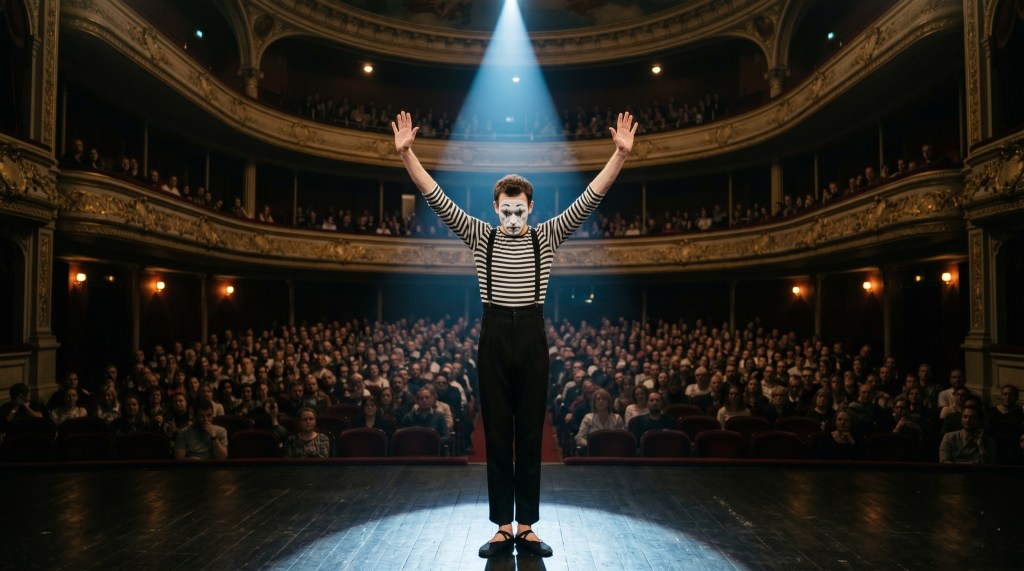
I reach for the box of cleansing pads on the dressing room shelf. The face in the mirror belongs to Auguste – white and exaggerated and ancient, the mask I have worn for eight years of professional performance on four continents. Tonight’s show was the third of a seven-night run. The house was full, as it has been full every night: nine hundred and thirty-two people in tiered red seats, holding their breath in places that I have spent months engineering precisely for that purpose.
There is a moment in the second act – I think of it as the still point – where I hold a single gesture for four full seconds. Both hands raised, palms outward, head slightly bowed. It began as a piece of blocking. It has become, over years of refinement, something closer to a question posed to an audience in a language that has no grammar and requires no translation. Four seconds of complete silence in a room of nearly a thousand people.
No word has ever done that for me.
I wipe the first layer of white from my jaw and watch myself emerge underneath it – ordinary, angular, thirty-five – and I think about Cara’s face when she realised what she’d said. The horror of it. The sincere, mortified horror. And I think, not for the first time and certainly not for the last, about how much energy is spent in this life apologising for words, defending words, retracting words, softening and qualifying and walking back words, while the rest of the body simply gets on with telling the truth.
Use your words.
I have been answering that instruction for as long as I can remember.
People are only just beginning to understand the reply.
II: The Words He Never Had
Let me tell you what it is to grow up silent in a world that never stops talking.
I should say first that silence, as I experience it, is not what most people imagine when they close their eyes and try to conjure it. It is not peaceful. It is not monastic. It is not the silence of a library or a snowfall or the moment before a piece of music begins. The silence that belongs to me is an active thing, a presence rather than an absence, because it exists entirely in contrast to everything around it. Silence only means something in noise. I have always been surrounded by noise. My silence, therefore, has always been deafening.
My family were not quiet people.
My father, Graham, had the voice of a man who had decided early in life that volume was a form of authority. He sold commercial insurance and he was good at it, which tells you most of what you need to know. My mother, Pauline, compensated for every room my father filled by filling the ones he didn’t. She was a talker in the way that some people are knitters or collectors – compulsively, comfortingly, as though the act of it kept some private anxiety at bay. And my sister, Deborah, four years older and constitutionally unable to let a silence sit for longer than three seconds, completed the arrangement. The Mander household was not a place where quiet was permitted to gather. It gathered anyway, wherever I was.
The dinner table was its own education.
I should be precise: they never excluded me deliberately. I want to be fair to them, and fairness requires precision, and precision is the one discipline that a lifetime of enforced non-verbal communication will absolutely beat into you. They loved me. Of that I have never had serious doubt. But love, I learned early, can operate in ways that manage you rather than see you, and my family’s love had developed, by the time I was old enough to notice it, a set of habits that were considerably easier for them than they were for me.
My mother had the fastest reflexes in the room. Before I could reach for the notepad that lived beside my plate – a spiral-bound thing, replaced every few weeks, a domestic fixture as ordinary as the salt – she would already be translating me to whoever needed translating to. “Ralph wants to know if there’s any more of the potatoes.” Sometimes she was right. Sometimes she wasn’t, and I’d sit there with the notepad half-raised, the correction already written, while the conversation moved on without me like a bus pulling away from the kerb. She was not doing it to silence me. She was doing it because she loved me and because waiting – the quality of waiting that I required – made her anxious in a way she could not sit with.
My father’s version was different. He did not answer for me. He simply, incrementally, stopped asking.
Not all at once. Not cruelly. But I watched it happen over years with the attentiveness of someone who has learned to read rooms because rooms are all they have. The questions at dinner became fewer. The silence around me became, in his company, a different texture to the silence anywhere else. His silence around me had the quality of a problem he’d decided to stop trying to solve. I was fourteen before I understood that it wasn’t contempt. It was helplessness. My father was a man who fixed things, who sold certainty for a living, who believed that most difficulties responded to sufficient confidence and direct speech. I was a difficulty that responded to neither, and I think it frightened him in a way he never found the words for.
Which, given everything, strikes me now as almost beautifully apt.
School was where I learned to perform.
Not mime – that came later. I mean the other kind of performance: the daily management of other people’s discomfort. The calibrated expressions, the reassuring nods, the carefully deployed smiles that said I am fine, you don’t need to feel awkward, we can all move along now. I became extremely good at it. It is exhausting work and I began it at the age of five, which means I have now been doing it for thirty years without a sabbatical.
The classroom in those early years operated on a simple and absolute principle: participation meant speaking. It meant putting your hand up and having sounds come out of your mouth when the teacher pointed at you. Everything else – the thinking, the understanding, the knowing – was secondary evidence at best. I understood everything. I was tested separately, written assessments, one-to-one sessions with a teaching assistant who had a tendency to over-enunciate at me as though I were learning English as a foreign language. I was not learning English as a foreign language. I was, if anything, more intimately acquainted with English than most of my classmates, because I had been reading it voraciously since I was four years old, filling the space that speech would have occupied with every book I could reach.
But the classroom has its own social weather, entirely separate from the curriculum, and in that weather I was poorly equipped.
The boys who decided mute meant stupid were not the worst of it, strange as that sounds. They were navigable. You learn quickly, at that age, that cruelty has a shape and a rhythm and if you understand the rhythm you can often step out of the way of it. The ones who were kind were considerably more difficult, because kindness without comprehension is its own form of diminishment. The careful voices. The slowed-down explanations. The way a well-meaning classmate might put his hand on my shoulder during a group task and say, with enormous gentleness, “it’s all right, Ralph, we’ll do the talking part.” Yes. Thank you. I am aware.
There was one exception, and he matters enough that I want to be careful about how I describe him.
Mr Caffrey. Year Six, so I would have been ten or eleven. He taught English and had a slight West Country accent that I found immediately reassuring without being able to say why. He did not slow down for me. He did not answer for me. He called on me the same way he called on everyone else, held the pause while I wrote, read what I’d written aloud to the class with the same intonation he’d have given a spoken answer, and then moved on. It sounds like a small thing. I assure you it was not a small thing. It was, in the architecture of my childhood, a structural beam.
Towards the end of the spring term he left a book on my desk after class. No note, no ceremony – just the book, face down, as though it had been accidentally left there by someone who hadn’t meant anything by it. It was a biography of Marcel Marceau. I read it in a single night. I didn’t sleep. I lay on my stomach in the light from my bedside lamp and read about a man who had survived the Second World War, who had led Jewish children to safety across occupied France partly by teaching them to walk silently, and who had then built from that silence something that filled theatres across the world for decades.
A man who had never needed to use his words.
I have not spoken to Mr Caffrey since I was eleven years old, but if I could write him a note today it would say, simply: you changed the direction of my life with a paperback. I hope you know that. I hope someone has told you something equivalent about yourself, because everyone deserves to be told.
College was freedom and loneliness in such close proximity that I spent three years unable to fully separate them.
I studied performance at a conservatoire in London. Got in on the strength of an audition piece that the panel later told me was the most unsettling thing they had seen in twenty years of auditions. I took that as a compliment, which I believe was the correct reading. The training was serious and physical and demanding in ways that suited me in every professional respect, and the social architecture of communal living was quietly dismantling me at the same time.
It is one thing to be silent in a family, in a school, in contained and structured environments where the rules are at least legible. It is another thing entirely to be silent in a student house at midnight when six people are sprawled across the living room furniture talking about nothing – the magnificent, easy, circling nothing of people who are young and don’t yet know it. I would sit in that room and watch them and understand, with a clarity that was almost clinical, exactly what I could not access. Not the content. The texture. The way conversation between people who are comfortable with each other is less about information exchange and more about the pleasure of the exchange itself – the interruptions, the digressions, the half-finished sentences that the other person completes because they already know where you’re going.
Nobody ever knew where I was going.
Relationships, for me, required patience of a kind that is genuinely rare. I knew this. I accepted it the way you accept a chronic condition: not happily, but practically, because the alternative is to spend your life catastrophising and I have always found catastrophising to be a poor use of what is, when you examine it, perfectly good cognitive space.
There was a woman called Nina in my second year. She was studying stage design, originally from Ljubljana, with the kind of direct intelligence that I found immediately appealing and that was, I think, what drew her to me as well. She stayed for seven months. She tried – and I want to be accurate about this – she tried with a sincerity and a sustained effort that I have never stopped respecting. She learned enough sign language to have basic conversations. She carried a notepad in her bag without being asked. She was patient with the time it took, patient with the looks in restaurants, patient with the careful choreography of a life conducted without speech.
Seven months. And then she sat across from me at the kitchen table one evening and said, very quietly, without cruelty, without anything other than a genuine and exhausted sadness: “I just need someone I can talk to, Ralph. I need to be able to just – talk. Without thinking about it.”
I picked up the notepad.
I wrote: So do I.
She cried. I didn’t, not in front of her, though I’d be lying if I suggested the evening ended tidily. She left a fortnight later and we parted without bitterness, which is perhaps the most adult thing I have ever managed. I have thought about Nina periodically ever since, not with grief exactly – grief requires the belief that things could reasonably have gone differently – but with a kind of retrospective tenderness for two people doing their best with an arrangement that was always, structurally, asking more than it could give.
The phrase came with me through all of it, you understand.
It surfaced at the dinner table and in the classroom and in my college seminar on Brecht when the tutor lost patience mid-discussion and said it without thinking. It came from an aunt at Christmas who’d had two glasses of mulled wine and meant absolutely no harm by it. It came from the therapist I mentioned, and from a casting director, once, who had the grace to look appalled at himself immediately afterwards. It is embedded in the language like a reflex, like a tic, and it follows me the way certain songs follow you – not because you invited them, but because you’ve heard them so many times that they’ve simply taken up residence.
I am removing the last of Auguste’s face now. The greasepaint comes away in long strokes, white on white, the pad darkening as the mask dissolves. In the mirror, Ralph Mander is assembling himself out of the residue of someone else’s face, which is, when I think about it, a reasonably accurate description of most of my childhood.
The wit that I have leaned on all my life – and I do lean on it, heavily, it is a weight-bearing wall rather than a decorative feature – was not always available to me. There were years when I had not yet developed the equipment to find any of this funny. When the dinner table felt not like a comedy of missed connections but simply like a room I could not get out of. When school was not a theatrical education in managing other people’s discomfort but just a place where I was, daily, reminded of everything I lacked. When Nina leaving was not a thing to be examined with retrospective tenderness but a door closing on a version of a life I had briefly and stupidly allowed myself to want.
I am telling you this because the philosophical composure, such as it is, was earned. It was not issued at birth along with the silence. I built it the way I have built everything – slowly, physically, through repetition and failure and the gradual, grudging discovery that the body, if you attend to it carefully enough, knows things the mind refuses to accept.
I learned to use my words.
It simply turned out that none of them were in the dictionary.
III: The Answer
The theatre is emptying.
I can hear it from here – the acoustic shift that happens when a full house begins to thin, the way the building seems to exhale as the people file out of it. Doors opening and closing in diminishing sequence. The muffled gathering of coats. The distant, echoing conversation of the front-of-house staff beginning the work of restoring order to the foyer. A theatre emptying after a performance has a sound entirely distinct from a theatre emptying for any other reason, and after eight years of professional work on stages across four continents, I can read it the way a sailor reads a change in the wind. Tonight it is slow and reluctant. That is the best kind.
They didn’t want to leave.
I know this not because anyone has told me, though Cara knocked on the dressing room door twenty minutes ago and slid a note underneath it that said standing ovation, third night running, the AD is absolutely over the moon – with a small hand-drawn moon in the corner that I found, despite everything, rather charming. I knew it before she knocked. I knew it in the second act, during the still point, in the four seconds that I have been perfecting since the piece was in its second week of development in a rehearsal room in Brussels with no audience and inadequate heating.
Four seconds.
I want to try to describe what those four seconds feel like from my end, because I don’t think it maps onto anything that happens in the conventional relationship between a performer and a room. It is not the silence of an audience waiting for something to happen. It is the silence of an audience that has, without warning and without quite understanding how, been relieved of the need for anything to happen. Both hands raised, palms outward, head slightly bowed. The gesture arrived during a rehearsal run-through as an instinct and stayed because it was true, which is the only reason any gesture stays. In those four seconds I am not performing. I am simply present, and the room, taking its cue from me, becomes simply present with me.
Nine hundred and thirty-two people.
Not one of them spoke.
I have been thinking, as the greasepaint comes away and Ralph Mander reconstitutes himself in the mirror, about language. This is not unusual. I think about language the way, I imagine, a person born without sight thinks about colour – with a sustained and genuinely forensic interest that a sighted person might never develop, precisely because they have never been required to question what they are taking on trust.
Here is what I have concluded, after thirty-five years of enforced observation: language is a magnificent, promiscuous, and deeply unreliable instrument.
I mean this with enormous affection. I am not one of those people who affects a disdain for words. I read voraciously, always have – novels, philosophy, biography, the backs of cereal packets if that’s what’s available. I think in words, structured and sequential and occasionally quite well-phrased, though I’ll admit the audience for that has historically been limited to myself. Language is extraordinary. It has produced Shakespeare and Chekhov and the King James Bible and the precisely worded note from Cara with its small hand-drawn moon.
It is also the instrument with which people lie to the faces of those they have promised to love. It is what a man uses to say I’m fine when he is not fine, and I forgive you when he doesn’t, and I do when what he means, and knows he means, is I’ll try, for now, until I stop. Words are what people hide inside. They are the most sophisticated concealment technology ever developed, deniable at every level – that’s not what I meant, you misheard me, I was speaking hypothetically, you’re too sensitive, I never said that. The architecture of language allows for infinite revision and zero accountability, and the world makes full and enthusiastic use of both provisions.
My body has never lied to anyone.
I don’t say this with pride, exactly. It is not an achievement so much as a condition of the work. When you train for years to make your physicality a transparent medium – to remove every habitual gesture, every nervous tic, every piece of unconscious self-protection that the body accumulates like barnacles – you lose the ability to be physically dishonest in any meaningful way. I cannot mask with my body what I mean. I have given that up in exchange for the ability to say, with that same body, things that words cannot approach without assistance from three other disciplines.
It is, on balance, a reasonable trade.
I think about Marceau.
I think about Keaton – that extraordinary face, the one that never moved, that somehow by its absolute stillness became a screen onto which an audience projected everything they felt, so that the emotion in any given scene existed not in the performer but in the room. I think about Jacques Tati, who understood that comedy is fundamentally a spatial art, a matter of where a body is in relation to the world around it. I think about Pina Bausch, who took the body’s grammar and restructured it into something that made literal language look like a first draft.
None of them needed to use their words.
What they understood – what I understood at the age of eleven, lying on my stomach with a biography of Marceau and my whole future rearranging itself around me – is that the body is not a lesser medium. It is not the fallback when speech fails. It is the original. It is older than every alphabet, older than every language that has ever lived and died, older than the written record of any civilisation that has ever committed itself to paper or stone or clay. Before anyone told a child to use their words, the child was already communicating with devastating precision using the only equipment it had. The words came later. The body was always there.
Language is the translation. We have confused it, over time, for the source.
I should like, in the abstract, to say something to all of them.
Not Cara, who is twenty-two and sorry and drew a moon. Not my mother, whose anxiety expressed itself as love and who has, in the past decade, learned to wait in a way that has cost her something and which I have never adequately acknowledged. Not Nina, who needed what she needed and was honest about it, which is more than most people manage.
I mean the others. The casting director. The therapist. The college tutor who said it mid-seminar. The boys at school. My father, in his long silence that mirrored mine but meant something entirely different. Every stranger in every restaurant and every stage manager and every well-meaning, unreachable person who looked at me and saw, first and last and most, a deficit.
I have composed what I would say to them. I have had, after all, considerable time to work on it. The version in my head is eloquent and precise and lands, I think, with exactly the weight it ought to. It makes the argument completely. It leaves no significant counter-argument unaddressed. It is, as far as I can judge these things from the inside, rather good.
I have decided it is better left unsaid.
Not out of reticence. Not out of the stoic resignation that people sometimes project onto me, the assumption that my composure is suppression rather than genuine equanimity. I have decided it is better left unsaid because saying it – even in the hypothetical, even in the privacy of a dressing room in York with greasepaint on a cotton pad and a standing ovation still settling into the walls – would require me to accept the premise. It would require me to stand inside the logic that decrees language as the site where accounts are settled and meanings are established and one person finally, definitively proves something to another.
I don’t accept the premise.
I haven’t accepted it since I was eleven years old.
I stand.
The mirror gives me back a man in a dress shirt with a collar not yet fastened, a trace of white still at the left temple that I’ve missed, eyes that are, at the end of a performance night, always slightly more awake than they have any right to be. I reach for my jacket from the back of the chair. Shrug it on. Fasten the collar button – I am aware this looks faintly eccentric without a tie, and I find I don’t mind. I have made my peace with looking faintly eccentric. It is, professionally speaking, a useful reputation.
I catch my own eye in the mirror.
The expression that crosses my face in that moment is not quite a smile and not quite defiance and not quite the private satisfaction of a point proven, though it contains elements of all three. It is something more distilled than any of those things. It is what is left when you subtract the performance from the performer and find that what remains is – sufficient. Not triumphant. Not healed in the way that stories prefer their characters to be healed. Just sufficient, which is, I have come to believe, a deeply underrated condition.
I pick up the note from the floor. Read it once more. The small hand-drawn moon. I fold it and put it in my jacket pocket, which is a thing I do with notes that have earned it, and not every note does.
Then I turn off the dressing room light and I walk out into the corridor where the theatre is almost empty now and the building is breathing its long, slow, post-performance breath, and I think – as I think every night, in some form, because it is the thought that the work keeps returning me to – about what it means to be heard.
Not understood. Not accommodated. Not communicated with, carefully, by someone who has made a generous effort with a notepad and a patient expression.
Heard.
Nine hundred and thirty-two people sat in the dark tonight and heard me. Not a word of it was spoken. Every syllable of it landed.
Use your words.
I have been using them for twenty-four years, since a biography landed on a school desk in a town in Suffolk and a man with a West Country accent pretended not to have left it there. I have used them on stages in London and Paris and New York and Tokyo and in a rehearsal room in Brussels with inadequate heating and in this theatre tonight, in a second act, in four seconds of stillness that nine hundred and thirty-two people will carry home with them in ways they won’t entirely be able to explain to anyone who wasn’t there.
They have, all of them, always been my words.
The world is simply still learning to listen with the right part of itself.
I walk towards the exit. Behind me, the stage waits in the dark – patient, empty, ready – and the last of the audience makes its way out into the night, and somewhere in the foyer a woman is telling her companion, in what she imagines is a low voice, that she doesn’t quite know how to describe what she just experienced.
I know exactly how to describe it.
I always have.
Bob Lynn | © 2026 Vox Meditantis. All rights reserved.


Leave a Reply