I: The Road as Confession Booth
The pre-dawn is the best part. Most people will tell you that’s when the road is empty and they mean it like a warning, like loneliness is something that creeps in through the dark. Maybe you think that too. You’re sitting there quiet enough. That’s all right. I don’t need you to talk. I drive better when nobody’s talking.
Three forty-seven in the morning, somewhere between Amarillo and nowhere, and the only light is what the headlights make. Forty-two feet of trailer behind me. Fourteen tonnes of tomatoes, if you can believe it. I haul produce now. Peppers, potatoes, strawberries. Things that bruise easily. There’s a joke in there somewhere, I expect.
I’m sixty-eight years old. I have crow’s feet from squinting at sunrises over every interstate this country has to offer, and a voice that sounds like gravel being poured into a tin bucket. That’s what my last dispatcher said. He meant it as a complaint. I took it as a description. I’ve been driving seven years. I’m not sure he works there anymore.
Before this, I was a hospice nurse for thirty-one years. Ward nurse first, then community, then a palliative care unit outside Pittsburgh that smelled of lavender air freshener and disinfectant and, underneath both of those, something older and quieter that I never found a proper name for. I sat with the dying. I held hands that were hours from going still. I learned, over three decades, what a person reaches for at the end. And I can tell you now that it is almost never what you think it’s going to be.
They don’t reach for their bank accounts. They don’t reach for their promotions, their accolades, all those things we spend our best years accumulating like they’re going to mean something when the room gets quiet. In thirty-one years, I never once heard a person say: I wish I’d worked harder. I wish I’d been more productive. Not once. Not from a single mouth, in a single room, in three decades of rooms.
I’ll come back to that.
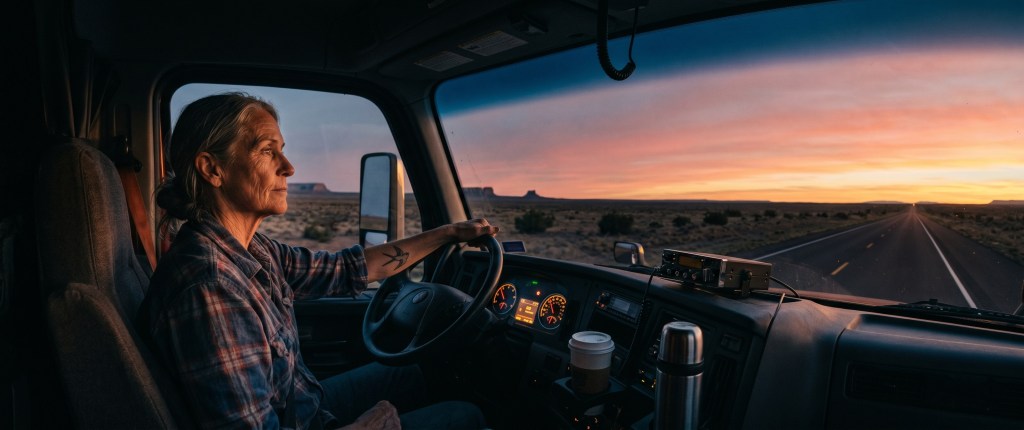
[She glances down at her left arm resting on the wheel. On the inside, there is a tattoo of a small brown sparrow, rendered in clean, uncoloured lines. She looks at it for a moment, then back at the road.]
I got this the week I retired from nursing. Seven years ago last March. People asked me what it meant and I told them I’d think about it and let them know. I’m still thinking. But I’ve got a theory now. I’ll get to that too.
Right now I want to say something I have never said out loud. Not to a colleague, not to a therapist, not to the highway patrol officer who once found me sitting on the hood of the cab outside Flagstaff at two in the morning watching a meteor shower and asked, very carefully, if I was doing all right. Not to anyone. Not in any version of the words.
I don’t know why now. Maybe it’s the dark. Maybe it’s the tomatoes. Maybe it’s just that I’m sixty-eight years old and the road ahead is shorter than the road behind, and some things want saying before the exit comes up.
So.
II: The One Who Laughed Like a Drainpipe
I was twenty years old.
I want you to hold that number for a second before I go on. Twenty. You’re barely cooked at twenty. You’ve got opinions you think are convictions, and fears you think are instincts, and you walk around carrying both like they’re the same thing. I did, anyway. Twenty years old in a shared house in Pittsburgh with woodchip wallpaper and a boiler that knocked all night, and a whole future stretched out ahead of me like a road I hadn’t earned yet.
There were people who broke my heart that year. I expect you had some too. Big, loud, theatrical heartbreaks. The kind that feel, at the time, like they’re going to leave a permanent mark. And they do, for a while. But here’s the thing about loud heartbreaks: they burn clean. You grieve them, you get up, you get on. By the time I was thirty I couldn’t have told you the last name of the person I cried hardest over at twenty. Couldn’t have told you the colour of their front door. That’s not bitterness. That’s just time doing its job.
The people who break your heart at twenty won’t even be a footnote by thirty. That’s not a comfort I’m offering you. It’s just true. File it away.
But there was another one.
She wasn’t loud. She never made a scene in her life, as far as I knew. She was quiet in the way that some people are quiet, where you first think it means she’s got nothing to say, and then you sit with her for an hour and realise it means she’s got too much, and she’s choosy about the spending of it. Dark hair. Worked at the library on Ellsworth Avenue three evenings a week and studied geology the rest of the time, which I always thought was the most quietly confident thing in the world, deciding to spend your life reading the patience of rocks.
She laughed like a drainpipe clearing after heavy rain. I know how that sounds. I know it’s not what you’d call a compliment if you didn’t hear it. But it came from somewhere low and genuine and it arrived without warning, and every time it happened I felt like I’d been let in on something private.
She remembered how I took my coffee without ever being told twice. Two sugars, a splash of cold water so I could drink it faster. She never mentioned remembering. She just did it. Every time.
[A beat. She adjusts her grip on the wheel.]
I let her go.
Not because she asked me to. Not because circumstances intervened, or the timing was wrong, or any of the other clean excuses people reach for. I let her go because I was twenty years old and convinced, with the total certainty of the young and frightened, that I was not enough. Not clever enough, not steady enough, not worthy of someone who remembered how I took my coffee without being asked. I thought: she’ll work it out eventually. I thought: better it comes from me first, the ending, before she gets there herself.
So I made myself small. I made myself scarce. And she, being who she was, quiet and proud and not in the business of chasing people who were already leaving, let me go right back.
[A long pause. The engine hums. A mile marker passes.]
I thought about her for years afterwards and told myself that was just nostalgia. The comfortable weight of a road not taken. I was busy by then anyway: training placements, night shifts, a career that asked everything of me and got it. I was good at the work. I was very good at the work. I held dying people’s hands and made sure they weren’t frightened and I went home and I slept six hours and I went back. For thirty-one years. And that mattered. I’m not sitting here telling you it didn’t.
But here’s what I learned in those thirty-one years. Here’s what three decades of being present at the end of things will teach you, if you let it.
In those last hours, when the room goes quiet and the morphine has done what it can and there’s nothing left but the waiting, people talk. Or they don’t talk, but their faces do. And what they’re reaching for, almost every single time, is not an achievement. It is not a possession. It is not a version of themselves they’re proud of.
It is a face.
Just a face. Sometimes a name attached to it, sometimes not. Just the memory of a person who once looked at them like they were worth looking at, and the mute, belated understanding that they should have stood still long enough to let themselves be seen.
I saw that. Thirty-one years of that. And it still took me until I was sixty-one years old, sitting in a truck cab outside Pittsburgh with the engine running and the rest of my life suddenly optional in front of me, before I understood that I’d been carrying my own version of it all along.
[She lifts her wrist briefly from the wheel. Glances at the sparrow. Sets it down.]
So. If I could go back.
If I could sit down next to that twenty-year-old girl in the woodchip-wallpaper house and say one true thing before she makes the mistake she’s already lining up to make:
I’d say: You’re not good enough for her. That’s true. You’re twenty years old and you’re a mess and you don’t know yet how to be still with another person. But she wouldn’t care about that. She already knows what you are and she’s making you coffee and laughing that laugh and she’s still there. That’s not an accident. That’s her telling you. And you are going to let your own fear do the loudest thing it knows how to do, which is to make the decision for her, and you’ll call it consideration, and it won’t be.
Don’t do that.
Let her tell you herself.
[Her hands are steady on the wheel. Her voice has not cracked. Outside, the dark is just beginning to suggest the outline of something approaching.]
III: The Sparrow and the Sunrise
The light is coming up over New Mexico now.
That’s where we are, if you were wondering. US-60, heading east toward Encino, and the sky is doing what desert skies do at this hour, which is put on a performance nobody asked for and absolutely nobody deserves at five in the morning. Salmon pink at the edges. A thin blue overhead that isn’t quite sure of itself yet. And the land out here is flat enough that you can see the whole argument happening at once, the dark retreating and the light insisting, and there’s something almost rude about how beautiful it is. Like it doesn’t care whether you’re watching or not. Like it would do this every single morning whether there was a sixty-eight-year-old woman in a truck cab having the most honest conversation of her life, or nobody at all.
I find that comforting, if I’m being truthful. The indifference of it.
[She glances at the sparrow on her arm. This time she looks at it for longer.]
All right. The tattoo.
I got it the week I retired from nursing. March, seven years ago, at a small parlour in Lawrenceville run by a young woman who had steadier hands than anyone I’d worked alongside in thirty-one years of hospital wards, which I told her and she took in her stride. I knew what I wanted. I’d thought about it for a while. A sparrow. Clean lines. No colour. Just the bird.
People assumed it was sentiment. Something about the soul, or freedom, or one of those easy symbols that tattoos tend to attract. A couple of colleagues at my leaving do suggested it was because sparrows are common birds, overlooked birds, and they meant it kindly, as a tribute to the unglamorous dailiness of the work. I let them think that.
The real reason is this. Sparrows don’t navigate by instinct the way some birds do. They don’t carry a compass in their chest, pointing them toward magnetic north without any assistance. They navigate by landmarks. They learn a landscape by moving through it, and they remember what they’ve passed, and they use what they remember to know where they are.
I thought that was worth putting on my body.
I’m not going to stretch that any further. It means what it means.
[She sets her wrist down. The sky outside is brightening by degrees.]
I want to say something clearly before I finish, because I know how this kind of thing can sound from the outside. I know the shape of it: older woman, alone on the open road, talking about the one that got away. I know what you might be assembling from those pieces.
I am not unhappy.
I want to be precise about that. This life, the truck, the pre-dawn starts, the tomatoes, the fourteen hundred miles between me and anyone who knows my name well enough to shorten it. I chose this. Not because I was running from something, or not only that, but because I got to sixty-one years old and looked at what I’d spent and what I had left, and decided that the remaining portion was mine to spend as I saw fit. And what I saw fit was this. The road. The silence that isn’t really silence. The sky doing that.
There is a difference between being alone and being lonely. I have been both. I know the difference the way you know the difference between a bruise and a break: same location, different depth. Right now, at five in the morning over New Mexico, I am alone. That’s all. That’s the whole of it.
I don’t regret the life. I want to be clear about that too.
What I regret is smaller than the life. It’s the size of a face I haven’t seen in forty-eight years. It’s the size of a laugh I can still hear if I let myself, low and sudden and real, in the cab of a truck on an empty road at the edge of a breaking day. It’s that size. Not larger.
[A long pause. The salmon pink is spreading now, eating the blue at the edges.]
So. One last thing for that twenty-year-old girl in the woodchip house.
Not advice this time. I gave you the advice already. Take it or leave it; I suspect you’ll leave it, because you always did have to learn things the hard way, which is the only honest way, really, if you’ve got the stomach for it.
This is just: thank you.
Thank you for not knowing what you were doing and doing it anyway. Thank you for thirty-one years of holding the hands of strangers at the end of things, because that work mattered and you were right to give yourself to it, even though it cost you in ways you’re still counting. Thank you for being frightened and getting in the truck regardless. For learning, somewhere around mile four hundred of your first solo run, that there is a difference between driving away from something and driving toward something, and that the second one feels entirely different in the body, and that you were doing the second one.
You worked it out. Slowly. In the wrong order. But you worked it out.
[She reaches across to the radio. Finds something old. Doesn’t name it. Turns it up just enough. The sky is fully pink now. The road is straight and long and hers. She keeps driving.]
Bob Lynn | © 2026 Vox Meditantis. All rights reserved.


 Vox Meditantis
Leave a comment