I: The Pile
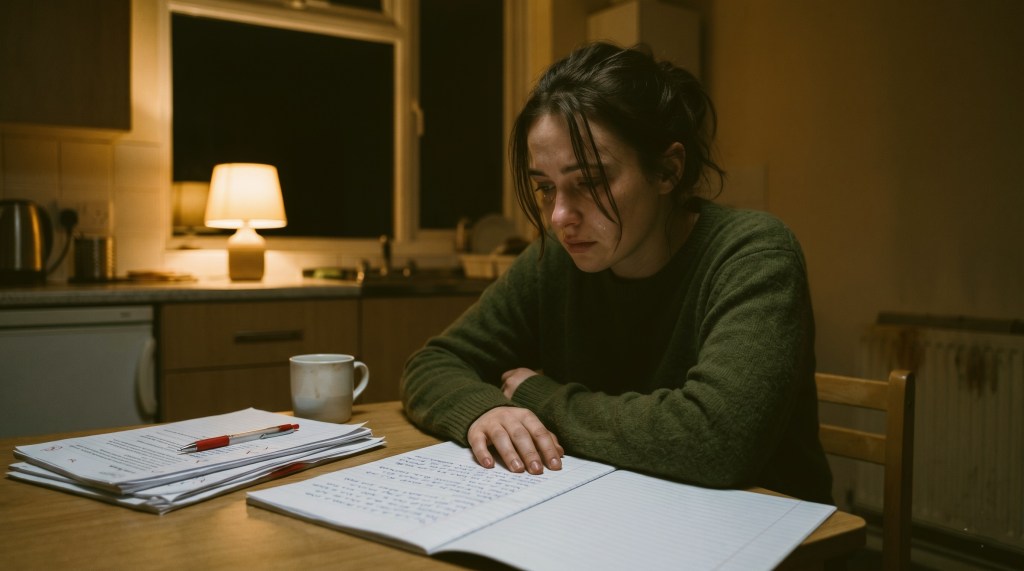
Twenty-six essays. Twenty-six. I counted them twice before I sat down, the way you might count out tablets from a bottle, steeling yourself. They’re stacked on the kitchen table in front of me now, squared off neatly at the edges, which is the only act of optimism I’ve been able to manage this evening. That, and the tea. The tea I made twenty minutes ago and have not yet touched.
I’m Kate, by the way. Kate Nichols. Twenty-seven years old. Primary school teacher. Year Six. And before you say anything – yes, I know. I know what people say about teachers and their holidays and their hours, and I have made my peace with the fact that those people have never once sat at a kitchen table on a Friday night in November with a red pen, a cold cup of Yorkshire tea, and twenty-six essays about the meaning of life. So.
I love this job. I want to be clear about that, because what I’m about to say might not sound like it. I genuinely, deeply love this job. I love the noise of it and the mess of it, the way a classroom at half eight in the morning smells of packed lunches and damp coats and something almost like possibility. I love the moment when a child who has been staring at a page for twenty minutes suddenly looks up with that expression – not quite surprise, more like recognition – as if the idea they needed had been hiding just behind their eyes all along, and has finally decided to come out. I live for that moment. I chose this job for that moment.
I also set my Year Six class an essay topic three weeks ago called “What Is the Meaning of Life?” and I am now facing the consequences of that decision like a woman standing in front of a bonfire she has lit herself.
It seemed right at the time. We’d been doing a unit on philosophical writing – structuring an argument, supporting a viewpoint, writing with conviction rather than just with information – and I wanted a topic that would genuinely open them up. Something they couldn’t just Google and copy out. Something that demanded a real opinion. I remember standing at the front of the room and writing the question on the board in big letters, feeling rather pleased with myself, watching thirty pairs of eyes go wide. A few of them groaned. Chloe Marsh put her hand up and asked if she could write about football. I said yes, so long as she made an argument. She seemed satisfied.
I should have known then, really.
Right. First essay. I uncap the red pen. I take a breath.
The meaning of life is to become a professional footballer and win the World Cup for England. I want to play for Manchester City first but then maybe Real Madrid because they pay better. The meaning of life is also to have a big house and a nice car maybe a Lamborghini.
Tyler Bennett. Eight out of ten for ambition, Tyler. I write good effort – try to develop your argument in the margin, which is teacher for I have questions, and move on.
The next four follow a pattern so consistent it begins to feel almost ceremonial. There is the pop star who will win The X Factor. There is the YouTuber who will have ten million subscribers. There is the girl who wants to be a vet but also rich and also famous, as though these are the three points of a compass by which a life can be reliably navigated. There is the boy who wants to own a gaming company, which is at least entrepreneurial, I suppose, and I give him a small mental tick for creativity before I notice that his entire second paragraph is about the size of his eventual yacht.
I am not, for a single second, judging them. I want to say that with some force. They are ten and eleven years old. The world as it has been presented to them – through screens, through adverts, through the strange ambient noise of modern life – tells them, constantly and without apology, that the meaning of life is acquisition. Get the thing. Win the prize. Accumulate. And these children are clever enough to have absorbed that message entirely and reproduce it with real enthusiasm, which is, in its own way, exactly what I asked them to do. Write with conviction. Support your viewpoint. They have done both.
It’s just that the viewpoint, across roughly twenty of the twenty-six essays, is: more.
I pause at Jake Humphrey’s essay, because Jake has written, rather wonderfully, that the meaning of life is to have lots of dogs. Not one dog. Lots. He has listed seventeen breeds by name. I smile at this and write creative and heartfelt before I catch myself and add expand on your reasoning so it looks educational.
And then there’s Ishika’s. Ishika Mehta, who is one of those children you get once every few years – the ones who seem to be operating on a slightly different frequency from everyone else, quietly thoughtful, always watching. Ishika has written about her grandmother. About the way her grandmother makes rice and the whole ritual of it: the washing and the measuring – I circle the word in my own head and rephrase – the way her grandmother hums while she stirs. Ishika says the meaning of life might be in the things we do the same way every time because they belonged to someone we loved before us. It’s three paragraphs and a little raw and the spelling of inherited has gone quite badly wrong, but I sit with it for a moment before I mark it. It is clearly and recognisably alive in a way that most of the pile is not.
I write beautiful, Ishika and immediately feel unprofessional and do not care.
It’s getting dark outside. I get up and switch the lamp on, and in doing so I catch my reflection in the window, which I resent. There’s red pen on my index finger. My hair is doing the thing it does. I look exactly like a twenty-seven-year-old woman who has been marking essays for two hours on a Friday evening and has not yet touched her tea, which is what I am, and somehow this seems important to acknowledge.
I make fresh tea.
I come back to the table.
There are two essays left in the pile. I glance at the top one, note the name, and find myself setting it aside without quite deciding to. Because the last essay is Anna Kovacs’, and I have been aware of it at the bottom of the stack for the last hour the way you are aware of a letter you are not quite ready to open.
Anna is one of those children who sits in the middle row, not because she’s been placed there strategically but because she genuinely seems to prefer a vantage point from which she can see everything without being the centre of it. She never shouts out answers. She never performs. She just – listens. Watches. Writes. When she hands work in, there’s always something a little careful about the way she does it, like she’s passing you something fragile and is trusting you not to drop it.
Her essay is longer than the others. Considerably longer. It’s handwritten in blue ink, neat and even, on lined paper that she’s clearly taken some care over. She hasn’t printed it off the computer like most of them. She hasn’t illustrated it with clip art of Lamborghinis.
I set down the red pen. I’m not sure why. Some instinct.
I pick up the essay. And I begin to read.
II: Anna’s Essay
Anna has written at the top of the first page, in careful block capitals: WHAT IS THE MEANING OF LIFE? A STUDY.
Not an essay. A study.
I sit with that word for a moment. I look at it. She is ten years old, and she has used the word study, and I feel something shift quietly in my chest, the way ice shifts on a river in early spring – not breaking, not yet, just beginning to move.
Her introduction is two short paragraphs. In them, she explains – with a steadiness that seems beyond her years and yet is written in entirely recognisable ten-year-old handwriting, the letters slightly large, the full stops pressed firmly into the page – that she has decided not to write about what she herself thinks the meaning of life is. She says this is because she has thought about it seriously and reached the conclusion that she is not yet old enough to know. But she has decided that some people in her life probably are old enough, and that the best essay she can write is not one full of her own ideas, but one that goes out and finds the ideas of people who have lived longer and thought harder. She says she hopes this is all right.
I put the page down. I pick it up again.
She hoped it was all right.
I think about Anna Kovacs sitting at whatever passes for a desk in her home, composing that sentence, genuinely uncertain whether her interpretation of the brief was acceptable, and I feel a surge of something so fierce and so fond that I have to take a breath before I can carry on. Yes, Anna. It is more than all right. It is the only right answer to a question like this, and you worked that out yourself, and I have a master’s degree in education and I’m not sure I would have thought of it.
I turn the page. I keep reading.
She interviewed three people. She explains this plainly, in a short paragraph that serves as a kind of contents page, which she has also numbered. I notice the numbering. She has structured this. She thought about the order.
The first interview is with her mum.
I know a little about Anna’s home life – the way you accumulate fragments, as a teacher, without ever quite assembling the full picture. I know her mum is on her own. I know there are two younger siblings. I know that Anna sometimes comes in with her hair still damp, which suggests mornings are busy and she is largely managing them herself. I know that when we had the school trip to the museum in October, Anna was one of three children who needed a subsidised place, and that she had handed in her permission slip without the accompanying note her mother was supposed to sign, and had signed it herself, and had not mentioned this, and I had pretended not to notice.
That is what I know. What Anna’s essay shows me is rather more.
She doesn’t say it directly – she is far too careful for that, and I wonder whether some instinct to protect her mum had shaped the telling – but between the lines of Anna’s careful, verbatim-style reporting, I can read the room. Her mum was tired when Anna interviewed her. Anna notes that she was washing up at the time and that she did not stop washing up during the conversation, which Anna records as a simple fact and which lands on me as something more. She asked her mum: what is the meaning of life?
And her mum – this woman I have never met, this woman up to her elbows in washing-up water at the end of another long day – said something that Anna has written down with evident pride, as though she had suspected her mum might be wise and had now had it confirmed.
She said: the meaning of life is the small things you nearly miss. She said it’s the feeling of a sleeping child’s weight on your arm, even when the arm has gone numb and you daren’t move. It’s the first sip of tea when the house is finally quiet. It’s a text from someone who was just thinking of you for no reason. She said the big things – the achievements, the milestones, the events you plan for years – those are important, but they flash past too quickly to live inside. It’s the small things you can actually hold. It’s the things you nearly miss that turn out to be everything.
Anna has written underneath, in brackets: (I think Mum was talking about us kids, but she didn’t say that.)
I put the page down again. I press my fingers briefly over my mouth. I think about a woman at a sink, tired in a way I don’t think I have ever been tired, finding meaning in the weight of a sleeping child’s arm. I think about Anna understanding that, at ten years old, and being gracious enough to let her mum have the privacy of not saying it out loud.
I pick the page back up.
The second interview is with her grandad.
Anna has written, at the start of this section, that she visited him in hospital with her mum on a Sunday afternoon three weeks ago, and that she had explained to him about the essay, and that he had laughed and said it was the best homework he’d ever been asked to help with. She says he was in a bed by the window. She says he had tubes in his arm but that he didn’t seem to mind them. She says she sat in the plastic chair next to him and took out her notebook, and that he had looked at the notebook and laughed again, and that she had felt proud.
I am already, reading this, having to work quite hard to keep myself composed.
She asked him: what is the meaning of life?
And he had been quiet for a while. Long enough that Anna had wondered, she writes, whether he had fallen asleep. But then he had opened his eyes and looked at her – looked at her properly, she says, the way adults usually don’t bother – and he had said that he had been thinking about this question his whole life and that he was glad someone had finally asked him.
He told her that when he was young, he thought the meaning of life was in becoming something. A success. A provider. Someone his own father would recognise as worthy. He had worked towards that with everything he had. And he had got there, more or less. And then, he said, he looked around one day at the life he had built and realised it felt like a house he had constructed very carefully but had somehow forgotten to move into.
He said the meaning of life crept up on him later, in things he hadn’t planned. In the way his wife used to mispronounce certain words and how he had never once corrected her because he loved the mistake. In the smell of a garden after rain. In the fact that his granddaughter was sitting beside him right now with a notebook, which was, he said, one of the finest things that had happened to him in a long time.
He said: don’t spend your life becoming. Spend it noticing.
Anna has transcribed this in full. I can feel her listening in the way she has written it – the care of it, the determination not to miss a word. I think she knew, even then, that she was being given something she needed to keep.
I stop. I go back. I read the whole section again.
I am a person who marks essays for a living and I want to tell you that this, filtered through the words of a ten-year-old girl who sat in a plastic hospital chair with a notebook, is one of the most quietly devastating things I have ever read. Not because it is dramatic. Because it isn’t. Because it is just a man, at the end of his life, talking plainly to the child who came to ask.
Don’t spend your life becoming. Spend it noticing.
I realise my hand is pressed flat against the page as though to hold it still.
I turn it over.
There is a short paragraph after the interview, set slightly apart from the rest, and it is written in a style that is subtly different from everything that has come before – a little more stilted, a little more careful, the handwriting marginally less even, as though the pen had been heavier in her hand when she wrote it.
It says: I did not finish this essay in time to show Grandad. He died on Tuesday the 8th. I am going to finish it anyway because I think that is what he would say to do. This part is for him.
I don’t reach for the red pen. I don’t reach for anything. I sit quite still for a moment in the lamplight, in my kitchen, and I breathe.
Then I turn the page.
The third interview is with the man who runs the corner shop at the end of Anna’s road. She calls him Mr Osei. She says he has worked there for twenty-two years and that he knows everyone’s name and what they usually buy and whether they take a bag. She says she asked him on a Wednesday after school and that he said he was happy to talk but that he might need to stop if a customer came in, which she thought was fair.
The tone of this section is lighter – warmer, more ordinary – and I feel my shoulders drop a little, as though my body needed the change of register before it could continue. But there is something about Mr Osei’s answer that, in its simplicity, carries its own kind of weight.
He told Anna that in his experience, most people already know what makes their life feel meaningful. They just don’t say it because it sounds too small. Nobody wants to stand up and say: I am here for the good mornings. I am here for the regular customers. I am here because this street needs someone who will notice when old Mrs Atkinson hasn’t been in for three days and will go and check.
He said: being needed is a privilege that people dress up as a burden.
He said the corner shop was not what he had planned for his life. He had planned something entirely different, something more impressive on paper, and for years he had felt the gap between the life he had imagined and the life he was actually living. And then one morning a woman had come in, someone he barely knew, and she had said – quite casually, on her way out – that she didn’t know what the street would do without him. And he said he had thought about that sentence for the next ten years.
He said: find the thing that the street would miss. That’s your answer.
Anna has written, underneath: (I think this means being useful to people near you, not just people far away.)
I let out a breath that is somewhere between a laugh and something else entirely.
That child. That extraordinary, careful, serious little child who sat in a plastic chair in a hospital room with a notebook, who listened to a tired woman at a sink, who stood in a corner shop after school and wrote down everything a man said about being needed – and then went home and synthesised it all into something true.
I turn to the final page. Her conclusion.
It is short. It is spelled imperfectly in two places. It does not use any of the connective phrases I have spent the last term teaching them. It doesn’t need to.
She writes that she has thought about everything her mum, her grandad and Mr Osei told her. She writes that they all said something different but that she thinks they were all saying the same thing underneath it, like how different songs can have the same feeling even if they don’t sound alike. She writes that none of them said the meaning of life was about being famous or rich or successful, and that she had found this surprising at first, because those are the things that seem most important when you watch television. But the more she thought about it, the more she thought those things were like the wrapping on a present: they might look important but they are not actually what you wanted.
She writes: I think the meaning of life might be about paying attention to the people you love, especially when it is hard to, and letting them know you are there. My grandad died before I could show him this. But I was there. I think he knew.
And that is the end of Anna Kovacs’ essay.
I am, by this point, crying. Not quietly and elegantly in the way that people cry in films, dabbing at the corners of their eyes with tasteful concern. I mean actually crying, in my kitchen, alone on a Friday night in November, in the undignified way that happens when something true catches you without warning and you simply have no defences left.
I don’t reach for the pen.
I just sit there, holding the essay, with the lamp on and the tea going cold again, and the room very quiet around me.
III: The Meaning
I should tell you that I’m not, as a rule, a crier.
I mean that sincerely, not in the way that people say it immediately before crying at an advert for insurance or a particularly moving episode of a baking programme. I am, by temperament, a person who feels things quite intensely but tends to process them internally, in the manner of someone quietly composting. My mum used to say I was born with the emotional life of a novelist and the exterior of a planning officer, which I found offensive at the time and have since come to suspect is accurate.
So the crying surprises me. Or I let it surprise me, at any rate, which is not quite the same thing.
The truth, if I sit with it honestly, is that I had felt this coming from somewhere around the second page of Anna’s essay – some pressure building behind the eyes, some tightening in the throat that I had been managing with the focused determination of a person who has a job to do and a pile to finish. And then she wrote I was there. I think he knew, and whatever I had been holding carefully in place simply gave way, and here we are.
Here I am. Kate Nichols. Twenty-seven years old. Crying into a Year Six literacy submission on a Friday night in November.
I let it run its course. There’s no one here to perform composure for, just me and the lamp and Anna’s essay and the cold tea, and so I let it go where it needs to go, which takes a little while longer than I would like, and involves a considerable amount of kitchen roll.
When it passes, I sit back and look at the ceiling for a moment, the way you do when you’re trying to let your face reassemble itself, and I think about Anna.
I think about her in the classroom. Middle row, second seat from the left, because that’s where she always is – not assigned, chosen. I think about the way she listens during a lesson: still, attentive, taking in everything without making a performance of it. I think about how she never shouts out, never waves her hand in that urgent, full-arm way that some of them do, as though the answer will expire if they don’t deliver it within three seconds. Anna waits. Anna thinks. Anna writes things down in that careful, deliberate way, pressing the full stops firmly into the page.
I have always liked Anna. I want to be precise about this because I think precision matters here: I have always noticed her, valued her, been glad she was in my class. I thought I knew her reasonably well, as a teacher knows a child – her abilities, her habits, her brand of quiet diligence. I thought I had a fair picture.
And what I am sitting with now, in the aftermath of this essay, is the full and uncomfortable understanding of how partial that picture was.
I knew she was clever. I did not know she was this kind. I knew she was thoughtful. I did not know she was this brave. I knew her mornings were busy and her family stretched thin, and I had quietly accounted for this in the way I treated her, the small adjustments you make without announcing them – but I had not known, or had not let myself know fully, that this child was sitting in hospital chairs with notebooks, and interviewing corner shop owners after school, and going home afterwards to write it all up for a homework assignment, all while carrying the knowledge that her grandad was dying.
She carried all of that. And she came into school every day and sat in the middle row and pressed her full stops firmly into the page and did not say a word.
I feel, in a way I’m not proud of and cannot entirely explain, that I have failed some small but real test of attention. That I, who stand at the front of a room and ask children to notice things, to think carefully, to look beyond the obvious answer – I had not looked carefully enough at the child in the middle row.
I think about what Mr Osei said, filtered through Anna’s neat handwriting. About people dressing up privilege as burden. About finding the thing the street would miss. And I think about what it means that a man behind a shop counter had seen this child clearly enough, in whatever brief exchange they had after school one Wednesday, to tell her something true.
I pick up the red pen.
I look at it for a long moment, turning it between my fingers.
I put it down.
The thing is – and this is a problem I have not encountered before in three years of teaching, which is not a long career but is long enough to have produced a fairly reliable marking instinct – I genuinely do not know how to grade this essay. Not because it is lacking anything. Because it is not lacking anything, and the framework I would normally use to assess it seems, under the present circumstances, about as appropriate as using a ruler to measure something that isn’t flat.
Technically, I can find things to note. The conclusion doesn’t use connective phrases. There are two spelling errors. The structure, while clearly intentional, doesn’t follow the form we’ve been practising. By the mark scheme, I could justify a number, attach it to a rubric, write something encouraging in the margin and file it in the folder.
The thought makes me feel faintly ill.
What do you write in the margin of something true? What does good effort mean next to I was there. I think he knew? I spent an hour earlier this evening writing try to develop your argument on essays about Lamborghinis, and I stand by that, I think that was the right call. But this is not that. This is not a thing to be developed. It is already fully what it is, which is something far more than I asked for when I wrote the question on the board three weeks ago, feeling pleased with myself.
I set the essay down flat on the table and smooth the pages with both hands, which is less a practical action than a gesture of some kind, I’m not sure of what.
I think about that moment. Writing the question on the board. What Is the Meaning of Life? Big letters, chalk on the whiteboard, the room going wide-eyed. I remember the small self-satisfaction of it – the sense of having set something genuinely interesting, something that couldn’t be Googled, something that would make them reach a little. I gave them three weeks. I told them to write with conviction. I went home that Friday feeling like a good teacher.
And then Anna Kovacs went home and decided she wasn’t old enough to know the answer herself, and rather than treating that as an obstacle, she treated it as a methodology. She went out and found people who were old enough. She sat with them and listened and wrote it all down. She kept going after her grandad died. She finished it anyway, for him.
I had asked them to look at a big question. Anna was the only one who understood that looking at a big question properly sometimes means getting up out of your chair.
There’s something in that, I think, that I need to carry with me. Not just as a teacher. As a person. Because the question I set as a literacy exercise has now come back to me as something I have to actually answer, or at least actually face, and I am sitting here at twenty-seven realising that I am not sure I have been going out and asking nearly enough. That I have been composting my feelings very efficiently and making decent tea and getting through the pile, and perhaps I have not been sitting in enough plastic chairs with notebooks, not been standing at enough sinks, not been paying attention in the way that a dying man described to his granddaughter as the only thing that matters.
Don’t spend your life becoming. Spend it noticing.
I have been, I think, quite focused on becoming. On being a good teacher. On doing the job properly, building the career, justifying the choice to people at parties who ask what I do and then say oh, that must be rewarding in a tone that means something else entirely. I have been constructing something, carefully, brick by careful brick. I wonder whether I have been remembering to move in.
I am twenty-seven years old. This is, I know, extremely young to be having a quiet existential reckoning at a kitchen table on a Friday night. I’m aware of that. I’m also aware that Anna Kovacs is ten, and she is considerably further ahead of me on this than I have any right to find humbling.
I reach a decision, though not about the grade – the grade can wait until Monday when I have some distance from all of this and can approach the mark scheme as a professional rather than as a woman who has been emotionally undone by a child’s homework.
The decision is about the morning. Well – about Monday morning, specifically. About how I walk into that classroom and face those twenty-six children, one of whom has handed me something fragile and trusted me not to drop it.
I will not make a fuss of Anna. I know, with a certainty born from three years of watching children in classrooms, that the fastest way to destroy something tender is to hold it up in front of thirty people and announce its value. Anna does not sit in the middle row by accident. She is a child who does her best work in the quiet. I will not drag her into the light.
But I can find her at the end of the day, when the room has emptied and the chairs are going up on the desks and it is just the two of us in that last-light hour when a classroom becomes briefly, strangely peaceful. I can tell her, quietly and directly, that I read her essay. I can tell her that I thought it was something special. I can tell her that her grandad would have been proud, because I believe that completely and it costs nothing to say and may mean more than I can currently calculate.
I can also, perhaps, look at her a little more carefully from Monday onwards. Sit in that plastic chair, metaphorically. Pay attention in the way that counts.
It occurs to me, as I sit here, that what Anna has written is not just a ten-year-old’s essay about the meaning of life. It is, without her knowing it, a lesson. And I am the teacher in this room, and I have just been taught.
I look down at the last page of Anna’s essay, still flat on the table in front of me, smoothed out under my hands. I read her final lines again, not for the third or fourth time now, but I have lost count.
I think the meaning of life might be about paying attention to the people you love, especially when it is hard to, and letting them know you are there. My grandad died before I could show him this. But I was there. I think he knew.
The lamp is on. The kitchen is quiet. Outside, the November dark is complete.
The tea is stone cold.
I don’t move.
Bob Lynn | © 2026 Vox Meditantis. All rights reserved.


Leave a Reply