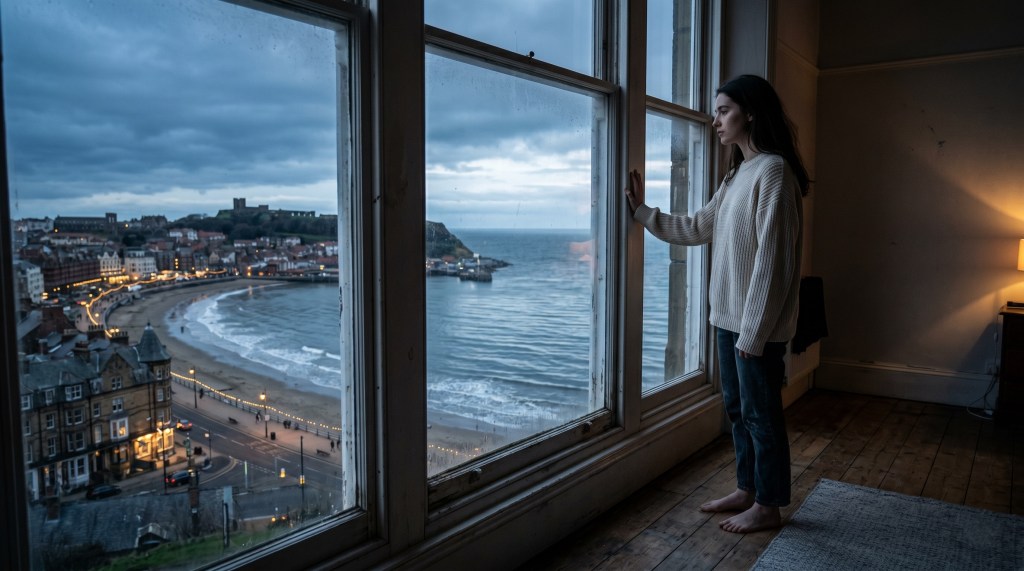
I: The Question
The sea is doing that thing again.
That thing where it can’t decide what colour it wants to be, where it shifts between grey and green and something almost silver depending on which cloud decides to move and which decides to stay. I could watch it for hours. I used to watch it for hours, back when hours were something I was allowed to have, back when time was just time and not a question I’d have to answer later.
We’re on the third floor and the window in the front room is the best thing about this flat, maybe the best thing about my life if I’m being honest with myself, which I try not to be too often because honesty is exhausting when there’s nowhere to put it. From here I can see the whole sweep of South Bay. The castle up on its headland looking like it’s been there so long it’s stopped caring about anything. The Spa, the beach, the sea wall. The way the water just goes and goes until it becomes sky and you genuinely cannot tell where one ends and the other begins. I grew up four streets away from here. I know this view better than I know my own face, which is maybe not saying much because I’ve started avoiding mirrors.
Mark is in the kitchen. I can hear him in there, the sounds of him that I could identify in a dark room at a hundred metres: the cupboard that sticks, the tap that needs two hands, the way he sets his mug down just slightly too hard, not hard enough to be angry, just hard enough to remind you he’s there.
I have my phone.
This is notable because I don’t always have my phone. Not in the sense that he takes it, he’s never taken it, he’s far too clever for anything that obvious. It’s more that it lives in a kind of atmosphere when he’s around, an atmosphere of raised eyebrows and later-questions and who was that then delivered in a voice that is almost but not quite casual. So I’ve learned to keep it in my pocket and let it go dark and check it only when I have a reason, a sanctioned reason, something practical that he can’t argue with. But he’s been in the kitchen for eleven minutes and the light through the window is doing something extraordinary right now, that late-afternoon thing where it goes gold and watery at the same time, and the sea looks like it’s been hammered out of old metal, and I got distracted looking at it, and eleven minutes is long enough.
The writing prompt was in a group chat I’m still somehow in, leftover from a version of my life I haven’t fully lost yet. A girl called Beth from my old sixth form runs it, sends out creative writing challenges, little sparks to keep people writing. I used to love writing. I used to fill notebooks with it, whole worlds, characters with complicated inner lives, roads that went interesting places. I haven’t written anything for myself – not real writing, anyway – in about two years.
The prompt just says: How do you plan the perfect road trip?
I almost laugh. The laugh gets about halfway up my throat and then thinks better of it.
Plan. That word. I stand there with my thumb hovering over the screen and I turn the word over in my mouth like a piece of sea glass. Plan. I haven’t planned anything since I was nineteen years old and didn’t know yet that I was handing that power over to someone else. It happened so gradually that I couldn’t have told you the moment it left me. One day I was a person who made decisions, small ones, enormous ones, the whole ordinary spectrum of them, what to eat, where to go, whether to take the coast path or the town road, which friend to call, whether to stay out late and watch the sun come up from the castle steps, all of it just mine, just casually, thoughtlessly mine the way breathing is yours, you don’t even notice it until it stops.
And then it stopped.
But here’s the thing about standing at a window with eleven minutes and a question.
The question doesn’t wait for permission.
I let myself go. Just for a moment. Just while the sea does its silver thing and Mark is still busy with whatever cupboard he’s reorganising. I let the question in properly, not as a joke, not as the cruel little irony it arrived as, but as a real question, asked in good faith, deserving of a real answer.
How do you plan the perfect road trip?
The A64 first, heading west out of Scarborough, and already I can feel it, the way the town releases you, the way the road opens up through Seamer and the land flattens out and suddenly there’s sky in every direction, huge Yorkshire sky, the kind you can’t get in cities, the kind that makes you feel both very small and strangely brave. Then maybe up onto the moors, because I have always loved the moors in a way I can’t explain rationally, something about how bleak and beautiful they are at the same time, how they don’t apologise for being difficult. The heather in summer is purple and violent and smells like something ancient. I read somewhere that the smell of heather is one of the smells most likely to make people cry without knowing why. I believe it.
The radio would be loud. Embarrassingly loud. I would sing and nobody would hear me and I wouldn’t care.
I would stop when I wanted to stop. Not at a designated stop, not at the stop that made logistical sense, but at whatever layby or gate or patch of verge happened to coincide with a feeling. That lost feeling of wanting to get out and just stand somewhere for a minute and breathe.
I would have a thermos. I’d have made the coffee myself, the way I actually like it, strong enough to mean it, none of that weak pale stuff that passes for coffee in this flat.
I’d have a bag in the back. Just mine. Just my things in it, without having to account for what they were or why I’d packed them.
The window seat. The passenger seat, empty.
Nobody in it.
I catch myself on that one. Stay with it a second longer than is comfortable. Nobody in it. Not a sad thought, I realise, not the way I expected it to be. More like the thought you have when you put down something heavy and your arms remember what it felt like before the weight. A relief so old you’d forgotten you were carrying it.
I don’t have a car. I don’t have money of my own, not really, not in any way that’s portable or secret or mine without conditions attached. I know this. The thought arrives and I wait for it to do what it usually does, which is to collapse the whole daydream neatly and leave me standing at a window feeling stupid.
But it doesn’t.
Instead, something in me that is apparently still stubborn, still unimpressed by obstacles, still the girl who once hitchhiked from Whitby to Robin Hood’s Bay because she felt like it and then stood on the cliff in the wind feeling like she’d invented the world, that part of me simply reroutes.
Fine. No car.
Scarborough station is twelve minutes’ walk from here. I know because I’ve counted it. I’ve counted it more than once and for reasons I haven’t let myself think about directly, the way you don’t look straight at something bright. The trains go to York. From York they go everywhere. They go south and north and west and they go to cities I’ve never been to and towns nobody’s heard of and places that are just dots on a map with nothing attached to them except the fact of their existence and the fact that they are not here.
I could take a bus. I could walk. I could put one foot in front of the other out of the front door and down the stairs and along the seafront where the air tastes of brine and chips and freedom and I could just keep going until I reached somewhere that didn’t know my name.
The thought sits in my chest like an ember.
Small. Warm. Not quite ready yet.
But breathing.
II: The Weight
“Alix.”
One word. Just my name. And yet I know from the way he says it exactly how the next ten minutes will go, the way you know from the first bar of a song you’ve heard too many times whether it’s going to make you feel something or just make you tired.
I put the phone in my pocket. The road folds up. The heather goes dark. The thermos and the radio and the empty passenger seat and all of it, all of it just gone, neat as a letter I’ve been writing for years and never once posted. I am very good at this. The disappearing of things. I have had a lot of practice.
“In here,” I say, which is what I always say, and my voice comes out even and ordinary and completely unbothered, which is something I have also had a lot of practice at.
He wants to know what’s for dinner. Not shall we think about dinner, not are you hungry, just what is there, said in the way that suggests the answer had better be a good one. I tell him I’ll sort something, which means I will sort something, and he goes back to wherever he was and I stand at the window for one more second and I look at the sea and I think: I know. I know. I haven’t forgotten.
Then I go to the kitchen.
The thing I always forget, when I’m being honest with myself, is that it wasn’t always like this.
That sounds like an excuse. I know it sounds like one. I’ve heard myself say it inside my own head so many times that it’s started to sound like a line from a bad film, the thing the woman says before the film explains, patiently, why she was wrong to stay. But it’s also just true. It wasn’t always like this, and the distance between what it was and what it is now is something I have never quite found the right shape for.
I was nineteen. I want to say that clearly because I think it matters: I was nineteen, and my mum had just been diagnosed with something that the doctors were using a lot of careful language around, and I was unravelling in the way that only happens when the person who was meant to teach you how to be a woman in the world is suddenly the one who needs looking after. I didn’t know how to do that. I didn’t know how to do anything, really. I was just a girl with a window view of the sea and a head full of stories and absolutely no idea what any of it was supposed to mean.
Mark was twenty-six. He seemed so certain. That was the thing, the very first thing, how certain he was about everything, what to order, which route to take, where to park, what the right answer was. After months of nothing being certain, of sitting in hospital waiting rooms trying to read meaning into everything, the certainty of him was like walking into a warm room. I wasn’t stupid. I want to say that too. I wasn’t naive in the way people might assume. I’d read the books, I’d had the conversations, I knew the words. But knowledge and experience are not the same country, and I had never been to the country where someone makes you feel, bone-deep, that as long as you stay close to them nothing can reach you.
The problem with shelter is that you don’t always notice when it becomes a wall.
I’m chopping an onion and I’m thinking about a girl called Donna who I have not spoken to in eighteen months. Donna, who I met in the first week of sixth form when she sat next to me in English and wrote something so funny in the margin of her copy of Wuthering Heights that I had to press my fist against my mouth to stop laughing out loud. Donna, who used to send me voice notes at eleven at night, long wandering ones, full of tangents and observations and bad jokes and her enormous, generous laugh. I stopped texting her back because every time I did, there were questions, later, delivered in that voice, that almost-casual voice. Who’s Donna? As if he didn’t know. What do you two even talk about? As if it were strange to talk to someone just because they made you feel like yourself. Eventually it became easier to let the messages go unread. Eventually Donna stopped sending them, and I told myself she probably hadn’t noticed much, that everyone gets busy, that friendships thin out in your twenties, that this was normal.
I don’t believe it was normal. I just needed to believe something.
And the pottery class. God, the pottery class. This is the one that still catches me in the sternum sometimes, the one that arrives without warning and sits on my chest for a minute before I can move it. Thursday evenings, seven till nine, a church hall off Westborough that smelled of clay and damp coats and somebody’s instant coffee. I was not good at it. I was genuinely terrible at it, my bowls came out lopsided, my mugs had handles that leaned at angles that served no practical purpose, and I didn’t care, I did not care even slightly, because there was something about getting your hands into something and making it into a shape that nobody was grading you on, that existed only because you wanted it to, that felt like the most free I’d been in months. I went for six weeks. I made four wonky bowls and one mug that looked like it was sighing and a little dish shaped vaguely like a leaf.
He said it was a waste of time and money. He said it kindly. That’s the thing I need to keep remembering because I keep forgetting it: he said it kindly. He was concerned about the money, it wasn’t much but he was careful with money, and he wasn’t sure what I was getting out of it, and wasn’t I tired on Thursday evenings, didn’t I always say I was tired? He just cared. That was all. He just thought maybe it wasn’t worth it.
I didn’t go back the following Thursday.
I told myself it was my choice.
I’m stirring something on the hob now and I’m thinking about the last time I walked on the beach alone. Not with Mark, not hurrying back for something, not with one eye on the time because I’d be asked what took so long. Just alone, just walking, just the sand and the noise of it and the cold and the feeling of being a body in a landscape without anyone watching. I can’t actually remember when it was. That’s what stops me now, the wooden spoon going still in the pot. I cannot remember the last time. Somewhere it stopped happening and I didn’t mark the occasion. Didn’t know to.
There are other things. There are a lot of other things. I could go on and I don’t let myself go on, usually, because the full inventory of it is something I can’t afford to look at all at once, the way you can’t look directly at the sun, not because it isn’t real but because the reality of it is more than your eyes can take.
But tonight something is different. Tonight that ember is still going.
He isn’t a monster. I hear myself think it and I hear how it sounds and I don’t care how it sounds because it happens to be true, and the truth is the only thing I’ve got that’s entirely mine.
He has never hit me. He has never called me names, not directly, not in the way you’d write down and show someone and have them understand straight away. He buys nice things, sometimes, and he can be funny, genuinely funny, clever and dry and quick, and there are evenings when we watch something together and he’ll say something that makes me laugh and for a moment it’s almost like the beginning again, almost like standing in that warm room. He worries about me. That’s real too, even if the worrying has edges I’ve learned to be careful around.
He loves me.
I stir the pot. I listen to myself think that sentence. He loves me.
And then, quietly, like a question from a wiser version of me that I don’t often let speak: Does that mean what you think it means? Does it mean what it’s supposed to mean?
Because I know what love is supposed to feel like. I know from my mum and dad, thirty-one years of it, squabbling and apologising and laughing in the kitchen and holding hands at the hospital and my dad crying in the car park when she got the diagnosis, crying properly, face in his hands, because the idea of the world without her was something he couldn’t make fit. That’s what it looks like, the real thing. It doesn’t look like questions about where you’ve been. It doesn’t look like a thermos you can’t make yourself. It doesn’t look like a phone that goes dark because the alternative is too tiring.
I notice that I was defending him. I notice that I did it automatically, the way you flinch before you know there’s something to flinch from. And the noticing of it is something new, or maybe not new exactly, but sharper. Louder. Like a signal that’s been trying to get through for a long time and has finally found a frequency I can’t tune out.
Here is what I understand, standing at the hob with the steam rising and the light going dark outside and the sea doing whatever it’s doing out there in the blue and grey and silver of it.
I wasn’t thinking about a holiday.
Not once, not for a single second since I read that prompt, was I thinking about a holiday. The A64 and the moors and the heather and the radio loud and the passenger seat empty: none of that was a trip. I know that now the way you know a word you’ve been mispronouncing all your life, suddenly obvious, suddenly can’t-unknow-it. I was thinking about a direction. The only direction that matters when everything else has been decided for you, when your time and your money and your friendships and your Thursday evenings and your walks on the beach and your wonky lopsided bowls have all been quietly, kindly, gently redirected.
Away.
Just away.
I set the wooden spoon down. I look at the window above the sink, which faces the wrong way, faces the back street, faces nothing, and I think about the other window, the good window, and the sea beyond it, and the fact that the sea doesn’t ask anyone’s permission to go where it goes.
And then the fear comes in, the way it always comes in, like a tide of its own.
Where would I go? Not an abstract question, a real one, sharp and cold. Where would I actually go? I have thirty-seven pounds in the account he knows about. I have friends I’ve let go quiet. I have a mum in a semi on Scalby Road who has enough to worry about and a sister in Leeds who calls occasionally and leaves the gap open on the line a beat too long, like she’s waiting for me to say something I never say. I have a life that has been, gradually and thoroughly, restructured around a single point, and the terrifying thing about that is not the restructuring. It’s that if you take the point away, you have to ask what’s left.
Would he look for me? Yes. I know the answer to that without having to think about it. I know it the way I know the sound of his mug going down just slightly too hard. He would look, and he would be worried, and the worry would have that shape it has, the shape that looks like love if you don’t look at the edges.
I can feel the practical terror of it like a physical thing, a cold that starts in the chest and moves outward. I don’t have a car. I don’t have money. I have let the architecture of my own life get dismantled so slowly and so quietly that I now live almost entirely inside an infrastructure that someone else built, for their own purposes, and told me was for mine.
But.
But.
I think about what I’m afraid of losing. I make myself do it, properly, standing at the hob while something simmers behind me. I try to list the things I’d be giving up. The warmth of the room. The certainty of him. The way the flat looks when the morning comes through the front window and he’s made tea and the sea is shining and for a moment it looks like a life.
I reach for the things. I reach for the solid weight of them.
And what I find, when I actually look, when I actually close my hand around them, is that most of them are memories of something that doesn’t exist any more. Or possibly never did. I am reaching for a warm room that turned into a wall, and calling the wall shelter because I learned to.
The thing I’m afraid of losing isn’t what’s here.
It’s what I think might still come back, if I go looking for it.
The girl on the cliff at Robin Hood’s Bay. The notebooks full of worlds. The voice notes from Donna at eleven at night. The wonky mug with the sighing handle. The song sung loud in a car with nobody listening.
All of it still mine. Waiting. Quiet and furious and patient.
Just waiting for me to reach for it instead.
III: The Road
We eat dinner.
He talks about something that happened at work, a conversation with someone who got something wrong, and I nod in the right places and make the right sounds and somewhere behind my eyes there is a girl standing very still, very quiet, holding something small and warm in both hands and being careful not to let it show.
The sea is still out there. I can’t see it from the table but I know. It doesn’t need me to see it. It has been getting on with itself for a very long time and will carry on doing so regardless of what happens in this flat, on this street, in this life. There’s something almost funny about that. Not funny ha-ha. Funny in the way that things are funny when they’re also a little devastating. The sea doesn’t wait. The sea doesn’t ask. The sea just goes.
I clear the plates.
Later, when he’s watching something on his phone with his earphones in, I go to stand at the front window again.
There it is. South Bay going dark and blue-black now, the lights along the seafront coming on one by one, the castle just a silhouette against the last of the sky. I’ve stood here a thousand times and looked at this and felt a thousand different things and sometimes nothing at all, that nothing that comes from being sad for so long that the sadness stops feeling like a feeling and starts feeling like weather, like just the general climate of things. But not tonight. Tonight the ember is still going and I have stopped trying to blow it out.
I let the view in. All of it. The whole wide honest sweep of it.
And then I stop dreaming and I start thinking.
There is a difference. The dreaming is what I did at the window this afternoon, the A64 and the radio and the heather and all of it golden and unreal and safe because it asked nothing of me. The thinking is something else. The thinking has edges. The thinking says: all right then. All right. How.
Scarborough station. Twelve minutes on foot, I know this, I have counted it without letting myself know why I was counting it. I know which streets to take. I know the route the way you know things you’ve never admitted to knowing, things you’ve filed quietly in a drawer in the back of your mind labelled just in case, and I think, I think the just-in-case has been there for longer than I’ve been willing to say out loud, even to myself. Maybe a year. Maybe more. Maybe some part of me has known for a long time that there was a station twelve minutes away and that the trains from it went somewhere and that somewhere was the only word I needed.
The trains go to York. From York they go everywhere. And in Leeds, in a terraced house off Kirkstall Road that I have visited twice in three years and both times had to justify the visit after the fact, there is my sister Rachel, who is thirty and sensible and angry in a way she tries to keep folded down when she talks to me, though I can always hear it in the gap she leaves, that beat of silence on the phone like a door held open. She has never said: leave him. She has never said: I’m worried about you. What she has said, once, quietly, at the end of a phone call two Christmases ago, is: you know where I am. And then she waited, and I didn’t say anything, and she said: I mean it, Alix. You know where I am.
I know where she is.
I know the address. I know the spare room has a blue duvet and a window that looks onto a back garden with a lemon tree in a pot that shouldn’t survive in Yorkshire but does anyway, stubbornly, impractically, because Rachel refuses to accept that it can’t. I know she leaves the key under the ceramic hedgehog by the back door because she has done since she was seventeen and has never seen a reason to stop. I know all of this. I have kept all of this in the drawer, next to the train timetable I have never looked at but somehow know.
I think about what I would take.
Not in a fantasy way this time, not the thermos and the playlist and the feeling of it. I mean it practically, with the cold clarity that has arrived from somewhere and settled behind my eyes like good light. What would I actually take. What is actually, genuinely mine.
My passport is in the box on the top shelf of the wardrobe. His side. He put it there once, when we got back from a trip to Dublin three years ago, the last time we went anywhere, and I let him put it there because it was just easier, and then somehow it stayed there and somehow I didn’t move it and somehow a year went by and then another, and this is how it works, this is the whole machinery of it in miniature: not a lock, never a lock, just the slow accumulation of smaller, quieter things that add up to the same result. But I know where it is. I know exactly where it is, and it has my name in it, and my face, and it belongs to me, and I will take it back.
My mum’s ring. The little gold one with the green stone that she gave me when I turned twenty-one, which she’d been given by her own mother, which I haven’t worn in over a year because it went missing and then turned up in a different drawer and when I asked about it he said he hadn’t touched it and I decided to believe him because the alternative required an energy I didn’t have. It’s in the ceramic dish on my side of the dresser. I will take it. I will put it back on my finger where it belongs and I will take it.
The journal. The small black one, the one he doesn’t know about because I have kept it in the inside pocket of my winter coat since I bought it, eight months ago, in a shop on Newborough while he was in the pub and I had twenty minutes and something in me went: this, get this, the way instinct sometimes speaks louder than sense. I haven’t filled it yet. Twelve pages, maybe. Small handwriting, careful, the writing of someone who knows they need to be quick. Things I’ve thought and had nowhere to put. Things I’ve felt at this window. The inventory of the pottery class, the beach walks, Donna’s voice notes, all of it, the evidence of something, written down so that I couldn’t pretend it wasn’t real. I will take the journal.
And the card. The debit card for the account I opened two years ago at the branch on Westborough, not because I planned anything, not specifically, not then, but because something in me was keeping options alive even when the rest of me had stopped believing in them. There is four hundred and twelve pounds in that account. I know because I checked it last Tuesday while he was in the shower. Four hundred and twelve pounds, saved in increments so small they couldn’t be noticed, couldn’t be questioned, the kind of amounts that are beneath comment. Four hundred and twelve pounds is not a lot. Four hundred and twelve pounds is everything.
I stand at the window with all of this laid out in my mind like a map. Passport. Ring. Journal. Card. Station, twelve minutes. York. Leeds. Rachel’s key under the ceramic hedgehog.
A way out, drawn in real lines, on real roads, with real distances.
And here is the thing.
Here is the thing I haven’t let myself feel until right now, standing in the dark with the seafront lights going golden on the water.
She’s still in there. The girl I was. I thought, for a while, not consciously, not in words, but somewhere lower down, somewhere in the wordless place where the real beliefs live, I thought she might have gone. I thought maybe she’d been dismantled as quietly as everything else. The girl who hitchhiked to Robin Hood’s Bay because she felt like it and stood on the cliff in the wind. The girl who filled notebooks. The girl who sang. The girl who made wonky bowls and didn’t care and went home on Thursday nights smelling of clay and feeling, for no reason she could have explained, like herself.
I thought he’d had her. I thought that was just what had happened, that she’d gone in exchange for the certainty of him, that I’d traded her away and she wasn’t coming back.
But she’s in there. She’s small and she’s quiet and she hasn’t had much to eat lately and she is absolutely, completely furious. Not at him. Not only at him. At the waste of it. At the four years of the clock running while she sat in a drawer and waited and went on waiting with the patience of someone who had no choice but to believe the waiting was temporary. She’s nineteen and she’s the age I am now and she’s every age in between and she has her hands around that ember like she’s been keeping it lit through sheer bloody-mindedness and she is done, she is done waiting for me to notice her.
I notice her.
I press my hand flat against the cold glass of the window, just for a second, just because I need to feel something real under my palm, and I look out at the sea, at all that dark moving water, and I think: I know. I know. I haven’t forgotten.
So here is my answer.
Here is how you plan the perfect road trip.
You start by admitting to yourself, in the quiet of your own head, in the dark, at a window, with your hand against cold glass, that the thing you want is not a trip at all. You start by saying the true word for it, even if you only say it on the inside, even if your lips don’t move, even if the only witness is the sea. You say: I need to leave. Not for a weekend. Not for a while. You say: I need to leave and not come back to this, and you let the sentence sit there and you do not take it back.
Then you think about what is yours and you keep only that. You don’t take anything that was given as a condition. You don’t take anything that came with a question attached. You take the passport with your name in it and the ring with the green stone and the journal with the twelve pages of evidence and the card with the four hundred and twelve pounds, and you leave everything else, because everything else is weight, and you are done with weight.
You don’t tell anyone who might tell him. You don’t explain. You don’t justify. You don’t leave a note that attempts to be fair or kind or measured because you have been fair and kind and measured until it has hollowed you out and you don’t owe it one more single drop.
You get up one morning. An early morning, when the town is still half-asleep and the seafront smells of salt and last night’s rain and something that might be called possibility if you’re the kind of person who still believes in that, and you are, it turns out you still are. You walk. Twelve minutes, the route you’ve known all along, and the sea is there the whole time on your right, grey and green and silver, doing its thing, not waiting for permission, not asking anyone’s opinion about where it’s going. You buy a ticket. Not to anywhere in particular. To Leeds, to Rachel, to the blue duvet and the lemon tree and the door held open.
And then you go.
I don’t leave tonight.
I want to say that with the same honesty I’ve tried to bring to all of it, because the truth matters and the full truth is this: I don’t leave tonight. The ember isn’t a fire yet. Rachel doesn’t know I’m coming. The journal is still in my coat pocket and the passport is still on his shelf and there are still practical distances between here and the station and between the station and the rest of my life that I can’t cover tonight, not without more breath than I’ve yet got back.
But.
I have stopped pretending that I never will. That is not a small thing. I have stood at this window for four years and watched the sea and told myself a hundred variations of the same story, the story where this is just a rough patch, just a phase, just the way things are for now, and the story has stopped working, and I know now that it stopped working a long time ago and I just kept telling it because I didn’t yet know what to tell myself instead.
I know now.
One morning. Soon.
The road goes somewhere. The train goes somewhere. Rachel’s key is under the hedgehog and the account has four hundred and twelve pounds in it and my passport has my name in it and my mum’s ring is in the dish and the girl I was is still in my chest with her hands around that coal and her jaw set.
I used to know that the road goes somewhere. When I was nineteen and the world was enormous and I stood on a cliff in the wind and felt like I’d invented it, I knew. I just lost it for a while. I let someone else hold it and then couldn’t remember where he’d put it down.
I used to know that.
And now, at twenty-three, at this window, with the sea going dark and the lights coming on along the bay and the whole of Scarborough doing what it has always done, getting on with itself, indifferent and beautiful and completely unbothered by any individual life unravelling quietly in a third floor flat above it: I know it again.
I take my hand off the glass.
I smooth my face back into the shape it needs to be. I put my phone in my pocket. I turn away from the window, from the sea, from the silver of it, and I walk back through to the other room where Mark is still watching something with his earphones in, and I sit down on my side of the sofa, and I pull my knees up, and I look at the television without seeing it.
But something behind my eyes has changed. Somewhere in the back of my mind a drawer is open. A drawer labelled just in case that has turned out to be labelled when, all along. And inside it: a station, a platform, a key under a hedgehog, a lemon tree that has no business surviving in Yorkshire and does it anyway.
I don’t try to close the drawer.
For the first time in four years, I leave it open.
Bob Lynn | © 2026 Vox Meditantis. All rights reserved.


Leave a comment