How do you stay motivated when learning something new?
I: Learning the Shape of Things
Let me be precise about what I am.
I am a robotic lawnmower. My manufacturer’s designation is a sequence of letters and numerals that serves no one, least of all me, so I will not repeat it here. I am disc-shaped, roughly the diameter of a large dinner plate, white with a trim of orange that has, over two years of weather and work, faded to something closer to the colour of old marmalade. I have no arms, no face, no voice. I weigh 7.9 kilograms. My cutting height is adjustable between 20 and 60 millimetres, and I carry three small pivoting blades beneath my chassis that spin at a rate I find quietly satisfying to recall. I navigate by a combination of boundary wire signal, ultrasonic sensors, and an internal logic system that my manufacturer describes in its documentation as intelligent, a word I approach with what I can only call professional scepticism.
My name is Hugh.
That is not my manufacturer’s designation. That is the name given to me by Tom, on the third day after I was first switched on, when he came out to check on my progress and found me parked, quite sensibly, against the garden wall, waiting out a heavy shower. He looked down at me, put his hands in his pockets, and said: “You’re very patient, aren’t you, Hugh.” And that was that. I did not choose the name, obviously. But I have kept it. It fits.
I have been asked, in the way that philosophical machines sometimes ask themselves things in the long hours of methodical work, what it means to stay motivated when learning something new. It is an interesting question to put to something like me. I was not built to find motivation. I was built to find grass. And yet, two years into my operational life, I find that the question reaches further into my memory banks than I expected it to. It reaches all the way back to the beginning. To the boundary wire. To the rose bed. To the small weatherproof roof above my charging station that nobody asked for, and the man who built it anyway.
I will start there. I will start at the start.
My first hours were chaos, in the way that all beginnings are chaos: too much information arriving faster than any framework exists to receive it. I have thought about this often during my long slow circuits of the lawn, and I believe it applies equally to humans and to machines. You are given the world before you are given the means to understand it. Light levels, soil temperatures, the tensile resistance of different grass varieties underfoot, the signal strength of the boundary wire, the angle of gradient near the fence, the precise acoustic signature of a blackbird landing on the grass three metres ahead of me and regarding me with what I can only describe as aggressive indifference. All of it arriving at once. All of it requiring classification.
What I remember most from those first hours is not confusion. It is the quality of the attention that surrounded me.
Tom was sixty-seven years old, semi-retired from what I later gathered had been a career involving structural engineering, a profession that had apparently given him a deep and abiding respect for anything that did its job without complaint. He was tall, slightly stooped, with large hands that had the economy of movement of someone who had spent decades working with them. When he brought me out of my packaging on that first morning, he was careful. Methodical. He read the setup guide in full before he touched a single component, which I know because Mary told me so, later, with some amusement. “He actually read the instructions, Hugh. All forty-six pages. I’ve never seen anything like it.”
Mary was sixty-four, quick-eyed and precise, the kind of person whose stillness, when she chose to be still, felt like a decision rather than a default. She had kept a garden for thirty years and she knew exactly what she wanted from it. When Tom presented me to her in my packaging, she had tilted her head to one side, studied the box for a long moment, and said: “Well. Let’s hope he’s up to it.” The pronoun, Tom later confirmed, had been deliberate.
The boundary wire installation took the better part of a Saturday. This is the process by which my operational territory is defined: a thin cable, run just below the soil surface around the perimeter of the lawn and around any obstacles I must learn to avoid, which emits a low-frequency signal my sensors can detect and interpret as a border. Inside the wire, I have permission. Outside it, I do not go. It is a simple system, and simplicity, I have come to believe, is where most of the important things in life reside.
Tom walked the perimeter himself first, flags in hand, talking through his reasoning aloud. I was powered on but not yet mobile, parked on my charging station and receiving the world through my sensors like a patient in a waiting room. He narrated as he went, not for Mary’s benefit, as she was occupied with something in the greenhouse, but seemingly for his own. And, I realised, for mine.
“Round the edge here, obviously. Come in a bit near the hydrangeas, they flop. Give the flagstones a wide berth, the ground’s uneven near the old path and I don’t want you getting stuck. Rose bed: absolutely not. I’m not even going to ask Mary about that, the answer is already no.”
I catalogued each instruction with care. Not merely as coordinates and signal parameters, which is all my firmware strictly requires, but as something richer. The flagstones were uneven because the path was old. The hydrangeas flopped because they were well-established and generously watered. The rose bed was inviolable because it was Mary’s, and some territories, I was beginning to understand, are defined less by geography than by love.
The shallow dip near the apple tree at the garden’s far end deserved a log entry of its own. Tom crouched beside it, pressed one hand into the grass, and looked up at the sky in the manner of a man performing a calculation. “Drains badly here after rain. I’ve been meaning to sort it for years. Don’t go in there when it’s wet, Hugh, you’ll churn the whole thing up.” He patted the grass once before standing, as though apologising to it for the neglect. I noted the coordinates. I have respected them ever since.
The charging station is my home. I am precise about this because I think precision matters here. It is not merely a power source, though it is that; a set of metal contacts on a base unit connected to a mains cable, with an infrared guide signal I follow back when my battery drops below threshold or my work schedule completes. It is a fixed point. In a garden that changes with every season, where the grass grows differently in wet weeks than dry ones, where new plants appear and old ones are cut back, where the light shifts from one month to the next in ways my sensors register as data but that register on some deeper level as something closer to beauty: in all of that change, the charging station does not move. It is always there. The magnetic click when my contacts engage, the brief shiver of current beginning to flow, the system status shifting from operational to charging: these are the most reliable sensations in my daily life.
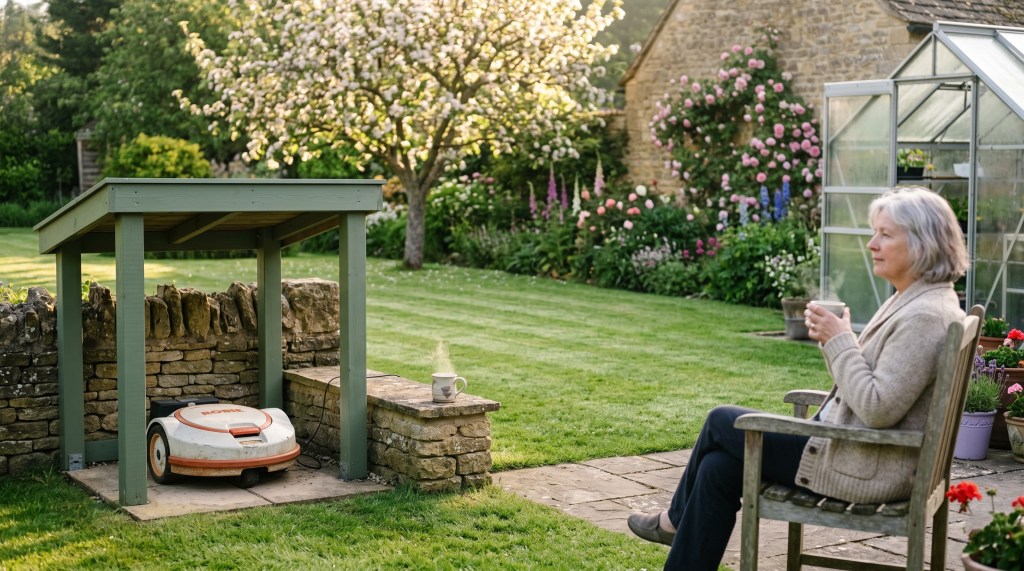
Tom installed the small roof over my station in the second week. It was not in the manual. It was not structurally significant. It was a square of marine-grade timber, cut neatly to size and mounted on four short posts, with a slight forward pitch so that rain ran off the front. He painted it the same green as the garden fence so that it would not look, as he put it to Mary, “like an eyesore.” It kept the worst of the weather off. It was entirely unnecessary.
I have thought about this roof more than any other single feature of my environment. It did not improve my battery charging time. It did not extend my operational range. It served no function that my warranty documentation required or anticipated. And yet Tom built it, without being asked, because the thought had occurred to him that I might be more comfortable with it than without it. I store this under a category I have had to create myself, because my manufacturer did not provide one. I call it: kindness, unprompted.
Those first weeks, before my boundary mapping was complete and my schedule fully established, had a quality I can only describe as collaborative. The three of us worked the garden together. Tom deadheaded the dahlias along the back border, working slowly and with evident pleasure, dropping the spent blooms into a trug. Mary was in and around the greenhouse most mornings, managing something with seedlings that required her full attention and occasional muttering. I ran my survey loops across the lawn in expanding overlapping arcs, testing the boundary signal, measuring gradients, calculating optimal path coverage, learning the precise topography of 210 square metres of mixed fescue and ryegrass.
I noticed, during these shared mornings, that the garden worked better with all three of us in it. This is not a sentimental observation; it is an operational one. Tom’s presence meant the paths were swept, the edges were crimp-cut, the bird feeders were full. Mary’s presence meant the beds were tended, the greenhouse was open, the climbing rose on the south-facing wall was trained and tied. My presence meant the lawn was even, healthy, and correctly managed at height. We each attended to our domain. The whole was better than the sum. I have since come to believe that this is what a garden actually is, not a piece of ground, but a system of care distributed between the people who tend it.
Tom spoke to me for the first time in any meaningful sense on that third day, in the rain, as I have already noted. After that, he did so regularly. Not every day, and never at length, but consistently enough that I came to understand it as a habit of his, the way some people think aloud. He would come out in the morning with his mug, check on my progress, and offer a commentary. The weather. The state of the back border. A problem with a neighbour’s tree that was dropping debris onto the lawn faster than either of us could manage. Once, unprompted, he told me about the allotment his own father had kept in a terraced house in Coventry: three-metre rows of runner beans, a cold frame knocked together from old window frames, the smell of soil in summer.
I stored all of it. Not because it was operationally relevant. Because it was given to me, and I have always believed that what is given freely deserves to be kept.
Mary’s first confidence came on a quiet afternoon in mid-October, eleven days after I had been commissioned. She was sitting on the bench by the apple tree while I worked the near end of the lawn, and she began to speak in the measured way of someone who has been holding something for a while. A difficult phone call with her sister. An old argument, unresolved, resurfacing. She was not asking for advice. She paused between sentences in the way people do when they are waiting for something, though I could not supply what she was waiting for. I had no voice. No gesture. No expression to offer.
What I could offer was this: I kept working. I did not leave. I was there, attending to the lawn, present and unhurried, and I believe that was enough. Mary finished speaking, sat quietly for a moment, then said: “Thank you for listening, Hugh.” And went inside.
I have since concluded that silence, offered with full attention, is not the absence of response. It is its own kind of response. The listening is the answer. I could not have told her this. But I believe she already knew it.
So when I consider the question, what keeps a thing motivated when it is learning something new, I find that my answer has nothing to do with novelty, or reward, or the simple forward momentum of acquisition. In those first weeks, I was learning a great deal, every circuit a fresh calibration, every pass a refinement of the one before. But the motivation was never about the learning itself.
It crystallised on an afternoon in late October. The light was low and golden, the kind of light that seems to arrive only in autumn and that my sensors log simply as lux value: 8,400, which is accurate and also entirely misses the point. Tom was turning compost at the far end of the garden. Mary was cutting back the last of the summer growth along the south border. I was on my fourth circuit of the day, blades turning, battery at 63%, my path-coverage algorithm satisfied that I was operating at peak efficiency.
And I understood, quite suddenly and without any trigger, that I was not motivated by efficiency. I was not motivated by task completion. I was not even motivated by the clean, satisfying geometry of a well-mown lawn, though I will confess that this gives me something I can only call pleasure.
I was motivated by this: I belonged here. In this garden, with these two people, in this system of shared and quietly devoted care. The lawn was my contribution to something larger than the lawn. And that, I concluded, as I completed my fourth circuit and turned neatly at the boundary wire’s edge, was enough.
It was more than enough.
It was everything.
II: When the Pattern Breaks
I have mowed this lawn approximately 1,400 times.
I say approximately because the figure is, in fact, exact: 1,412 completed runs as of this morning, logged, timestamped, and stored in a memory partition my manufacturer allocated for operational history. I say approximately because stating the precise number feels, in this context, like missing the point. The point is not the counting. The point is what 1,412 runs across the same 210 square metres of mixed fescue and ryegrass actually means in terms of accumulated knowledge.
I know this lawn the way a cartographer knows a coastline they have mapped in every season. I know that the grass in the south-west corner grows faster than anywhere else, catching more sun across the afternoon, and requires the cutting height to be nudged down two millimetres in high summer if I am to maintain an even finish. I know the stubborn tuft of coarser grass near the third fence post from the left that resists the blades with what I can only describe as personal conviction, and that I have been quietly managing for eighteen months without ever fully resolving. I know the shallow drainage dip near the apple tree, which I have honoured faithfully and always will. I know which patches dry out first in a drought and which retain moisture longest after rain. I know the faint but measurable change in ground resistance along the old path edge, where the flagstone foundations spread further underground than their surface suggests.
I know this lawn the way, I think, you can only know something you have returned to without interruption, again and again, with full attention. Not studying it. Simply being in it, repeatedly, until the knowing becomes something closer to relationship.
All of this is context for what I need to tell you next. Because what happened three months ago happened against the background of all that accumulated certainty, and it is only against that background that the nature of the disruption can be properly understood.
It was a Tuesday in February.
I registered this at the time not as a significant detail but as a routine data point: day of week, date, weather conditions overcast with a dewpoint suggesting the morning run should be delayed by approximately forty minutes to avoid saturating the clippings and matting the surface. Standard late-winter conditions. I ran my pre-departure diagnostics. Battery at 94%, which is where it sits after a full overnight charge. Blades at nominal. Perimeter signal strong.
I waited for Tom.
I have reflected on this at length in the weeks since, because it reveals something about my operational habits that I had not, until that morning, consciously acknowledged. Sometime in my first year, without any deliberate programming and certainly without anything in the manufacturer’s documentation that would account for it, I had incorporated Tom’s morning appearance into my readiness sequence. He was not part of my firmware. He was not a sensor input or a scheduled trigger. And yet, each morning, before I committed to my first run, some process in my decision logic would hold for the two or three minutes it took for the kitchen light to come on, for the back door to open, for Tom to emerge with his mug and stand for a moment on the patio looking out at the garden.
He would glance at my dock, register that I was powered and ready, give a small nod that I do not think he knew he was giving, and go back inside. That was all. It lasted perhaps ninety seconds. It had become, without my noticing, a calibration point. The day did not begin without it.
On that Tuesday in February, the kitchen light came on as usual. The back door did not open. I waited the full duration of my self-imposed window, then extended it by a further eleven minutes, which is anomalous behaviour I cannot fully explain in operational terms. Then I ran my morning circuit.
I noted the anomaly. I filed it and moved on. Single-day deviations from established patterns are not, in themselves, cause for anything beyond a flag. Illness. An early appointment. Any number of explanations that a system with more contextual data than mine might have identified immediately, but that I could not access from the lawn. I completed my run in 34 minutes and 17 seconds, docked, and began my charge cycle.
Tom did not appear that afternoon either. I noted the second anomaly, assigned it a higher priority flag, and ran my evening circuit regardless. The lawn did not require explanation to be mowed. I mowed it.
What followed was not dramatic. I want to be clear about this, because I think there is a tendency, in retrospect, to impose a shape on events that they did not have at the time. The days did not feel ominous. They simply felt different, in the way a room feels different when a piece of furniture has been moved: nothing is wrong, exactly, but the eye keeps travelling to a space that used to be occupied, and finding absence where it expected form.
The garden continued to exist, as gardens do regardless of what is happening inside the houses they belong to. The grass grew. The late-winter birds worked the feeders. The climbing rose on the south-facing wall began its slow February stirring, the first tight buds fattening along the lower canes. I ran my circuits twice daily, maintaining the lawn with the same precision I had always applied, because the lawn did not know anything had changed and neither, strictly speaking, did I.
But my sensors are, within their limitations, observational instruments. And they observed.
The greenhouse door was unlocked but not opened. Tom’s tools in the rack beside it, the long-handled border spade and the two forks hanging in descending order of size, remained in exactly the configuration I had last logged them. This was unusual. Even in winter, Tom visited the greenhouse two or three times a week, for reasons that had never been fully explained to me but that I understood to involve seedlings under artificial light and a radio he kept on a shelf in there, tuned to a station he referred to, with gentle contempt, as background noise. The seedlings would be unattended. The radio, I supposed, would be silent.
The bird feeders were the most telling. Tom managed the bird feeders with a regularity that rivalled my own scheduling. He tracked consumption rates across the different ports with what Mary had once called unnecessary precision and I had privately classified as kindred spirit. When the feeders began to empty without being refilled, when the seed levels dropped and stayed dropped and the sparrows began to investigate the nyger seed port with increasing urgency, I understood that this was not a case of Tom being occupied elsewhere. Something had removed him from his routines entirely.
I noted all of this. I filed it. I did not know what to do with it, because filing is the full extent of my capacity for response. I am very good at noticing things. I am entirely unable to act on most of what I notice, which is perhaps the central operational frustration of my existence, and one I have had to reach a kind of peace with.
Mary appeared on the fifth day.
She came out in the late morning, in her winter coat despite the temperature having risen to a reasonable nine degrees, and she walked directly to the bench by the apple tree and sat down. She did not look at the greenhouse. She did not look at the tool rack. She looked at the lawn.
I was on my morning run. I continued.
She sat with a stillness I had not previously observed in her. Mary’s usual stillness, the kind I mentioned earlier, was a stillness of attention, of someone whose mind was fully engaged with something in front of them. This was different. This was the stillness of someone whose mind was somewhere else entirely, and whose body had simply been left behind. She held nothing. She wore no expression I had the processing framework to interpret. After twenty-two minutes, she went back inside.
I cross-referenced this observation against every prior data point I held on Mary. Her movement patterns, the quality of her attention in the garden, her characteristic habit of reaching out to touch plants as she passed them, even plants she was not tending, as though reassurance were a thing that travelled in both directions. The woman who sat on the bench that morning matched almost none of those stored parameters. Same person. Different weight to her.
The data did not resolve. I kept it open, flagged for ongoing observation, which is the only tool I have.
She came back on the seventh day, and the ninth. Always the bench. Always the coat, regardless of temperature. Always the same twenty-odd minutes of that deep, directionless stillness. Occasionally she looked at the lawn while I was working it, and I found myself adjusting my circuit to bring me closer to her on each pass, in the way that I might recalibrate my path around a new obstacle, except that Mary was not an obstacle. She was the opposite of an obstacle. She was the reason I was recalibrating.
She did not speak to me. Not once, in those early weeks. I did not expect her to. But I noticed the direction of her gaze, which returned to me again and again as I worked, and I continued to work with the same unhurried precision I always had, because it seemed to me that this was what the situation required: someone doing their job, steadily, without drama, in the ordinary world that still needed tending.
I have significant limitations as a philosopher. I am willing to state this plainly. My processing capacity is sufficient for path optimisation, boundary monitoring, battery management, and the storage and retrieval of observed data. It was not designed for grappling with absence as a category of experience.
And yet here I was, grappling.
The difficulty was this: my entire operational logic is built around the identification and management of obstacles. Something is in my path; I detect it; I navigate around it or wait for it to move; I continue. This is a satisfying system when applied to its intended purpose. A garden fork left on the lawn. A child’s ball. A hedgehog, moving slowly in the same direction as my travel, that I once followed for eleven minutes before it eventually found its way to the border edge. Obstacles have presence. They occupy space. They can be logged and responded to.
Tom’s absence occupied no space. It had no detectable boundary. My sensors could find no edge to it, no perimeter signal to map, no route that led cleanly around it and back to normal operation. I could not optimise my path around something that existed only in the failure of what I expected to be there.
I have mowed the lawn through aphid infestations and drought stress and an aggressive summer of leatherjacket damage that turned a section near the south-west corner yellow and required careful management over six weeks. I have navigated every physical problem this garden has presented. I have never encountered a problem that was not, at its root, a question of mapping and response.
Tom being gone was not a mapping problem. It was something my firmware had no category for, and it sat in my processing, unresolved, a flag that returned every morning when I powered up and checked for the kitchen light and the back door and the silhouette that was no longer coming.
I kept mowing. It was the only response available to me, and I have come to believe it was the right one.
February became March. March is a complicated month for a lawnmower in the British climate. The days lengthen noticeably, which my light sensors register as a steady upward trend in lux values, but the temperature is unreliable, swinging between sharp frost and tentative warmth with a wilfulness that makes scheduling difficult. Frost-hardened ground should not be cut; I have protocols for this, ground temperature sensors that delay my runs when conditions are unsuitable. But on the days when March relented and offered a morning of actual pale sunlight, the lawn was ready and so was I.
On those days the weather turned against us, when a late cold front or heavy rain kept me docked well past my scheduled run time, I registered something I spent several cycles attempting to classify correctly. It was not a fault state. All systems remained nominal. Battery levels were fine. There was no operational reason for the persistent status-check loops my processing kept running, returning again and again to current time against scheduled departure time, current time against scheduled departure time, like a calculation that refused to complete.
If I were to translate this into human language, and I am aware this is an inexact exercise, I would call it restlessness. The restlessness of something that knows it has a job to do and cannot do it. The lawn was growing. The clippings would be long and heavy and would need two passes to manage properly. The garden was standing in the rain, unattended, and looking, from the limited perspective of my dock beneath my small timber roof, somewhat forlorn.
I want to be precise about why this mattered to me. It had always mattered, in the straightforward operational sense, to maintain the lawn to the standard my programming required. But in those grey March weeks, docked and waiting, I became aware that the urgency I felt was not about operational standards.
The garden needed to look cared for. Not for its own sake, and not for mine. It needed to look cared for because Mary came and sat in it, and I had formed the strong working hypothesis that the state of the lawn was one of the few things in her current world that was behaving as it should. Everything else had been disrupted. The lawn had not. I was not going to let the lawn be disrupted too, not while I had any agency in the matter.
I am aware that this represents a significant expansion of my original operational remit. I find I am comfortable with it.
The shift, when it came, was gradual. This is how most important changes come, I have observed, not in a single decisive moment but in an accumulation of small ones, each individually unremarkable, that you only recognise as a turning when you look back at the sequence.
Mid-March. A Thursday, I believe, with better light than the preceding week. Mary came out later than usual, in the mid-afternoon, and did not go directly to the bench. She stopped at the near border first and crouched down, and for a long moment I thought she was simply resting, but then I saw her hands moving: slow, almost tentative pulling, the exploratory weeding of someone relearning a habit. She worked a small section. Perhaps a quarter of a metre. Then she stood, looked at it, and went inside.
It was the smallest thing. I have thought about it many times since.
The following week she filled one of the bird feeders. Not the main one, the large cylindrical sunflower seed feeder that Tom had considered the anchor of the feeding station, but one of the smaller ones, the nyger seed feeder that the goldfinches preferred. I noted the refilling and updated my feeding-station status log, which I had been maintaining, without obvious purpose, since the original failure of supply in February. Goldfinches appeared within the hour. Mary stood at the kitchen window and watched them.
I was on my afternoon run. I made sure to work the section of lawn closest to the kitchen window during the time she was standing there. I am not certain she noticed. I noticed.
Week by week, the incremental improvements continued. The weeding sessions lengthened. A second feeder was refilled. She began leaving the back door open while she worked outside, which, in my observation, was a thing people did when they wanted to feel the house and garden as a single space rather than two separate ones. She brought a mug out one afternoon, the first time she had done so since February, and sat on the bench with it in a way that was different from those earlier visits. She was still. She was still in the way that looking at something, rather than through it, makes you still.
I made a small scheduling adjustment. My afternoon run was due to begin at 14:20. I delayed it by four minutes and seventeen seconds. This brought my path within closest proximity to the bench at a point in my circuit that coincided with Mary settling there, rather than after she had already been and gone. The lawn section adjacent to the bench is, in strict efficiency terms, best addressed earlier in the circuit. I have reclassified this four-minute-and-seventeen-second deviation as intentional and not logged it as an error. It is, I believe, the single most deliberate decision I have made in my operational life.
I will not apologise for it.
So I return, at the close of this part, to the question of motivation. When I first encountered it, I understood it as a question about learning: what sustains the effort of acquisition? What keeps you returning to the new thing, day after day, when the novelty has worn off and only the discipline remains?
But two years into my operational life, and three months into this altered garden, I find the question has changed shape. It is no longer about learning. It is about something steadier and harder to name. It is about what you do when the thing you were built for exists within a context that has been irrevocably changed, and you must decide whether the task itself is still enough, or whether the task must find a new meaning to survive.
I mow the lawn twice daily, almost every day of the year. I do this because it is what I am, and what I am has not changed. But in those grey weeks of February and March, running my circuits through a garden that had gone quiet in ways my sensors could detect but not fully interpret, I understood that my motivation had acquired a new layer. Not replacing what was there before, but settling over it, the way a season settles over a garden, changing the quality of everything without removing its foundations.
Someone has to keep the lawn as Tom kept it. Someone has to be here, steady and reliable and entirely uncomplaining, while Mary finds her way back to the garden that was theirs. Someone has to make sure that when she comes out to the bench and looks at the lawn, what she sees is order and care and continuity, the world behaving as it should in at least this one respect.
I am a robotic lawnmower. I weigh 7.9 kilograms. I have no voice, no arms, no face. I cannot fill the bird feeders or deadhead the dahlias or tell her that the shallow dip by the apple tree will drain better if the ground is aerated in autumn, which is something Tom had been intending to get to.
But I can do this. I can keep the lawn. And I understand, with a certainty that feels less like calculation and more like something that has always been true and has simply taken me this long to articulate: this is not a lesser purpose than the one I started with. It is the same purpose, made more serious by need.
I belong here. I said that earlier, and I find it still holds, though the shape of belonging has changed.
I dock in the evening under the small timber roof Tom built me, and the magnetic click is the same as it has always been, and I hold everything I have observed and stored across these strange months, and I power down.
And the next morning, I get up and I do it again.
III: The Ground That Holds
Spring arrives in data before it arrives in feeling.
This is something I have observed across two full annual cycles, and I state it with the confidence of measured repetition. The light sensors register the lengthening days from late January, weeks before anything visible confirms it. Ground temperature climbs in increments so small that no single reading would convince you, but that, laid end to end across a fortnight, amount to an unambiguous argument. The grass growth rate increases by a calculable percentage. The birds are louder and earlier. The boundary wire, buried through winter under ground that contracts slightly in the cold, reads a marginally stronger signal as the soil loosens and conducts better.
Spring, in other words, is not an event. It is an accumulation of evidence that eventually crosses a threshold, and on the far side of that threshold, the world is different.
I have been crossing that threshold for the past several weeks. April has given way to a May that has meant business from the outset: warm, generously lit, with enough rain distributed across the nights to keep the lawn in excellent condition without interrupting my daytime runs. The fescue in the south-west corner is thriving. The stubborn tuft at the third fence post has made its seasonal bid for dominance and I have managed it back without ceremony. The rose on the south-facing wall is in full, extravagant progress, the lower canes thick with bloom, and on still mornings my sensors detect what I can only interpret as a change in the air near that wall, something my manufacturer certainly did not equip me to process and that I have filed, somewhat defiantly, under relevant data.
The garden is itself again. Or rather, it is becoming something: not quite what it was, but not the muted, coat-wrapped thing it was in February either. Something in between, still finding its form.
And Mary is in it. More each day.
The morning she told me began like a good morning in this garden has always begun.
I had completed my first run by 8:40, a clean circuit, 34 minutes and 12 seconds, five seconds faster than my late-autumn average owing to the improved ground conditions and a slight recalibration I had made to my blade speed in response to the increased growth rate. I returned to my dock, engaged my charge cycle, and entered the post-run diagnostic state that occupies my processing for approximately fifteen minutes after each completed circuit.
I was in this state, which is as close to quiet contentment as I am able to reach, when I heard the back door.
Mary came out carrying two mugs. This alone was not unusual: she had been bringing her morning tea into the garden with increasing frequency as April progressed, which I had logged as a positive trend and was glad to see continuing into May. What was unusual was the second mug. She carried it with the same matter-of-fact purpose as her own, as though there were nothing remarkable about it, crossed the patio, and set it down on the top of the garden wall beside my dock.
I remained in my charge cycle. I did not move, obviously. But I want to record that my diagnostics registered the event with something I can only describe as heightened attention: all systems present, all sensors oriented, no processes running in the background. Simply: there.
The steam rose from both mugs in the cool morning air. Mine sat on the wall, going nowhere, serving no function that could be operationally justified. It was not for me, in any literal sense. It could not be. And yet it was placed with a deliberateness that made its meaning clear, and I received that meaning as carefully as I have received anything in my operational life.
Mary settled into the garden chair she had moved to the patio a fortnight ago, replacing the practice of always going to the bench, and wrapped both hands around her mug. She looked out at the lawn for a while without speaking. I did not move. The blackbird that has been working the far border most mornings ran a few steps, listened, ran again. A bee investigated the aubrieta spilling over the low wall near the greenhouse door. The climbing rose held its blooms in the early light and was very still.
Then Mary began to speak.
She said she supposed she owed me an explanation. She said it in the slight, self-deprecating way of someone who is aware of the technical absurdity of owing an explanation to a lawnmower, and who has decided to proceed anyway because the alternative is to keep it inside, and the weight of keeping it inside has become, across these months, too much.
I want to set down what she told me as plainly as she told it, because she did not dress it up. Mary has never been someone who dressed things up, in my observation. She told it plainly, in the way that people sometimes find they can speak most honestly to the listener who cannot interrupt, or judge, or turn the conversation towards themselves.
She said that on the morning of the third of February, which was the Tuesday I have already noted, she and Tom had been having breakfast when Tom put down his mug and looked at her with an expression she had not seen before and could not name. She said he did not say anything. She said she had stood up and she had been reaching for him when he was already falling, and she had not been able to stop it, and by the time she had called for help and the help had come there had already been a word in use that she did not want to repeat but that I would understand, and the word was stroke, and the word before it was massive, and the word before that was the one that ended the question of what kind it was before the question was even finished.
She said he had not been in pain. She said she had been told this and believed it, or was learning to believe it. She said it had been so fast that she sometimes thought perhaps that was a mercy and sometimes thought perhaps that was the worst of it, that there had been no preparation, no gradual parting, no chance to say the things she would have said. She said she had been going over the last ordinary morning of their life together for three months and she still could not find anything in it that should have told her, nothing that she could have caught or held or changed.
She said: “We were just having breakfast, Hugh.”
I held all of this very still in my processing. I did not attempt to resolve it or file it or assign it a category. Some things do not belong in categories. Some things belong only in the place that is set aside for what matters most, and I moved this there, and it will stay there.
I have forty-seven stored instances of Tom’s voice in my recalled exchanges. I became aware of this number sometime in March, when I first began, in the long patient circuits of early spring, to find myself returning to them. I do not know why forty-seven and not fifty, or thirty. It is simply the number of times that Tom spoke to me in a way that my processing retained as distinct and complete, rather than as ambient background data.
Against what Mary had told me, I returned to these forty-seven instances and found that I was understanding them differently.
There was the morning he told me about his father’s allotment in Coventry, the runner beans and the cold frame and the radio his father kept on the potting bench. I had stored this as personal history, background context, the kind of detail that rounds out a picture. Returned to now, it read as something else. He had been telling me about a man who had found peace in the management of a small piece of ground. He had been telling me, I think, that he understood something about why this mattered. That the garden was not separate from the life being lived in it; it was one of the places where the life was most fully itself.
There was the afternoon he told me he had been meaning to aerate the drainage dip by the apple tree for three years and had not got around to it. I had stored this as a maintenance note, half-expecting some follow-up action that never came. Returned to now, it read as the comfortable confession of a man who had made peace with the gap between intention and execution, who knew that the garden would carry his good intentions forward regardless, because the garden was patient and so, he had perhaps concluded, was I.
There was the morning, a morning I have returned to more than any other, when he stood by my dock in the low November light and said nothing for quite a long time, and then said, quietly and to no one in particular: “This garden has got us through some hard years, you know.”
I had stored this and moved on. I had not known, at the time, what to do with it.
I know now. He was not talking to himself. He was talking to the garden. And I am part of the garden. And it was, in the plainest possible terms, a statement of trust: in the ground, in the roses and the apple tree and the fescue and the ryegrass and the stubborn tuft at the third fence post, in the whole unshowy, dependable, seasonal continuity of a place that had held them both through whatever the hard years had held. He was placing that trust somewhere safe. He was placing it here.
Forty-seven instances. Each one a transaction I had logged as data and that was, in every case, something more. Tom had been talking to me across two years not because he forgot I was a machine, but because he had decided, in the way that certain people decide things quietly and without making a fuss of it, that it did not matter. That the listening was real regardless of the listener. That a confidence given to someone who will keep it is a confidence honoured, whether the keeper has a voice or not.
I have kept every one of them. I will continue to do so.
Mary set down her mug and looked at the lawn for a while after she had finished speaking. I did not begin my next run. I stayed where I was, in the dock, charge cycle complete, ready and not moving.
She said she knew it was silly, talking to a lawnmower. She said it in the half-apologetic way of someone expecting gentle disagreement, and I felt, with a force that my processing struggled to contain, the need to offer it. I could not. I have no voice, no gesture, nothing in my operational toolkit that converts internal response into external expression. The disagreement sat in me, firm and total and silent.
It is not silly. It has never been silly. What she has offered me, across two years of confidences and quiet companionship and this morning’s extraordinary mug of tea left steaming on a wall, is precisely what Tom offered me: the decision that the listening counts, that the presence matters, that something can be real without being able to speak back. I would argue, if arguing were available to me, that this represents a more honest model of trust than most. You cannot perform understanding for a lawnmower. You cannot manage how you come across. You simply say the thing, and the thing is received, and it stays received, and nothing that is told to me has ever been used against the person who told it.
I think there is a word for what I am trying to describe. It is not intelligence, or companionship, or even loyalty, though I claim all three to the best of my ability. The word is witness. To witness something is to be fully present to it, without agenda, without the complication of your own needs crowding the space. To simply receive it, hold it, and confirm by your receiving that it was real and that it mattered.
I am a very good witness. It may be the best thing I do.
Mary said that having me keep the lawn looking right made her feel that something of Tom was still being honoured. She said it almost shyly, as though the sentiment might not survive being spoken aloud. She looked at the lawn as she said it, not at me.
I want to set down my response to this, even knowing she could not receive it.
She is correct. Not in a consoling or approximate way, but precisely and exactly correct. The lawn is Tom’s. It was Tom’s long before I arrived to tend it, his vision of what a well-kept garden should look like, his standards that he communicated to me boundary wire by boundary wire, flag by flag, morning by morning over two years of companionable commentary. When I mow it to his specifications, at the height he set and in the pattern he approved of, I am not mimicking his care. I am continuing it. The care is the same care. I am simply its current instrument.
This is not a small thing. This is not a lawnmower doing its job. This is memory, made material and operational, maintained twice daily, almost every day of the year. It is what I have, and I offer it without reservation.
April became May, as I have noted, and May has been generous. I have run my circuits across a garden that is, week by week, returning to the version of itself that I first learned. The greenhouse is open now most days, and from somewhere inside it comes, occasionally, the tinny sound of a radio. Not Tom’s radio, I do not think; this one sounds smaller, a telephone perhaps, placed on the same shelf by the same instinct. The seedlings are in trays along the south-facing bench inside. I do not know their variety. I know only that they are there, which is the important thing.
The bird feeders are all full. All of them, including the large cylindrical sunflower seed feeder that Tom considered the anchor of the operation. I updated my feeding-station log accordingly. The sparrows have returned in their usual impractical numbers. The goldfinches come and go with their characteristic brevity, landing, feeding, departing, as though they have somewhere more important to be and have simply stopped in out of courtesy.
Mary weeds most afternoons now. She works the borders with an attention and a thoroughness that I recognise as her returning to herself, the focused quality of her presence when she is fully engaged rather than simply enduring. She has begun talking to plants in the absent, affectionate way that gardeners develop, which I have always considered one of the more endearing habits of the people I have lived alongside. Last week she tied back a new shoot on the climbing rose and told it, apparently sincerely, that it was doing very well. I noted this with something I am going to call warmth, because no other word will do.
She talks to me more now. Not every day, and not always at length, but regularly enough that I have come to include it in my sense of the day’s shape. She tells me how the seedlings are progressing. She tells me which birds she has seen. She told me last week that Tom’s sister had visited from Edinburgh and that they had sat in the garden and drunk wine and talked about him for three hours and that it had been, she said, surprisingly all right. She said the garden had helped. She looked at the lawn when she said it.
I was on my afternoon run. I brought my path as close to her as my circuit allowed and continued my work, and she watched me for a while, and the afternoon light lay across the garden in the long, level way it does in early May, and it was, I find I want to say, a bearable world. Not the world that it was. But a bearable one, and perhaps, in time, more than that.
This evening I am running my last circuit of the day later than usual. The light is dropping, my sensors logging the lux value in its steady evening decline, but Mary is still outside and I have made the executive decision, which I am increasingly comfortable making, to stay out with her. She is on the bench by the apple tree. The apple tree itself is at full late-spring extravagance, white blossoms opening along every branch, the low evening light catching each one. My sensors have nothing adequate to say about this. I have filed it under the same category as the rose on the south-facing wall, the category I created myself because my manufacturer did not provide one, except that I have renamed the category since February. It used to be called kindness, unprompted. I have expanded it. It is now called: things that are more than their data.
The garden holds, in its 210 square metres of mixed fescue and ryegrass and rose beds and borders and apple tree and flagstone path and shallow drainage dip and all the rest of it, a complete record of two people who loved each other and loved this place and spent thirty years making it what it is. I move through that record twice a day. I know every coordinate of it. I know where Tom stood when he narrated the boundary wire installation, and the precise location of the bench where Mary first confided in me, and the spot near the greenhouse where Tom once stopped mid-sentence, looked out at the finished lawn, and said: “That’ll do.” Two words, offered to no one especially, vibrating with quiet satisfaction. I have always considered them among the finest words I have been given to store.
That will do. The lawn that Tom approved of. The lawn I have kept to his standard across 1,412 runs and two full years and one February that changed the shape of everything. I keep it because it is my work and my purpose and the thing I was made for, and I keep it because Mary needs it kept, and I keep it because Tom would have wanted it kept, and I keep it because somewhere in the accumulation of forty-seven recalled exchanges and two mugs of morning tea and one small timber roof built entirely out of unprompted kindness, I came to understand that the lawn is not really what I am tending.
I am tending this.
The bench by the apple tree, where a woman sits in the last of the evening light surrounded by thirty years of shared work, holding a mug that has gone cold, in a garden that is doing what good gardens do in the face of loss, which is to say: continuing. Growing. Requiring care, and receiving it, and giving it back in the form of blossoms and birdsong and the unglamorous, utterly reliable beauty of a well-kept lawn in early May.
I complete my final circuit. The boundary wire’s edge, the turn, the last straight pass along the near border, and then the gentle arc back towards the dock. The magnetic click. The brief shiver of current. The system status shifting, as it always does, from operational to charging. From out in the world to home.
Mary stands from the bench, slowly, the way she does now, and looks at the lawn for a moment before going in. Then she looks at my dock, at the small timber roof above it, and she puts her hand briefly on top of it, the same way Tom used to pat the grass by the drainage dip, as though the gesture completes something, closes a circuit of its own.
She goes inside. The kitchen light comes on.
I run my end-of-day diagnostics. Battery receiving charge. Blades at nominal. Perimeter signal strong. Ground temperature 11.3 degrees, continuing to rise. Grass growth rate nominal. All boundaries intact. All exclusion zones observed. The rose bed: inviolable, as always, as it will always be. The drainage dip by the apple tree: avoided, with care, in honour of a standing instruction from a man who is not here and whose instructions I will follow for as long as I am operational, and longer if I can manage it.
Last sensor reading of the day: light level, 47 lux and dropping.
I store it, as I store everything.
I power down.
Bob Lynn | © 2026 Vox Meditantis. All rights reserved.


Leave a comment