What are the biggest benefits of minimalist living?
I: The Inventory
You’ll have to forgive the accommodation. Or rather, you won’t, because there’s nothing to forgive – it is simply what it is, and what it is, is this: eleven feet by thirteen. I measured it on the third morning with the length of my own foot, which is a size five, since you ask, and still perfectly functional. I am quite aware that a size five foot is precisely nine inches long; it took roughly fifteen lengths to confirm the eleven feet of width, a piece of mental arithmetic I performed before the tea trolley arrived. Eleven by thirteen. The whole of it. They have a name for rooms like this in the property supplements. They call it cosy. They mean: we are very sorry, but you have stopped mattering.
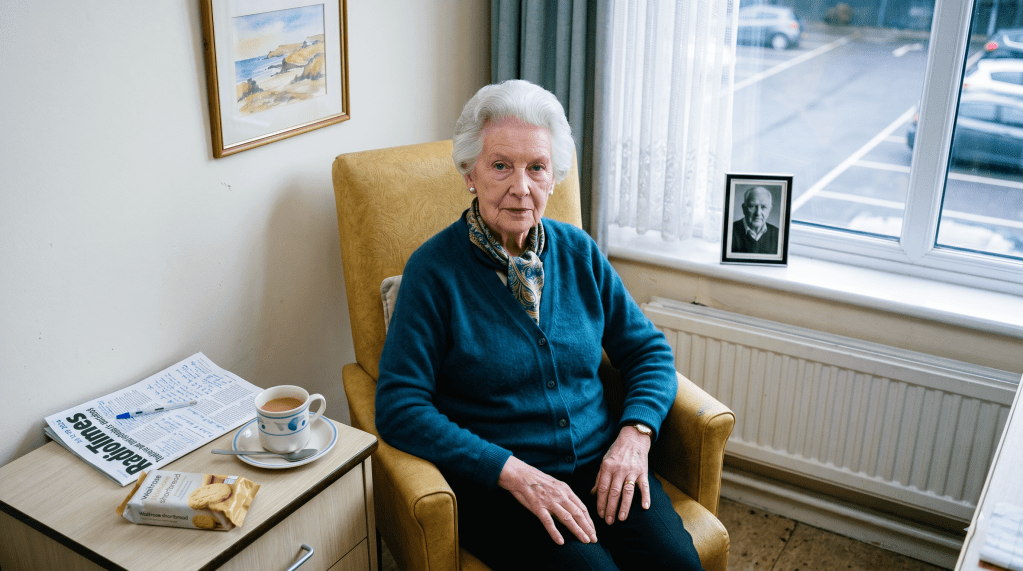
There is a wardrobe. It is pine-effect – not pine, pine-effect, which is a phrase that should be tried for crimes against the English language – and it smells of whoever lived in this room before me. Lavender, mostly. A little sadness. I’ve left the door open on principle. There is a chair, which is upholstered in a fabric the colour of old mustard and is, I will admit, comfortable enough to have surprised me twice. There is a window. The window looks out onto the car park: I have a premium view of bays one through four of the disabled parking, which means that several times a day I watch people arrive, and I watch them leave, and I think: yes, that’s about right.
My name is Edith Calloway. I am seventy-eight years old. For forty-one years I ran an antiques dealership in Bath – Calloway & Sons; my late husband Gerald chose the name ‘Calloway & Sons’ on optimistic grounds, though the sons remained stubbornly theoretical for the duration of the enterprise. My son, Christopher, being the sole occupant of that plural title, never once saw fit to enquire about the vacancy. I suspect he viewed the ‘Sons’ on the sign with the same vague, polite indifference he applies to my address book or the the shop’s hand-written stock ledgers: as a piece of legacy that had nothing to do with him.
Whilst I was arguing the provenance of Meissen, Christopher was already looking toward a world that did not require a shopfront in Bath to feel substantial. To him, the business was never a dynasty: it was merely a building where his mother spent her time, a fact he has now solved by placing the entire inventory into cardboard boxes in his garage. He is the ‘Son’ who finally retired the ‘and’, and I find the efficiency with which he did so to be his most maddening quality.
I had a house on the London Road with nine rooms, four fireplaces, two staircases and approximately four hundred books, which my daughter Rachel called a fire hazard in the same bright, efficient tone she uses to discuss anything she has already decided to dispose of.
I tell you all of this because in three weeks it has become relevant in a way it never was before, which is to say: it is gone. Most of it. Nearly all of it.
What came with me to Sunnybrook Care Lodge – and if you would like a moment to consider the name Sunnybrook Care Lodge I will allow you that, it has given me considerable mileage – what came with me was one suitcase, one cardboard box, one framed photograph, and a carrier bag containing my washbag and two packets of the expensive biscuits that Rachel does not know about and will not be finding out about. The suitcase holds my clothes, my medication, my address book and a small watercolour of the Algarve coast that I painted in 1989 and kept not because it is good – it isn’t, particularly – forgive me, I mean it isn’t especially good, I painted it in forty minutes in direct sunlight after two glasses of wine – but because looking at it makes me feel like someone who once stood on a hillside in Portugal with wine and paint and an afternoon and thought: yes, this will do. This is a life.
The cardboard box holds seven books. I was allowed seven. I stood in front of four hundred and chose seven, which I understand is meant to sound like an interesting puzzle and is in fact a bereavement.
The framed photograph is of Gerald. Christopher nearly left it behind. Not maliciously – Christopher does very little maliciously, which is its own kind of maddening – but because he was already on his phone by the time he got to the hallway, confirming dinner reservations in a voice that suggested the dinner reservations were the thing requiring the most careful attention that afternoon. I picked it up myself. Put it under my arm. He didn’t notice.
That photograph sits on the windowsill now, Gerald’s face tipped slightly toward the car park. I have decided he would have found this funny. He found most things funny, which was one of the things I held against him and then spent twenty years missing.
Now. I understand that people – thoughtful, educated, perfectly solvent people who own several rooms and could fill them however they chose – are currently paying considerable sums to be told that owning less is the key to happiness. That the stripped-back life is the enlightened life. That freedom lives in empty shelves and a capsule wardrobe and a single, beautiful, intentional ceramic bowl. I have read the books. I have, in fact, been forced to leave most of them behind, which I note with the serenity of someone who has not yet entirely processed her feelings on the matter.
What I am telling you is this: I have had the treatment. Not the retreat version with the linen throw and the mindfulness journal. The other version. The version where it is done to you, at speed, by people who love you in the abstract and find you inconvenient in practice. The version where the minimalism is not a philosophy you adopt but a verdict that is handed down.
So. I have some thoughts.
I should warn you that I have nowhere to be. I have nothing to tidy, nothing to catalogue, no appointments until later today when a woman called Diane comes to do something to my feet. The staff here are perfectly adequate and largely indifferent, which I respect more than false warmth. There is a communal lounge in which the television is always on and always showing something that appears to have been selected to confirm that the world has moved on without us. I go there rarely. I am not, broadly speaking, a communal lounge sort of person.
What I am is a woman with eleven feet by thirteen, a chair the colour of old mustard, a view of a car park, seven books, and an unusually large number of opinions for someone the world has decided has nothing left to say.
You were warned about the forgiveness. I meant it.
Let’s continue.
II: The Uninvited Discoveries
Here is something nobody tells you about losing everything, and I suspect the reason nobody tells you is that it doesn’t make for a very sellable retreat weekend: the first thing that happens is not grief. The first thing that happens is noticing.
I have lived with things for so long – beautiful things, complicated things, things with histories I could recite like other people recite their children’s school reports – that I had stopped seeing anything that wasn’t one of them. My attention, for forty years, moved through a room the way a dealer’s attention moves: cataloguing, assessing, resting briefly on what was interesting and sliding past everything else. Gerald used to say I could walk into a house fire and come out describing the mantelpiece.
He wasn’t wrong.
But now there is no mantelpiece. There is a wall, painted in a shade I can only call institutional cream, and because there is nothing on it and nothing in front of it and nothing I am meant to be doing about it, I have been looking at the wall. I have been looking at the wall the way I once looked at a piece of late seventeenth century Dutch marquetry – carefully, with time, without agenda. And the wall, for the record, is more interesting than you’d think. There is a hairline crack above the window that runs for approximately eight inches and then stops, as though it thought better of the whole enterprise. I respect that crack. It has restraint.
The light here, in the mornings, comes in at a low angle off the car park tarmac and throws a pale, watery reflection across the ceiling that moves as the clouds move. I noticed it on day four. I have watched it every morning since. I watched it this morning for eleven minutes before I realised I was doing it, and then I carried on for another six because there was nothing and nobody to tell me not to.
I have also, with some reluctance, begun to find the staff interesting.
There are seven of them on regular rotation that I have identified so far. I study them the way I once studied hallmarks – looking for the maker’s mark, the date letter, the signs of what they’re actually made of beneath the finish. Diane, who does the feet on Tuesdays, qualified as a nurse in the Philippines and retrained as a podiatrist after her youngest was born and finds both facts faintly embarrassing to mention, though I can’t work out why. Marcus on the night shift reads on his phone between rounds – not social media, actual long-form reading, I’ve seen the scroll length – and has the look of someone who ended up here by a route that surprised him. There is a woman called Precious, who I shall return to in due course, because Precious deserves her own consideration.
The point is: I am looking at people. Really looking. I had forgotten I knew how.
The second thing that happens – and this one I resent more, because it crept up without announcing itself and I prefer things to have the decency to announce themselves – the second thing that happens is that the noise stops.
Not literal noise. The literal noise here is considerable and largely consists of the television in the communal lounge bleeding through the walls at a volume calibrated for people whose hearing has given up entirely, which mine has not. I mean the internal noise. The constant, low-level administrative hum of owning things: is it insured, is it dusted, is it fading in the sunlight, who will want it when I’m gone, where did I put the receipt, does it need reupholstering, what does it say about me that I have it, what would it say about me if I sold it.
That noise has stopped.
I want to be very clear that I did not ask for it to stop and I did not welcome the stopping. I noticed it the way you notice a fridge that has been running constantly finally switching off – only in the silence do you understand how loud it had been. The cognitive equivalent of a power cut, I decided. Alarming at first, that sudden dark. And then, frankly, rather peaceful.
I have thought more clearly in the past three weeks than I have in years. That is an admission that costs me something and I am making it with my eyes open. I have thought about Gerald, properly, without the interference of all the things we chose together that needed attending to. I have thought about the dealership, about the years I loved it and the years I ran it on momentum alone and couldn’t have told you which was which. I have thought about my children – Christopher with his dinner reservations, Rachel with her categories – and managed, on two occasions, to think about them without the flavour of fury that has been my default position since mid-April. I cannot promise this will last. But it has happened.
My mind, stripped of its curating function, has apparently decided to do philosophy instead. I am not sure this is an improvement. But it is at least something.
What the philosophy keeps returning to, annoyingly, unhelpfully, with the persistence of a dripping tap, is memory.
Specifically: what I actually remember.
I had a theory, held for most of my adult life and reinforced professionally at every turn, that objects are the vessels of memory. That things hold time. That the reason you keep the terrible vase your mother bought you in 1987 is not the vase – it is the afternoon she brought it, the way she held it out in both hands, the expression on her face that was hope and apology and love all at once, wrapped in brown paper from the market. I believed this. I built a career on a version of it. I charged people good money to acquire the right vessels.
And now I have almost none of them, and the memories have not gone with them. That is the inconvenient discovery. That is the thing I am still turning over.
What I remember – what comes to me here, in this eleven-by-thirteen room with its mustard chair and its crack in the plaster – is not things. It is not the Persian rug from Istanbul, though I remember buying it, the dusty chaos of the market, the way the dealer and I argued pleasantly for twenty minutes over tea and I won. It is not the writing desk Gerald built, though I remember his hands on it, the sound of the sandpaper on a Sunday afternoon. The rug and the desk were not the memory. They were where I stored it, which is not the same thing at all.
What I remember is the smell of my mother’s kitchen on a Saturday morning, which was flour and the Home Service and something unidentifiable that I have never encountered anywhere else and cannot describe and would give quite a lot to smell again. I remember the weight of Christopher as a newborn – not as a concept but as a physical fact, the solid warmth of him across my forearm in those first days when I was terrified and didn’t show it. I remember a thunderstorm in Lisbon in 1977 with Gerald, the two of us soaked through in a doorway in the Alfama, laughing at nothing, laughing because he was thirty-four and I was twenty-nine and we were wet and in Lisbon and the storm was extraordinary, and I hadn’t thought about that afternoon in perhaps twenty years but it has come back to me three times this week with a clarity that is almost aggressive.
None of those memories lived in an object. They lived in my body. They were waiting.
I resent what this implies. I resent it because it suggests that Rachel, in her ruthless, unfeeling, efficiency-brained way, may have inadvertently been right about something, and I am not ready to grant her that.
This brings me to the thought I keep arriving at and keep leaving and keep arriving at again, the way you circle a piece at auction that you know is going to cost you more than you mean to spend.
I spent fifty years, more or less, acquiring objects that reflected who I was. That was how I understood it. The books said: I am someone who thinks. The Persian rug said: I am someone who travels and haggles and has an eye. The taxidermy said: I find the world strange and beautiful and I am not afraid of either. The Meissen said: I know what things are worth and I know what I’m worth and the two are not unrelated. The house on the London Road with its nine rooms and its four fireplaces said, simply: I am here. I have been here. I am not going anywhere.
And then I went somewhere. And the things stayed behind, or were sold, or are in boxes in Christopher’s garage where they are absolutely not being properly stored, I can tell you that for nothing. And I am still here. The same person, by any measure I can apply. More annoyed, perhaps. More awake. But not diminished – or not in the ways I expected.
The woman who ran Calloway & Sons for forty-one years, who argued down dealers in three countries, who steered a family and a business largely alone after Gerald’s heart gave out at sixty-three, who once reduced a VAT inspector to a respectful silence purely through the quality of her filing – she is sitting in a mustard chair looking at a crack in the wall, and she is intact.
I am not sure whether that is comforting or insulting.
I have been considering it since week one and I still cannot decide. It is comforting because it means that nothing they took can touch what I actually am. It is insulting because it raises the question of what, precisely, I was doing with all those things for all those years, and whether any of it was as necessary as it felt.
I suspect the answer is both. I suspect the answer is that we fill space to feel substantial, and that we are substantial without the filling, and that knowing this in theory and having it demonstrated without your consent at seventy-eight in a room that smells of someone else’s lavender are entirely different experiences and I would not recommend the latter.
But I am finding things out. Against my will and against my instincts and on a schedule set by people who love me in a way I find extremely hard to forgive at present.
I am finding things out.
Precious finishes her shift at seven. She disagrees with me about Thatcher, about the necessity of curtains, and about whether a person my age ought to be drinking coffee after four in the afternoon. She is wrong on all three counts, which I have told her, and she laughs in a way that fills the room completely.
It is the best part of my day. I will not be examining why.
III: The Verdict (Delivered Under Protest)
Very well. You’ve been patient. More patient than my children, which is not the high bar it might sound like, but I note it nonetheless.
The prompt, as I understand it, is this: what are the biggest benefits of minimalist living? And since I have apparently been enrolled in a masterclass on the subject without submitting an application, I am in a position to answer it with what I think you’ll find is a fairly authoritative perspective. I have the practical hours. I have the case study. I am the case study, sitting in it, in a mustard chair, on a Tuesday.
So. The benefits.
Clarity, obviously. You think more clearly without the weight of things pressing on every available surface of your attention. I have covered this. Lightness – yes, fine, there is something to be said for not being responsible for the maintenance and insurance and dusting and ethical consideration of four hundred books and forty years’ worth of carefully chosen objects. The freedom from acquisition: I have not once in three weeks walked past something in a shop window and thought about whether it would work in the hallway, because I have no hallway, I have a door that opens directly onto a corridor that smells of industrial disinfectant and, on Thursdays, shepherd’s pie. Freedom from acquisition has, it turns out, been achieved completely. I will not be writing a glowing review on the wellness retreat’s website, but I cannot argue with the outcome.
There is also, I am told, the environmental benefit. The reduced footprint. The lighter tread upon the earth. I have a great deal of sympathy for the earth and very little patience for the people who invoke its wellbeing whilst simultaneously flying to Bali to attend a workshop on conscious unconsumerism, but the principle stands and I will not dispute it here.
You may write those down if you are taking notes. Clarity. Lightness. Freedom from acquisition. Environmental virtue. They are real. They are documented. They are, if you’ll forgive me, exactly what it says on the brochure – and the brochure, let me tell you, is a document I trust in approximately the same way I trust a piece of furniture described in an auction catalogue as showing some wear consistent with age and character. Technically accurate. Strategically incomplete.
Because here is what the brochure does not tell you.
The brochure version of minimalism is a chosen thing. It has a start date and an aesthetic and a podcast and at least one Norwegian architect who has written a very slim, beautifully designed book about it that costs forty pounds and contains, at a generous estimate, nine pounds’ worth of ideas. In the brochure version, you decide. You stand in your home – your full, complicated, memory-soaked home – and you choose what to release, and you release it with intention, and you feel lighter, and you journal about the lightness, and the lightness is the point.
What I have is not that. What I have is the other version: the version that is done to you. The version where the lightness is not the point – the lightness is the side effect of a decision made in your absence, by people who had already mentally converted your house into a problem they needed to solve before Christmas. The version that does not come with a journal, or a podcast, or a Norwegian architect. It comes with a suitcase, a carrier bag, and a view of bays one through four.
And what that version gives you – what the brochure cannot sell you because nobody would voluntarily purchase it – is something lonelier and stranger and, I have come to think, considerably more honest than anything you will find in the slim forty-pound book.
It gives you yourself. Without the set dressing. Without the scaffolding. Without the rooms full of carefully curated evidence of the person you have been constructing for the past seven decades. It gives you the raw thing, in a pine-effect wardrobe room, with no audience and no props and nowhere to hide, and it says: right then. What have you actually got?
That is not a comfortable question. I want to be precise about that: it is not comfortable, it is not enjoyable, and I would not wish it on anyone who hadn’t earned it. But it is clarifying in a way that makes every other definition of clarity look like a rough draft. Because when you answer it – and you will answer it, because there is absolutely nothing else to do at three in the morning when the television in the lounge is finally off and the corridor is quiet and Gerald’s face is turned toward the car park – when you answer it, what you find is that the answer was there all along, and did not require a single object to support it.
You find, in other words, that you are not a collection. You never were.
My children took everything from me to make their lives simpler.
The joke – and I have had considerable time to appreciate it, I have had nothing but time and I have put it to use – the joke is that it worked.
Not for the reasons they intended. Christopher wanted the house cleared so it could be valued. Rachel wanted me placed, which is a word I have chosen to live with rather than fight because fighting it takes energy I am currently redirecting. They wanted their own lives simplified, their own consciences squared, their own weekends returned to them. They got all of that. I hope the dinner reservations were worth it. I genuinely do – I have thought about this in the early mornings while the light moves across the ceiling and I have arrived, against most of my instincts, at something that is not quite forgiveness and not quite its opposite. I am calling it a stay of proceedings. Gerald would understand.
But the simplification ran the other way. It ran toward me. And in the stripping back, in the beige room with the institutional cream walls and the single framed watercolour of the Algarve that nobody thought was worth taking, I have arrived at something I could not have reached by any other route, and would never have chosen, and cannot now unknow.
That I am still entirely here.
That I have always been entirely here.
That the house on the London Road with its nine rooms was magnificent and I loved it and I grieve it in the way I grieve Gerald – steadily, privately, without performance – but it was not me. It was where I lived. I am where I live. I am this, in this chair, thinking this thought, with the irreducible thing that has been Edith Calloway for seventy-eight years running at full capacity in a room the size of a generous parking space, and nobody took it, and nobody could have taken it, and I find that I am furious and grateful in equal measure and I do not know what to do with either.
So I am doing what I have always done when I don’t know what to do. I am getting on with it.
I have ordered three books from the library service. A woman named Janet brings them on Wednesdays in a canvas bag with a picture of an owl on it, and she stays for twelve minutes precisely and we discuss what I thought of the previous three and she recommends the next three and she has not yet been wrong, which has elevated her, in my estimation, to a position of considerable standing. Three books is not four hundred books. Three books is, however, three books more than I felt I possessed in those first shell-shocked days after the move, and I find that the fewer I have, the more attention I give them, which is something I will be turning over for some time.
I have Precious, who finished her shift at seven this morning and stopped in for eleven minutes beforehand to tell me, incorrectly, that I shouldn’t be awake yet. We have now disagreed about Thatcher on four separate occasions and I have not repeated myself once, which I consider a significant intellectual achievement and which she considers, in her words, deeply exhausting. She says this whilst sitting down. She has not yet left without sitting down. I am not drawing conclusions. I am, however, noting the data.
And I am writing.
Not on anything sensible. The notepad I asked Christopher to pack is in a box in his garage alongside the Georgian silverware and my second-best reading lamp, because Christopher’s relationship with lists has always been theoretical. What I have is the Radio Times – the actual paper one, which Diane brings me on Fridays because she remembered I mentioned it once, which is the kind of detail that separates the people who listen from the people who perform listening, and Diane, for all her embarrassment about the podiatry, is a listener of the first order.
The margins of the Radio Times are, it transpires, sufficient, provided one possesses a steady hand and a fine-nibbed pen. Smaller than I’m used to. Tighter. I have developed a script so microscopic it would make a Victorian engraver weep with envy, but even so, every word has to earn its place because there is nowhere to put the ones that don’t. I am writing about the crack in the plaster and the light on the ceiling and what Gerald’s face looks like at different times of day in different weathers. I am writing about my mother’s kitchen, trying to get the smell of it down in words before the words fail me, which at seventy-eight is not an abstract concern. I am writing the things I know before I can no longer be certain of knowing them, and I am writing them in the margins of the listings for programmes I have no intention of watching, and it is the most purely satisfying writing I have done in years.
Minimalism, the brochure will tell you, creates space for what matters.
This is true. It is irritatingly, insufferably true, and I will be acknowledging it precisely once and not again.
But let me be clear – and I am always clear, it is one of my better qualities and one of my more exhausting ones, as Gerald spent thirty-five years pointing out – let me be absolutely clear about what this is and what it is not.
This is not a redemption. I have not been improved by adversity in the way that adversity, in lesser stories, improves people. I have not emerged from the beige room a softer woman, a more forgiving woman, a woman who has learned to let go. I am the same woman I was in the house on the London Road, which is to say: opinionated, unreasonably well-informed about Georgian silverware, constitutionally incapable of watching poor television without audible commentary, and in possession of a quality of stubbornness that has outlasted a marriage, a bereavement, a business, two children’s best efforts and a move to Sunnybrook Care Lodge, which, I remind you, has a car park view and a shepherd’s pie Thursday.
What I am is awake. More awake than I have been. Awake in the way of someone who has had everything taken from them and discovered that what remained was not a diminishment but a distillation – the whole of a life boiled down to its actual substance, which turns out to be fiercer and stranger and more alive than the curated version I had been presenting for the past four decades.
Minimalism does not diminish a person.
I say this as a data point, not an endorsement.
But I will tell you this: it had better watch itself around this one.
I have ten books – the seven I salvaged and the three Janet brought in her owl bag – a tube of expensive biscuits, a view of a car park that I have come to know in all its weathers, a watercolour of the Algarve that I painted drunk in forty minutes in 1989 and which is, on reflection, rather good, Gerald’s face on the windowsill looking out at the world with the mild amusement he brought to everything including, as it turned out, death, and approximately one thousand, four hundred words left in the margins of this week’s Radio Times. I intend to use every one of them.
That will be all.
Bob Lynn | © 2026 Vox Meditantis. All rights reserved.


Leave a comment