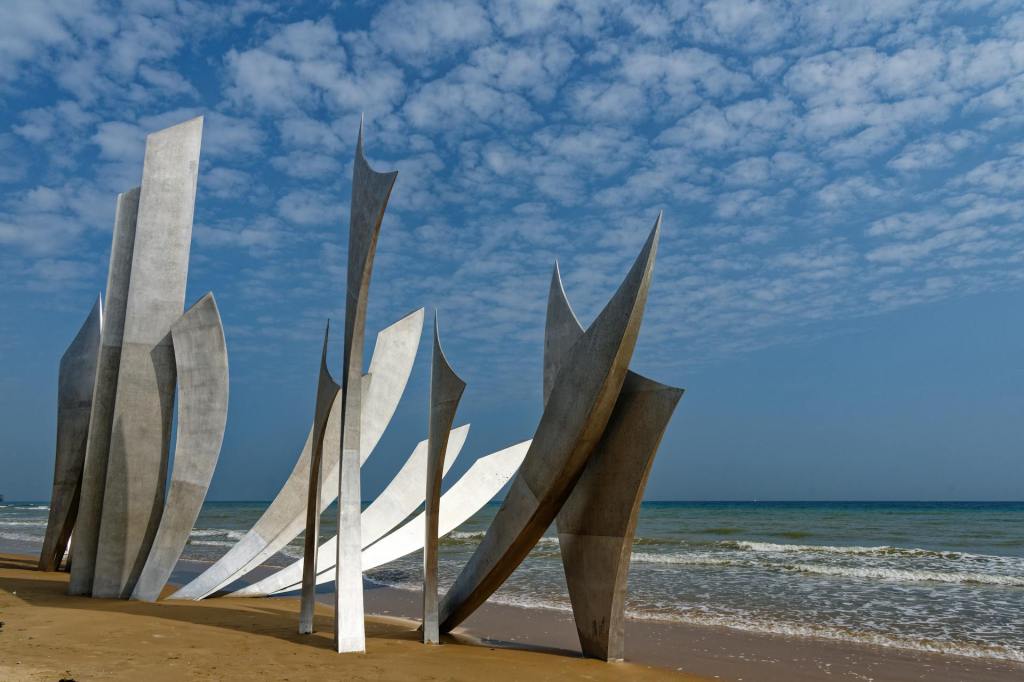
Normandy, France – 6th June 1944 (D-Day)
The Channel was angrier than I’d ever seen her, and I’d been staring at those grey-green swells for what felt like hours. The landing craft pitched and rolled beneath us, thirty-six men packed like sardines in a tin, each lost in his own thoughts as we drew closer to the Norman coast. The diesel fumes mixed with salt spray and fear-sweat created a cocktail that would have made me retch if my stomach hadn’t been empty for the past twelve hours.
I clutched my leather notebook against my chest, feeling the familiar weight of the pencil stub tucked between its pages. The other lads had stopped ribbing me about my writing habit weeks ago, assuming I was penning letters to some sweetheart back in Brooklyn or perhaps composing my last will and testament. If only they knew the truth was far more complicated.
“Steinberg still scribbling away,” muttered Kowalski from beside me, his Chicago accent thick with nerves. “What’s it gonna be today, Eli? Love poems?”
I forced a grin. “Something like that, Ski.” The lie came easily now. I’d been telling variations of it since we’d shipped out from England.
The truth was, I’d been wrestling with the same question for months, ever since we’d received word about the invasion. Not when we’d land or how we’d survive the beach—those were givens, written in the stars by men with more brass than sense. No, my question was far more personal: If I don’t make it home, what name would I want carved on my headstone?
Elias Stein was the name on my dog tags, the name I’d carried since birth. It was the name that had earned me bloody noses in the schoolyard and suspicious glances from shopkeepers. It was the name that marked me as different, as other, in a country that promised to accept everyone but often struggled to live up to that promise.
But it was also the name my father had whispered to me in Hebrew prayers, the name that connected me to centuries of ancestors who had somehow survived every attempt to erase them from history. Eliezer ben Shlomo—Eliezer, son of Solomon. My Hebrew name, the one I’d rejected when I’d first enlisted, too ashamed to explain its significance to the recruiting sergeant.
The landing craft lurched, and someone behind me was sick. The smell of vomit joined our symphony of misery, but I barely noticed. My pencil moved across the page, writing names like a man possessed:
Edward Stone
Ellis Stanley
Eli Stevens
Each one a possibility, each one a potential escape from the weight of history. I’d been carrying these alternatives for years, tucked away like spare ammunition, ready to deploy when the time came to reinvent myself. After the war, perhaps. When I returned to civilian life and needed to blend in, to disappear into the American dream without the burden of a name that announced my difference to the world.
“Five minutes!” The officer’s voice cut through the engine noise and the prayers being muttered in half a dozen languages.
I closed the notebook and slipped it into my jacket pocket, next to my heart. The radio strapped to my back felt heavier than usual, the weight of responsibility settling across my shoulders like a yoke. I was the voice that would guide our artillery, the link between the beach and the ships that would keep us alive. If I failed, good men would die.
The French coast emerged from the morning mist like something from a nightmare. Omaha Beach stretched before us, a crescent of sand backed by bluffs that bristled with German fortifications. Even from a distance, I could see the obstacles jutting from the water like broken teeth—Hitler’s Atlantic Wall, waiting to tear the bottom out of our landing craft.
“Jesus,” whispered Murphy, a farm boy from Iowa whose hands shook as he gripped his rifle. “Look at those cliffs.”
I followed his gaze to the heights above the beach, where concrete bunkers squatted like cancerous growths. Machine gun nests. Artillery positions. Positions that commanded perfect fields of fire across the killing ground we were about to cross.
My father’s voice echoed in my memory, speaking words from the Talmud he’d taught me as a boy: “Who is wise? One who learns from every person.” What would I learn from the Germans waiting for us on those cliffs? What would they learn from us?
The ramp dropped with a metallic crash, and suddenly we were moving, stumbling into chest-deep water that was shockingly cold despite the June morning. The weight of my equipment dragged at me, the radio seemingly determined to pull me under. Around me, men were shouting, cursing, praying—sometimes all three at once.
Then the machine guns opened up.
The water around us erupted in geysers of white foam, and men began to fall. Kowalski, who’d been beside me just seconds before, suddenly wasn’t there anymore. The peaceful morning was transformed into a symphony of violence—the rattle of automatic weapons, the whistle of incoming shells, the screams of wounded men.
I fought my way towards the beach, using my rifle as a walking stick, the radio on my back making me a target for any German gunner who understood the importance of cutting communications. Bullets whined past my head, so close I could feel their passage. Sand kicked up around my boots as I stumbled across the killing ground, following the white tape that marked the cleared paths through the minefield.
The seawall provided temporary shelter, but not safety. German mortars were already finding our range, and the survivors of the first wave huddled against the concrete like frightened animals. I found myself pressed against the wall next to a medic whose hands were slick with blood and a sergeant whose thousand-yard stare suggested he’d seen too much already.
“Stein!” The voice belonged to Lieutenant Whitaker, our platoon leader. “I need a fire mission on that bunker!” He pointed to a concrete position that was spitting death down onto the beach.
I unslung my radio and began the familiar ritual of calling in coordinates. My voice was steady despite the chaos around me, professional despite the fear that clawed at my chest. This was what I’d trained for, what I was good at. The radio crackled with static, then cleared.
“Thunder Six, this is Lightning Two-Seven. Fire mission, over.”
The voice that answered was calm, matter-of-fact. “Lightning Two-Seven, Thunder Six. Send your mission.”
I read off the coordinates, adjusting for wind and distance, painting a target on the German position with words instead of artillery. Within minutes, our naval guns would respond, turning concrete and steel into rubble. It was impersonal, efficient—the mathematics of death reduced to grid references and deflection angles.
But as I spoke into the radio, something changed. The German bunker wasn’t just a target anymore; it was a position manned by young men who might have been conscripts, who might have been thinking about their own names, their own identities, their own chances of survival. They were the enemy, yes, but they were also human beings caught in the same meat grinder that was consuming us all.
The naval barrage arrived with the sound of freight trains passing overhead. The bunker disappeared in a cloud of smoke and debris, and the machine gun fell silent. Around me, men cheered, but I felt no joy. Only a hollow satisfaction that we might live a few minutes longer.
We pushed inland, fighting for every yard of Norman soil. The bocage country beyond the beach was a maze of hedgerows and stone walls, perfect for defence, hell for attacking infantry. I stayed close to Lieutenant Whitaker, ready to call for support whenever German resistance stiffened.
It was in a small village whose name I never learned that everything went wrong. We’d been advancing through an orchard when the mortars found us. The world disappeared in a storm of fire and flying metal, and when my hearing returned, I was lying in a crater that hadn’t existed moments before.
Lieutenant Whitaker was dead, his body twisted at an impossible angle. The sergeant who’d been beside him was calling for a medic, blood streaming from a head wound. I tried to stand and discovered that my left leg wasn’t working properly—shrapnel, probably, though I couldn’t feel the pain yet.
The radio was still intact, still strapped to my back like a loyal dog. I crawled to the edge of the crater and tried to establish contact with headquarters. Static filled my ears, then voices speaking German. I’d lost touch with our forces, but I could hear the enemy’s communications clearly.
They were calling for reinforcements, reporting our position. In minutes, perhaps less, they would counter-attack. The handful of us who remained would be overwhelmed, captured, or killed.
I keyed the radio one more time, broadcasting on the emergency frequency. “Any station, any station, this is Lightning Two-Seven. We are cut off and under heavy fire. Grid reference…” I read off our position, hoping someone was listening, hoping help would come.
But as I spoke, I could hear German voices growing closer. Boot-steps on cobblestones. The metallic sound of weapons being readied. This might be my last transmission, my final words to the world.
And suddenly, I knew what name I wanted to be remembered by.
“Lightning Two-Seven, signing off,” I said into the radio. Then, in a voice that seemed to come from somewhere deeper than my throat, I added: “This is Eliezer ben Shlomo. Tell my father I remembered who I was.”
The Germans found us twenty minutes later, but by then American armour had arrived from another direction. The counter-attack dissolved into confusion and retreat, and I found myself being loaded onto a stretcher by a medic who spoke with a Brooklyn accent not unlike my own.
“You’re gonna be fine, soldier,” he said, checking the shrapnel wound in my leg. “What’s your name?”
For a moment, I hesitated. The question that had haunted me for months hung in the air between us, waiting for an answer. I thought of all the names I’d written in my notebook, all the possibilities I’d considered. Edward Stone. Ellis Stanley. Eli Stevens.
“Stein,” I said finally. “Elias Stein.”
He nodded and made a note on his clipboard. “Well, Eli Stein, you’re going home.”
But home turned out to be a field hospital behind the lines, then a recovery ward in a liberated French town. The leg healed slowly, and I found myself with time to think—too much time, perhaps. The notebook survived the battle, though several pages were stained with blood and mud. I read through the names I’d written, the alternatives I’d considered, and found them all wanting.
It was in the hospital that I met Ruth.
She was working as a translator for the American medical corps, helping wounded French civilians communicate with the doctors. I noticed her first because of her voice—soft, melodious, speaking French with an accent I couldn’t quite place. Then I saw her face, and understood why she seemed familiar. She had the same dark eyes, the same careful way of watching the world that I’d seen in my own family.
“You’re Jewish,” I said one afternoon when she paused beside my bed.
She nodded carefully. “I was hidden on a farm outside Caen. The family took me in when my parents were deported.” Her English was accented but precise. “They saved my life.”
“Where are you from originally?”
“Paris. Before the war.” She hesitated, then added: “My family name was Rosen. But I’ve been Marie Dubois for three years now. Sometimes I wonder if I remember how to be Ruth.”
I understood. The weight of false names, of borrowed identities, of becoming someone else to survive. “I’m Elias,” I said. “But I’ve been thinking about changing it.”
She sat down beside my bed, and I told her about the notebook, about the names I’d collected like butterflies. About the question that had haunted me from Brooklyn to the beaches of Normandy: If I had to change my name, what would it be?
“And what did you decide?” she asked.
I thought about that moment in the crater, with German voices growing closer and the radio crackling with static. The moment when I’d chosen to identify myself not as Eli or Edward or any of the American names I’d collected, but as Eliezer ben Shlomo—son of Solomon, inheritor of a tradition that Hitler had tried to erase.
“I decided I already have the right name,” I said. “I just needed to remember why.”
Ruth smiled, and in that smile I saw something I hadn’t seen in years—someone who understood the weight of names, the burden of identity, the choice between hiding and being seen.
“What will you do after the war?” she asked.
“Go home to Brooklyn, I suppose. Help my father with his shop. Maybe…” I hesitated, then continued. “Maybe stop pretending to be someone I’m not.”
She nodded. “I think I’d like to be Ruth again. Just Ruth.”
“And I’d like to be Eliezer. Just Eliezer.”
We sat in comfortable silence, two people who had rediscovered their names in the ruins of Europe, who had learned that sometimes the greatest act of rebellion is simply to be yourself. Outside, the war continued, but inside that French hospital room, we had found something worth fighting for: the right to exist, to be named, to be remembered.
The notebook remained in my pocket, its pages filled with names I would never use. But I kept it anyway, a reminder of the question that had brought me to this moment: If you had to change your name, what would your new name be?
The answer, I had learned, was not to change it at all. Sometimes the name you’re born with is exactly the name you need to die with. Sometimes the greatest courage is not in becoming someone else, but in remaining yourself despite everything the world might do to erase you.
In the end, that’s what we were fighting for on the beaches of Normandy: the right to be ourselves, to speak our names aloud, to exist without apology. It had taken a war to teach me that lesson, but some lessons are worth any price.
My name is Eliezer ben Shlomo. I am my father’s son, and I will not be forgotten.
The End
Bob Lynn | © 2025 Vox Meditantis. All rights reserved.


Leave a comment