-
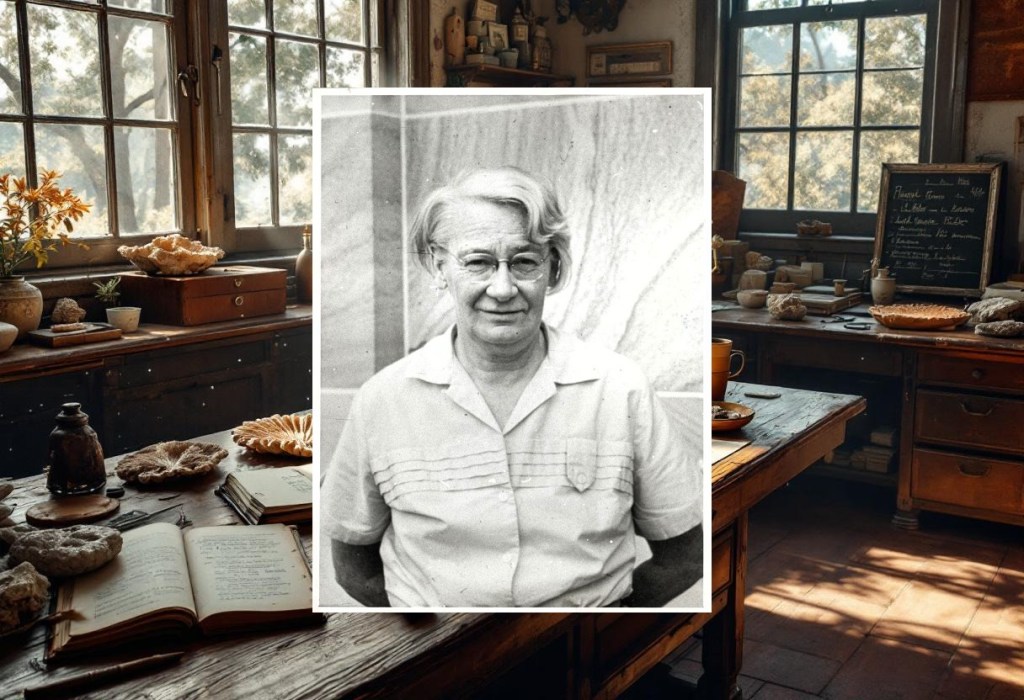 Continue reading →: Dorothy Hill: World Authority on Palaeozoic Corals History Nearly Forgot
Dorothy Hill classified thousands of fossil corals, built Queensland’s geological map, and opened Australian universities to women – then vanished from history. She explains why taxonomic labour disappears, how ancient reefs predict modern collapse, and what she got wrong about mentoring.
-
 Continue reading →: Heavy Keys
A weary shopkeeper and mother in 1850 reflects on duty, lost learning, and the heavy keys at her waist. Between trade, faith, and her son’s schooling, she weighs what knowledge truly opens – and what remains forever locked.
-
 Continue reading →: Architecture of Witness
Catherine explores what counts as history – not just televised disasters but inherited silence, shipyard closures, and yesterday’s watercolour risk. At the Historical Society, she asks: whose memory gets archived? Personal and collective trauma blur in consulting rooms and harbour light.
-
 Continue reading →: Alice Catherine Evans: She Proved Raw Milk Kills and Was Told She Was Wrong
Alice Catherine Evans discovered that raw milk transmitted deadly brucellosis from cattle to humans – then spent a decade being dismissed by male scientists and dairy interests who valued profit over proof. She contracted the disease herself, worked whilst chronically ill, and waited for men to confirm what she’d already…
-
 Continue reading →: At the Crossroads
At a moonlit crossroads in October 1892, a Victorian merchant reflects upon the circular nature of trade, the weight of historical memory, and the moral dimensions of his itinerant travelling life. Every journey he takes shapes both fortune and character.
-
 Continue reading →: The Corridor
Catherine registers for watercolour class, accepts a concert invitation, and sits for the Historical Society as subject rather than interviewer. A rainy Tuesday prompts her to name the risk she’s avoided: ordinary intimacy without the clinical frame to hide behind.
-
 Continue reading →: Hertha Sponer: The Bridge Builder Between Quantum Physics and Chemistry Who Vanished
Hertha Sponer built the experimental foundations of quantum chemistry, developed methods still taught worldwide, and trained 35 scientists – yet history remembers her as “Franck’s assistant.” She explains how interdisciplinary innovation becomes invisible, why exile shattered her career’s momentum, and what bridge-builders lose when traffic flows freely across their work.
-
 Continue reading →: October Stars
In a misty October orchard, a headmistress contemplates the stars and the dawning age of machinery. Between duty and desire, she reveals her deepest ambition: to create a technical college for young women, despite the risk of failure and ridicule.
-
 Continue reading →: What We Carry Forward
A psychiatrist examines what pride means when you’ve spent decades learning to dissolve the self. Not credentials or reputation, but something quieter: thirty years of steady showing up, inherited industriousness transformed into therapeutic architecture, and the courage to finally risk being ordinarily seen.
-
 Continue reading →: Mollie Orshansky: The Government Analyst Whose Work Became Invisible Policy Infrastructure
In 1963, Mollie Orshansky created America’s poverty line – a formula so successful it became invisible infrastructure, erasing her name entirely. She discusses measuring deprivation, bureaucratic erasure, why her “temporary” thresholds lasted sixty years, and what happens when a woman’s achievement outlives her memory.
Feign the virtue thou dost seek, till it becometh thine own

Recent Posts
- Caroline Eichler: Springs, Silver and the Art of Walking Again
- The Door of My Lips
- Twenty Metres of Chain
- Look Up: Why We Feel Most Alive When Comfort Fails
- Anna Winlock: The Computer Who Measured the Sky by Hand
Categories

