What are your favorite 5 apps on your phone?
A scene for three performers. No interval. No blackouts. The afternoon keeps its own time.
PERSONS
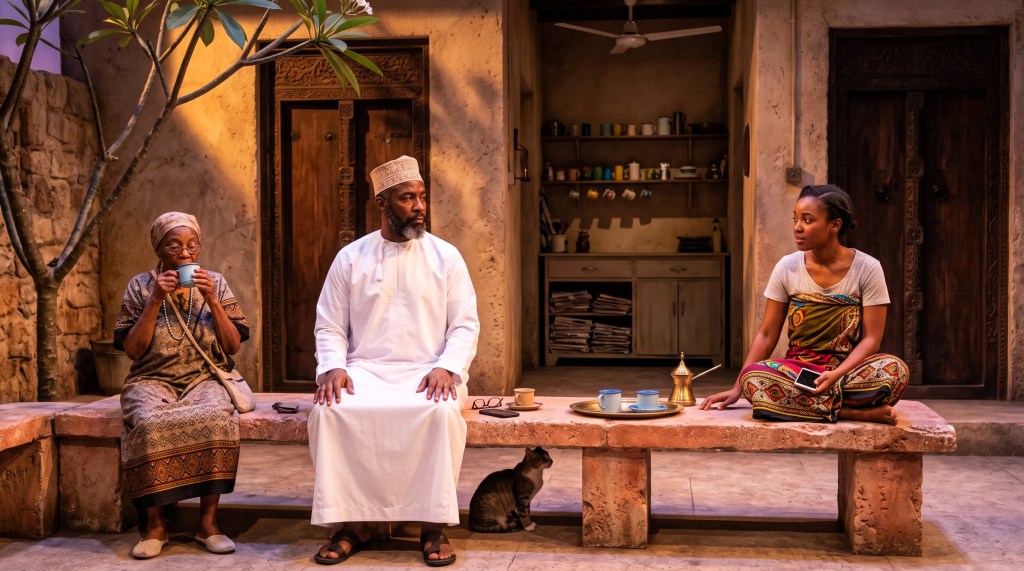
SHEIKH IDRIS JUMA KHAMIS – 57. Retired Chief Kadhi of Zanzibar. White kanzu, kofia, reading glasses. His stillness is the heaviest object in the courtyard. He does not turn his head when he speaks.
NEEMA – 26. Granddaughter of his late wife Amina’s younger sister, living in the house by family arrangement. Phone in hand, always. A small weather system.
BI. KHADIJA – 74. Amina’s childhood friend. Slippers, spectacles on a beaded chain, a cloth bag over one shoulder. Small, and shrinking. Her voice pipes, and whistles a little on the s-sounds.
PLACE
The ua – the inner courtyard – of an ancestral coral-stone house in Stone Town, Zanzibar. Two carved doors: one to the street, one to the interior of the house. A worn stone baraza runs along one wall. At the back, a kitchen alcove: electric kettle, stove, cupboards, and a low cupboard stacked with old newspapers and a broken radio. A frangipani tree overhangs one corner. A ceiling fan ticks overhead. The smell of cardamom. The Indian Ocean is audible beyond the narrow lanes, but never seen.
At the left end of the baraza: a small cup of coffee, reading glasses, a smartphone face-down. At the right end: a second phone, a half-eaten mango, a tangle of charging cable.
A cat crosses the courtyard at intervals. It does not speak. It is a presence.
TIME
Monday, 2nd September 2024. A little before four in the afternoon, moving toward asr, and by the end toward maghrib. The light does the accounting.
NOTE ON THE LANGUAGE
All three characters are speaking Swahili with their hearts. What is heard is the afternoon’s translation: slightly formal for the Sheikh, fast and mixed for Neema, spare and old for Bi. Khadija. The Swahili words that have no English pocket stay as they are.
The adhan will sound twice during the scene. The courtyard is one room; no one leaves it.
Lights up. SHEIKH IDRIS sits at the left end of the baraza, upright as a carved door. His cup of coffee stands on the stone beside him. His glasses are on. His phone lies face-down. He regards the middle distance. NEEMA sits at the right end, legs folded under her, phone in both hands, thumbs working. Between them is a space neither of them has measured and both of them keep. The fan ticks. Somewhere beyond the lanes, very faint, the sea. The cat crosses upstage, unhurried, and is gone.
NEEMA. (without looking up) Sheikh. Sheikh. Sheikh, unaona? This woman. This woman is telling me her scratch card scratched itself. She says, I bought the voucher, I scratched, the numbers were not there, she says, the airtime was not there, she says the phone swallowed it. Ndio. The phone swallowed it. Like a fish. She has sent me four voice notes, Sheikh, four –
She taps the phone flat against her palm. A small voice bleeds out of it, fast Swahili, rising. She taps it silent again.
NEEMA. – and the last one is just breathing. She is breathing at me.
SHEIKH IDRIS. (he does not turn) A complaint is a document. A document is read to the end.
NEEMA. I have read it to the end. I have read it to the end twice. (typing, fast) “Dear customer, we regret the inconvenience, kindly share the voucher number.” Kindly. I say kindly every time. I am the kindest person in this company. I am the kindest person on this island. (beat) Sheikh, do you think “kindly” is too much? Am I sounding like a robot? My friend Zuhura says when I type kindly I sound like a man from 1974.
SHEIKH IDRIS. Kindly is not the matter. The voucher number is the matter.
NEEMA. (typing) “Kindly share the voucher number.” Sawa. Sent. (she sets the phone down, picks it up again) The thing is, if she scratched the numbers, the numbers are gone, so what is she going to share with me, the dust? Haya. (she chews the mango) You know what I would do? I would buy a new voucher. I would scratch it slowly. Slowly. With a coin, not a fingernail. (beat) But she wants free airtime. Everyone wants free airtime. Everyone wants something for nothing, and then they send voice notes.
Silence. The fan ticks.
NEEMA. (softer) Sheikh.
SHEIKH IDRIS. I heard you.
NEEMA. Then say something.
SHEIKH IDRIS. I have said something.
NEEMA. You said you heard me. That is not something, that is a receipt. You are giving me a receipt. I don’t want a receipt, I want – (her phone buzzes; she is on it instantly) Sasa. The voucher number. Fifteen digits. (typing) Asante mama, tunashughulikia. (to herself as she types) “We are looking into it.” I am always looking into it. I have been looking into it for eleven months. I have looked into so many things, Sheikh, I am like a well. Everyone looks into me. (beat; she types faster) There. Solved. Next. (brightly, too brightly) You know, if I close my numbers this month, they move me to the business line. Business customers. They pay more, so they are angrier, but the allowance is – (she makes a small money-sound with her tongue) – and then the spice business is just for Sundays, inshallah, and by December I have a shop. A real shop. With a door.
SHEIKH IDRIS. Inshallah.
NEEMA. You said inshallah like a door closing.
SHEIKH IDRIS. Inshallah is a door. One says it, and the opening is left to God.
NEEMA. (grinning) Okay, okay, Sheikh. (typing)
The cat returns, crosses the courtyard, and sits in the thin shadow of the baraza. NEEMA reaches for it without looking. The cat steps around her hand. She withdraws the hand, looks at the hand, looks at the cat.
NEEMA. Bahati. My heart. You were friendly in June. What happened in June, Bahati?
SHEIKH IDRIS. It is not Bahati’s season.
NEEMA. Cats do not have seasons, Sheikh.
SHEIKH IDRIS. This one does.
NEEMA. (shrugging, back to the phone) Fine. Keep your secrets, Bahati. (she scrolls, stops, frowns, tilts the phone toward him) Sheikh. Sheikh, read this.
SHEIKH IDRIS. I am not a reader of other people’s telephones.
NEEMA. I am reading it to you, that is not the same. Listen. (she is already reading) “Dear Lady Mariam. Greetings to you from Zanzibar, the island of spices. We are happy to offer you our Zanzibar spice mixes – cloves, cinnamon, black pepper, and our special pilau masala – packed with love and hygiene.”
SHEIKH IDRIS. (a pause) Hygiene.
NEEMA. It is important! People want to know the spices are clean. I put hygiene in every draft.
SHEIKH IDRIS. One does not announce hygiene. One practises it quietly. A shop that announces hygiene has already raised a question.
NEEMA. (typing, deleting) Okay, okay. (reads on) “Packed with love.” Do I delete the love? Do I keep the love? Sheikh, this woman wants fifty packets. Fifty. If I land her, I put the money in the business account, and then the business account becomes real, and when the account is real the bank gives me the loan, and with the loan I –
SHEIKH IDRIS. Neema.
NEEMA. – I buy the stock, and with the stock I –
SHEIKH IDRIS. Neema.
NEEMA. Nini?
SHEIKH IDRIS. The message.
NEEMA. What about the message?
SHEIKH IDRIS. Read it the way you would wish to receive it.
NEEMA. (beat; more slowly) “Dear Lady Mariam. Greetings from Zanzibar. We offer our spice mixes – cloves, cinnamon, black pepper, pilau masala. Fifty packets is no trouble. We pack on the day we post.” (beat) Hm. Now it sounds like a man wrote it.
SHEIKH IDRIS. It sounds like a person who knows the weight of fifty packets.
NEEMA. (softening) Okay. Okay, that is – okay. (typing, slowly now, carefully) “We pack on the day we post.” (beat) Sheikh, is it okay? Really?
SHEIKH IDRIS. It is sufficient.
NEEMA. Sufficient is not fine, Sheikh. Is it fine? Tell me it is fine. Say, Neema, you are doing fine.
SHEIKH IDRIS. (a pause) Neema. You are doing fine.
NEEMA. (lighting up, typing) Asante! You see, that takes four seconds. (she hits send; instantly the doubt returns; she seizes the phone again) Wait – “no trouble” – what if it is trouble? Fifty packets is trouble. Where am I getting fifty packets by Friday? (scrolling) I will call Mama Zubeida, she packs for me, she has daughters, daughters have hands – (she stops, looks at him) You are not going to say haba haba?
SHEIKH IDRIS. Haba haba hujaza kibaba. Little by little the measure is filled.
NEEMA. You say it like a funeral.
SHEIKH IDRIS. It is a proverb. It is not a song.
NEEMA. Everything is a funeral, Sheikh. Even the fan. Listen to it. (she holds up a finger; they both listen to the tick) That fan is ticking like it is counting something.
SHEIKH IDRIS. The fan is old. Old things tick.
NEEMA. I could fix it. I watched a video –
SHEIKH IDRIS. The fan is not your patient.
She laughs – too loud. The cat opens one eye. NEEMA’s hand drifts along the baraza and finds the reading glasses. She puts them on, gasps, clutches her chest.
NEEMA. Ayaa! I can see everything. I can see the year 2040. I can see your thoughts, Sheikh, they are – hm, they are very neat in there. Like a cupboard. (she takes them off, sets them back exactly where they were; SHEIKH IDRIS, without a word, adjusts them a millimetre)
SHEIKH IDRIS. The glasses are not a toy.
NEEMA. I was testing them. For quality. In case they break, I will know how they were. (her phone pings; she glances at it, rolls her eyes) Uuh. Your phone is crying too, by the way. It has been crying since yesterday. It wants to update.
SHEIKH IDRIS. It does not want. It requests.
NEEMA. Same thing. Just tap update, Sheikh. Two seconds.
SHEIKH IDRIS. Yesterday it showed me a paper. In English. It said, this application wishes to enter your position, your pictures, your microphone. At the bottom there was a small word. Allow. (a pause) One does not sign a paper one has not read.
NEEMA. Everyone taps allow, Sheikh. The whole world taps allow.
SHEIKH IDRIS. Then the whole world is signing what it has not read. That is why the world is as it is.
NEEMA. (beat) Okay, that was actually good. That was a kadhi’s answer. (typing again) Fine. Your phone stays crying. I respect it. (beat) Mine is on fourteen percent, look. Fourteen. And the cable – (she lifts the tangle, shakes it) – this cable is a nest. Every day it is a bigger nest. I think it is laying eggs.
SHEIKH IDRIS. Put the phone down. The charge will come to it.
NEEMA. If I put the phone down, Lady Mariam goes to another spice person. The spice person in Mombasa does not put the phone down. The Mombasa spice person is probably typing right now with her feet. (she unplugs the cable, plugs it back in, holds the phone up) There. Now we wait. Waiting is also a job, Sheikh. Some of us are very employed at it.
She settles back. Chews the mango. The fan ticks. The sea, faintly. SHEIKH IDRIS lifts his small cup, drinks, sets it down precisely. Then he looks past the kettle, at the shelf of cups in the alcove. He looks at it for a moment. NEEMA notices the look and misreads it.
NEEMA. You want another one? I can make another one. The kettle is fast, two minutes –
SHEIKH IDRIS. The coffee is sufficient.
NEEMA. Then what are you looking at?
SHEIKH IDRIS. (a pause) The shelf.
NEEMA. The shelf.
SHEIKH IDRIS. It is not your shelf. Continue with your work.
NEEMA. (shrugging, typing) Okay. Mysterious man. Okay. (beat, brightly) Lady Mariam is typing. She is typing, Sheikh. Three dots. The three dots of destiny –
– and from somewhere beyond the lanes, thin at first and then doubled, the adhan for asr. One mosque, then another leaning into it, the voices overlapping a little, unhurried. NEEMA’s thumbs slow. SHEIKH IDRIS sets his glasses down beside the cup and rises without haste, the way a door opens that has always opened.
NEEMA. Oh – is it asr already? Where did the hour go? (she does not move)
SHEIKH IDRIS. (taking the small prayer mat from its nail by the inner door) The hour went where the hours go.
NEEMA. I will pray after. When the chat closes. It closes at five. (beat, at his silence) I will pray, I will pray. Don’t look at me like that.
SHEIKH IDRIS. I am not looking at you.
NEEMA. You are looking at me without looking.
He spreads the mat in the corner of the courtyard under the frangipani, adjusts it once with his foot, and faces away from the gate. He says the iqama, low, to himself: Allahu Akbar, Allahu Akbar. The prayer begins. This is the scene’s quiet centre, played in full, in real time: the standing, the bowing, the prostration. NEEMA works through it in silence – mouthing replies, tapping, wincing at a voice note she does not play. Once she rises to reach the kettle, trips on the step of the alcove – the step she has tripped on every day for two years – catches herself on the doorframe, and looks back to see if he saw. He is in prostration. She mouths pole kwangu at no one, fills the kettle, does not switch it on, and sits down again. SHEIKH IDRIS finishes. He turns his head to the right, to the left: Assalamu alaikum wa rahmatullah, Assalamu alaikum wa rahmatullah. He folds the mat back onto its nail with great care, smooths his kanzu, and sits down in his place as though he had never left it.
NEEMA. (immediately) Okay, finished, good. Because listen. (reading) Lady Mariam has answered. She says, “I will pay half now, and half when the parcel reaches me.” Half, Sheikh. Half now. Which means I buy stock with half, which means Mama Zubeida gets paid late, which means – (she stops, looks at him) You have the face.
SHEIKH IDRIS. I have no face.
NEEMA. You have the face. The kadhi face. The it-is-my-finding face. Give the finding.
SHEIKH IDRIS. (a pause) It is permitted to accept part of a debt. It is better to agree upon the whole. When a person accepts half, he teaches the other person that his word has two prices.
NEEMA. (beat) Okay. But she is paying, Sheikh. Money is coming. The measure is filling. Haba haba. (typing) “Half is acceptable, dear Lady.” – I put the dear back. It is my letter. (she sends, then, as if remembering, she is on her feet; she crosses to the alcove, lifts a small plate, comes back, sets it on the baraza between them: viazi karai, still warm. She dusts her hands on her kanga.) Kula, Sheikh. You look thin.
SHEIKH IDRIS looks at the plate. He does not touch it. The sentence has crossed this courtyard before, in another voice.
SHEIKH IDRIS. I have eaten.
NEEMA. You have always eaten. You have been “having eaten” for two years. Kula. (she pushes the plate one finger-width closer) The oil is fresh. I made them myself. I only burned two.
SHEIKH IDRIS. (he takes one piece, precisely, without looking at her) The oil is not the matter. The plate is the matter.
NEEMA. What about the plate?
SHEIKH IDRIS. It is set for two. There is one person sitting here.
NEEMA looks at the plate. It is set for two – two of everything, arranged by a hand that learned arrangement somewhere. She looks at it for a moment too long.
NEEMA. (quietly) I didn’t – I just put them on the plate. My hand just – (she stops) Okay. Okay, I will eat the second one. I will eat both. For bulk. For the business body. (she takes one; they eat in silence; the fan ticks; she speaks with her mouth half full, gentler now) At Eid, you know Amani said – no wait. Zuhura said Amani said. She said, and I quote, “My uncle will take a smartphone over my dead body.” (she laughs) And then he gave you one, and put you in the group! Kumbe! The dead body is alive and posting! (beat; she looks at him) Sheikh? That is funny. It is slightly about you, but it is funny.
SHEIKH IDRIS. (a long pause; he adjusts his glasses) Amani is my brother’s son. His words are my brother’s words in a smaller shirt. (a pause) One does not prosecute one’s family. One notes the evidence.
NEEMA. (carefully) You are noting.
SHEIKH IDRIS. I am noting.
NEEMA. (softly, scrolling again) Okay. (beat; brightly, before she can stop herself) And at Eid, Auntie Halima said – and I am quoting again, I am only the newspaper – she said, “The Sheikh eats alone, like a man waiting for a train.” (she winces the instant she lands it) …That one I shouldn’t have said. Delete. Delete. (she mimes deleting the air)
SHEIKH IDRIS. (very still) Your auntie Halima has her mother’s tongue and none of her sense.
NEEMA. Deleting.
SHEIKH IDRIS. (to the middle distance) There is no train.
NEEMA. (gently) I know, Sheikh.
SHEIKH IDRIS. There has never been a train in this town.
NEEMA. (softly) I know.
A beat. The fan ticks. Then, from beyond the wall – offstage, behind the street gate – a thin electronic wailing begins: the pre-paid meter, crying for units. NEEMA sits up.
NEEMA. Ayaa. Ayaa, that is the meter. The meter is crying. Sheikh, did you buy units?
SHEIKH IDRIS. Units are bought by the one who spends the light.
NEEMA. I spend the light! I spend all the light! The kettle, the fan, the fridge, my phone, your phone – your phone is spending light right now, it is in the house charging like a little guest –
SHEIKH IDRIS. My telephone consumes what a lamp consumes.
NEEMA. Everything consumes! (she is scrolling) Okay, okay, M-Pesa, tokens, wait – (she stops mid-swipe; holds the phone up) Sheikh. Sheikh, the Wi-Fi.
SHEIKH IDRIS. What of it.
NEEMA. It is dead. It is lying on its back like Bahati in the sun. One bar. No bar. (she stands, lifts the phone to the sky, walks the courtyard slowly, like a person searching for water with a branch) Here. Here I have one bar. Sheikh, come stand here, you are tall, hold it up –
SHEIKH IDRIS. I am not a mast.
NEEMA. You are a very tall mast, come –
She takes his arm and tugs. He does not move. He does not even sway. She lets go, pats the arm, apologetic, not sorry.
NEEMA. Okay. Fine. I will stand on the wall. (she does not stand on the wall; she sits back down, phone raised) One bar. One bar is enough. One bar is a miracle. Alhamdulillah for the one bar. (she types with the phone in the air) Sheikh, your nephew is a software developer, he can fix anything, tell him to fix the Wi-Fi of my heart.
SHEIKH IDRIS. Amani is in Dar es Salaam. Dar es Salaam is a place where people go to become busy.
NEEMA. (laughing) That one I will also delete, because if Amani hears you said that he will actually die. (her phone pings; she lowers it, looks – and stops. Her face changes: delight, mischief.) Oh. Oh no. Oh, Sheikh.
SHEIKH IDRIS. What is written.
NEEMA. The group. Your group. Amani’s Writing Circle. Nineteen days you have been in it, nineteen days, I have been counting because you counted out loud – (she is reading, slow, savouring it) “Good afternoon writers! Today’s question…” (she stops, squints, bursts out laughing) No. No, no, no. He did not.
SHEIKH IDRIS. Read what is written.
NEEMA. (reading) “What are your favourite five apps on your phone?” (she looks up, radiant) That is today’s question! The big question! The deep question of our time! (already typing) I am answering. I am answering now, before Zuhura answers, because Zuhura writes essays, she will write about her camera roll, she will bring her childhood into it – okay. (she counts on her fingers, fast, flat, like a shopping list) WhatsApp. Instagram. M-Pesa. Camera. TikTok. (typed in eight seconds) Sent. Done. Next. (she sets the phone down on her knee and turns to him, bright, open, expecting nothing) Your turn.
SHEIKH IDRIS. (a pause; he adjusts his glasses) I am not a member of that circle.
NEEMA. You are a member. You have been a member for nineteen days. You have never written, but you are a member. Like a ghost. You are the ghost of the group, Sheikh.
SHEIKH IDRIS. One does not answer a question one has not been asked.
NEEMA. You have been asked. I am asking. Sheikh Smartphone. (she performs it – holding an invisible phone at arm’s length, eyes narrowed, shoulders squared, voice dropped an octave, grave as a courtroom) “One does not tap the thing. One studies the thing.” (she breaks, delighted) It is a good impression. You know it is a good impression.
SHEIKH IDRIS. (without a flicker) The impression holds the telephone too far away. I hold it at the correct distance.
NEEMA. Which is the arm’s-length distance, Sheikh.
SHEIKH IDRIS. It is the correct distance.
NEEMA. (leaning in, coaxing) Come. Answer. Five apps. Everyone has five. Even Bahati has five, if Bahati had a phone, which she does not, because she is a cat, and even she is more reachable than you.
SHEIKH IDRIS. (a pause) The question will not be answered in your manner.
NEEMA. My manner took eight seconds.
SHEIKH IDRIS. Some questions require more than seconds.
NEEMA. Not this question! This question requires less than seconds! This question requires a reflex! Sheikh, what is even on your phone? Tell me what is on it. You have – what – you have WhatsApp, because Amani put it there. You have the Qur’an, because you put it there. You have the lamp, because the torch. And you have the phone, because the phone. That is four. Four, Sheikh. You are one short of a life.
SHEIKH IDRIS. (very still) You have counted my belongings.
NEEMA. I have counted your apps.
SHEIKH IDRIS. It is the same counting.
A beat. The fan ticks. NEEMA hears something different in his silence now and leans closer, gentler.
NEEMA. So answer.
SHEIKH IDRIS. (to the wall, quietly) A man’s hours are a trust.
NEEMA. Okay –
SHEIKH IDRIS. He will be questioned about them. How he spent them. The phone is – (he stops)
NEEMA. The phone is?
He lifts his cup, and sets it down again without drinking. Precisely.
SHEIKH IDRIS. The phone is a door with many doors behind it. The one who answers this question is answering another question. The question behind the question.
NEEMA. (beat) Sheikh. It is a list. It is only a list.
SHEIKH IDRIS. There are no lists. A list is a confession in small letters.
NEEMA. (thrown, and now a little alarmed; she fills it) It is not! It is five words! I said five words and my heart rate did not move! Sheikh, look, I will help you, I will make it easy – number one, WhatsApp, because Amani. Number two, the Qur’an. Number three –
SHEIKH IDRIS. (quietly, and it stops her) Neema.
NEEMA. – number three can be the lamp, the torch, very useful, I also have the torch –
SHEIKH IDRIS. Neema.
NEEMA. (softly) Nini?
SHEIKH IDRIS. (a long pause. He straightens his kanzu. Something gathers in him; the courtyard goes still; even the fan seems to tick slower. When he speaks, it is the old voice, the court voice, and it is far too large for the question, and he knows it is far too large for the question, and he cannot stop.) It is my finding – that this question is not what it appears to be. That a man is not his tools. That when the son of Adam is asked, what do you reach for, he is in truth being asked, to what is his heart attached. And I say – I say that in the morning, the first thing –
NEEMA’s phone has lowered to her lap. She is watching him. The sentence is building in the air, mid-flight –
SHEIKH IDRIS. – the first thing a man reaches for is not a thing. It is a –
And then: from the gate. A small sound. The soft drag of slippers on coral stone. The faint creak of the gate settling on its hinge. The whisper of a cloth bag against a hip.
The sentence dies in his mouth. His hand, which had begun to lift the cup, stops in the air. He does not turn. He knows. The knowing is a contraction: the shoulders draw in a fraction, the jaw sets. He lowers the cup – slowly, carefully, as if the lowering were the only decision left to him.
NEEMA startles. Her phone clatters against the stone of the baraza. She turns toward the gate – and her whole body opens: relief, visible, physical, a person handed an escape.
BI. KHADIJA comes through the gate. She does not burst. She does not announce. She shuffles in – small, slippers, spectacles on their beaded chain, the cloth bag over one shoulder, her kanga hanging a little loose on her shrunk frame. She moves the way a habit moves: straight down the courtyard to the left end of the baraza, the seat under the frangipani branch, the seat facing the door. She sits, arranges the bag on her lap, and settles – before either of them has fully understood that the courtyard is no longer a two-body system. She surveys the place over her spectacles, slowly, the way a person checks a room they have not entered in a while.
NEEMA. (too loudly, too brightly, already on her feet, expanding toward the gate) Habari! Habari yako! Karibu, karibu! – Bibi, come in, come in, the gate was – I left it, I went to the shop for sugar and I forgot the gate, astaghfirullah, one whole hour the gate was –
BI. KHADIJA is already seated. The welcome lands on empty air. NEEMA brings it back and sets it down beside the bench.
NEEMA. Shikamoo, Bibi.
BI. KHADIJA. (her voice thin, piping, a whistle on the s) Marahaba, mwangu. (a pause; she looks at the shelf of cups, at the kettle, at the tangle of cable, at the phone in NEEMA’s hand; then at the Sheikh’s back) I was passing. (a pause) It is the afternoon.
NEEMA. Yes, Bibi. It is the afternoon.
BI. KHADIJA. On Thursday there is coffee.
NEEMA. …Yes, Bibi.
BI. KHADIJA. Today is not Thursday.
NEEMA. (gently) No, Bibi. Today is Monday.
BI. KHADIJA. (a pause, and the pause is populated) I know it is Monday. (she settles her kanga) A person may sit in a courtyard on a Monday.
NEEMA. (quick, hostess) Karibu, of course, sit, you are sitting – can I bring you – the kettle is right there, tea, two minutes, or water, we have cold water, or –
BI. KHADIJA. (not unkindly, precisely) Sit down, mwangu. The noise is not needed. (she looks again at the Sheikh’s back. She does not raise her voice.) Idris.
He turns. Not quickly. Like a door remembering its hinges.
SHEIKH IDRIS. (a pause) Khadija. (a pause) You are well.
BI. KHADIJA. I am old. These are not the same thing. But I am also well. (she looks him up and down, over the spectacles) You are performing reading. You are not reading.
SHEIKH IDRIS. (a pause) I was resting my eyes.
BI. KHADIJA. You rest your eyes with the spectacles on. In our house, we removed the spectacles.
SHEIKH IDRIS. (a pause; he removes the spectacles and sets them beside the cup)
BI. KHADIJA. You have put on weight. Amina would not have let you put on weight.
NEEMA’s mouth opens and closes. SHEIKH IDRIS does not move.
SHEIKH IDRIS. (a pause) Amina had her opinions. God has given her rest.
BI. KHADIJA. Her opinion was that you should eat properly and sit straight. You are sitting straight. The eating is the failure. (she turns her head, slightly, toward NEEMA) This one cooks. That is plain.
NEEMA. (straightening) I cook, Bibi. Every day. Rice, fish, mchuzi, viazi karai on the weekends –
BI. KHADIJA. He has put on weight. (back to the Sheikh) Someone is making your coffee. Tell me who.
SHEIKH IDRIS. I make my coffee.
BI. KHADIJA. In the machine.
SHEIKH IDRIS. (a pause) In the machine.
BI. KHADIJA. (a pause, quietly) Haya. (she surveys the courtyard once more; her eyes come to rest on the street gate) The gate should not have been open.
NEEMA. That was me, Bibi, I told you, the sugar –
BI. KHADIJA. An open gate invites the whole street.
NEEMA. The whole street is very quiet today, Bibi.
BI. KHADIJA. (looking at her over the spectacles) The street is never quiet. The street is pretending.
A beat. She arranges her hands on her knees. Then, as a statement, in the tone of a person ordering what is already ordered:
BI. KHADIJA. You will make the coffee. (a pause) In the bango. The brass one. With cardamom.
NEEMA looks at the Sheikh, expecting the refusal. SHEIKH IDRIS regards the middle distance for a long moment. Then, without a word, he rises. He smooths his kanzu. He goes to the alcove.
NEEMA. (low, following him) Sheikh, the kettle is faster, I can –
SHEIKH IDRIS. (low, not looking at her) You will sit with the guest.
He kneels at the low cupboard, moves the old newspapers aside, lifts out the broken radio and sets it down like a thing that is sleeping. Underneath: the brass bango, dull with four years of dark. He sets it on the stone. His hands move without consulting him. NEEMA watches from the baraza.
NEEMA. (softly) I didn’t know we had that.
BI. KHADIJA. (hands on her knees, watching him) You did not know.
He rinses the pot. From a high place he takes a small cloth-wrapped jar, opens it, smells it, and frowns – slightly. From a lower place he takes another jar, opens it, smells it, nods once.
BI. KHADIJA. (from the baraza, without turning) The cardamom is from the corner shop. The one with the green door.
SHEIKH IDRIS. (his back turned) The corner shop closed two years ago. (he opens the wrapped jar) This is from the creek market. Fridays. It is sufficient.
BI. KHADIJA. (a pause) It is not the same.
SHEIKH IDRIS. (a pause) No. It is not the same. (a beat) The man who sold it died in Ramadhan. His nephew sells it now. The nephew’s hand is heavier.
BI. KHADIJA. (she nods, once) Amina said the same. The month before she went, she said, the nephew’s hand is heavier.
His hand stops over the pot. Then continues.
SHEIKH IDRIS. She had a good nose.
BI. KHADIJA. She had a good everything.
Silence. NEEMA picks up her phone. Puts it down. Picks it up again. He crushes the cardamom with a small pestle; the sound is dry and sweet. She listens to it with her eyes half closed.
BI. KHADIJA. The hands, you have not forgotten.
SHEIKH IDRIS. The hands do not forget.
BI. KHADIJA. (quietly) She used to say that. About the dough. The hands do not forget.
He does not answer. He sets the bango on the small flame. Blue light under the brass. NEEMA stands – she has to be in it – and reaches for the brass tray on the shelf, and bumps it; it clangs; the cups on it jump. Ayaa. She steadies it, catches her foot on the step, steadies again, carries it to the baraza, and sets it down with a rattle.
NEEMA. (to the tray) Sorry. Sorry, sorry.
BI. KHADIJA. (mildly) The tray is brass. Brass remembers dents.
The pot begins, very faintly, to murmur. NEEMA sets a small cup before BI. KHADIJA. BI. KHADIJA looks at the cup. She does not lift it.
BI. KHADIJA. You have changed the cups.
NEEMA. These are the cups we have, Bibi –
BI. KHADIJA. There were others. Blue at the rim. Six of them. (a pause) I do not see them.
Silence. In the alcove, SHEIKH IDRIS goes still. The pot murmurs.
SHEIKH IDRIS. (quietly) The blue cups are on the high shelf. Behind the rice.
He reaches. He brings down two small cups, blue at the rim, and sets them on the stone. He looks at them a moment longer than is necessary.
BI. KHADIJA. There were six.
SHEIKH IDRIS. Four remain.
BI. KHADIJA. (quietly) Two went out on the tray to Fatma’s funeral house, the year of the rains, and did not come back. (a pause) Amina counted them every year. She said, cups go out like guests and do not greet you.
SHEIKH IDRIS. (a pause; he lifts one of the blue cups)
BI. KHADIJA. The cracked one. That one was mine.
He pours into the cracked cup from the bango, slowly, from a low height, and sets the cup on the brass tray. He pours the second blue cup. His hand pauses over it. NEEMA sees the pause. She says nothing. She takes up the tray to bring the cup over – too fast – and coffee sloshes over the rim onto the coral stone.
NEEMA. Ayaa! Pole, pole! (she is on her knees with the hem of her kanga, dabbing the stone) It is fine, it is only coffee, coral stone loves coffee, probably –
BI. KHADIJA. (mildly) The tray in the left hand. The right hand empty. Amina carried it that way.
NEEMA. (rearranging, left hand only) Sawa, Bibi.
She carries the cup the rest of the way and sets it before BI. KHADIJA.
BI. KHADIJA. (she lifts the cup with both hands. She smells it. She sips. She sips again. She sets it down.) It is almost correct.
NEEMA. (hopeful) Almost?
BI. KHADIJA. The pot is cold from sleeping. Four years of sleeping makes a pot cold in the belly. (she sips again) Amina would have warmed the pot first. (a pause; she looks at the Sheikh) You forgot to warm the pot.
SHEIKH IDRIS. (a pause) I did not forget.
BI. KHADIJA. (looking at him) You forgot.
SHEIKH IDRIS. (a long pause. He sits down in his place. He does not lift his own cup.) I forgot.
BI. KHADIJA. (she sips; the smallest thing) The pot forgives. The pot only remembers.
The cat crosses and stops at BI. KHADIJA’s feet. It looks up at her. She looks down at it.
BI. KHADIJA. Amina’s cat.
NEEMA. My cat now. By default. Her name is Bahati.
BI. KHADIJA. (to the cat) It still looks for her in the kitchen. (to NEEMA) You know this. Every morning it sits by the stove and waits.
NEEMA. (quietly) …Yes.
BI. KHADIJA. Let it wait. Waiting is also work.
NEEMA laughs – a small, wet, surprised laugh. She sits. She looks at the two of them: the old man and the old woman on either end of the baraza, the pot murmuring between them like a third conversation. She picks up her phone. Puts it down. The fan ticks. BI. KHADIJA sips, both hands on the cup, eyes half closed, and for a moment the courtyard is arranged exactly the way it was arranged on a thousand Thursdays, and NEEMA is the thing that is not part of the arrangement.
NEEMA’s phone pings. She looks at it. Then – unusually – she sets it on the stone, screen down, without answering.
NEEMA. Zuhura answered. (she is reading it off the lock screen anyway; she cannot not read it) “My five favourite apps are the five windows of my soul.” She wrote a page. She used bullet points. (beat) The Sheikh has not answered, by the way. I asked him. He – (she gestures at him) – he seized.
BI. KHADIJA. (sipping) Seized.
NEEMA. Like a door that will not open. I said, five apps, what is on your phone, and he started a finding. A finding, Bibi. In the courtyard. (she performs it, lighter this time, almost fond) “It is my finding that this question is not what it appears to be -“
SHEIKH IDRIS. (quietly) I did not finish the sentence.
NEEMA. No. Something came in. (she waves vaguely toward the gate; realizes; flails) Something. Meaning. The – the afternoon came in.
BI. KHADIJA. (setting down her cup) What is this app.
Silence. NEEMA blinks.
NEEMA. The app? Bibi, apps are – (she waves her phone) – the little things on the phone. The programmes. You touch one, it opens. Like – like a door. (the word lands; she hears it land; she glances at the Sheikh, who has not moved) For example, WhatsApp is an app. You touch it, you speak to people. M-Pesa is an app, you touch it, money moves. TikTok is an app, you touch it, you waste – (a cough) – you spend time.
BI. KHADIJA. (a pause) You touch it, and it opens.
NEEMA. Yes, Bibi.
BI. KHADIJA. Like a door.
NEEMA. (softly) Yes. Like a door.
BI. KHADIJA looks at her cloth bag. She opens it. She takes out the grey Nokia brick. She holds it in both hands, the way one holds a bird.
BI. KHADIJA. This phone has no doors. (a pause) It has one work. It calls. Once a week I call my daughter in Mombasa. She says, Mama, eat. I say, I have eaten. That is the whole call. (she puts the phone back in the bag; she does not close the bag) So. You asked me the question. The five things I touch, that open. (a long silence. When she speaks again, the whistle on her s-sounds is stronger, and the breathing between the phrases is audible.) I had five.
NEEMA’s phone lies face-down on the stone. SHEIKH IDRIS’s hands rest on his knees.
BI. KHADIJA. Amina. Fatma. Zainab. Mwanaisha. (she counts them on her fingers, one by one, slowly, like beads) And Sauda.
NEEMA. (barely a voice) Five.
BI. KHADIJA. Five. We were girls together. In this town. Before the tarmac, before the buses, when the creek was where you washed, and the mango trees belonged to everyone. (a pause) Amina, you know. Fatma had a voice – when she recited at a wedding, the women stopped chewing. Zainab walked to the creek every morning for fish, and she argued with the fishermen until the fishermen apologised to the fish. Mwanaisha went to Pemba when she married, and she wrote letters, and we read them here, in this seat, aloud, because her handwriting was rain on a roof, and Amina said rain needs sound. (a pause) And Sauda.
She stops. SHEIKH IDRIS’s head turns – the first time he has turned toward her.
SHEIKH IDRIS. (quietly) I do not know that name.
BI. KHADIJA. (without looking at him) You would not. She was before you. Before the beard. Before the court. (a pause) Her people took a ship, the year of the wind. The ship went north. I was at my aunt’s in Uroa. I came back, and the house was closed. (a long pause) I was twelve. She was thirteen. She had a laugh like – (she stops) – like something falling upstairs. (a pause) I did not see her again after the year of the wind.
NEEMA. (a whisper) Bibi…
BI. KHADIJA. (no pity in it; a statement) I had five. Four are gone. I am the last. (she looks at her hands on the cup) So you see, mwangu. When you ask me what I reach for, what I open first, what I hold in my hand in the morning – (she lifts the cup, a little) – it was never a thing. It was a person. And the persons are gone. (a beat) Your list of five. This is my list.
A long silence. The pot murmurs on its low flame. The fan ticks. The sea, beyond the lanes, moves out and back.
NEEMA. (she has been sitting very still. Now she puts her phone down on the stone. She moves along the baraza, closer to BI. KHADIJA. She takes the bango by its wrapped handle and pours the second cup herself – carefully, both hands, the way she was taught in the last ten minutes. She offers it. And when BI. KHADIJA takes it, NEEMA’s hand rests a moment on her hands. Her voice is not bright. It is not performing.) Bibi. Tell me about them. Tell me about the five.
And BI. KHADIJA tells. She tells it to NEEMA, not to the Sheikh. The telling is small stones, placed one by one. The Sheikh is present. No one turns to him.
BI. KHADIJA. Amina’s coffee was never correct, and it was always correct. (a pause) She let it rise, as I told you. Once a week. And when it rose she blamed the pot. And when I said the pot is not misbehaving, she said, Khadija, the pot is misbehaving, we are not discussing the pot. (a pause) That was her way. When she lost an argument, she moved it onto something smaller, and she won it there.
NEEMA. (a small laugh)
BI. KHADIJA. Fatma recited. But this you do not know – she was afraid. Before every wedding her hands shook, and she held the Qur’an against her chest, and she said, Khadija, I am not carrying the words, the words are carrying me. (a pause) She died in the month of the long rains. The rain came to her funeral like it was invited.
NEEMA. (quietly) Mungu wangu.
SHEIKH IDRIS picks up his phone from the baraza. He holds it in his palm, face-down. He puts it down.
BI. KHADIJA. Zainab’s husband went to Muscat and did not write. Zainab said, good, now I can eat the fish I like. And she laughed. And she ate the fish she liked, for thirty years. (a pause) She did not laugh every day. But she ate the fish.
NEEMA. (wiping her eyes quickly, with the back of her hand, thinking no one saw; the Sheikh saw; he looks away)
BI. KHADIJA. Mwanaisha came back from Pemba once a year, for the mango season. She brought cloves and she took rice. She said, Pemba has the smell and Zanzibar has the taste, and she would not say which one was home, because, she said, a woman with two homes has two hearts, and both are hungry. (a pause) She wrote to me until her hand failed. The last letter was written by her daughter. It said, Mama says tell Khadija the roof is fixed. (a pause) I understood.
The cat rises and crosses behind the three of them, slow, going nowhere.
NEEMA. And Sauda.
BI. KHADIJA. (a long pause) Sauda braided hair. Everyone’s. Mine, Amina’s, the neighbours’, the rich women’s daughters from the big houses, who came secretly, because their mothers said do not go to that street. (a pause) She sang while she braided. Songs with no words in them, only – (she makes a small sound, two notes, humming; the whistling voice softens it; it is almost nothing, and it fills the courtyard) – like that. (a pause) The year of the wind, her people took a ship. Everyone took a ship that year, or stayed and became someone else. (a pause) I have five names, mwangu. I carry them like – (she touches the cloth bag) – like this bag. Light. And heavier every year.
A silence.
NEEMA. (barely) Asante, Bibi.
BI. KHADIJA. (a pause; she sips) The second pour is better. The pot is warm now. (almost casually) You poured well. Someone taught you.
NEEMA. (a small laugh, still wiping her face) Nobody. I just learned. From watching. Right now.
BI. KHADIJA. (she nods, once) That is the oldest school.
SHEIKH IDRIS. (quietly) Khadija.
BI. KHADIJA. (not turning; to NEEMA) Drink, mwangu. Your cup is empty and your face is full.
NEEMA. (half laugh, half something else) Bibi –
BI. KHADIJA. Drink.
SHEIKH IDRIS picks up his phone. He puts it down. He adjusts his glasses. He smooths his kanzu. He looks at the middle distance. The murmur of the two women goes on, low, like a murmur through a wall. He is on the other side of the wall. The pot ticks gently on its dying flame. The light has begun to go gold.
Then NEEMA rushes – she cannot help it; the silence has grown teeth –
NEEMA. – and of course the apps are nothing, we all have apps, Bibi, it is just a phone thing, a small question, Amani asks them every day, yesterday it was describe your breakfast, and I said viazi karai, and he said that is not a description, and I said –
BI. KHADIJA. (quietly) Mwangu. You are loud because you are afraid of the quiet.
NEEMA stops. A beat. She looks down at her phone on the stone. She leaves it there.
NEEMA. (softly) …Yes, Bibi.
Another silence. SHEIKH IDRIS speaks – to the middle distance, to no one, answering the question that was asked an hour ago. His voice is quiet, and level, and it costs him everything, and none of it shows.
SHEIKH IDRIS. The machine has four things. The Book. The lamp. The door to my nephew. And the clock, which rings before Fajr, though I have not asked it to ring, because I am awake before it. (a pause) A man who is asked what he reaches for first is being asked a question about the morning. (a long pause. He lifts his cup. He lowers it. He does not drink.) In the morning, the first thing I reach for is not in the machine. (a pause) That is my finding. Let it be recorded.
A long silence.
BI. KHADIJA. (quietly) Sawa.
She lifts her second cup. She finishes it. She sets it down, precisely, on the stone. She does not announce her departure. She does not say she will come on Thursday. She does not say she must go. She sits. NEEMA pours nothing more. No one says anything more about the question. It sits in the group chat, unanswered by every person in this courtyard, an old little blinking thing in a room that has moved beyond it.
The light goes copper. From beyond the lanes, distant, the maghrib adhan: one mosque, then a second, overlapping, then a third, the voices folding into each other over the rooftops, filling the courtyard the way water fills a bowl. BI. KHADIJA closes her eyes. SHEIKH IDRIS closes his eyes. NEEMA does not close her eyes, but she is still – still the way she is never still, her phone in her lap, the screen dark. The cat crosses the courtyard, slowly, in full view, and takes its time about it.
Three phones. The Sheikh’s, face-down on the baraza. Neema’s, in her lap, dark. Bi. Khadija’s, in the cloth bag, unopened. The adhan continues, overlapping, unhurried. The sipping has stopped. The prayer fills the place where the sipping was.
BI. KHADIJA’s empty cup stands on the stone. The bango stands on its dead flame. The frangipani drops one flower, unheard. The light goes violet at the edges of the courtyard, and does not stop changing.
The scene does not end. It pauses. If a theatre must darken, it darkens reluctantly, against the courtyard’s will. The last sound is the prayer. Or the sipping. Or the cat. Or the sea – the sound the courtyard makes when three people are in it and one of them is not there any more, and the not-there is the coffee, and the coffee is the brass pot, and the brass pot is the last thing, and the last thing is enough.
Bob Lynn | © 2026 Vox Meditantis. All rights reserved.


Leave a Reply