If you had to get a tattoo right now, what would it be and why?
A play in one scene.
The dialogue is rendered throughout as a translation of the characters’ actual speech: Byzantine Greek for THEODOROS and Romani-inflected Greek for ZLATA.
THEODOROS – A Byzantine icon painter, aged seventy-three.
ZLATA – A Romani dancer and fortune-teller, aged approximately twenty.
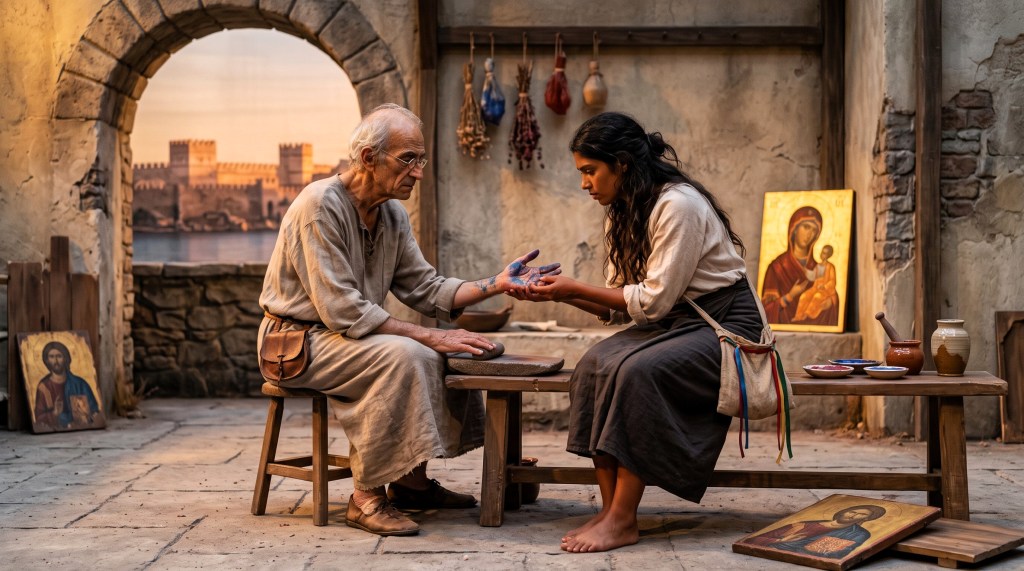
A small, half-ruined workshop courtyard in the Blachernae quarter of Constantinople. The 24th of August, 1351, late afternoon. The yard is bounded on three sides by crumbling plaster walls and on the fourth by a low stone archway, through which one can see the outer land walls and, beyond them, the pale coppery waters of the Golden Horn catching the long sun. Dried bundles of lapis lazuli and cinnabar hang from a blackened beam that spans the archway. Against the far wall, a half-finished panel of the Theotokos leans face-outward; its gold ground catches the August light in amber bars, as though the panel breathes.
The air carries linseed oil, egg yolk, and a faint salt tang from the sea. On a low bench: a grinding stone, a clay dish of powdered lapis, a bowl of egg yolk thinned with water, a jug, a worn pestle, and several small sealed jars. On the edge of the bench, a small pot of cinnabar, its lid ajar. Stacked panels and a roll of sized linen lean against one wall. Near the bench, facing outward, an older icon fragment: a Pantocrator, its varnish slightly yellowed, the right hand of Christ raised in blessing, two fingers and thumb upright, the other two curved. A wooden stool.
THEODOROS sits on the stool, grinding lapis lazuli with a flat muller on the stone slab. The motion is slow, circular, and deeply habitual; he does not look at his hands. He looks instead, over a pair of crude Venetian glass spectacles, at the Theotokos panel across the yard. His old tunic hangs from his shrunken shoulders. A worn leather pouch of pigments is tied at his hip. His hands are permanently stained: the fingertip whorls ground deep with lapis, a blue so old it might be born there; the creases of the knuckles yellowed with dried egg; traceries of red earth, ochre, and gold throughout. His voice, when it comes, is thin and reedy, barely above a murmur.
A church bell sounds somewhere across the rooftops. He counts it silently, lips barely moving.
THEODOROS: [to no one, or to God, or to the panel across the yard] Two. The afternoon moves faster than it once did.
He grinds. Silence. He sets the muller down, rises with effort, a small sound escaping him, and crosses to the Theotokos panel. He crouches before it. He studies the face with the expression of a man reading a sentence he cannot parse. He raises one stained finger and holds it an inch above the paint, not touching, tracing the air above the face. He straightens. He goes back to the stool.
THEODOROS: [flatly] No.
He picks up the muller. He grinds.
Footsteps in the archway: quick, light, wrong for this neighbourhood’s usual quiet. ZLATA ducks under the blackened beam, clipping the hanging cinnabar bundle with her shoulder so it swings, and steps into the courtyard with the ease of someone who does not consider a stranger’s threshold a meaningful boundary. She carries a worn linen bag slung across one shoulder; ribbons in several colours trail from it. She blinks in the change of light, sweeps the courtyard with one fast, bright look, and has already begun speaking.
ZLATA: The man in the street said: look for the old painter’s yard, and this is plainly it. You have water?
THEODOROS does not look up.
THEODOROS: There is a well in the alley to the north.
ZLATA: There is a dead bird in the well. A starling, or what was a starling once. (She sets her bag down without being invited, rolls her neck from side to side, looks at the hanging pigment bundles.) Those are lapis.
THEODOROS: Well observed.
ZLATA: And that is cinnabar. (She prods the hanging bundle with one finger; it swings, releasing a faint reddish dust.) My uncle ground his own as well. He could not always find the good blue, so he would say a prayer over the cheap stuff and trust the Virgin not to look too closely.
THEODOROS: (drily) She looks closely.
ZLATA drifts further into the yard, unhurried, curious, looking at everything with the alert ease of a traveller perpetually assessing a new space. She reaches past the jars on the bench toward the sealed ones and her elbow catches the pot of cinnabar. It falls. The lid comes off. A long bright arc of red powder scatters across the stone flags.
A beat.
ZLATA: (not unduly alarmed) Ah. I am sorry.
THEODOROS regards the spilled cinnabar with the flat expression of a man for whom this is simply one more thing.
THEODOROS: It is very red.
ZLATA: (crouching, righting the pot, considering the spill) Can it be saved?
THEODOROS: Leave it and the dust rises into the air for a fortnight. Sweep it back into the pot with your hand and you will have red hands until the Resurrection of the Dead.
She considers this. She sweeps the cinnabar back with her palm. She holds up the red hand and looks at it with apparent satisfaction.
ZLATA: The Resurrection it is. (She wipes the worst of it on a rag from her bag and rises, the palm still faintly red.)
She comes to stand before the Theotokos panel. She stops.
The gold ground holds the light.
ZLATA: She is not finished.
THEODOROS: No.
ZLATA: How long have you been not-finishing her?
THEODOROS: (grinding) Three months since I mixed the gesso. Forty years since I have known how.
She looks at the panel, then at him, gauging something.
ZLATA: Everyone in the Blachernae says the same of you. The old icon man. Four hundred Pantocrators and never satisfied.
THEODOROS: Four hundred. You rounded up.
ZLATA: (cheerfully) I was rounding up in your favour.
THEODOROS: My favour does not require rounding.
She takes this in. She crouches to look at the Pantocrator fragment near the bench: the old piece, the varnish slightly yellowed, the hand of Christ raised.
ZLATA: What is wrong with them? The four hundred.
THEODOROS: They are mine.
She looks up. This is not what she expected.
ZLATA: (back to the fragment) This one looks right enough.
THEODOROS: It is not.
ZLATA: (studying the raised hand) What is wrong with it?
THEODOROS: (very quietly) The hand.
ZLATA: The hand looks like a hand.
THEODOROS: (with something old in the flatness) It only has to look like one. Yes.
ZLATA rises. She looks at him properly for the first time, with a look that is both curious and professionally assessing. She comes to sit on the corner of the low bench, sliding the jars aside without looking at them.
ZLATA: My name is Zlata. I dance and I read the lines of the hand. I came from Adrianople, and before that Thessaloniki, and I am going to… (she gestures vaguely southward) …somewhere the road bends. What is your name?
THEODOROS: Theodoros.
ZLATA: Gift of God. (She nods.) A heavy name.
THEODOROS: I have had it a long time.
ZLATA: (watching his hands on the muller) How long does the grinding take? Before you can begin?
THEODOROS: An hour for the blue. Two if the lapis is coarse.
ZLATA: (shaking her head in pure, uncomplicated wonder) Two hours before you raise a brush. I am ready in the time it takes to find my shoes. (She glances at her feet, currently bare.)
THEODOROS: What you do and what I do are not the same order of thing.
ZLATA: (simply) No. Yours lasts. Mine is gone the same breath that carries it away. (She opens her hand flat and blows across it.) There. Done.
He grinds. Silence.
THEODOROS: (without looking up) And you are not troubled by that.
ZLATA: Should I be?
He grinds. He does not answer.
ZLATA: (after a moment, her foot finding a rhythm on the flags – two beats, three – then stilling as she catches herself) Do you ever dance?
THEODOROS: I am seventy-three. My left eye is clouding. My left knee has not been right since… (He does not finish. There is a year he will not name.) No. I do not dance.
ZLATA: Not when you were young?
THEODOROS: (with flat completeness) I was never young in the way you mean. My master took me at seven. I was grinding pigment before I could write.
ZLATA: Was he strict, your master?
THEODOROS: He was strict.
ZLATA: Was he good?
A pause.
THEODOROS: He was better than I am.
ZLATA looks at the panel.
ZLATA: I was in Thessaloniki last summer.
THEODOROS: (without inflection) The Pestilence was in Thessaloniki last summer.
ZLATA: [going still, the brightness stilling to something plainer] Yes. It was. (Then the brightness returns, as a bird rights itself mid-flight.) I was already on the road when it came. A magpie crossed my path at dawn the morning I left. One magpie. I said to myself: right, then. And I put my bag on my shoulder.
THEODOROS: (over his spectacles) You attribute your survival to a magpie.
ZLATA: I attribute my survival to my legs. The magpie reminded me I had them.
A small silence. He grinds.
THEODOROS: (very quietly) Did you lose anyone? In Thessaloniki.
ZLATA: A woman I used to dance with, in the cloth-dyers’ quarter. She had very loud opinions about everything. (A beat.) The city was very quiet after.
She comes back to her brightness not falsely but as one who has no other instrument for living in the world.
ZLATA: And you?
THEODOROS: My last apprentice. A boy from Monemvasia with very small hands who ground pigment without being asked. (He grinds.) The priest at the Chora. The abbess at the Holy Apostles. Most of those who once sent commissions to this yard. (Pause.) The city is quieter now than it was during the civil wars, and during the civil wars it was quieter than in my grandfather’s time.
ZLATA: And before that?
THEODOROS: I am told there were crusaders once who set fire to everything. But that was before my time.
ZLATA: (briefly) The city has had a difficult century.
THEODOROS: Several.
A pause. She touches the small pouch at her hip without thinking, the gesture of superstition, quick and automatic. Then she gets up again, drifts around the perimeter of the yard, lifts the edge of the rolled linen and sets it down, peers at the stacked panels.
ZLATA: (not looking at him) The hand of Christ. The blessing hand. Is it always the hand that is wrong?
THEODOROS: (grinding) It is always the hand.
ZLATA: (turning) What should it do, that it does not?
A silence. He grinds.
THEODOROS: The gesture is prescribed. Two fingers and the thumb upright; the other two curved down. The initials of the Holy Name encoded in the form of the fingers. I paint it as it was given to me, as my master painted it, and his master before him, back to… (he waves a stained hand in the direction of some distant east) …the beginning of the matter. The form is right. It has always been right. I follow the canon without deviation, as I was taught to follow it.
ZLATA: And?
THEODOROS: And the form is only the body of the thing.
ZLATA: (coming to crouch again before the fragment, looking at the hand) And the life of it?
A long silence.
THEODOROS: I stood once, many years ago, in the church at the Chora. You know the Anastasis in the apse? Our Lord descending into Hades to raise Adam and Eve from their tombs. He grasps Adam by the wrist. (His voice is very quiet now, and there is something in the quietness that has not been there before.) I stood before that mosaic and the hand in it took me by the wrist. Not a craftsman’s hand rendering a prescribed form. A hand that reached and seized. You feel it. A person of clay and error and small fears standing in a dim church feels that hand close on his wrist and pull him upright. (Pause.) I have never made a thing that does that. Not once. In four hundred icons, not once.
ZLATA is very still.
THEODOROS: (barely) I have wondered sometimes whether it is a matter of character.
ZLATA: Whose?
THEODOROS: The window’s. (He grinds.) An icon is not a painting. It is a window. You paint the window correctly – in the canon, in the prescribed form – and the light should come through from the other side. That is the theology of it. That is what the holy Fathers tell us. (Pause.) I paint the window correctly. (Pause.) The light does not come through.
A long silence.
ZLATA: (carefully) How do you know?
He looks up.
ZLATA: Were you there, in every room where your icons stood? Did you watch every person who came before them?
THEODOROS: (quietly) No.
ZLATA: Then perhaps the light comes through and you are simply never in the room when it does.
He looks at her for a very long time.
THEODOROS: (with a dry, flat, exhausted gentleness) That is a kind thought.
ZLATA: (lightly) It is also possibly true.
THEODOROS: (barely) Yes. Possibly.
The light has shifted. The gold ground of the Theotokos panel moves from amber to something cooler and more still. He grinds on.
ZLATA returns to the bench. She produces a coin from her bag and begins to walk it across her knuckles, absently, one hand to the other and back.
ZLATA: (after a moment) Give me your hand.
He glances at her.
ZLATA: I told you. I read the lines. Come. I have read the hand of a Genoese merchant and a Serbian man of rank and a very frightened nun, and none of them came to immediate grief afterwards. Mostly.
THEODOROS considers. Then, with the air of a man who does not believe in this for one moment but is perhaps too worn to argue, he sets the muller down and extends his left hand, palm upward.
ZLATA leans forward and takes it in both of hers. She studies the palm with genuine attention. His hand is extraordinary: the whorls of his fingertips ground so deep with lapis that they are permanently blue; the creases of the knuckles yellowed with dried egg; red earth at the base of the thumb; ochre in the lines of the palm; and throughout, worked into the skin so deep that it catches even this thin light, the shimmer of gold leaf.
ZLATA: (quietly, absorbed) The roads in your hand are very long.
THEODOROS: I have not been anywhere.
ZLATA: The roads in a hand are not the roads of the feet. (She traces a line with one finger, then another.) You have gone a very long way in one direction for a very long time. (She presses lightly at the centre of the palm.) And here. You stopped. A long time ago.
THEODOROS: (pulling his hand back gently) I have not stopped. I ground pigment this morning as I have ground it every morning for fifty years.
ZLATA: (letting his hand go without protest) Yes. That is what I mean.
A silence. He picks up the muller.
ZLATA: (after a moment, the coin reappearing between her fingers) I know a different game. A better one.
THEODOROS: I am not playing games.
ZLATA: You are grinding lapis in a ruined yard in August with no commission and no apprentice, talking to a Romani woman you did not invite in. (Beat.) You are playing a game. You have simply not yet admitted it to yourself.
He grinds. He says nothing. It is, in its way, a concession.
ZLATA: (leaning forward, elbows on knees, the coin stilling in her palm) When I tell fortunes I read what the hand already shows. But suppose I reversed the game. Suppose I were not a reader of marks but a maker of them. (Her voice drops just slightly, into the fortune-teller’s register – half performance, half entirely genuine.) Suppose I had the power to set a sign into your flesh, old man. To press it in. To burn it deep, the way God sets the seal of the Holy Spirit upon the baptised soul at the chrism. Fixed. Indelible. As permanent as the Name of God. No water, no oil, no knife, no turning of the years could lift it or fade it or scrape it away. (She pauses.) What sign would you choose to carry to your grave?
THEODOROS stops grinding.
He is very still.
A long pause. A very long pause.
THEODOROS: (very quietly) That is the mark of a slave.
ZLATA: Only if another chooses it for you.
THEODOROS: It is the seal of the Antichrist. The Book of Revelation. The mark set upon the hand or the forehead, that none might buy or sell without it.
ZLATA: (patiently) You are buying and selling nothing. You are choosing a sign. Your own. The one that is true.
THEODOROS: (with cold, careful precision) In the letter of the holy Apostle Paul to the Galatians: I bear on my body the stigmata of the Lord Jesus. The Apostle speaks of wounds. Of persecution. Of suffering accepted in the name of God. He does not speak of choosing.
ZLATA: (gently, unmoved) You have spent fifty years painting sacred images. You know better than I do that it is not about the seal of the Antichrist or the wounds of the Apostle. It is a riddle. About who you are. (Softly.) What would you choose?
Silence. He sets the muller down. He looks at his hands resting on the stone, palms up.
THEODOROS: The correct answer is nothing. (His voice is very quiet.) The flesh is a temporary dwelling. A tent, as the holy Apostle says elsewhere. Whatever is set upon it endures no longer than the flesh endures, and the flesh does not endure. The icon outlasts the painter. The panel, if the gesso is sound and no damp gets in behind the wood, may stand five centuries beyond the hand that prepared it. The mark on the flesh lasts precisely as long as the flesh lasts. (Pause.) Which is, in my case, not very long.
ZLATA: (after a moment) And the correct answer is not the true one.
He looks at her steadily.
She waits. The coin moves across her knuckles, back and forward, back and forward.
A very long silence. He looks at the Pantocrator fragment.
THEODOROS: (barely, at last) The hand.
ZLATA: (quietly) Which hand.
THEODOROS: His hand. The blessing hand. The one I have painted four hundred times and cannot make live. (He turns his own right hand over and looks at the back of it, at the stained skin, the thin tendons.) Here. The back of my own hand. Where I would see it every time I raised a brush.
ZLATA is very still.
THEODOROS: (to himself as much as to her) Two fingers and a thumb upright. The other two curved. The Holy Name in the form of the fingers. As my master showed me. As it has always been painted. The hand that should reach through the window and seize the soul by the wrist. (Pause.) The hand I have never been able to make reach.
ZLATA: (very gently, after a moment) So that you could look at what it ought to be, while you painted what you could do.
THEODOROS: (barely) Something of that kind.
ZLATA: (more quietly still) Or so that you could stop comparing the two. And rest.
He does not answer. He looks at the back of his right hand in the shifting light.
ZLATA watches him for a moment. Then she straightens, her register lifting back toward warmth – not falsely, but naturally, as a tide returning.
ZLATA: And me?
THEODOROS: (not unkindly) What of you?
ZLATA: What would I choose? (She holds up her own hand and considers it with theatrical gravity, the red of the cinnabar still on the palm.) A swallow. Here. (She touches two fingers to the inside of her wrist, where the pulse is.) Small. The wings open.
THEODOROS: A swallow is a migratory bird. It comes. It goes.
ZLATA: (grinning) Yes. That is precisely why.
He looks at her. A very long pause. Something in his expression shifts – not warmth alone, or not only warmth. Something older. A recognition.
THEODOROS: (murmuring) The moving sign on the fixed place.
ZLATA: (touching her wrist once more, then letting her hand fall) The bird that cannot stay, pressed into the skin that cannot move. (Beat.) Would God mind?
THEODOROS: (with flat, calm certainty) Almost certainly.
ZLATA: (laughing, rising, reaching for her bag) I have given God larger reasons for complaint than a swallow on my wrist. He has had time enough to send the thunderbolt and has not troubled to.
THEODOROS: (very quietly) He is patient.
ZLATA: (already moving, the ribbons shifting) So they say.
She pauses before the Theotokos panel. She looks at it honestly, without performance, for a long moment. The gold ground holds her reflection, faintly.
ZLATA: She is beautiful. Your unfinished woman.
THEODOROS: She is not mine. She is the image of her prototype. I am only the occasion of her appearing on this wood.
ZLATA: The unfinished part is yours.
He does not answer. He does not look for one.
She moves toward the archway. At the beam she stops. She turns back. She looks at his hands resting on the grinding stone.
ZLATA: Look at your hands, Theodoros.
He looks at his hands.
ZLATA: (coming back two paces, not touching him, indicating with one finger as a woman names countries on a map she knows well) Lapis here. At the tips of the fingers, in the whorls. Blue as deep water, and fifty years of mornings have not lifted it. Gold here, in the lines of the palm. The uncreated light – is that not what you call it? The light that stands not for yellow but for the light of God before the sun was made. Cinnabar at the base of the thumb. Ochre in the crease of the wrist. The white of ground egg in the hollow of the palm. The ground of a hundred panels in the lines of your own hand.
A silence.
ZLATA: (quietly) No water has washed this clean.
THEODOROS: (barely) No.
ZLATA: No oil. No sand. Fifty years of mornings and it is still there.
He looks at his hands.
ZLATA: (barely above a murmur) You have been painting on yourself for fifty years, old man. The mark is already set, and it is set in God’s own colours. (She steps back. For a moment the performance and the fortune-teller fall entirely away, and what remains is very plain and very serious.) You are already the panel.
A pause.
ZLATA: God sees your hands.
She ducks under the low beam. This time she catches the hanging cinnabar bundle before it swings, holds it still a moment, then lets it go. She touches the pouch at her hip. She goes through the archway and is gone.
Footsteps, quick and light. Diminishing. Then silence.
A ribbon, come loose from her bag, lies on the flagstones near the archway.
THEODOROS sits alone in the courtyard. He does not grind. He does not rise. He sits with his hands open on his knees, palms upward, looking at them in the long August light.
The courtyard is very quiet. The city beyond the walls makes its sparse sounds: a distant cart, gulls. Nothing more.
A church bell rings once, thinly, from somewhere across the rooftops. Then silence.
After a very long time, he raises his right hand and turns it over slowly. He looks at the back of it. The blue. The gold. He turns it palm-up again.
He reaches for a fine-pointed brush from the jar at the bench’s edge. He holds it between his stained fingers. He does not dip it. He holds it.
He sets it down.
He picks up the muller. He begins to grind lapis.
Slowly. Not preparing pigment for the panel. Not working toward anything he can name. Grinding as though the motion itself were enough. As though to do the work were already a form of prayer, and had perhaps always been.
On the far wall, the last of the August light falls across the half-finished Theotokos panel. The gold shifts one final time: cooler, stiller, more precise. Her face receives the light without expression. In her arms, the Christ-child raises one small hand – two fingers and a thumb upright, the other two curved.
The grinding continues.
Light. Salt. Linseed. The sound of the sea, very far off.
End.
Bob Lynn | © 2026 Vox Meditantis. All rights reserved.


 Vox Meditantis
Leave a comment