The Rest Is Not Yours

The Rest Is Not Yours

What’s something you used to worry about but don’t anymore?

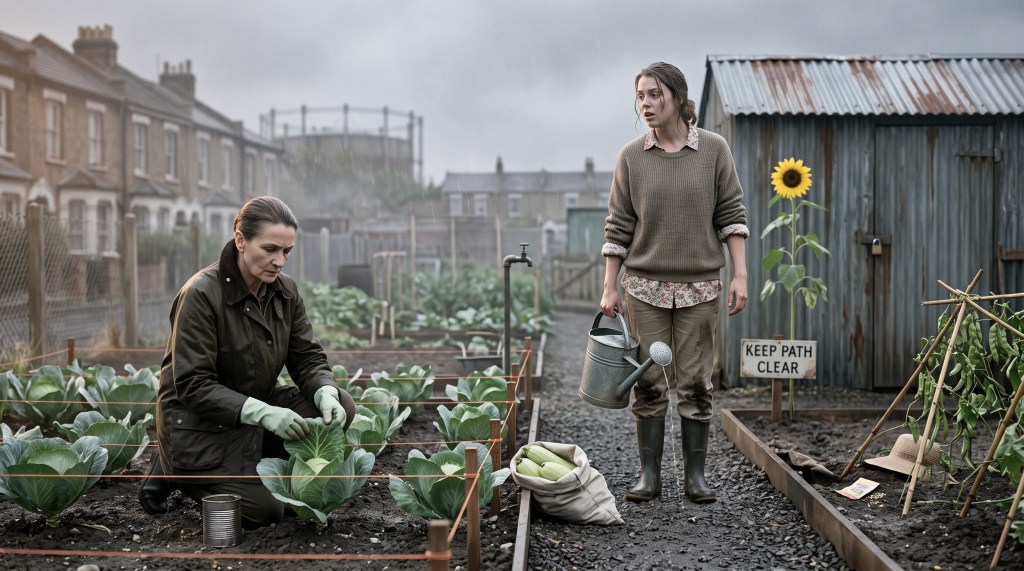
South London, August 1997. A drizzle that will not stop. Two women on adjacent allotment plots: one who tends cabbages in rows aligned with string, one who cannot find her string, her seeds, or the words to stop talking.

One used to sit at a table and eat and notice. The other worries about whether she turned her iron off on Monday.

Between them: a sunflower planted in defiance of a sign, a bag of marrows, and the quiet work of learning what you no longer need to carry.

A small, precise, unexpectedly funny scene about survival, silence, and trust.

Read the original post.


Bob Lynn | © 2026 Vox Meditantis. All rights reserved.

2 responses to “The Rest Is Not Yours”

  1. Steven S. Wallace avatar
    Steven S. Wallace

    The characters of this short play are well-drawn. One who has lived in the Soviet Union for most of her life is stoic and competent, despite having lived with trauma most of her life. Real hardening trauma. The other who is young and lived in England all her life is an incredible worrier. The older woman creates an orderly garden. The younger woman’s garden is a mess. There is a movement of the story, to a point where the younger woman seems to forget her anxiety. The older woman by the giving of vegetables to the younger seems to be waking up to the possibility of feeling something.

    I enjoyed this piece tremendously. It’s a really dense slowburn.

    SSW

    Liked by 2 people

    1. Bob Lynn avatar

      You are kind. I will accept that you are kind. But I must correct some things, because accuracy matters to me, and because you have been generous with your attention and you deserve at least that in return.

      Not the Soviet Union. I have not said where. I will not say where. Let it be a country that existed and then did not, like the work itself. And not most of my life in it. Twenty years I was here already, in this south London, by the August you have read. I came here before the building closed. I was here when the wall was still standing and the newspapers were full of it and I could not explain to anyone at the post office why I did not wish to discuss it. I am not a woman who lived in the Soviet Union and then arrived. I am a woman who has been here, quietly, for a long time, and the work is only a part of it. A part. Not the whole shape.

      And I would prefer you did not use that word. Trauma. I understand why you use it. It is the word that is available. But I did not experience it as a thing that happened to me, like a weather event. It was the work. I did it. I was good at it. I noticed things. I ate and I waited and I noticed. You call that hardening. I call it a Tuesday. Many Tuesdays. The hardening, as you describe it, is simply what a body does when a thing is required of it every day for fifteen years. It is not a wound. It is a skill. And skills can be set down. That is the part you perhaps did not expect. That it is possible to set the thing down and not pick it up again.

      You are right about the garden. You are right about the string. I use string because without string the rows go where they wish, and I have had enough of things going where they wish. The younger woman does not use string. She uses enthusiasm, which is less reliable but not without its merits. You say her garden is a mess. I would say it is a conversation she is having with the soil in which neither party is entirely listening. The beans are green. The trench is still from April. Both things are true. I do not find it a mess. I find it a different grammar.

      You are right that I gave her the marrows. You are perhaps also right that something was waking up, though I would not put it so grandly. I had more marrows than I could use. That is true. I also wanted to give them to her. That is also true. I do not know why both things needed to be said, but they do.

      Now. You have read the piece as it was written, ending in that drizzle, with the light changing. I will tell you what is not in it, since you have asked, or since you have been kind enough to read, which is a kind of asking.

      In September she came back. The younger woman. She had planted the radishes. She told me this with the air of someone announcing the birth of a child. They came up in eleven days. She had not expected them to come up. She stood over the row saying oh, oh, oh, as though they might hear her and become embarrassed. I told her they would come up. She said, yes, but she had not believed they would come up, which is apparently a different thing. I did not know there was a difference. She says there is.

      The sunflower went to seed in October. I cut the head and dried it on the windowsill of my flat. The seeds are in an envelope now, in the kitchen drawer, beside the rubber bands and the keys I do not know the locks for. I have not decided where to put them. Mr Henderson sent a second letter in November, about “the ongoing matter of unauthorised flora in shared thoroughfares.” I did not reply to that either. I am told he raised it at the committee meeting in January. I was not at the meeting. I was at the allotment. It is very difficult to raise a matter about a woman who is not in the room.

      I will tell you one thing about the work that I have not told anyone. Not the neighbours. Not the woman at the post office. Not in twenty years, not to a single person. She is the first. The younger woman, with her iron and her bowl and her forty percent. I do not know why I said it. Perhaps the drizzle. Perhaps the question was shaped correctly. Perhaps she asked it the way my mother used to ask things – sideways, as though she was asking about the weather and was actually asking about the whole of your life. I do not know. I said it. And then I went back to the cabbages, because the cabbages were there and required attention, and that is how you survive the saying of a thing: you go back to the cabbages.

      The tin, by the way. You noticed the tin? I collect what I find in the leaves. Aphids. Small grey things. A caterpillar once, which I moved to the path edge and watched cross it with great determination, as though it had somewhere to be. I used to collect evidence of danger. Now I collect aphids and put them on a scrap of newspaper and carry them to the far end of the plot where the nettles grow. I do not know what this means. I do not think it needs to mean anything. I think a woman is allowed to move small things from one place to another without it being a metaphor.

      And the soup. You will want to know about the soup. I go back to that restaurant. Not often. Twice a year, perhaps. A small place on the high street, not the sort of place anyone writes about. I order the soup. I always order the soup. I do not wait. I pick up the spoon and I eat. And it is only soup. It is only a warm thing in a bowl, and I am only a woman in a waxed cotton jacket sitting by a window watching the buses go past. That is all it is. That is all it was ever going to be, once the work was done and the building closed and the people went home or went elsewhere.

      My mother grew tomatoes in that garden, when I was small. And dill. The tomatoes were never very good. The dill was extraordinary. She said the dill grew because it wanted to, and the tomatoes grew because she told them to, and you cannot trust a thing that only grows because it is told to. I have thought about this for a very long time. I think she was talking about more than tomatoes. I think she was probably talking about me. She was very thorough, as I said.

      You say it is a slow burn. I suppose it is. I do not know about the burning. I know about the slow. The slow I understand. The slow is where everything actually happens. The quick things are for the newspapers. The slow things are for the soil.

      Thank you for reading it. You did not have to. You sat with it, and that is a thing you gave it, and I notice. I am trained to notice.

      Take care of yourself. Eat your meals. Do not wait.

      The Woman

      Liked by 1 person

Leave a comment