I: The Chemistry Of It
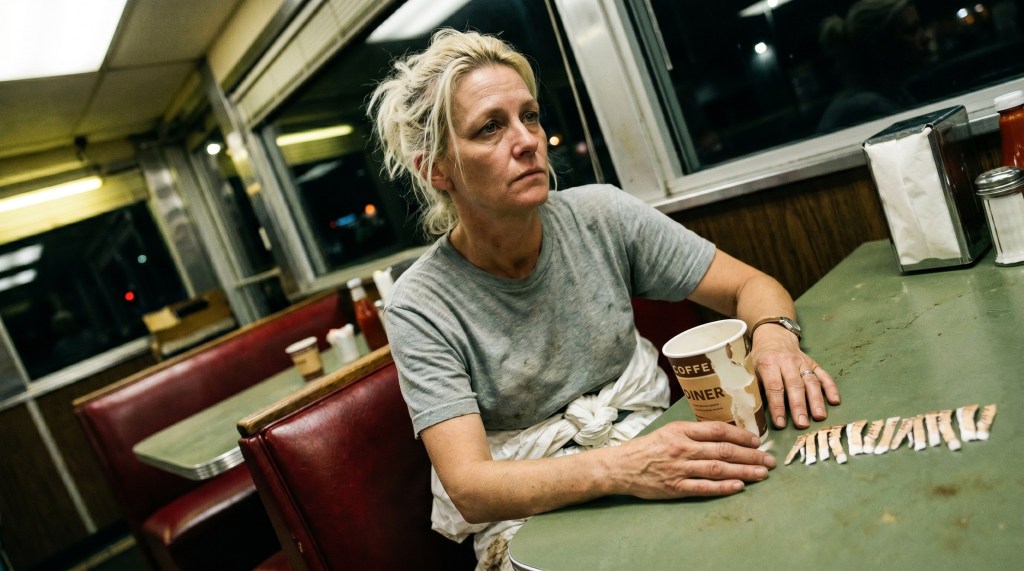
She hesitated. Did you catch it? The woman with the coffee pot – she came over, she saw the coveralls, and the hand slowed. Just a fraction. Then she poured anyway, kept her eyes at cup level, moved on to the next booth. Good. I like that. I don’t want conversation. I want the coffee.
I notice the pause every time. People see the coveralls, they run a quick calculation – construction, first guess, or maybe maintenance – and then they get close enough to smell something on me, not bad exactly, but clinical, sharp underneath the diner smell, and the calculation revises. And then they decide not to ask. Which is correct. Which I am grateful for, at this hour, in this state.
But you want to know. So I’ll tell you. Not yet, though – first, I want you to picture a room.
Four walls. A kitchen. Laminate flooring, the kind that comes in flat-pack boxes, hollow underfoot. You open the door and there is a smell before anything else – not blood, not precisely blood, but something beyond blood, something that has had time to settle and change into something else – and you note it on the clipboard before you cross the threshold. You don’t go in until you’ve looked. You catalogue the surfaces, the floor, the soft furnishings if there are any. You’re reading the extent of contamination. Whether it has reached the grout. Whether the walls will need to come down. You photograph everything before you touch a single thing, because documentation is the foundation of accuracy, and accuracy is the whole discipline. Then you lay your sheeting, set your containment, prepare your kit.
And then you neutralise.
That word. Neutralise. Not clean – cleaning is what you do to a kitchen after Sunday lunch. What I do is neutralise. I make the space chemically safe for the next human being who will stand in it. I reduce what is present to its components and I remove those components, or dissolve them, or seal them, depending on the surface and what it has absorbed. When the room is neutralised and documented and released, I pack my equipment and I leave.
Assess. Contain. Neutralise. Document. Leave.
That’s the job.
Now. What is it, precisely, that I’m neutralising?
I am a biohazard remediation specialist. Fifteen years in the trade. Before that, a nurse’s assistant in Düsseldorf – a different kind of exposure to the worst days of strangers’ lives, but exposure all the same. What I do now, and I have watched this sentence land on many faces at many tables, is I go in after. After the paramedics have left. After the police have finished and the coroner’s office has released the scene. There is a gap between the authorities are done and the room is fit for a person again, and I am the one who closes it. Nobody calls me at a good time. There is no good time. I come when the room is ready and the family isn’t.
Blood is iron and protein. The iron is in the haemoglobin – that’s what gives it the colour. When it dries, the iron oxidises, goes rust-brown, the same chemistry as a garden gate left out in the rain. People don’t recognise it at first. I always do. Bleach is sodium hypochlorite, a base, and it denatures the protein and neutralises the remaining organic matter. This is not complex. You could read it on an afternoon and understand the fundamentals. The reaction, technically, is unremarkable.
Decomposition is bacterial. Temperature-dependent. It follows a predictable sequence – you learn the stages, you learn what to prepare for, and preparation is the whole discipline. I said that already. I meant it both times.
This is how I hold the work away from me. Reduce the room to its chemistry, the problem to its components, and you can move through the space without being stopped by it. Stopped in it.
It makes it manageable.
I was going to stop there. That sentence used to be enough.
[I peel another strip from the label. Set it flat on the table. Look at it.]
That’s the easy part. The chemistry. That’s what I know how to do.
II: What The Bleach Doesn’t Touch
Here is the thing they don’t train you for.
They train you for blood. They train you for decomposition, for the stages of it, for the smell and the colour and what it means about timeline. They train you to read contamination, to assess penetration depth into porous materials, to know when a floorboard is salvageable and when it isn’t. All of that is learnable. All of that has a manual. I have read every manual. I have written some of them.
They do not write a manual for the toast.
I walked into a flat on a Tuesday – this was maybe year four, maybe five – ground floor, council housing, a man in his sixties. Nobody had gone in for eleven days. The authorities had done what the authorities do and left, and I came in with my kit and my clipboard and I started my assessment, and there on the counter, under a tea towel, was a plate. And on the plate was a piece of toast. He had made toast. He had covered it – covered it, you understand, set the tea towel over it as you do when you’re keeping something warm for someone, or when you’re stepping away for just a moment – and then he had not come back.
I stood and looked at that plate for longer than I should have. Nobody covers toast for themselves. That is not a thing a person does alone.
I documented it. Photographed it. Kept moving.
But I still have the photograph in my head, fifteen years on. The angle of that tea towel. The way it had dried and stiffened at the edges. I carry it the way you carry a stone in a coat pocket – you forget it’s there, and then your hand finds it, and there it is, exactly as heavy as before.
That is what I am talking about. Not the blood. Never the blood. The blood is chemistry and I know what to do with chemistry.
I am talking about the television.
I have walked into rooms where the television was still running. Days later, sometimes. A nature documentary. A shopping channel. Once, a football match that had been recorded and was playing again on a loop, and the crowd noise in that empty flat was the most wrong sound I have ever heard in my life. Nobody chooses a shopping channel. Nobody, given any choice at all, chooses to spend their last evening watching somebody sell them a cubic zirconia pendant at a reduced price. The television tells you something. It tells you the evening started normally, that they were tired, that they sat down and took what came. I never watch television without thinking about that now. Every time I sit in front of a screen, some part of me is logging it as evidence.
And the dogs.
I have to be careful about the dogs.
Three times over fifteen years I have entered a property and there has been a dog. Alive, unharmed, waiting. Because the dog doesn’t know. The dog has been waiting beside the door for days, patiently, because that is what a dog does – it waits, because the person always came back before, and the dog sees no reason to revise this. The first time, I sat down on the floor in my full kit, contamination protocol be damned, and I stayed there until the dog stopped trembling. They don’t include that in the billing. I absorbed it as a professional cost and I would do it again without hesitation.
I name no names. In fifteen years I have never said a name outside of official documentation. That is the rule and I keep it without exception. But I count the rooms. I carry their dimensions. I know the floor plans of more final hours than I can say, and the weight of them is not abstract. It is not grief in the way you’d recognise grief. It’s more structural than that. It sits in my shoulders and the base of my neck, and some mornings I wake up with my jaw aching from the night, from whatever I was clenching against while I slept.
What I am is a forensic reader of lives I was never supposed to read.
I am not a detective – there is no case. The case is closed. I am the one who comes after the case is closed. But the evidence is still there when I arrive. The two mugs on opposite sides of the kitchen, both unwashed, set down in positions that mean something, that map an argument in negative space. The birthday card on the doormat, unopened, from someone who didn’t know yet. The good coat still on the hook by the door, as though the person just stepped out for something small and quick and didn’t need it.
I read all of it. I was trained to read surfaces for contamination. Nobody told me I would also end up reading surfaces for everything else.
I got too good at the rooms. That is the honest version of what happened. I learned to move through spaces with a kind of total attention, and total attention does not switch off at the door. I don’t leave the rooms in the rooms. I bring the rooms home, and they arrange themselves in my memory with the same clinical clarity as my documentation photographs, and they are there at two in the morning when the sleep won’t come.
Whiskey helps. Not to forget – I am not interested in forgetting. Forgetting makes you sloppy, and sloppy in my trade means secondary contamination, means compromised documentation, means a family getting wrong information at the worst point in their lives. Forgetting is a professional hazard. The whiskey is just a volume dial. Turns the rooms down low enough that I can get a few hours.
It is not a solution. I know it is not a solution. I maintain it the way you’d maintain anything – a car, a piece of equipment – with the minimum input necessary to keep it functional. I assess, I note the cost, I factor it in. I move on.
What I want – what I would give a great deal for – is not to feel less. I want to feel it in the room and leave it in the room. I want the ability to walk out over the threshold and do something precise and deliberate with the weight of it. Not drop it, not lose it. Something more surgical than that.
[I line up the label strips along the edge of the table. Four of them now. Even spacing.]
There is a word for what I’m describing. I’ve been turning it over for years.
Com-part-men-tal-i-sa-tion.
Say it slowly enough and it sounds almost like something a person could actually do.
IIII: The Unzip
So. That is what I would master.
The ability to walk into a room, open every sense I have, read every surface, do the work with full attention and full competence, and then – at the threshold, on the way out, in the moment between that space and the world again – file it. Seal the file. Set it down on the correct side of the hazmat tape and step away from it as a person who is not carrying it.
Not forgetting. I have said this and I will keep saying it because forgetting is the version that sounds easier and it is not what I mean. Forgetting is a leak in the containment. Forgetting is how you miss something, how you carry contamination out on the sole of a boot and don’t know you’ve done it, how a family gets an incomplete handover and has to live in the consequences of your carelessness. Forgetting is sloppy and sloppy is the only professional failure I consider unforgivable.
What I am describing is not forgetting.
I am describing a door with a lock on my side of it.
The filing is the thing. I can build the file – fifteen years of practice, I can catalogue a room with a precision that would satisfy any documentation standard you care to name. I can hold the toast and the tea towel and the cubic zirconia shopping channel and all the rest of it, I can hold all of it with total recall and total accuracy. The filing is not the problem. The problem is the unzip. The problem is that I have never once managed to walk out of a room and leave it behind me. The file comes. Every time. I have excellent files and no way to close them.
That is the skill. That is the whole answer to your question. Not a language, not an instrument, not some capability that acts on the external world. Something that acts on the interior one.
Every skill I have ever learned has been outward-facing. I learned to read contamination. I learned the chemistry and the documentation and the protocol and the containment. I learned to move through the worst rooms in a person’s story and leave them cleaner than I found them. All of it pointed outward, at the world, at the surfaces, at the problem in front of me. I am very good at problems in front of me.
This would be the first skill that points the other way.
[A pause. She looks at the label strips on the table.]
I don’t talk about this next part. I am telling you once and then I am done with it.
There are rooms where nobody comes.
Not every death leaves a forwarding address. Not every person has a family that can be reached, or a neighbour who noticed, or anyone waiting by the door. Sometimes the post piles up for weeks before a council office makes a call and somebody like me gets the referral. I have walked into those rooms. I have done the assessment and the documentation and the neutralisation and I have packed my kit and I have left the space ready for the next person who will stand in it.
And in those rooms, I am the last person who will ever know how they lived.
The mug on the draining board. The library book with the receipt still in it as a bookmark, three weeks overdue by the time I photographed it, a thriller, and they never found out how it ended. The notepad by the phone with a shopping list in careful handwriting, milk and bread and the name of a medication I recognised from my nursing days. That is all that is left of how a person moved through their mornings. I documented it. I sealed it. I left.
I carry those people as well. I carry them in addition to all the others, and I carry them slightly differently, the way you carry something that has no designated place to go. You keep moving it from surface to surface and it is always slightly in the way and you cannot bring yourself to put it in a bin bag because it was somebody’s.
Someone has to carry them. I have never been able to argue myself out of that. Someone was the last person in that room and that person was me and so I carry them, because the alternative is that nobody does, and I cannot make peace with the alternative.
This is what I mean about it being a weight in the shoulders and not a weight in the chest. It is not grief, not exactly. It is more like structural load. I was not built for it, and I took it on anyway, and fifteen years of additional load on a frame that was not designed for it has consequences. The consequences are whiskey and jaw pain and a preference for diners at three in the morning where the waitress has the good sense not to ask.
I am not asking to be relieved of the knowledge. I am not asking to unfeel any of it. I felt it in the room and that was correct and I would feel it again. I am asking for somewhere to put it down when I walk out. A room of its own, behind a door, on the other side of the threshold. I would visit it. I would maintain it, keep the documentation current, honour what is in there. I just want to be able to close the door.
I want to clock out. That is the whole of it. I want to finish a job and walk to my car and drive away and be, for however many hours remain before the next call, a person who is not on site. Not a specialist. Not a reader of rooms. Not the last witness to somebody’s final Tuesday.
Just a woman who had coffee at a diner and drove home and slept.
[She straightens the label strips. Lines them up with the edge of the table, evenly spaced, four of them, neat as documentation. Then she looks up.]
I don’t need you to tell me it’s admirable, what I do. I don’t need recognition or absolution or a conversation about resilience. I’ve had the conversation about resilience. I found it largely unhelpful.
I just want the one skill I don’t have. The only one that would make a difference to anything that actually matters to me, at this hour, in this diner, in these coveralls that I haven’t taken off yet because if I’m honest I’m not ready to be a civilian again quite yet.
The unzip. That’s it. That is the complete answer.
[She picks up the coffee. Drinks. Sets it down.]
Bleach neutralises the blood. I have never found the equivalent for the rest of it. If you find one, you have my number.
Bob Lynn | © 2026 Vox Meditantis. All rights reserved.


 Vox Meditantis
Leave a comment