I: The Ledger
You’ll have to forgive the fingers. Ink. Always ink. I’ve tried every solvent known to a woman who has lived alone with a typewriter for forty years, and nothing quite shifts it. I’ve stopped minding. There’s something honest about a stain that stays.
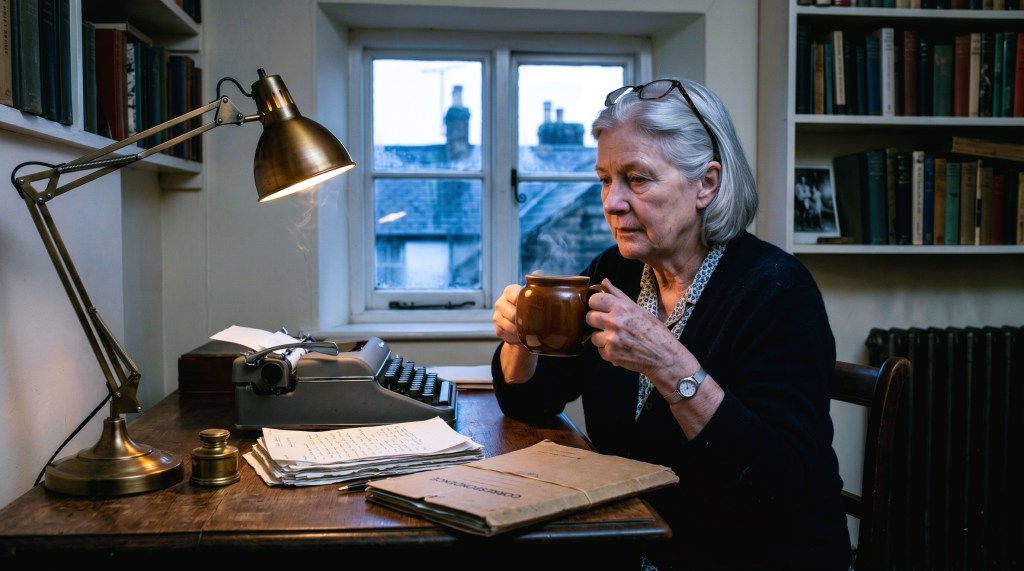
I write obituaries for a living. Have done since I was twenty-nine, when a small regional newspaper in Shropshire needed someone who wasn’t afraid of the subject matter and didn’t flinch at the phone calls. Most of the staff back then treated the obituary desk the way you’d treat a draughty room in an otherwise pleasant house: unavoidable, a little uncomfortable, best passed through quickly. I moved in and unpacked. I’ve been there ever since, though the newspaper itself is long gone and I work freelance now, out of the back room of my house in Ludlow, where the radiator clanks every morning at half past five like a old friend arriving for tea.
People tend to react in one of two ways when I tell them what I do. Either they go quiet and slightly respectful, as though I’ve mentioned a terminal illness, or they become oddly fascinated and ask whether it’s depressing. It isn’t. Or rather, it is, in the way that rain is depressing: sometimes, yes, but mostly it’s just the weather, and the garden needs it.
What I do, at the most essential level, is this: I am given the outline of a person’s life and I am asked to make it mean something in two hundred words or fewer. The family sends me dates, names, a handful of anecdotes. Sometimes a photograph. Sometimes a voice message, halting and wet with grief, from a son who hasn’t slept in four days. I sit with all of it. I make tea. I write.
Every January, I count them. The year’s obituaries. It’s a habit I picked up somewhere in my forties and never dropped, the way you might keep a tally of books read, or miles walked. Not out of pride, and not quite out of grief either. It’s more the way a librarian might run her finger along a newly shelved row, just to confirm that the work was done, that the names are in order, that nobody has been misplaced. This year: two hundred and fourteen. I wrote them between the third of January and the twenty-ninth of December, in this back room, at this desk, with the radiator clanking and the tea going cold while I searched for the right word for someone I would never meet.
Two hundred and fourteen lives reduced to their essence. You’d think that would feel reductive. It doesn’t. It feels, if anything, like a form of devotion.
Here is something I’ve noticed over four decades of this work, something that took me far longer to see than it should have: the things that never appear.
Promotions. Not once, in forty years, has a family called to tell me their mother received a commendation from her regional manager in 2003 and they’d very much like that mentioned. No one has ever asked me to note that their father paid off his mortgage ahead of schedule, or that their sister finally made it to Machu Picchu. The bucket lists, the performance reviews, the LinkedIn milestones, the language courses half-completed and the half-marathons run at an embarrassingly slow pace but run nonetheless. Gone. All of it, gone, as though it evaporated the moment it was no longer needed.
I find the absences extraordinary. We spend such enormous energy on these things while we are living. And then they simply don’t make the final draft.
What does make it, again and again, with a consistency that stopped surprising me around 1998 and has since become something closer to a quiet conviction, is this: She always remembered your name. That one appears in some form or another at least a dozen times a year. He laughed at his own jokes and didn’t care who else was laughing. They still held hands on the bus, right until the end. She’d leave a light on for you even if you hadn’t said you were coming.
I have a folder on my desk. Old, cardboard, held together with a rubber band that I really ought to replace. Inside it, I keep the phrases I return to. Not the grand summations, not the solemn elegies. The small ones. The precise ones. The ones that make you feel, reading them, that you have just glimpsed something true about what it is to be a person among other persons.
I read them back sometimes, when the work feels heavy. They have never once failed to steady me.
And then, this year, I began asking myself a question I’d somehow managed to avoid for four decades. If I were the subject instead of the writer, what would the single line be? What is the thing that the people who knew me best, who would make that halting phone call from a room still full of my absence, would circle back to, again and again, as the thing that mattered?
I won’t answer that yet. I’m not sure I’m ready to.
I pick up my tea. I let the question sit, the way I’ve learned to let uncomfortable things sit.
The ink stays on my fingers. That seems right.
II: The Well
I was not always like this. I want to be clear about that, because there is a version of the person I’ve just described to you, this woman who sits quietly and counts her dead and keeps a cardboard folder of small true phrases, that could sound as though she arrived fully formed. As though wisdom simply settled on her, the way snow settles, quietly and without effort.
It didn’t. I was ambitious. Profoundly, almost embarrassingly ambitious, in the way that women of my generation often were: with a certain ferocity born from knowing you would have to be twice as sharp, twice as composed, and considerably more patient than anyone else in the room just to be assigned the work that mattered.
I measured myself by accumulation. Each year had to show a return. A new skill acquired. A more prestigious commission. A broader readership. A harder-won composure at a graveside, because even that I treated as a form of professional development, something to be refined and improved upon, another rung gripped and cleared. I kept a journal in those years and I have reread it occasionally since, with a mixture of affection and something close to pity. Every entry had a tally. What I had done. What I had learned. What I still needed to become. The journal of a woman climbing, always climbing, scanning the rungs above her rather than looking at the ground beneath her feet.
I don’t say this with shame. The ladder served me. It got me places. It kept me moving through decades that might otherwise have swallowed me whole, and there is no dishonour in that.
But somewhere in my mid-sixties, the ladder became suspect. And I can tell you precisely when.
I was sitting with a woman called Marion. She was fifty-three years old and her father had died the previous Tuesday, and I had driven to her house in Hereford to gather material for the obituary, which was something I did then and still do when the family is close enough and the grief is fresh enough that a phone call feels insufficient. Marion had made tea she didn’t drink and put biscuits on a plate that neither of us touched, and we sat in her front room surrounded by the photographs and accumulated objects of her father’s long life, and she talked. Haltingly at first. Then less so.
She was not asking me for anything. She wasn’t asking for perspective, or comfort, or the careful professional reassurance that her father would be well represented, remembered with dignity. She was simply talking, because the talking needed somewhere to go, and I happened to be there.
And I sat with everything in me leaning toward intervention. I could feel it like a physical pressure, this trained and lifelong impulse to respond, to shape, to offer something useful. A gentle reframe. A considered question. Some small verbal gesture that would signal I was doing my job, that I was present and capable and earning my place in the room. The silence kept opening in front of me and every instinct I had wanted to fill it.
I didn’t. I held it.
Not gracefully. I want to be honest about that. I held it the way you hold something heavy when your arms are shaking: with effort, and with a growing awareness that the effort itself was telling me something important. The silence cost me, that afternoon. It asked something of me that the ladder had never asked, because the ladder had always rewarded action. Movement. The demonstrable proof of having done a thing.
Sitting still and saying nothing and letting Marion grieve without directing or improving it, that wasn’t a rung. It didn’t look like anything from the outside. It registered nowhere in my professional ledger.
And yet when I drove home through the Herefordshire lanes in the late grey afternoon, I felt something I hadn’t felt in years. Not pride. Something quieter than pride. Something more like alignment. As though I had, for the first time in a long while, been exactly the right shape for the space I was occupying.
I’ve thought about that afternoon a great deal since.
I want to be careful here, because what I’m about to say is frequently misunderstood. When I talk about unlearning hope, people assume I mean something bleak. Resignation. A kind of elderly surrender. It is not that. I am not a pessimist; pessimism requires just as much energy as optimism, and I find I have less patience for that energy than I once did.
What I mean is something more like this: for most of my life, hope came with a tyranny attached. Every experience carried the implicit demand that it be improving me. Leading somewhere. Earning its own justification. The bad years were acceptable because they were building character. The tedious years were acceptable because they were building patience. The losses were acceptable because they were building wisdom. Everything was raw material. Everything was in service of a future, better Evelyn who would arrive eventually at the top of the ladder and look back down with the serene authority of someone who had climbed the whole thing.
That future Evelyn never came. And at some point I had to decide whether she was simply delayed, or whether I had been measuring the wrong direction entirely.
I chose the well.
It came to me the way the best images always come: not as a decision but as a recognition. Growth as a deepening rather than a rising. I turned the ladder on its end in my mind and lowered it down, and something settled. The well goes down. It’s darker at the bottom, yes; I won’t romanticise that. But it is also cooler. Quieter. There is something at the bottom of a well that the top of a ladder simply cannot offer, and that is stillness. True stillness. The kind that isn’t the absence of movement but the absence of the need for it.
I am slower now. Not because the body has forced it, though the body has made its own contributions to the pace of things. Slower as a choice. I take longer to reply to a question than I used to. I let pauses run further than is strictly comfortable before I speak into them. I have developed, over these last few years, what I can only describe as a growing tolerance for questions that have no floor. The questions you can lower a rope into indefinitely and never feel it go taut. I used to find those questions intolerable. Now they are the ones I find most worth keeping.
And I have grown, if that is still the right word, in my capacity to not fix things.
I mean that seriously, and I mean it as something hard-won rather than easily arrived at. There is a certain vanity in fixing, in being the person who finds the remedy, who offers the reframe, who leaves a conversation having added something measurable to it. I know that vanity intimately, because it was mine for a very long time, and it dressed itself up beautifully as care. As competence. As professionalism. It took me the better part of a decade to see the vanity underneath the costume.
To sit with someone in their grief and not reach for a solution: that is not passivity. I would like that to be clearly understood. It is a discipline, and it is the most demanding one I have ever practised, harder than any deadline I have met, harder than any composure I held at any difficult graveside in four decades of this work. It requires you to override something very deep in the human wiring, the thing that says: do something, say something, justify your presence. It requires you to trust that presence itself is sufficient. That your silence is not an absence but a kind of offering.
Most days, I still find it difficult. I am telling you about it as a growth, not as an achievement.
And here is the paradox that I keep returning to, because I am a woman who cannot leave a paradox alone: the less I reach outward, the more I seem to find inward. The less I try to accumulate, the more capacity I discover. I don’t know entirely what to do with that. I’m not sure I need to do anything with it. I write it down the way I write a phrase in my cardboard folder: plainly, without adornment, trusting the thing to carry its own weight.
The well goes deeper than I’ve measured yet.
I find, on balance, that I’m glad of it.
III: The Shrinking
I want to say something about the question before I let it go. Not about the answer; I’ve been circling the answer for the better part of an hour and I think it has said what it needed to say. I mean the question itself.
What is one way you have grown this year?
I’ve spent four decades sitting with families in the earliest hours of their grief, and the questions I’m asked in those rooms are almost always practical. How long will the piece run. Will you mention the dog. The grandchildren would like a photograph included if there’s space. Necessary questions. Good ones. But they tend to face outward, toward the logistics of how a life gets commemorated, rather than inward, toward the person doing the commemorating.
This one faces inward. And I find I’m grateful for it, genuinely, without the deflecting wit I might once have reached for when sincerity felt a little too exposed. It assumes that growth is still occurring. That at seventy, with ink on my fingers and two hundred and fourteen obituaries behind me this year alone, there is still something worth enquiring after. That is a generous assumption. I don’t take it lightly.
Ask me again next year. I expect I’ll have shrunk further.
I mean that as a prediction rather than a complaint. Each year I find I need fewer words to say what matters. The social architecture I once maintained out of professional obligation, the editorial meetings, the lunches, the careful performance of being a woman with somewhere to be, it has fallen away piece by piece, and I find I don’t miss any of it. I am quieter. Smaller in that sense. More willing to sit in a room and add nothing to its atmosphere.
But I’ve come to understand that this is not diminishment. It is precision. The way a good obituary is precise: not through carelessness about what it omits, but because it has learned, through the long discipline of the form, exactly what carries weight and what is simply occupying space. I am editing myself down toward the truest version of what I am. Whether I reach it before I become someone else’s two hundred words is the open question. I hold it without urgency.
What I will keep, in the meantime, is this.
The ink. I’ve told you about the ink already. It stays regardless of my intentions.
The tea, made in the same brown pot I have used since 1987, which produces a cup that is by any reasonable standard too strong, and which I will continue to drink until I no longer can.
The silence of the house at half past five in the morning, before the first obituary of the day. The radiator knocks. The light outside is still deciding whether it is committed to the idea. Those minutes before the work begins are not empty; they are preparatory, in the way that a drawn breath before a difficult conversation is preparatory. I have been collecting myself in them for years.
And the moment just before I write a stranger’s name for the first time.
I have never described this to anyone, so I will try to get it right. After the family has sent me their dates and their anecdotes and their voice messages still damp with grief, and after I’ve read everything through at least twice, there is a moment before I pick up my pen when I simply sit with the name. Not the dates. Not the phrase the daughter kept returning to. Just the name, held quietly in the room. It lasts perhaps five minutes. It arrived uninvited sometime in my forties and I have never seen any reason to send it away.
What happens in those five minutes is a promise. Small and private, made to no one who can hear it. I will get you right. I will find the true line. I will not let you be reduced to what is convenient or comfortable. I will sit here, in this room, with this cooling tea, until your name tells me something real about what it was to be you.
That is the truest answer I can give to your question. That is what I have grown into, or perhaps grown down into: the capacity to make a silent promise to a stranger before dawn, in an empty room, that advances nothing and earns nothing and adds no rung to any ladder. It is not growth by any measure I once would have recognised. But the well does not ask to be measured. It simply goes further down.
I lean forward a little, hands still round the cup, the warmth of it just at the edge of cooling. Not waiting for anything I could name. Just waiting, the way I’ve learned to wait. The way a well waits, I suppose: full of something it doesn’t advertise, going further down than anyone has yet thought to lower a rope.
The ink stays on my fingers.
That seems right.
Bob Lynn | © 2026 Vox Meditantis. All rights reserved.


 Vox Meditantis
Leave a comment