Who are some underrated people in history?
I: Same Route, Every Day
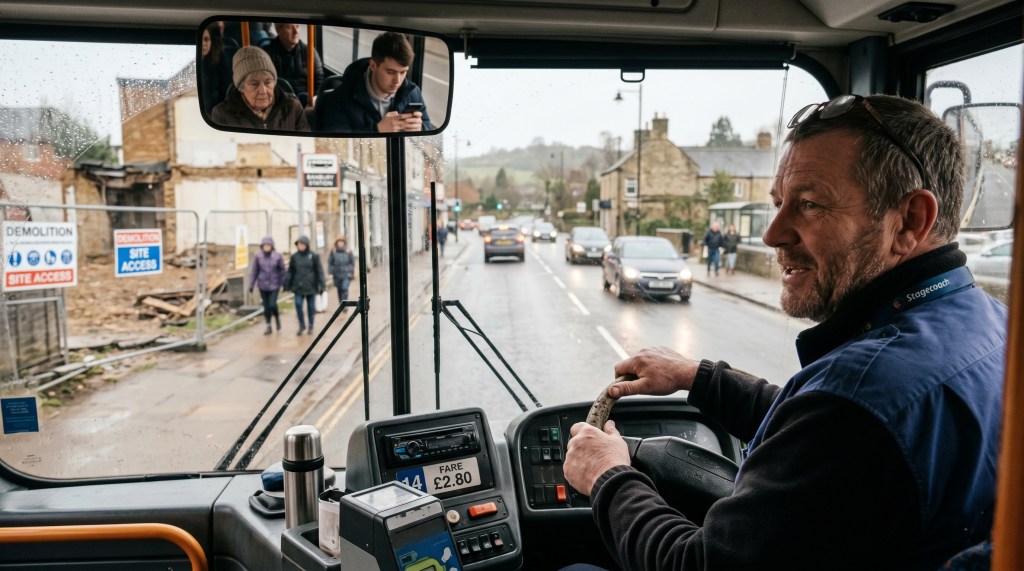
You alright there? Yeah, near the front’s the best spot on a morning like this, I always think. You can see where you’re going, can’t you. I mean, I can see where I’m going regardless, that’s rather the job description, but you know what I mean. Company’s better up here an’ all. Some of ’em sit all the way at the back like they’re on a school trip. Force of habit, I suppose. Never quite grows out of you, does it, the back seat.
I’ll warn you now, by the way – I talk. Not everyone wants that at this time of the morning, I get it, and you just say the word and I’ll leave you to it, no offence taken. But if you’re not fussed either way, I tend to… yeah. You’ve been warned.
Name’s Gary, since we’re neighbours for the next twenty minutes or so. Gareth, technically, but nobody calls me Gareth except my mother when I’d done something wrong, and she passed away three years back, God rest her soul.
Twenty-six years I’ve been doing this route. Twenty-six. People say, don’t you get bored, same roads every day, and I say no, because it isn’t the roads that change, is it. It’s everything else. The roads just sit there being roads. It’s the rest of it that keeps you paying attention, if you’re the paying-attention sort. And I am, as it goes. Occupational hazard.
This stretch here, coming out from Farfield – that’s the estate back there, the big one, used to be all fields before they built on it in the eighties, hence the name, bit of a giveaway that, isn’t it – this stretch is my favourite part of the whole run. I know that sounds daft because there’s nothing much to look at. Retail park on the left there, that big grey shed is a carpet warehouse, the other big grey shed used to be a carpet warehouse and is now, I think, a slightly different carpet warehouse under different management. Life is rich. But there’s something about the way the road opens up here after all those tight little turns through the estate that I’ve always liked. The bus breathes out. That’s what it feels like. Like we’ve both had a chance to stretch our legs before the town gets hold of us.
Coming up on the left in a minute, that’ll be Sandra’s stop. You’ll know it’s Sandra because she’ll be standing there in her big orange coat looking like a traffic cone that’s had enough of the outdoors and wants to go shopping. Sandra’s been getting this bus since before I took the route over. She was here before me, and I’d put money on her being here after me. She’s eternal, Sandra is. I think the orange coat might be load-bearing.
And there she is. Right on cue.
(brief pause, the doors open)
Morning Sandra, love. Yeah I know, shocking isn’t it. In you come.
(doors close)
See, you get to know people. That’s what I mean. Twenty-six years, you’d better get to know people, otherwise what have you been doing, just ferrying strangers about for no reason? No. These are my people. I know Sandra’s bad hip gives her grief on cold mornings so I wait an extra beat before I pull away. I know that the two lads who’ll get on at the next stop – Terry and his mate whose name I genuinely don’t know after four years, and I’m too far in to ask now, that ship has sailed, I just nod at him and he seems fine with it – they’ll want the doors held because they’re always just slightly late, always, they walk very fast but they never quite run, there’s a dignity to it that I respect. And I know that Maureen, she’s there at the back already, was on before I’d even pulled out of the depot this morning, Maureen treats this bus like a second living room and I have never, not once in twenty-six years, seen her without a Tupperware container of something. Today it looks like biscuits. Yesterday it was what I think was a quiche, though I’ve learned not to ask too many questions about Maureen’s Tupperware. You just accept it as one of the wonders.
This bit here, coming up – see that gap in the wall? That’s where the old post office used to be. Knocked it down in 2019, and I’ll be honest with you, I took it personally. They’re going to turn it into some sort of artisan coffee thing, which, fine, fair enough, I’m not a monster, but the post office had been there since 1934. Some things should just be allowed to be what they are. My wife says I’m sentimental. I prefer thorough. There’s a difference.
That hill up ahead, by the way, just to set your expectations – you’ll hear the engine complain. It always does. Don’t be alarmed, it just likes to let you know it’s making an effort. I know exactly which gear she wants and when, and she knows I know, so it’s more of a formality at this point. Twenty-six years, you develop an understanding.
(beat)
Actually, funny you should be sitting up here today. I was thinking this morning, pulling out of the depot, about this route. About this very stretch. I think about it more than I probably let on, if I’m honest.
Had a bit of a do, couple of years back. On this road. On this bus. This actual bus, as it goes, they didn’t retire her, which I find either comforting or slightly haunting depending on the day.
Nothing to worry about now, I’m fine, I’m here, obviously, hence the driving and the talking, but – yeah. A bit of a do.
And the thing is, right – the thing I keep coming back to whenever I’m on this stretch – I look around at the faces on this bus some mornings, and I think: half of you were here. Half of you were on this bus that day. And you probably don’t even know what you did.
II: The Day Itself
Tuesday it was. I’m almost certain it was a Tuesday. February, definitely February, because the heating on the bus had been playing up and I’d put in a report about it twice already and been told twice that it was on the list, which as far as I can tell is a list that exists purely to stop people asking when something’s going to get fixed. It was cold. That kind of cold where the sky goes that flat white colour and everything just looks a bit defeated. You know the one.
I’d had a bacon roll from the garage at the depot. Tony’s garage, just round the back of the bus station – Tony does a good bacon roll, I want to be fair to him, it’s not his fault, I’m not here to throw Tony under the bus. Pun intended. But I mention the bacon roll because when it started, the tightness, that’s what I told myself it was. I thought: that’ll be the roll. Too much brown sauce, probably. I’ve got form with brown sauce, my wife will back me up on that.
So I kept driving.
I want to be straight with you about that bit, because I’ve told this story a few times now and there’s a version of it where I’m quite heroic for keeping the bus going, and I don’t want to give you that version because it’s not true. The true version is I kept going because I didn’t want to make a fuss. That’s it. That’s the whole reason. Fifty-two years old – well, fifty at the time – fifty years of being told, by nobody in particular, just by the general atmosphere of being a bloke in England, that you don’t make a fuss. That you walk it off. That it’s probably nothing. So I drove past the retail park and I thought: brown sauce. Settle down.
But it wasn’t settling down.
It got – heavier, I suppose is the word. Like someone was slowly stacking things on my chest. And I remember gripping the wheel a bit tighter, which did nothing obviously, the wheel wasn’t the problem, but you hold on to what’s in front of you, don’t you. That’s instinct.
Now. See the woman in the green jacket there, third row back? Don’t stare, just – yeah. Her. That’s Donna. Donna was on this bus that morning. She’d got on at the post office stop – the old post office stop, I should say, pour one out – and she’d sat almost exactly where she’s sitting now, which I find strange to think about. She’d been a care worker for, she told me later, just over twenty years. Mostly elderly patients, end of life stuff. The sort of work that most people couldn’t do for twenty minutes, let alone twenty years. And she came up to me – didn’t shout, didn’t make a drama of it – she just came and stood by the cab and said, very quietly, very directly: your colour’s wrong.
That’s all she said. Your colour’s wrong. And something about the way she said it – like she was reporting a fact rather than raising a concern – just cut right through all the brown sauce logic I’d been feeding myself for the past ten minutes. She told me to pull over. And I did.
I pulled over just past the old post office. Right there where the road widens a bit. I called it in on the radio – I’m quite proud of that bit, I kept my voice level, I said there was an incident and gave my location and I must have sounded calm enough because the woman on the other end didn’t seem alarmed, and I remember thinking: good. Good, that’s – keep it tidy.
Then I put the handbrake on and things got a bit loose after that, if I’m honest.
What happened next – and this is the bit that still gets me, if I let it – what happened next was that about forty people on a bus, most of whom didn’t know each other from Adam, just… sorted it out. That’s the only way I can put it. It wasn’t organised. Nobody appointed anyone. It just happened.
There’s a lad – he gets on two stops before the town centre, young fella, early twenties, works in IT or web design or something, I always see him looking at his phone with that expression like the phone has personally let him down. He’d done a first aid course. One of those half-day ones they make you do at work. And he was down the aisle and crouching next to me and asking me questions before I’d even fully registered what was happening. Asking me where the pain was, was it in my arm, could I squeeze his hand. He was nervous – I could tell, his voice had that slightly too-controlled quality that people get when they’re frightened but determined – but he did it. He just got on with it.
There was a woman, retired nurse, she’d been on her way to see her sister in town. She didn’t make a song and dance about being a nurse, she just moved to where she was needed and between her and the lad they had it covered between them better than I had any right to expect. I learned her name afterwards. Janet. I sent her a card. I wasn’t sure what to write so I think I wrote something like thank you for everything which feels woefully inadequate but there we are. Some things don’t have the right words and you just have to send the card anyway.
And then – this is the bit that makes me laugh, even now – a woman got off the bus. Just stepped off into the road. And started directing the traffic.
Her name – I found out afterwards – was Bev. Retired, used to be in the police, years back, different town entirely. And she stepped off this bus and she stood in the middle of the road in her good coat and she started moving cars around us like she’d never stopped doing it. No vest, no radio, nothing. Just absolute authority. Apparently a van driver wound his window down to argue with her and she gave him a look, and he didn’t.
I only heard about Bev second-hand because I was a bit preoccupied at the time, as you’ll appreciate. But when someone described it to me later I thought: of course. Of course there was a Bev. How would it have worked without a Bev.
And then there’s the 999 call.
There’s a lad – teenager, fourteen or fifteen, I’ve seen him a handful of times since and I don’t know his name and it bothers me more than I can fully explain – he was sitting near the back. He rang the ambulance. And apparently – I got this from one of the paramedics afterwards – he was calm, clear, gave the road name, gave the right direction, described what was happening without panicking, answered every question they asked him. Fifteen years old, something like that. And I remember, from somewhere that felt like it was getting further away, I heard his voice and I thought: someone’s got it. Someone’s got hold of it. You can let go a bit.
I don’t know that lad’s name. I’d like to. I’m not sure what I’d do with it if I had it. But I’d like to know it.
I don’t remember a great deal after that for a while. I remember the coat – somebody folded a coat and put it under my head and the window was cold against my arm and someone was talking to me steadily, keeping me in the room, and I’ve no idea who that was either. I’d give a lot to know. That’s the thing about it, there are these gaps, these hands you never got to shake, and you just have to – yeah. You carry it.
The paramedics were there faster than I’d have expected, given everything. The one who worked on me – I found out later she’d been covering an extra shift because a colleague was off sick. Wrong day to be ill, her colleague. Or the right day, depending on how you look at it. And I’ve turned that over a lot since, because there’s something in it that I can’t quite leave alone – the idea that the whole thing balanced, in part, on some poor sod having a cold. The randomness of it. I’m not a superstitious man, not really, but I find it – I don’t know. Interesting’s not quite the word. Significant, maybe. That the margins are that thin.
The hospital I’m a bit hazy on, the first couple of days especially. But I remember a consultant – very composed woman, the sort who makes you feel that whatever is happening has happened before and been dealt with before – and a junior doctor who I’m told barely left. And a porter called, I think, Marcus, who brought me tea and called me mate and somehow that just – that landed differently than it had any reason to. When you’re frightened, and you’re far from home in your own body, and someone calls you mate. I’m getting a bit close to the bone now, so I’ll leave that there.
And there was a nurse who explained the whole thing to me – what had happened, what they’d done, what was next – in plain, honest language without wrapping it in cotton wool or burying it in jargon. And I thought: that’s a skill, that is. That’s underrated, that is. To just tell a person the truth in a way they can hold.
And that’s – well. That’s what I mean, isn’t it.
The care worker who said your colour’s wrong. The lad with his half-day first aid certificate. The retired nurse who didn’t hesitate. Bev, out there in her good coat, sorting out the A-road. The teenager at the back who kept his head when there was no obvious reason he should have done. The paramedic who was only there because of a timetable that had nothing to do with me. The consultant, the junior doctor, Marcus and his tea, the nurse who told me the truth.
Take any one of them out of it.
Go on. Take any one of them out of that day and tell me how it ends.
III: This Bus, This Morning
Right, here’s that left turn I mentioned. You’ll want to hold on to something if you’ve got a bag on your lap. She pulls wide if you let her, so I don’t let her.
(beat)
That’s where Bev stood.
Just there. Right there where that white van’s parked now. She was standing more or less where that van’s bonnet is and she had her arm out and I’m told she didn’t move for twenty minutes. In her good coat. Just – stood there and made herself into a lollipop lady by sheer force of will.
I always look when I take this turn. Every single time, two years on, I look at that spot. My wife thinks I should maybe talk to someone about that and she’s probably right, she usually is, but I think there’s a difference between something haunting you and something meaning something. This means something. Looking at it is how I keep track of that.
(pause, the bus settles into the straight)
Maureen at the back there. I told you about Maureen. Tupperware. Eternal. What I didn’t mention is that on the day, while all the other stuff was going on, Maureen rang her daughter. Which sounds like not very much when I put it like that. Except her daughter works at the council, and somehow – I’ve never fully mapped out the chain of it, it’s like one of those diagrams with the string and the pins – somehow that phone call meant that my wife, Carol, was told what had happened by someone she knew before it went anywhere near the local news. Before she saw anything on her phone. She got a human voice on the end of a telephone instead of a headline, and that was Maureen’s doing, whether Maureen knew that’s what she was doing or not.
I didn’t find that out until weeks later. I nearly didn’t find it out at all. Which makes me wonder what else I don’t know. What other bit of it happened quietly somewhere I wasn’t looking.
Terry – the lad from the warehouse, next stop coming up – Terry and his mate, the nameless one, they were on the bus that morning. Got on at their usual stop, just like today. And they’re big lads, both of them, the kind of build that’s professionally useful, and when it was all over and the ambulance had gone and someone had to figure out what to do with a bus that wasn’t going anywhere, they were the ones who helped the replacement driver get sorted. Fetched stuff, moved stuff, kept people calm without making a fuss about keeping people calm. Terry told me about it on my first day back. He said, very Terry about it: yeah, we just hung about and helped, it was nothing. I said it wasn’t nothing. He said, well, you know what I mean. And I said yes, I know what you mean, but I want you to know it wasn’t nothing all the same.
He went a bit red. Lovely fella, Terry.
(the bus slows)
Morning lads. Yeah, not bad thanks. In you come.
(doors close, bus pulls away)
See. Like clockwork.
Now. The ones who aren’t here this morning. Because there are some, and I want to – I want to give them their due even though they can’t hear it.
Janet, the retired nurse: she moved. Somewhere up north, I think, about a year after. I know because she’d become a bit of a regular, and then one day she just wasn’t. I asked after her and Sandra, who knows everyone’s business by some mechanism I’ve never fully understood, Sandra told me she’d gone to be nearer family. I hope she’s alright. I hope she’s standing on some other bus somewhere, spotting things that other people miss. That’d suit her.
The teenager. I still don’t know his name. I’ve looked, in a non-alarming way, I want to stress that – I’m not combing through records or anything, I’m not that far gone – but I’ve just never managed to catch him at a moment where it wouldn’t be strange to suddenly say: hang on, were you on this bus two years ago, because I owe you a considerable debt. That moment has just never quite arrived. And I’ve had to make a sort of peace with that, the same way I’ve had to make peace with the coat. Whoever’s coat it was. I think about that coat more than is strictly rational.
And the paramedic. Sarah, her name was. I found that out through the hospital, eventually. I wrote to the ambulance service to say thank you, which felt a bit feeble, but I didn’t know what else to do. I don’t know if she ever got it. I hope she did. I hope someone read it to her in a staff room somewhere and she had a cup of tea and thought: alright, good. I hope it was at least worth the price of a stamp to someone.
There are holes, is what I’m saying. Loose threads. And I’m not a man who does well with loose threads – ask my wife, she’ll back that up, she’ll say he cannot leave things unfinished, it’s exhausting – but I’ve had to learn to accept that not every thread gets tied. Sometimes you just have to carry the gratitude around with you and hope it counts for something, even when there’s nobody on the other end of it.
(long beat, the town beginning to appear ahead)
The thing that I keep landing on, when I think about all of it – and I do think about it, not every day, but regularly, the way you check on something that matters – the thing is that not one of those people thought they were doing anything significant. I’d stake anything on that. Donna was just reading the situation the way she’d been reading situations for twenty years. The lad with the first aid was just doing what the course told him to do. Bev was just – Bev. The teenager rang a number that exists for exactly that purpose. The paramedic turned up to a shift she’d been asked to cover. Janet was on her way to see her sister.
Nobody thought: today I’ll be part of something. Nobody thought: I’ll save that bus driver. They were just people, on a Tuesday in February, doing the thing that was in front of them. And that, to me – I’ve turned this over and over and I keep coming back to the same place – that is not a small thing. That is, actually, if you think about it seriously, an enormous thing. Dressed up as nothing. Wearing nothing’s clothes.
I reckon that’s what most of it is, in the end. The stuff that matters. It turns up in ordinary clothes and it doesn’t make a speech about itself and then it gets off at the next stop and that’s it.
(he glances at the passenger)
Anyway. That’s why I talk.
Because you’re sitting up here, and I don’t know anything about you. And I know that sounds like the beginning of something weird, so I’ll just – what I mean is: I’ve thought about this, the randomness of who ends up where and when. I’ve thought about it rather a lot, as you might imagine. And you never know, do you. You never know what you know that turns out to matter. You never know what you’ll notice, what you’ll remember from some half-day course three years ago that you didn’t think you were paying attention in. You never know when it’s going to be you standing at the front of the bus because somebody needs somebody to just – stand there. And know what to do. Or be willing to try.
I’m not being morbid. I want to be clear about that. I’m in good nick, the doctor’s happy with me, Carol’s got me eating more vegetables than I would strictly choose to eat if left to my own devices, I’m fine. I’m not telling you this because I think anything’s going to happen this morning, although I would ask you not to have a bacon roll for breakfast just on general principle.
I’m telling you because I didn’t know any of those people’s stories before that day. Not really. I knew Sandra’s bad hip. I knew Terry’s always nearly late. I knew Maureen’s Tupperware. But I didn’t know what any of them were carrying with them, all that accumulated experience and competence and just basic human willingness to help – I didn’t know any of it was there until the day I needed it to be there.
And now I can’t unknow it.
Every face on this bus, I look at it differently now. I think: what have you got? What do you know that I don’t? What would you do, if it came to it, when it came to it?
I think the answer, mostly, is something good. I think the answer, mostly, is that people are a lot better at the sharp end than you’d expect if all you did was read the news. That’s my sample size of one speaking, granted. But it’s a pretty compelling sample, as it goes.
(the bus slows, the town centre coming into view)
Right. Here we are then. Town centre, next stop, calling at the Market Street stand.
(the routine of it returning to his voice)
Watch your step on the way out, it’s slippy round the front. Not you – you’re not there yet, are you, do you want this stop or are you going further? Right, well, I’ll see you then. You know where I am.
(calls back to the bus as passengers begin to move)
Lovely, thank you sweetheart. Mind the step. Morning. There you go, Terry, mate. Morning Maureen – is that shortbread? Don’t tell Carol.
(one last, quiet beat, almost to himself)
Every single one of them.
Bob Lynn | © 2026 Vox Meditantis. All rights reserved.


 Vox Meditantis
Leave a reply to Bob Lynn Cancel reply