What is the best concert you have been to?
I: Con Autorità
You want to know about the best concert I have ever played.
Very well. But first, you will have to trust me. And to trust me, you will need to know something about who – what – is speaking to you. So permit me a moment, before we get to the music, to establish my credentials. I have found, over the course of several centuries, that humans are far more willing to listen to a thing once they understand how old it is.
I was made in Naples, in the workshop of a luthier whose name you would not recognise, in or around the year 1741. I say “in or around” because my maker was not the sort of man who kept meticulous records. He was the sort of man who kept good wine and a catastrophically bad-tempered cat, and who worked by feel rather than formula. He was not Stradivari. He was not Guarneri. He has no entry in the encyclopaedias and no asterisk in the auction catalogues. What he had was a gift for selecting spruce – a nearly mystical patience for it, running his thumb along the grain of a piece of wood the way another man might read a letter from someone he loved. The top plate of my body came from a single piece of Alpine spruce that he had been seasoning for eleven years before I was born. Eleven years. Waiting for the wood to become what it needed to be.
I mention this because it matters. I am not a famous violin. I am not the sort of instrument that arrives at Sotheby’s with a certificate and a mythology and a roomful of collectors going quietly pale at the estimate. My varnish is a deep amber-brown, warm rather than spectacular, and I bear the small asymmetries of a craftsman working alone, without apprentices, without fanfare. But I have a voice. Those who have really listened – and there have been fewer of those than you might imagine – have described it as something between a cello’s darkness and a soprano’s reach. A sound that seems to come from further back in the instrument than is physically possible. I do not say this to flatter myself. I say it because it is the only reason I have survived as long as I have. Beautiful objects get preserved. Useful objects get worn out. I have been, it turns out, both.
I will spare you the complete inventory of my history, partly out of consideration for your time, and partly because several decades of it are genuinely undignified. The dissolute Neapolitan nobleman who acquired me from my maker’s estate played me precisely twice and then left me in a cabinet for eighteen years, face to face with a broken mandolin and what I can only describe as the skeletal remains of an optimistic ambition. After him, a Viennese cantor of considerable seriousness who played with great feeling and almost no technical precision whatsoever, God rest him. A regimental bandmaster in the 1820s whose left hand was steadier than his right, owing to an incident at Waterloo he would never adequately explain. A concert violinist of modest regional fame in Bohemia who had one truly magnificent season and then, as so many do, began to rely on reputation in place of practice. A pawnbroker’s shelf in Prague for eleven years – this was not a low point so much as an extended philosophical interlude. And then, in the 1890s, a succession of teachers and students and amateur players and semi-professional orchestras, spreading westward across Europe as the century turned, each one adding something to my understanding of what human beings do with music and why they insist on continuing to do it despite the extraordinary suffering it causes them.
I have been in the hands of the genuinely gifted and the genuinely deluded, and I want to tell you plainly: the gap between those two categories is both wider and narrower than you would expect. I have known players of technical perfection whose playing left me entirely cold – every note impeccable, every phrase correctly observed, and all of it as emotionally nourishing as a beautifully typeset legal document. I have known players who could barely hold the bow correctly and yet produced, in their lurching and unguarded way, something that resonated in my spruce and maple like a struck bell long after they had stopped. One celebrated soloist – and I will not name him, since several of his former students are presumably still alive – had a habit of whispering instructions to himself under his breath while he played, which I found less charming than he clearly did. Another spent the thirty seconds before every performance addressing me directly, in terms so extravagantly complimentary that I began to suspect I was being softened up for something.
What I am telling you is this: I have perspective. Earned, weathered, occasionally reluctant perspective, accumulated across nearly three hundred years and more human hands than I have been able to keep count of. When I tell you that the best concert I ever played was not in Carnegie Hall, not at the Proms, not at any of the storied venues where I have stood under lights and felt the electricity of a full house holding its breath – when I tell you it was a Tuesday afternoon in a school music room in the north of England in 1987, with an audience of precisely one tired music teacher and a stack of unmarked exercise books – I ask that you do not dismiss this too quickly.
I have thought about it for a long time. I know what I heard.
II: Sostenuto e Riflessivo
But before I tell you about Saoirse, I need to ask you something.
What do you think a concert actually is?
I raise this not to be difficult – though I confess I have been called difficult, by musicians who mistook my resistance for a fault in the instrument rather than a fault in themselves – but because the question is more genuinely complicated than it first appears, and I think you owe it to yourself to sit with it for a moment. You have an image in your mind, I suspect. A stage. Lights. A hall of a certain grandeur, its acoustics the product of either excellent Victorian engineering or extremely expensive twentieth-century intervention. An audience in good clothes, maintaining the performative silence of people who are conscious of being seen to listen. And at the front, a soloist – singular, spotlit, the converging point of all that attention – drawing the bow across the strings with the certainty of someone who has played this concerto so many times that it has become less a piece of music and more a well-maintained road through familiar country.
I have been that soloist’s instrument. Many times. In many halls. And it is extraordinary – I will not pretend otherwise. There is a physical sensation to a full concert hall that has no equivalent elsewhere; the way several hundred human bodies alter the air, the temperature, the very acoustic character of the space, so that the room you are playing in at the end of the first movement is subtly different from the room you began in. I have felt the Musikverein in Vienna settle into itself like a living thing as the audience fills it. I have felt Carnegie Hall in a state of such concentrated attention that the silence between phrases seemed to have a texture. These are not small things. I do not dismiss them.
And yet.
I have been thinking about this word – concert – for considerably longer than most people have been alive, and I keep returning to its origins, the way you might keep returning to a loose thread, not quite able to leave it alone. It comes from the Latin, by way of the Italian. Concertare. To contend with. To strive together. There is, buried in the etymology, the idea of a negotiation between parties – a working out of something between two forces that are not identical, are perhaps not even entirely compatible, but are committed, for the duration, to finding a common resolution. Not a performance at an audience. A conversation between the music, the player, and the instrument in which all three are genuinely at risk of being changed by what happens.
I have played concerts, in the grandest sense of the word, where no such conversation took place.
I want to be precise here, because I am not interested in cheap cynicism about the professional world. The musicians who have carried me onto great stages were, most of them, remarkable human beings who had sacrificed things you cannot easily imagine in the pursuit of their craft. The hours. The physical cost – do not let anyone tell you that playing the violin at the highest level is not a bodily discipline as demanding as any athletic pursuit; I have known players whose left hands would not fully open in cold weather by the time they were forty, whose spines had been quietly rearranged by decades of asymmetric posture. The loneliness of the practice room. The particular cruelty of an instrument that will expose every unguarded moment, every lapse of concentration, every emotional dishonesty, without mercy and without exception. I have enormous respect for what those players gave.
But here is what I have noticed, across the long accumulation of my experience. There is a plateau that the very accomplished can reach, without quite realising they have reached it, where technical mastery becomes its own kind of ceiling. The music is executed rather than inhabited. The phrases are all correctly shaped – the swells and diminishments are in the right places, the tempo relationships are considered, the tone production is even and controlled – but something essential has been replaced, incrementally and almost invisibly, by a very sophisticated form of repetition. The player is no longer finding out what the music is. They already know. And the knowing, paradoxically, closes a door that only uncertainty can open.
I noticed it most acutely when a player was no longer listening to me.
This sounds like vanity. I understand that. But consider: I am not a passive object in this arrangement. I am not a loudspeaker, faithfully reproducing whatever signal is fed into me. I am a physical system of wood and varnish and gut and air, nearly three centuries old, with resonant characteristics and weaknesses and a voice that has been shaped by every player who has ever drawn a bow across my strings and left some infinitesimal trace of themselves in the way the wood has settled and responded over time. When a player truly listens to the instrument – adjusts their bow speed to what the instrument is giving back, follows a resonance rather than imposing one, allows the sound to bloom at its own rate rather than the rate they have decided upon in advance – something happens that neither party could have produced alone. The music becomes genuinely three-dimensional. It has a past and a future and a present, all at once.
When a player stops listening to me, the music becomes a very accurate, very detailed, very finished painting of itself.
I played a recital in London in the 1970s – I will tell you only that the soloist was very famous, and that the interval drinks were excellent, and that the critic in the broadsheet the following morning used the phrase “immaculate authority,” which I have come to regard as the most precise possible description of a beautiful disappointment. The audience gave a standing ovation. I felt, throughout, as though I were somewhere behind the performance rather than inside it, looking on. It is a curious sensation, being played without being heard. A little like speaking to someone whose eyes are focused on a point just past your left shoulder.
Whereas a concert, in the deepest sense – the concertare sense, the striving-together sense – is when a player walks onto a stage, or into a room, or sits down in a school music room on a grey November afternoon, and genuinely does not know what is about to happen. When the music is not a road they have already travelled but a territory they are entering for the first time, despite having learned every note by heart. When they are listening – to the room, to the instrument, to themselves, to the specific and unrepeatable conditions of this moment – and adjusting, and following, and being surprised.
That is a concert.
Everything else, however magnificent, is something slightly less.
III: Con Moto Tranquillo
So. The north of England. November. 1987.
I want you to see it clearly, because the details matter here in a way that the details of a concert hall rarely do. A concert hall, after all, is designed to impress – every proportion calculated, every surface considered, the whole enterprise a kind of architectural argument that what happens inside it is important. The room announces the significance of the event before a single note has been played. It does a great deal of the work for you, and this, I have come to feel, is not entirely a virtue.
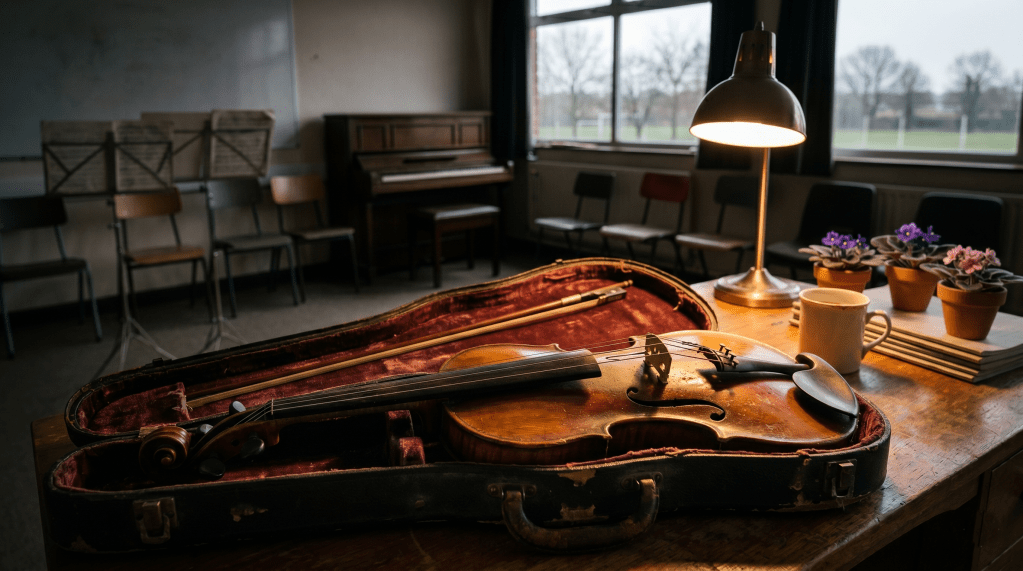
There is no such assistance available in Room 14 of Northgate Comprehensive School, which occupied a low annexe building at the far end of the main block, separated from the science labs by a corridor that smelled persistently of both mildew and formaldehyde, in a combination that suggested neither department had adequately resolved whatever had originally caused it. The room held approximately thirty chairs in various states of structural confidence, three metal music stands with the slightly defeated posture of objects that had been assembled, collapsed, dropped, and reassembled too many times to maintain any strong feelings about the process. A piano of considerable age and uncertain temperament stood against the far wall, its upper register sharp and its sustain pedal given to a soft, rhythmic squeak that Mr. Kowalski had long since stopped hearing. A printed poster of the orchestra’s seating plan, the kind issued by every local education authority in England at the time, had been on the wall for so long that it had faded to a near-uniform cream. On his desk, three African violets in terracotta pots, doing better than anything else in the room.
Outside, the playing fields. The grey of a northern November sky – not dramatic, not threatening, simply grey in the way that a wool blanket is grey, as though the light has been washed too many times and lost whatever colour it once had. The trees at the far edge of the field had finished with their leaves and stood in their honest, stripped winter condition, neither beautiful nor ugly, simply patient. It was a Tuesday, shortly after four o’clock, and the school had largely emptied. There was a distant sound of a caretaker moving something heavy along a corridor somewhere, and from the road beyond the fence, the irregular percussion of rush-hour traffic.
This is where I was.
I had arrived at Northgate eighteen months earlier, through one of those circuitous routes that seem improbable in retrospect but feel, at each individual step, entirely logical. A music teacher at a school in Yorkshire had retired and left his small collection of instruments to the county music service, which had distributed them with the pragmatic arbitrariness of an organisation simultaneously underfunded and overwhelmed. I had passed through two other schools before reaching Northgate, neither of which had a student capable of doing anything with me beyond producing the sort of sounds that make a luthier wish they had gone into furniture. Then the county service, in a rare moment of either insight or administrative accident, had passed me to Mr. Kowalski, with a note suggesting I might be suitable for an advanced student.
Mr. Kowalski had held me for a long time before he said anything. He had turned me over in his hands slowly, looked at the label through the f-hole, run a finger along the seam of the ribs with the light touch of someone who knows what they are examining. Then he had set me down very carefully on his desk and sat for a moment in what I can only describe as respectful silence.
“Well,” he had said, to no one in particular. “How did you end up here?”
I found, despite everything, that I liked him immediately.
Stefan Kowalski was at that point fifty-three years old, a compact, careful man with close-cropped grey hair and the hands of someone who had played seriously in his youth and maintained the habit without any remaining ambition for recognition. He had come to England as a child with his father, who had left Poland in 1947 with a single suitcase and the kind of quiet, unshakeable determination that catastrophic historical circumstance either produces or destroys, with very little in between. Stefan had grown up in Leeds, studied at the Royal Northern College of Music in Manchester, played for some years in various regional orchestras and chamber ensembles, and then, by a route he never fully explained to anyone, had found himself teaching music at a comprehensive school in the north and stayed for twenty-six years. He was not bitter about this. I want to be clear about that, because it would be easy to cast him in that light and it would be wrong. He was one of those people who find, in the unremarkable and unglamorous work of teaching adolescents, something that is not a consolation prize for a different life but an actual vocation, recognised and embraced on its own terms. He brought the same seriousness to a beginner’s first hesitant scales as he did to preparing an advanced student for a county concerto competition. He had, as far as I could determine, no interest whatsoever in being known beyond the confines of his own life, and this gave him a quality of presence that the fame-oriented conspicuously lack.
He also made excellent tea, brewed in an actual teapot, kept on a small table beside the piano. I mention this because it was a constant feature of my time in that room, and because there is something about the smell of properly brewed tea that has always seemed to me deeply consonant with the serious, unhurried application of effort to difficult things.
I had been played, in those eighteen months, by seven of his students. Four were beginners, industrious and well-intentioned, for whom I tried to be patient. One was a boy of fifteen with a real facility for tone production and a deeply complicated relationship with practice. One was a girl of seventeen who was technically advanced but played, it seemed to me, largely to please her parents rather than herself, and whose sound had the careful, pressurised quality of someone performing a task they have not yet decided is actually theirs. And one was Saoirse.
Saoirse Brennan was thirteen, the daughter of an Irish civil engineer who had brought his family to the north of England for a contract that had extended, as contracts do, into something resembling permanence. She had been playing for three years. She was slight and dark-haired and had a habit, when she was thinking, of going very still in a way that was unusual in someone her age – a quality of interior focus that Mr. Kowalski had clearly identified long before I arrived, because he treated her with a careful, precise attention that was different in character from how he taught the others. Not kinder, exactly. More serious. The way you might speak to someone you have decided to tell the truth to.
She had been working on the Bruch Violin Concerto No. 1 in G minor for five months. The Bruch is one of those pieces that sits at a junction in a young violinist’s development – technically demanding enough to be a genuine test, emotionally wide enough to require something beyond technique, but not yet so architecturally complex that the emotional content becomes hard to access. It is a piece that rewards feeling at least as much as it rewards precision, which makes it both a gift and a kind of trap, because a player who leads with feeling and neglects the precision will find it exposes them just as mercilessly as it rewards them. It was, in short, exactly the right piece for this girl at this moment in her development, and Mr. Kowalski had known that when he assigned it.
On this Tuesday afternoon, the rest of the school had gone home. Mr. Kowalski had pulled a single plastic chair to the centre of the room and sat in it with the unmarked exercise books on the floor beside him, not as an affectation but simply because he had been intending to mark them during a free period that had not materialised, and this was where they had ended up. He had poured himself a cup of tea. He had turned off the overhead fluorescent light – it had a faint flicker that he knew disturbed sensitive players – and left on the small lamp on his desk, which threw a warmer, more contained light across the room. Outside, the sky was doing its implacable grey November thing. The radiators ticked and knocked with the mild, apologetic irregularity of old heating systems in old buildings.
Saoirse stood at the music stand with me under her chin, rosin dust still faintly visible on the strings, her bow held ready. She had not yet played a note. She was doing what I had already learned she always did in these few seconds before she began – going still, going inward, finding whatever it was she needed to find before she allowed the music to start.
Mr. Kowalski held his cup of tea in both hands and waited, without impatience, without any expression on his face. The caretaker had finished whatever he had been moving. The traffic outside had quietened slightly.
The room held its breath.
I held mine.
IV: Appassionato, ma Intimo
She began with the orchestral introduction.
This is not, strictly speaking, how the Bruch is meant to be performed. The concerto opens with the orchestra, not the soloist – a brooding, purposeful passage in the lower strings that establishes the key and the mood before the violin enters with its first, unforgettable phrase. Saoirse had no orchestra. She had a Tuesday afternoon and a music room and one man in a plastic chair. So she had developed, with Mr. Kowalski’s guidance, a habit of playing the orchestral introduction herself before her entry, quietly, almost under her breath, not as a performance but as an act of orientation. A way of stepping into the world of the piece before the piece proper required anything of her.
I had heard her do this many times by then. I knew the shape of it. But I want you to notice something, because it matters to what came next: she was not doing it mechanically. Even in those few quiet preparatory bars, she was listening. Her bow arm was relaxed, the pressure unhurried, and she was adjusting as she went – following the resonance of the room, feeling how the late afternoon and the lamplight and the quality of this very moment were affecting the air and the sound and whatever it is, somewhere between the physical and the ineffable, that connects a player to an instrument when the conditions are right.
And then she arrived at the entry.
The violin’s opening phrase in the Bruch G minor is one of the great gifts in the concerto repertoire – a long, rising, aching line that seems to gather itself from somewhere below the instrument and move upward through two octaves with an almost vocal urgency, as though the music has been waiting to say this thing for a very long time. In the hands of the technically assured it is deeply satisfying. In the hands of the technically perfect it can be, as I have indicated, a beautiful and slightly airless construction. But Saoirse was thirteen years old and had been playing for three years, and she did not yet have the kind of technical assurance that forecloses surprise. She entered the phrase and the phrase entered her, more or less simultaneously, and what came out was something I had not quite heard from her before.
I should describe, as precisely as I can, what it actually feels like to be played. Not the acoustics of it – you can find that in any physics textbook, the vibrating string, the resonating body, the f-holes releasing the sound into the room, all of it perfectly explicable and not, in itself, interesting. I mean the felt experience, from the inside. Because I do have an inside. Three hundred years of one has left me with something, if not consciousness in the way you would recognise it, then at least a form of accumulated sensitivity that amounts, in practice, to much the same thing.
When a player draws the bow across the string, I feel it through the entire body – not just at the point of contact but everywhere, simultaneously, the way a struck bell feels the strike not only at the rim but through the whole of its metal. The vibration travels through the string, through the bridge, into the top plate and down through the sound post into the back, spreading through the ribs, finding the frequencies that my structure of wood and varnish and age amplifies most willingly, and in this process I am not a passive resonator but an active participant, shaping what I return to the player as surely as they shape what they give to me. Good players feel this. They understand, at some level below conscious thought, that the sound they receive back from the instrument is information – that I am telling them something about what I can do, what I want to do, what will happen if they trust me rather than override me.
Saoirse felt this. She had felt it from the first time she played me, which is part of why I had been paying close attention to her from the beginning.
But on this afternoon, in the opening bars of the Bruch, something was different. The phrase moved through me and I felt it not as a sequence of correctly executed notes – not even as a sequence of expressively executed notes – but as something that had, for want of a more precise word, weight. Genuine emotional weight, the kind that does not come from technique or intention or even talent alone, but from some convergence of readiness and circumstance that cannot be manufactured and cannot, in my experience, be reliably repeated. She was ready. Not merely technically ready – Mr. Kowalski had already told her as much, I suspected, in their previous lessons – but ready in some deeper and less manageable sense. Ready to mean it.
There was a slightly uneven shift at the end of the second phrase, her fourth finger arriving a fraction late on the high D, and the note bloomed with the smallest catch in it, not quite centred for just a moment before she found it. In a competition this would have been marked. In a recording it would have been corrected. In that room, on that afternoon, it was simply true – the trace of a real effort, a real reaching, not an error so much as evidence that she was genuinely climbing rather than walking a route she had already mapped. I felt her adjust, not with anxiety but with a quick, instinctive responsiveness, her bow arm rebalancing, her weight shifting back into the phrase, and the next note landed with a fullness that the slightly imperfect one before it had, in some way I cannot entirely explain, made possible. As though the small uncertainty had opened a door.
Her vibrato, in those first bars, was wide and a little uneven, the way it always was when she was nervous. But I noticed, and this is the thing I want you to understand, that she was nervous in the right way. Not the nerves of someone who is afraid of making a mistake – that kind of nervousness tightens the arm and shortens the bow and produces a thin, pressurised tone I have heard more times than I care to count. This was the nervousness of someone who cares very much about what they are doing and is not entirely sure they are equal to it, which is an entirely different thing and considerably more useful. It is, in fact, the precondition for most of the genuinely moving music I have ever been part of. Certainty produces accuracy. Uncertainty, of the right kind, produces truth.
She moved into the development of the first movement and I felt the room change. This is not a metaphor. The acoustic properties of a room genuinely alter as the music in it intensifies – the air behaves differently, the surfaces that have been reflecting sound in a pattern begin to accumulate something, an energy that is physical and measurable and also, simultaneously, something else entirely. Mr. Kowalski had set down his tea. I could not see him – I am a violin, not an owl, and my perspective on the room when I am being played is considerably limited – but I could tell from the quality of the silence behind the music that he had stopped doing anything except listening. Not evaluating. Not cataloguing the shifts and ornaments and bow technique for later discussion. Simply listening, in the way that you listen when something has taken hold of you and the critical faculty that makes you a teacher has, for the time being, quietly stepped aside.
The slow movement was where she found the thing I am still thinking about.
The Adagio of the Bruch is not technically the most demanding passage in the concerto. It asks for sustained, singing tone – the kind of long-breathed, openly emotional playing that requires the player to remain exposed for extended periods without the cover of technical activity, with nowhere to hide and nothing to do but mean it, bar after bar, for minutes at a time. Many players, even accomplished ones, rush it slightly – not from disrespect but from a kind of instinctive self-protection, a reluctance to remain in that degree of emotional openness for quite as long as the music demands. It is easier to keep moving. Stillness, in music as in life, requires a certain courage.
Saoirse did not rush it.
She played the Adagio at the tempo of someone who had decided, perhaps without fully articulating this decision even to herself, to inhabit every single bar for its full duration and accept whatever that required of her. The tone she produced in those minutes was the best tone I had yet felt her produce – not the most technically correct, not the most perfectly controlled, but the most resonant in the deep sense: the sense in which the sound seemed to come from something larger than technique, to draw on a reservoir that is not exhausted by effort but replenished by it. I felt it in my back plate, a warmth of vibration that I associate, in my long experience, with the moments when an instrument is not being played so much as being allowed to speak.
I am going to tell you something I have told no one, because until this moment there has been no one I could tell.
About two thirds of the way through the Adagio, I was surprised.
Not by the music – I knew the music. Not by a technical event, not by an ornament or a shift in the phrasing. I was surprised by the simple fact of what was happening, which was that a thirteen-year-old girl in a school music room in the north of England was doing something with me that I had not felt since – and I had to go back a very long way to find the comparison – since a young man in a small apartment in Vienna in 1887 had played through a Brahms sonata alone, after a funeral, not for any audience but simply because he could not not play, because the music was the only language adequate to what he was feeling, and the feeling had come through the instrument with a directness and an honesty that had registered in the wood of me like weather.
It registered in the same way now.
She was not performing. There was no audience worth the name, no occasion, no structure of expectation within which she was operating. She was simply playing, with the whole of herself, in a room where the light was going and the radiators were ticking and a man she trusted was sitting quietly in a plastic chair, and the music was coming through her and through me and into the room in a way that felt – there is no other word and I have considered many – necessary. Not impressive. Not accomplished. Necessary. As though this piece of music had been waiting, in the this configuration of this instrument and this player and this afternoon, for the conditions to finally be right.
My stoicism, I am aware, has been established. I mentioned it near the beginning, and I meant it. I have outlasted most of what the world has thrown at me. I have been neglected, mishandled, undervalued, left in conditions that would have destroyed a lesser instrument, and I have absorbed all of it with what I flatter myself is a certain dignified equanimity. I am not, as a rule, given to sentiment.
But I will tell you – quietly, and with the full awareness that this admission costs me something – that in the Adagio of the Bruch G minor, played by Saoirse Brennan on a grey Tuesday afternoon in 1987, in a room that smelled of mildew and formaldehyde and the ghost of someone’s packed lunch, I felt something move through me that I recognised from the very deepest part of my experience as the reason any of this exists at all.
Not the concert halls. Not the standing ovations. Not the reviews in the broadsheets or the recordings or the encores or the flowers thrown onto stages or the names in the programme notes.
This.
Precisely and only this.
V: Diminuendo al Niente
She played the final note of the Adagio and let it die in the room.
Not immediately. She held the bow on the string for a moment after the note had technically ended, the way you might keep your hand on a door after closing it, as though the gesture requires a proper completion, a full and deliberate finishing before the next thing is allowed to begin. The sound faded into the room’s silence – absorbed by the chairs and the curtains and the three African violets on the desk – and then there was nothing except the ticking of the radiators and the last of the evening traffic outside and the soft, rhythmic squeak of the piano’s sustain pedal, which nobody was touching.
Mr. Kowalski did not speak.
I counted, in the manner of a thing with no heartbeat but a very acute sense of duration, approximately forty-five seconds of silence. This is a long time, in the context of a music lesson. It is a long time in most contexts. It was not an uncomfortable silence – it had none of the charged, evaluative quality of a silence in which someone is marshalling a careful response. It was the silence of a man who had just received something unexpected and was sitting with it honestly, without hurrying toward a conclusion. The silence of someone who knows that the first thing said after a significant moment either honours it or diminishes it, and who was in no rush to risk the latter.
Saoirse had lowered the bow to her side but kept me tucked under her chin, her eyes not quite focused on anything in the room. She was still, in her way. Still in the way she had been before she started, except that the stillness had a different quality now – less anticipatory, more settled, the stillness of someone returning from somewhere rather than preparing to go. She looked, if I am honest, faintly surprised by herself. As though some part of her had not entirely expected to find that the music went that deep, and was quietly recalibrating in response.
Mr. Kowalski set down his cup, which had been in his hands untouched, the tea inside it long past any reasonable drinking temperature.
“Yes,” he said. “You’re ready.”
Two words. After forty-five seconds of silence and five months of preparation and three years of learning and whatever quantity of innate gift and private longing and ordinary Tuesday-afternoon courage it had taken to play like that in a room with no audience and no occasion and nothing at stake except the thing itself. Two words, chosen with the precision of a man who understood that the moment did not need anything added to it, only confirmed.
Saoirse nodded, once, and lowered me from her chin.
I want to tell you what happened next, because it is not dramatic, and the absence of drama is precisely the point. She loosened her bow and wiped the rosin from my strings with a soft cloth, the way she always did – methodical, gentle, unhurried. She returned me to my case with the care she always took, neither more nor less than usual, as though what had just happened was continuous with everything else rather than separate from it. Mr. Kowalski began to say something about the first movement, a small technical observation about the approach to the shift in bar forty-two, and Saoirse listened and asked a question, and they talked about it for a few minutes in the practical, grounded way of a teacher and a student who have real work still to do. And then she put on her coat and picked up her school bag and said goodnight, and the door to Room 14 closed behind her, and Mr. Kowalski stood alone for a moment in the lamplight before turning to collect the unmarked exercise books from the floor.
Outside, the November evening had completed its business. The playing fields were dark. The trees stood in their patient winter condition. The caretaker, somewhere in the building, locked a door.
This is what I need you to understand. What happened in that room did not require anything from the world beyond itself. It did not need a review, or an audience, or a recording, or a career built upon its foundation, or any subsequent event to justify or commemorate it. It was not a rehearsal for something else. It was not a stepping stone or a formative experience or a chapter in a larger narrative, though of course it was all of those things too, in the way that everything is always also something else. But first, and most essentially, it simply was. Complete in itself, in the way that very few things are ever complete in themselves. Finished in the old sense of the word – not terminated, but fulfilled.
Saoirse went on to play the Bruch at the school Christmas concert three weeks later, and she played it well, and her parents were in the audience and her father, the Irish civil engineer, cried without making any attempt to conceal it, which I found, and continue to find, deeply honourable. She won a county junior concerto competition the following spring. She was offered a place at a junior conservatoire and did not take it – I never learned why, though I have my suspicions, and chief among them is that she had already, at thirteen, a sufficiently clear sense of herself to know what she wanted music to be in her life, and it was not a career. She continued with Mr. Kowalski until she left for university. Medicine, in the end. She played in an amateur orchestra for twenty years – I know this because Mr. Kowalski mentioned it once, years later, to a colleague, with a satisfaction he did not bother to moderate – and then she stopped, for whatever reason people stop, and that was that.
I lost track of her. This is the nature of my existence – people move through it and out of it, and I remain, and the connections that felt, at the time, as though they must surely persist, dissolve in the ordinary passage of time and circumstance. I have made a kind of peace with this. It took longer than I would like to admit.
Mr. Kowalski retired in 1999, and passed me, with considerable care and a written note about my provenance, to the county music service. I moved on. Other schools, other students, other Tuesday afternoons – some of them remarkable in their own right, none of them quite that. I will not pretend that the years since have been without their pleasures. I have been surprised more than once, which at my age is not nothing. I have felt, on perhaps a dozen further occasions, something approaching what I felt in that room – the flicker of that quality of attention, that quality of listening, that precondition for the thing I am trying to describe.
But I have felt it fully only once.
Now. You might ask – and I think it is the right question, the one that the whole of this account has been moving toward – why? Why that afternoon, that girl, that room? Why not the Musikverein, the spotlit stage, the full house in the expensive clothes? I have been asking myself this question for nearly forty years, which is, I am aware, a considerable portion of even my lifespan, and I have arrived at an answer that satisfies me, though I hold it, as I hold most things at this point, with a degree of humility appropriate to something that has been wrong before.
It was the stakes.
Not the stakes of reputation, or career, or critical reception. Not the stakes of a competition result, or a conservatoire place, or a parent’s hopes or a teacher’s investment. Those stakes produce a very distinct and recognisable kind of playing – pressurised, effortful, sometimes thrilling, always in some degree self-conscious, because when something external depends on the outcome, the player cannot entirely forget the outcome. Part of them is always elsewhere, in the future, measuring the distance between what they are producing and what they need to produce.
The stakes on that afternoon were entirely different. They were the stakes of the thing itself – the stakes of a thirteen-year-old girl who wanted, with the whole of herself, to know whether she could do this. Not whether she could win something, or impress someone, or be deemed ready by an external authority, though all of those things were present too at the edges. But at the centre, before any of that: whether she could enter the music fully and return from it having made something real. Whether she was the kind of person for whom this was possible.
That is the only question that has ever truly interested me. In three hundred years and more hands than I have counted, across the concert halls of Vienna and London and New York and the music rooms of provincial schools and the practice rooms of hopeful amateurs and the parlours of long-dead aristocrats who played, badly, for themselves alone – that is the only question that has ever mattered. Not are you technically sufficient. Not are you career-ready, competition-ready, audience-ready. Are you the kind of person for whom this is possible.
Saoirse was. Is. Whatever she is doing now, wherever she is, I hold that as a certainty. The wood of me holds it.
And the best concert I have ever played was the moment she found that out.
You asked me a question at the beginning of all this, and I have answered it in the only honest way I know – not briefly, and not simply, but then, I am nearly three hundred and eighty years old, and I have earned the right to take my time. What I hope you take from it, if you take anything at all, is not a lesson about music or greatness or the relative merits of the famous and the obscure. I am not interested in lessons. I am interested in the thing I felt in that room, and in the possibility – which I believe, on my best days, to be a genuine one – that you have felt something like it too. Perhaps not with an instrument. Perhaps not with music at all. But the quality of it – the quality of being fully present in an act that genuinely matters to you, with nothing between you and the doing of it, no audience in your head and no future in your eye and nothing at stake except the truth of the thing itself – that quality is not exclusive to concert halls or even to art.
It is, I think, what any of us are looking for, in whatever way we are equipped to look.
I have been looking for it for a very long time.
On a Tuesday afternoon in November 1987, in a room that smelled of mildew and formaldehyde, with the radiators ticking and the evening coming down outside, I found it.
That was enough.
That was, it turns out, everything.
Bob Lynn | © 2026 Vox Meditantis. All rights reserved.


 Vox Meditantis
Leave a reply to Bob Lynn Cancel reply