What super power do you wish you had and why?
What a thoroughly idiotic question.
I mean that as a compliment to whoever devised it, because idiotic questions are often the only ones worth answering. The sensible questions have been asked so many times that the answers have gone smooth and useless, like a coin handled by too many strangers.
Right, then. A superpower.
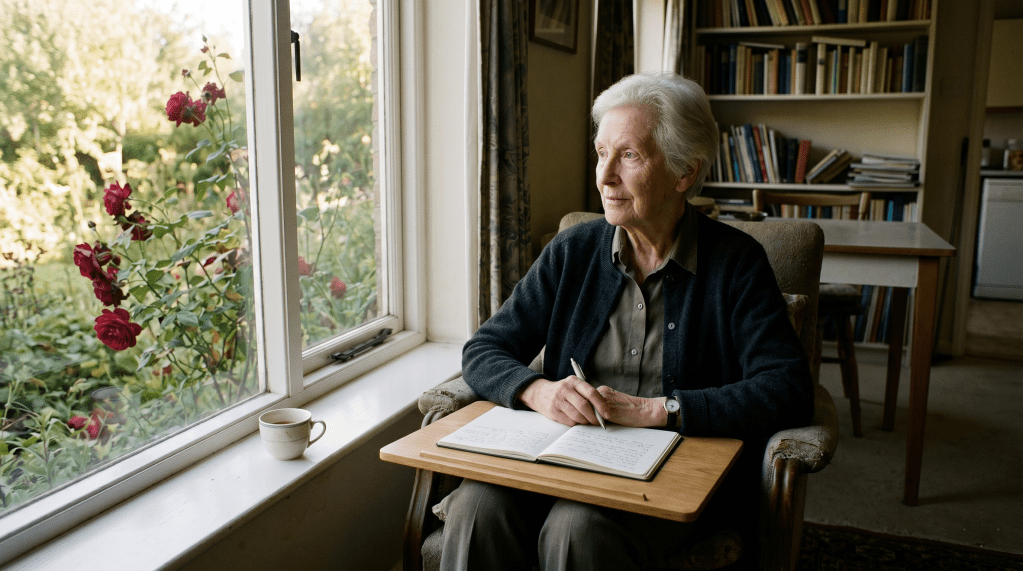
I should explain something first, for the sake of context: I am eighty-one years old, and I have spent the better part of six decades actively avoiding being perceived. I wrote one book. One. It was published in 1966 and it caused what people who enjoy catastrophising called a sensation. It won a prize. Several prizes, actually, though I could never quite remember which ones because I had the habit, perhaps ill-advised, of putting the letters from publishers and literary committees underneath the leg of the kitchen table to stop it wobbling. The table was the more pressing concern.
The book was about a village. About silence, and what silence conceals. About the violence that ordinary people do to one another when they are frightened, and how landscape holds memory in a way that human beings seem constitutionally unable to. The critics called it austere. They meant it as a slight. I took it as the finest thing anyone had ever said to me.
After that, the world wanted more. More books, more of me, more interviews, more appearances, more evidence that I was a going concern, a productive literary enterprise, a name with legs. I went to one literary luncheon. One. A woman in a silk blouse asked me how I found my characters and I told her I found them the way one finds anything – by not looking too hard and having the sense to stay quiet. She didn’t speak to me again. It was the most enjoyable afternoon I’d had in years.
I came back to Oxfordshire. To the house with the low ceilings and the garden that has been consistently defeating me since 1974. I did not publish another novel. This was considered, by some, an act of aggression. A critic wrote a piece about my silence as though it were a kind of theft. As though I had reached into his pocket and removed something that belonged to him. I found this mystifying and then, gradually, quite funny.
I wrote, of course. I always wrote. There are fourteen notebooks in the wardrobe upstairs and they will be burned when I’m gone because they were never meant for anyone else. Writing was never about the publishing, for me. Publishing is just the unfortunate industrial process that writing sometimes has to pass through, like grain through a mill. What comes out the other end may feed people, and that is genuinely good, but the grain itself had no wish to become flour.
So. A superpower.
My first instinct, which I’ll share because honesty is the only style I ever managed, was invisibility. Obvious, for someone like me. Sixty years of dodging journalists and declining invitations and pretending not to be home when the wrong sort of car came up the lane – invisibility would have saved an enormous amount of bother. There were decades when I genuinely envied the hedgerows. Nobody expects a hedgerow to give a statement.
But I’ve been sitting with the question this morning, which is the only thing I’m really fit for these days, sitting and thinking, and I find I’ve changed my mind. Invisibility is just hiding, and I’ve done enough of that. Hiding is the defensive version. What I actually wanted, all my life, was something more precise.
I would want the ability to make other people invisible. Not permanently. Not cruelly. Just the power to draw a curtain around someone when the world came too close. My younger sister, when the newspaper people came to our mother’s funeral, because apparently even that was a public event. A friend’s son, who was gentle and thoughtful and entirely unsuited to being looked at, who had the misfortune of being handsome in a way that made strangers feel entitled. The girl who worked in the post office in the village for thirty years and was kind to everyone and deserved, above all things, to be left alone to be kind.
That is what I would want. Not to be unseen myself – I managed that well enough with ordinary stubbornness – but to throw a cloak over the people I loved when the world got its great blundering hands too close to them.
The world has very little patience for quiet people. It mistakes quietness for emptiness and moves in to fill the space. I spent my whole career – if one book and sixty years of deliberate refusal can be called a career – arguing, in the only way I knew how, that the interior life is not a void simply because it isn’t on display. That restraint is not poverty. That a person can be entire and sufficient and unannounced.
Nobody quite believed me. They kept looking for the second novel as though the first one must have been an accident, a lucky lurch forward, and the real evidence of my worth was still somewhere in the pipeline.
There is no pipeline. There never was.
There’s a garden, mind you. Largely defeated, as I said, but still. The roses have come back this year, which I didn’t expect. They’re the most stubborn things in it, which is perhaps why we’ve always gotten along.
I’m tired now. I’ll stop here.
That’s another thing nobody tells you about dying – it makes you remarkably decisive about when to stop. You stop when you’re finished. Not when the allotted space has been filled, not when someone knocks on the door, not when the form requires three more paragraphs.
When you’re finished.
Which I am.
Bob Lynn | © 2026 Vox Meditantis. All rights reserved.


 Vox Meditantis
Leave a reply to Bob Lynn Cancel reply