What’s your favorite Lord of the Rings character?
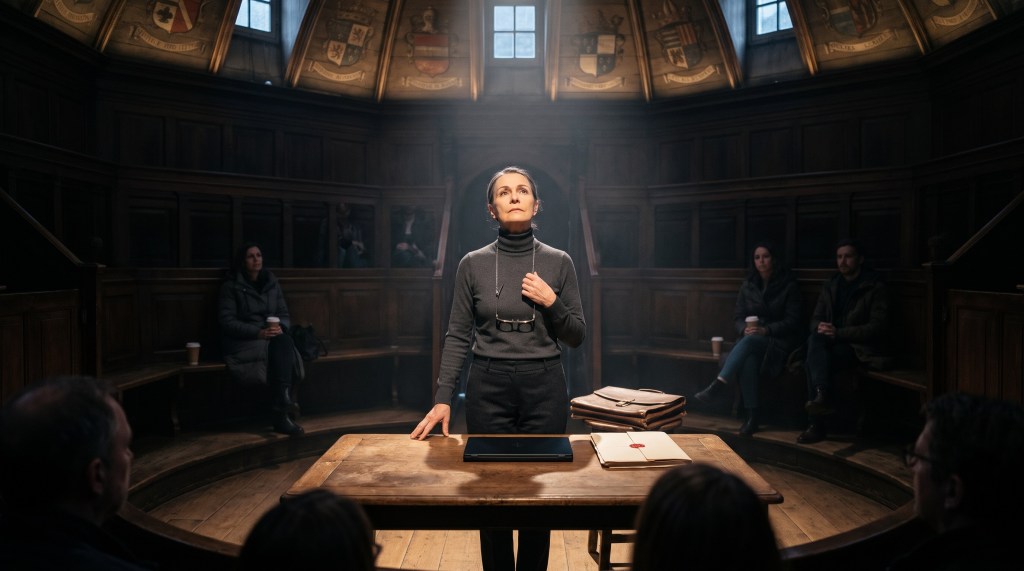
(The high, octagonal timber dome of the Waag Anatomical Theatre holds the damp chill of an Amsterdam November night. Rain drums steadily against the leaded casements above the Nieuwmarkt. At the centre of the circular wooden floor, MARLIES KOVÁČ stands beside the empty oak demonstration table. She has just snapped her black laptop shut after the projector cable betrayed her desktop image for two seconds. In the tiered stalls above, around thirty symposium attendees pause with their wool coats half-buttoned and paper coffee cups in hand. From the shadowy second tier, a clear, familiar voice has just asked the question. Marlies does not scan the circular gallery. She reaches up, slides her reading glasses off the bridge of her nose, and lets them hang from their silver chain against her charcoal turtleneck. Her gaze lifts and locks entirely onto one spot in the second row.)
You have been sitting up there in the dark for ninety minutes while I spoke about cementum annulation in degraded premolars, and that is the question you choose to ask me.
(A quiet ripple of polite laughter moves through the lower stalls. Marlies does not smile, though the corner of her mouth softens by a fraction of a millimetre. Her right hand settles on the bevelled edge of the dissection table, her fingertips tracing the grain of the old wood.)
People in our line of work are not supposed to keep fantasy illustrations behind our encrypted tribunal folders. When the cable slipped just now, half of this room probably assumed they were looking at a seventeenth-century anatomical woodcut, or perhaps a topographic scan of a karst sinkhole outside Srebrenica. Only someone who already knew the crease of that particular spine would recognise Alan Lee’s watercolour of the Houses of Healing from a two-second flicker on a wall.
(She leans back lightly against the oak table, folding her left arm across her waist while her right thumb catches the silver chain of her glasses and begins to roll the fine links back and forth.)
If you ask the junior magistrates at The Hague, or the postgraduates who come through our laboratory on two-month rotations, they will tell you that books about elves and magic rings belong to children who have never smelled adipocere in a waterlogged trench. They prefer their literature severe. So did I, once. Before the summer of nineteen ninety-six, my bedside reading in Bratislava and later in Zagreb consisted entirely of dental morphology atlases and international protocols on the exhumation of unindexed graves.
Then I was assigned to a prefabricated metal tent four kilometres outside Tuzla with a Croatian osteologist who kept a paperback copy of Tolkien inside an empty ammunition tin so the damp would not rot the glue.
(Her thumb stills on the silver chain for a beat. Above her, the gallery goes very quiet, the rustle of raincoats subsiding as the audience realises this is not a standard post-lecture dismissal.)
She read it at night by the light of a paraffin lamp while we waited for the generator to cool down. Back then, I told her it was escapism. She looked over the rim of her tin mug and told me that anyone who spends twelve hours a day sorting the fractured mandibles of fifteen-year-old boys and still thinks Tolkien wrote escapism has never paid attention to how much of that book is about accounting for the dead. When her lungs gave out twelve years ago in a hospital ward in Leiden, the ammunition tin came to my flat, along with everything else she left behind. Including a twenty-year-old student with her mother’s stubborn supraorbital ridge and a habit of sitting in the second row of lecture halls when she wants to ambush me.
(One or two heads in the lower tier turn slightly toward the shadows of the second balcony, then look back down at Marlies, sensing the private current cutting across the public floor. Marlies keeps her eyes fixed exclusively on that single point in the gloom.)
You asked for my favourite character. You already know it is not Aragorn, because I have spent thirty years around men who claim kingship over ruined territories, and they never clean up the rubble themselves. Nor is it Samwise Gamgee, though your mother loved him. Samwise is loyal, certainly, yet his loyalty is clean. He carries his master up a mountain of ash and goes home to plant trees and have children. His hands are never dirtied by an administrative lie.
My devotion belongs to a much smaller, much less comfortable figure. I care for Beregond, Captain of the White Company, First Guard of the Citadel of Minas Tirith.
(She lets go of the silver chain and rests both palms flat against the wooden rim of the demonstration table behind her.)
Most readers barely remember his name by the time the grey ship sails from the Havens. He has no royal blood and no ancient blade forged in Gondolin. He is simply a career civil servant in a silver helmet who stands at a closed door and enforces the regulations of a dying city. Every institution that deals with death relies on people like Beregond. In our world, they are the archivists who check the bar-coded titanium tags on evidence bags, or the odontologists who verify that radiograph four-zero-nine matches specimen four-zero-nine before a family in Sarajevo or Bucha is handed a coffin to lower into the clay. For Beregond, the law of the Citadel is not an abstraction. The law is the only wall standing between an orderly city and the abyss.
Until the morning his Steward loses his mind and orders the servants to stack brushwood around his own breathing son in the street of the tombs.
(Marlies steps forward half a pace, leaving the support of the table. Her posture is erect, almost severe, yet her right index finger taps slowly against her thigh.)
Consider what Beregond actually does in the dark inside that mausoleum. People remember that he saves Faramir from burning. They forget the cost of how he does it. To keep the boy alive until help arrives, Beregond abandons his post without leave, draws his sword inside a consecrated house of the dead where weapons are forbidden by statute, and slaughters the porter and two of his own fellow guardsmen on the stone threshold. He spills the blood of colleagues who were simply following the chain of custody they had sworn to uphold.
When the war is over and the rightful king sits on the marble seat, Beregond is not given a medal. He is brought before a tribunal. Because a violation of the record remains a violation, even when committed out of fierce, terrified love.
(She pauses. In the silence of the old guildhouse, a tram bell rings faintly out on the Damstraat, muffled by the wet stone walls.)
A decade ago, at a dinner in Geneva after the Balkan identification commission wound down its third mandate, a retired Belgian prosecutor sitting beside me drank too much Bordeaux and asked the table what was the worst piece of advice any of us had ever received. People offered the usual professional vanities. Someone mentioned a thesis supervisor who told them not to specialise in mitochondrial DNA. Another cited a ministry director who advised against taking posts in The Hague.
When it came to my turn, I told the prosecutor I had never been given bad advice, because I did not take advice at all. It sounded delightfully cold. The postgraduate fellows at the end of the table wrote it down in their notebooks as if it were wisdom.
(A dry, brief breath escapes her nose – the closest she comes to a laugh.)
It was a lie, of course. I knew the exact sentence that had poisoned my life, and who had spoken it, and the date on the calendar when it entered my bloodstream. It was the fourteenth of November, two thousand and fourteen, in Room Twelve of the academic hospital in Leiden. Your mother could barely speak above a rattle, yet she caught me by the wrist over the steel bedrail and said: “Marlies, you are stronger than she is, so if the roof ever starts to come down on her head, do not hold a family council. Just step under the beam and take the weight yourself.”
(Marlies reaches for the silver chain at her throat again, her thumb and forefinger pinching a single link tightly.)
That was the worst piece of advice I ever received. Not because your mother meant harm by it – she was forty-six years old and dying before she could watch you finish your degree, and she was bargaining with the only coin she had left. The danger of that advice was that it flattered my worst deformity.
I am fifty-eight years old. I know what I am like to live with, and I know what I was like to work under for six years in Lab Three. In forensic odontology, we tell ourselves that perfectionism is a form of piety. If you misread a root canal filling by half a millimetre on an ante-mortem dental chart, a widow in Mostar weeps over the wrong box of calcium. So we become fanatics of the unbroken record. The trouble is that when a woman like me takes charge of a young life, she treats human frailty the way she treats a misaligned maxilla. She does not ask the bone how it feels about being wired shut. She simply reaches in with the pliers and fixes the discrepancy in the dark.
(Her voice drops slightly, losing every trace of the lecture hall, becoming plain and razor-sharp.)
Fourteen months ago, in September of last year, during the re-indexing of the Donetsk railway corridor remains, batch seventeen arrived on our steel tables at two in the morning. You had been awake for thirty-one hours because you were trying to outwork my shadow. When you logged mandible seventeen-B against the digital dental panorama from the Kharkiv clinic, you transposed two digits on the bar-code scanner and signed the chain-of-custody ledger before the secondary verification ran.
By six in the morning, when you came back from the locker room with wet hair and fresh gloves, the ledger showed my digital key-card stamp over the override entry. It showed my cryptographic signature taking authorship of the initial intake scan, and my formal self-report to the Directorate admitting a procedural lapse due to senior examiner fatigue.
(Across the circular stalls, the thirty remaining strangers sit entirely motionless, caught inside an autopsy they were not invited to witness yet cannot walk out on without breaking the air.)
You stood by the sink with a paper towel in your hands and asked me why my credentials were attached to your workstation terminal. Do you remember what I told you? I did not look up from the stereomicroscope. I told you that the Directorate could not fire a thirty-year Chief Specialist over a single typographical discrepancy, whereas they would terminate a junior contract fellow before noon, and that the matter was closed. I would not even let you apologise. I took your error, locked it inside my own personnel dossier like an unlabelled bicuspid in a lead drawer, and expected you to go on eating Sunday dinner at my kitchen table in Scheveningen as though nothing had changed between us.
For six months you tried. Every time I passed your bench and corrected the angle of your callipers, or paid for the wine when we met at the harbour, or asked if you were sleeping enough, I could see the calculation running behind your eyes. I had saved your career by amputating your adulthood. By stepping under the falling beam without your consent, I turned myself from your mentor into your creditor, and I turned your mother’s memory into a lien you could never pay off.
When your resignation letter appeared on my blotter in March with a forwarding address in Brussels, my deputy asked me how you could be so ungrateful after everything I had built for you. I told him to shut the door and mind his own inventory. I knew why you ran. Nobody can breathe inside a museum where the curator owns the air.
(She releases the silver chain of her glasses. Her hands drop to her sides, fingers uncurling slowly until they hang open and still against the dark wool of her trousers.)
What I did not understand until tonight – until the projector cable slipped and you used a dead Oxford philologist to announce across an Amsterdam guildhall that you were sitting forty feet above my head – was the end of Beregond’s trial.
When King Elessar sits in judgment on Beregond for shedding blood in the hallowed place and breaking the law of his office, he does not pretend the crime never happened. To erase the record would corrupt the city they both fought to save. Instead, the penalty is spoken aloud in the hall before witnesses: Beregond must forfeit his rank in the Third Company and leave the Citadel forever, so that the law is satisfied. Then, having stripped the old authority away, the King sends him out to the green hills of Ithilien to serve Faramir not as a jailer or a saviour hovering over a pyre, but as a captain on open ground.
The flaw in your mother’s advice was that she thought love required one person to remain the roof while the other remained a child underneath it. She was wrong, and I was arrogant enough to obey her because I was terrified that if you did not owe me your survival, you would look at an obsessive, sharp-tongued old woman who smells of bone dust and formaldehydes, and decide you had no further reason to call me on Thursdays.
(Marlies turns slightly, reaching onto the oak table behind her. She unlatches her black leather briefcase, pulls out a slim, cream-coloured tribunal dossier stamped with a red archival seal, and lays it flat on the centre of the empty dissection table under the vertical downlight.)
Before I took the train up from Den Haag this afternoon, I sat for two hours with the Clerk of the Registry at the International Commission. The Donetsk railway corridor docket closes permanently at midnight tomorrow for final archival deposit in Geneva. This folder contains Affidavit Nine-Dash-C, signed and notarised at four o’clock today.
It revokes my fatigue attestation from September of last year. In its place, it enters the exact digital timestamp logs from workstation four. It states that Fellow K. Novotná committed a two-digit clerical transposition at zero-two-fourteen hours, caught the discrepancy herself at zero-five-fifty hours, and was prevented from logging the standard six-hour self-correction amendment by the improper unilateral intervention of Chief Specialist M. Kováč, who falsified the override terminal to shield her subordinate from routine administrative review.
(A sharp intake of breath comes from the darkness of the second tier. Down on the floor, Marlies rests two fingers lightly on the cream cover of the folder. Her thumb does not twitch. Her hands are completely steady.)
Under Article Fourteen of the Registry Code, a self-corrected clerical transposition caught within the six-hour window carries zero sanction for the junior fellow, provided the supervising officer admits to the obstruction of the log. As of tomorrow morning at nine, your record at the Commission is not clean because I hid the dirt in my pocket. It is clean because it is accurate. And as of December the thirty-first, having received a formal reprimand for tampering with an active intake register, I am stepping down from the Directorate chair to take an Emeritus research desk in the osteological archive.
(She lifts her chin, looking straight up into the second tier. For the first time all evening, the stoic clinical mask drops away completely, leaving a fifty-eight-year-old woman standing under an old wooden dome, tired and terribly exposed, yet entirely composed.)
Do not shake your head at me up there. I am fifty-eight, my knees ache whenever the North Sea wind comes off the dunes, and frankly I loathe committee meetings with the Brussels procurement board. The archive suits me. More importantly, the truth suits us both.
I am leaving this copy of the affidavit here on the table so you can read the notary seal with your own eyes and verify the chain of custody. You do not owe me your licence anymore, Katka. You do not owe your mother’s ghost a single syllable of obedience. If you choose to get back on the nine-forty intercity train to Brussels tonight and never look back, you will go as a master odontologist whose ledger balances to the last decimal point.
(She slips the reading glasses over her head, folds them neatly, and places them into her briefcase alongside her laptop, snapping the brass locks shut. She lifts the briefcase in her left hand, steps toward the heavy oak exit doors beneath the gallery stairs, and pauses near the threshold, looking up once more into the second tier.)
However, it is raining very hard on the Nieuwmarkt, and the café on the corner by the pharmacy still serves that atrocious sour cherry brandy your mother used to drink when the generator broke down. I am going to sit by the window for forty-five minutes and dry my coat. If a colleague from the Brussels laboratory cares to join me and argue about dental radiography – or about minor guardsmen in Gondor – she may buy her own drink.
(Marlies inclines her head once in a crisp, formal nod toward the gallery, turns, pushes open the heavy timber door, and walks out into the stone corridor, leaving the cream dossier gleaming alone under the single lamp in the centre of the dissection table.)
Bob Lynn | © 2026 Vox Meditantis. All rights reserved.


Leave a Reply