What’s the worst piece of advice you’ve ever received?
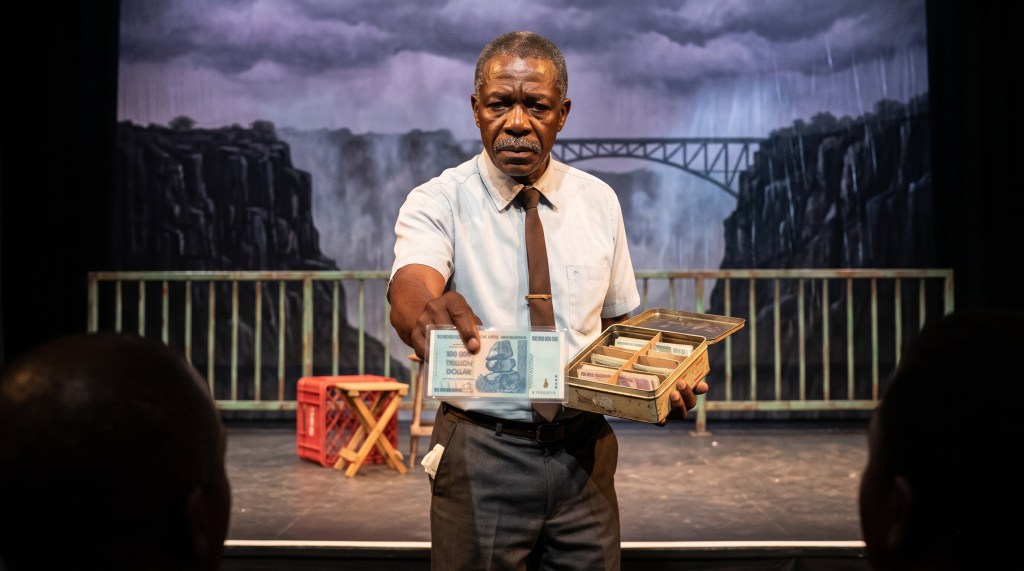
[Late afternoon, Tuesday 24th November 2026. The Zimbabwean approach to the Victoria Falls Bridge. An iron railing runs the width of the stage. Heavy cloud hangs low over the gorge beyond it, and the light is the colour of weak tea. A steady roar rises from below, the sound of a waterfall running thin. Downstage stands a red plastic crate with a rectangular biscuit tin on top, and beside it a folding stool.]
[TENDAI MUPFUMIRA, 63, stands at the crate in a pressed short-sleeved shirt and a narrow brown tie. A faded tie clip holds the tie in place. He is squaring a stack of banknotes against the lid of the tin.]
[A scream rises from beneath the bridge and dissolves into laughter. He does not look up.]
Australian. They always scream as if they have won something. [He taps the stack twice on the lid.] The Germans jump in silence, like men paying tax.
[He looks out at the audience, as if someone has stopped in front of him. His face opens into a practised welcome.]
Good afternoon, my boss. Welcome to Zimbabwe. Is it your first time at the Falls?
[He listens.]
Not the first. Ehe. Then you know already that you have chosen the wrong month. [He gestures behind him without turning.] Look at the Zambian side. Nothing but rock, black like the bottom of a pot. Come in April and this place shouts at you until you cannot hear your own wife. Now it is only clearing its throat. [Beat.] We call October suicide month, because of the heat. November has borrowed October’s coat and is refusing to give it back.
[He fans himself with the stack of notes, then stops, embarrassed, and squares them again.]
Forgive me. One does not fan oneself with money. Even this money.
The rain is late. My wife, Rudo, says it will come tonight. She has been saying so since the second of November, standing at our door every evening with her arms folded like a bank inspector. This morning I came in on the seven o’clock kombi from Chinotimba, and the conductor said the same thing. Up there the clouds are waiting like a queue at a bank where the tellers have gone for lunch.
[He lifts a single note from the top of the stack and holds it up so that the long row of zeros can be seen.]
Now. One hundred trillion dollars. Reserve Bank of Zimbabwe, signed by the Governor himself, Dr Gono, may God forgive him. Uncirculated. [He jerks his head stage left.] That boy by the curio stall, Tinashe, sells photocopies. Printed in some internet café in Bulawayo on paper you could wrap fish with. He is twenty-six years old and calls me Old Man Trillion, and he cannot count change without moving his lips. Me, I sell genuine. [He rubs the note between thumb and finger.] Feel. There is the security thread. Here on the front are the balancing rocks of Epworth, standing one on top of the other, like this country’s promises.
Five dollars.
[He listens. A small, patient smile.]
Three.
[He returns the note to its exact place in the stack.]
My boss, three dollars is what the hotel up the hill charges for a small bottle of water. You drink three dollars and an hour later you are looking for a toilet. For five, you carry a hundred trillion home to… [He looks the man up and down.] …London?
[He listens.]
Reading. Ah, I was close. You have the hat of a Reading man. [He leans in to read the lanyard.] “Roots and Return Heritage Tours.” So you are one of ours. You have come home to see what we did while you were away. [Beat.] We sold the money, sekuru. That is what we did.
[He listens, then raises a hand.]
No, no. Put your phone away, you will finish the battery. You want to know what you are paying per dollar. At three, you pay one US dollar for thirty-three trillion, three hundred and thirty-three billion, three hundred and thirty-three million, three hundred and thirty-three thousand, three hundred and thirty-three Zimbabwe dollars and thirty-three cents. Recurring. [Beat.] At five, it is twenty trillion exactly. A banker prefers a clean number. Recurring is untidy. It is also how this country got into trouble.
[A crash off-stage left. Shrieking, then a woman’s voice shouting in German. He glances over without hurry.]
Baboons. That is the big one with the torn ear. We call him Minister, because he takes what he likes and nobody arrests him. [Beat.] Yesterday he took my lunch. Sadza and covo in a Tupperware. He did not bring back the Tupperware. Rudo grieved more for the container than for the food. Sadza you can always cook again. In this country a Tupperware is an heirloom.
[He sits on the stool with the tin on his knees and lifts the lid. Inside, the notes lie in neat rows divided by strips of cardboard. A single note in a plastic sleeve is taped to the inside of the lid. His voice slows and smooths.]
While you think about your five dollars, let me ask you something. What is the worst piece of advice you have ever received?
[He raises one finger before any answer can come.]
No, keep it. The British always tell me about a timeshare in Spain. For the Americans I usually say the story belongs to my uncle, because Americans like to feel sorry at a distance. But you are one of ours, so for you I will tell it as mine.
[He lays his palm flat on the tin.]
Twenty-four years I worked in a building society in Harare. Mutapa Permanent, First Street branch. Senior teller at counter number one, by the door where the important customers came in. And I had a manager. [Pause.] A man I would have followed into the Zambezi in the rainy season. Big. Not in the stomach. Big in the room. When he walked onto the banking floor, even the ceiling fans turned more respectfully.
2006. Inflation was passing one thousand percent. Clever people were putting their money into cattle and into South African rand under the mattress. My manager called me into the back office and closed the door. Then his hand came onto my shoulder, like this. [He lays his own hand on his own shoulder.] And he said, “Mupfumira. When a ship has trouble, it is the rats who leave. Men stay aboard. The institution looks after those who look after the institution. Keep your savings where they are, and the pension too. Trust the system.”
[He lowers his hand.]
And outside the window, at that very moment, I promise you, it began to rain.
[A long beat. Thunder rolls far off. No rain follows.]
So I stayed. On the thirtieth of June 2006 my savings stood at four hundred and twelve million, eight hundred and six thousand, two hundred and forty dollars and fifteen cents. That August the Reserve Bank cut three zeros, and overnight I had four hundred and twelve thousand, eight hundred and six dollars and twenty-four cents. They rounded my fifteen cents away. Nobody asked me. By 2008 I was standing in the queue at Spar with a carrier bag of notes, and by the time I reached the till, the price of bread had moved. You arrive a rich man and leave a poor man, and still you have no bread. In August 2008 they cut ten zeros, and the following February another twelve. Then they put the money to sleep altogether and we woke up in US dollars, like a man who goes to bed in his own house and wakes in a stranger’s.
Since then we have had bond notes, RTGS dollars, the ZWL and now the ZiG, Zimbabwe Gold, since 2024. Every few years a new money arrives and asks to be trusted, like a new pastor. Rudo keeps the ZiG for the market and the US dollars in her Bible, between Leviticus and Numbers. She says no thief has ever read Leviticus.
[He touches the plastic-sleeved note inside the lid, then takes his hand away.]
In 2015 the Reserve Bank sent word. For balances up to one hundred and seventy-five quadrillion Zimbabwe dollars, they would pay out five US dollars, flat. Five. [Beat.] Twenty-four years at counter number one, and the state looked at my account and said, “Five dollars, Mr Mupfumira, and thank you for your loyalty.” The pension fund wrote me a letter of regret. It was printed on better paper than the money.
[He stands and holds a note out towards the man.]
So that is my price. Not really mine, you understand. The government set it. I am only the cashier. [Beat.] That was the worst advice I ever received, my boss, and this is what it bought. Five dollars.
[He listens. His smile does not change.]
Still three. Ehe, you are a hard man. Show me your three, then.
[He holds out his palm and waits. Then his hand stops where it is. His eyes are on the other man’s hands. The roar of the Falls rises.]
[Very quietly.] You tapped them on your palm. Twice.
[He watches.]
Left thumb under. Fanned out from the corner. You don’t lick your finger.
[He hears something, and his lips move with it.]
“Kunye… kubili…”
[His hand closes. The counting stops.]
Who taught you to count like that?
[He listens.]
Nobody. Of course. You have always counted like that. [The polish has gone from his voice.] A banker who licks his finger is tasting money that is not his. Look at the man, never at the notes. And count in Ndebele, so no customer can rush you.
[He steps closer, peering under the brim of the sun hat.]
Take off the glasses, sekuru. Please.
[A long silence. He straightens.]
Mr Nyathi.
[The tin slips from his other hand. He catches it against his chest, but a spill of notes flutters to the ground at his feet. He does not pick them up.]
Mr Nyathi. Branch manager, Mutapa Permanent, First Street, 1989 to 2008. Signing authority on everything that passed through that building, including me.
[He listens.]
No, you don’t know me. Why would you? Eighteen years, and one pressed shirt looks like another. [He unfastens the tie clip and holds it out on his open palm.] Look. The lion has worn off under my thumb, but read the back. “Ten Years’ Service, 1994.” You pinned it on me yourself at the Christmas function at Meikles. “Mupfumira,” you said, “the fastest thumb on First Street.”
[He waits.]
Tendai. Counter one. [Beat.] Ehe. There it is. Now you see me.
[He refastens the clip. His hands are not steady, and it takes two attempts.]
It did not rain.
[He glances at the sky.]
That day in the back office. I put the rain in afterwards. Americans like weather in a story. It was a dry Thursday and the fan in your office squeaked. There was a Delta Beverages calendar on the wall. Nobody’s hand came onto my shoulder. You said it across the desk while you were signing something, without looking up. [Beat.] Every season I improve it. A story is like a shirt. You press it until it looks better than it was. And you stood here and listened to it, nodding at the sad part. Three dollars, you offered me for it.
[He bends, picks up one fallen note and holds it without putting it back.]
Do you remember Highfield? The Methodist church, the fourteenth of December 1991. You were best man. My brother was meant to stand, but he was coming from Botswana and his bus broke down at Plumtree. So you borrowed a jacket and stood at my right hand. In your speech you said a marriage is like a savings account: deposit more than you withdraw. Everybody laughed. Rudo still has the photograph on the wall unit, the two of us with carnations, and you holding the ring box like a cash box.
And in 2003, when Chipo got her place at Waddilove and I could not find the fees, you called me into that same office. An envelope was waiting on the desk. One hundred and sixty-two thousand dollars, term two. “Pay me when the country is better,” you said. [Beat.] I have been waiting for the country to be better, Mr Nyathi. Twenty-three years now.
[He listens.]
Chipo is a nurse at Mpilo, in Bulawayo. Half her class went to England, to Birmingham and Leeds. Perhaps some to Reading, who knows. Our best maths teacher at Chinotimba High is teaching other people’s children in Leicester. Chipo stayed. Stubborn, like her father.
[He listens. His jaw tightens.]
Rudo is well. She is at home, waiting for the rain. [Beat.] She thinks you are a good man. I never told her otherwise, nor anybody at church. Eighteen years I have kept your secret for you, like a deposit in a safe box. Nobody comes to collect it, and still I pay the rent.
[He turns the fallen note over in his fingers.]
In 2011 I went to a funeral in Glen View. Mai Dube’s husband. You remember Mai Dube, foreign exchange desk, the one with the red spectacles. After the burial she sat beside me under the tent and said, “Tendai, you knew the boss was sending US dollars to London from 2005? Every month, through my desk. A UK account in his wife’s maiden name.” She thought I knew already. Everybody knew, she said, and she laughed. [Beat.] I did not know.
In 2006 you told me to stay on the ship. You were already in the lifeboat, with your name painted on the side. And in May 2008 you flew to Heathrow for a conference and never came back. We kept your desk for six months. Your plant died on it.
[He listens. He shakes his head slowly.]
A family. Ehe. Children to think of. [Beat.] Everybody had a family, Mr Nyathi. Even the rats had families.
[Silence. He waits. Nothing comes. Distant thunder.]
Nothing? Twenty years you could talk any customer out of closing his account, and now nothing.
My grandmother in Murehwa used to say the ngozi of a wronged man will not rest until the wrong is paid. It sits on the family of the one who did it, generation after generation. [He glances off towards the bus.] Those are your grandchildren? [Beat.] Do not worry. Ngozi is a spirit of the dead, and I am not dead. Nobody needs to send a spirit after you, because I am standing here myself, in a pressed shirt. We have a saying. The punishment for ploughing on the sacred day does not come on the day you plough. It waits, and arrives when you are old and wearing linen trousers on a heritage tour.
[He sits heavily on the stool.]
And now I must say the rest, because my class meets at seven tonight and I cannot stand before them with half a ledger. I was a senior teller. Every morning the queues went round the block on Samora Machel Avenue, and I watched them. A banker who cannot see that his bank is falling is not a banker. He is furniture. [Beat.] You gave me the advice. But I wanted it. It is easier to trust than to know, and when a man is afraid, another man in a good suit telling him to stay where he is gives great comfort. I bought your advice, Mr Nyathi. Nobody forced it on me. That part is mine.
Our Lord tells of the servant who buried his talent in the ground, and the master cast him into outer darkness. Mine was not buried. I handed it to the master for safekeeping, and the master took his own talents to Reading. [Beat.] Joseph stored grain in the fat years, but he stored it for Egypt, not only for his own house.
[He looks up sharply and rises.]
What is that? [He stares at the man’s hand.] Hundred-dollar notes. US. Crisp ones. You always liked them crisp. [Quieter.] Put it away, Mr Nyathi.
[He does not move towards it.]
Away. Do you think I am a beggar at the robots on Jason Moyo? In 2003 you gave me an envelope because you were generous, and I received it with both hands, the way my mother taught me. Today, if you give me a hundred dollars, it is because you are ashamed, and I do not sell shame. It is not in the tin. [He taps the lid.] Notes only. Genuine.
[He catches himself and lowers his eyes, a small reflexive dip of the head.]
Forgive me, Baba. I should not raise my voice to an elder. [He lifts his eyes again.] But I will not take it.
There is a steward in Luke sixteen. His master is about to dismiss him, so he calls in the debtors. “How much do you owe my lord?” “A hundred measures of oil.” “Sit down quickly, and write fifty.” He cuts their debts to buy himself friends, and the master commends him, because the children of this world are in their generation wiser than the children of light. [Beat.] Eleven years at this railing I have thought about that steward. Today I am going to do the opposite.
[He gathers the fallen notes one at a time and wipes each one on his trouser leg. He finds each note’s place in the tin by its serial number.]
The price is five dollars. Not three, and not a hundred. Five, the honest price, the price the state put on my life. You will pay it like any other tourist.
[He holds out his palm and waits. Money is placed in it.]
[He taps the notes twice on his palm. Then he fans them with his left thumb from the corner, the way he was taught.]
Poshi… piri… tatu… ina… shanu.
Five. Correct.
[He folds the money into his breast pocket and buttons it shut.]
[He takes a note from the top of the stack and holds it out.]
One hundred trillion dollars. Your souvenir.
[He does not let go until it is taken.]
[He turns the lid of the tin towards himself and peels the plastic-sleeved note free of its tape.]
This one is not for sale. Serial number AB 4471906. In January 2009 I went back to First Street, to my old counter, and closed my account. A girl I had trained myself served me. What was left of the savings, together with the little the pension fund had paid out, came to one note. This one. [He holds it up.] My pension, Mr Nyathi. Seventeen years I have carried it.
Chipo’s school fees. Term two, 2003. One hundred and sixty-two thousand dollars. [He holds the note out.] Here is one hundred trillion. And do not tell me about the zeros they cut in 2006 and 2008. I know about the zeros. I crossed them out of the ledgers myself, with a pencil. Today we use face value. At face value I have overpaid you by ninety-nine trillion, nine hundred and ninety-nine billion, nine hundred and ninety-nine million, eight hundred and thirty-eight thousand dollars. [Beat.] Keep the change.
[He waits, arm outstretched. At last the note is taken. His hand stays out a moment longer, empty.]
You told me to trust this money, so I am paying you in it. It is the currency you recommended, Mr Nyathi. I would not insult you with any other.
You see, advice is a cheque. It is only good if the man who writes it keeps his own money in the same bank. Yours bounced. [Beat.] But listen now, because I will not say it twice. What I gave you was real. All those years at that counter I was loyal, and that was not foolishness. That was mine. I keep it. You cannot have it back, and no Governor can cut zeros from it. What you gave me, I am giving back. It is there in your hand, with the Governor’s signature on it.
[He draws a small notebook from his shirt pocket. With a pencil he writes a line and rules it off.]
Paid in full, and the account is closed.
[Off-stage, a child’s voice calls: “Grandpa! Grandpa, come on!”]
[Further off, the tour guide: “Mr Nyathi, sir! The bus is leaving!”]
They are calling you, sekuru. [He steps back from the railing to let him pass.] Go. Tell them you bought a souvenir from an old man at the bridge. It is the truth. [Beat.] And tell them the Falls were low. Let them come back in April and hear what they missed.
[He bows his head slightly, hands pressed together, the way a younger man greets an elder.]
Fambai zvakanaka, Baba. Go well.
[He watches the man go. A bus engine starts and pulls away.]
[Thunder, close now. A single heavy drop strikes the biscuit tin with a hollow knock, then another. He looks at the lid, then up at the sky.]
Ehe. Rudo was right. [Beat.] She will tell me so tonight. Twice.
[The rain begins in earnest, hissing on the iron railing. Behind him, the roar of the Falls deepens. He squares the stack inside the tin until the edges are flush and closes the lid. Then he wipes it dry with his handkerchief.]
[He turns downstage towards someone new, and his face opens into the practised welcome.]
Good afternoon, my boss! Welcome to Zimbabwe. You have brought the rain. [He lifts the tin.] One hundred trillion dollars, genuine, uncirculated. Five dollars.
[He holds the smile as the rain comes down. Blackout.]
Bob Lynn | © 2026 Vox Meditantis. All rights reserved.


Leave a Reply