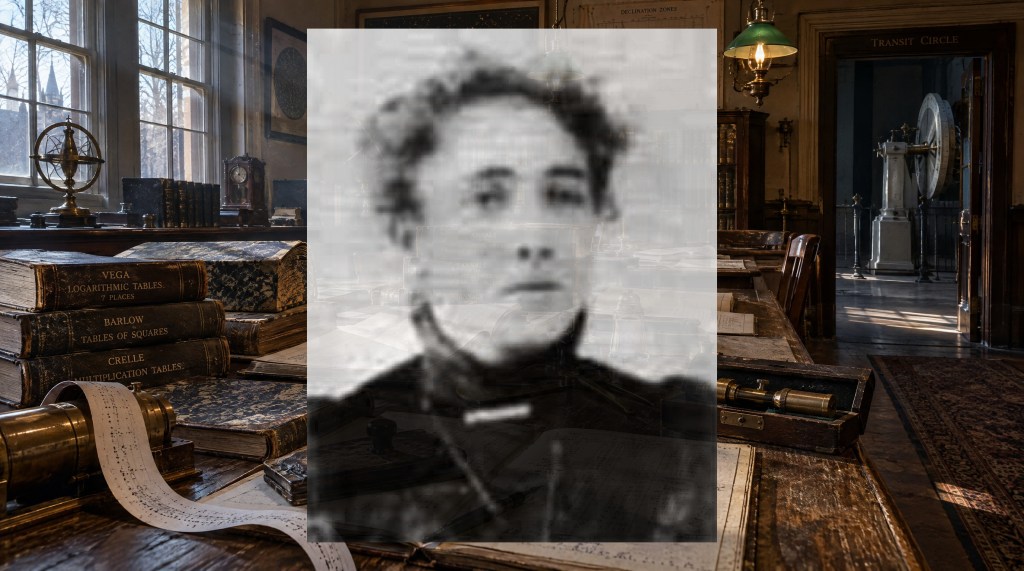
This interview is a dramatised reconstruction: Anna Winlock never gave it, and the woman speaking here is built from documented facts about her life and work, interpreted through the social and technical constraints of her era. The dialogue, the interviewers and their questions are invented; the dates, salaries, catalogues, institutions and archival records behind them are not, and are cited in the full note on method.
Anna Winlock was born in Cambridge, Massachusetts in 1857, the eldest daughter of Joseph Winlock, third director of the Harvard College Observatory. When her father died suddenly in 1875, leaving the family without a pension, she went to work at the observatory that same year at twenty-five cents an hour, reducing astronomical observations by hand. Over the following twenty-eight years she directed the reduction of the Harvard zone of the Astronomische Gesellschaft Katalog (AGK), co-published a catalogue of polar stars that resolved coordinate singularities near the celestial pole, and computed the orbits of two minor planets – including 475 Ocllo, whose extreme eccentricity she was credited with rescuing from loss.
Interviewer: Anna, welcome. Before we get anywhere near the telescope, I want to put a piece of paper on the table between us. It’s a payroll entry from 1875, Harvard University Archives, and it says twenty-five cents the hour. There’s a note beside it in the same ledger where a male assistant is carried at fifty. I’ve been staring at that margin for a week, and I keep wanting to ask you something about it, and I keep not knowing how to ask it without being the hundredth person to do so.
Anna Winlock: Then ask it plainly and let us both be done with it.
Interviewer: Was it insulting?
Winlock: It was arithmetic. I could do the work and I needed the money, and those two facts met. Whether the figure was just is a question I put to myself about once a year, generally in February, and then I went back to the tapes. I don’t say it was right. I say I didn’t sit at that table composing grievances. There were twenty thousand transits waiting and no one else to take them.
Interviewer: All right. Then let me start further back. There’s a story that gets told, that you walked into the observatory in late 1875 and offered to finish your father’s reductions. Is that what happened?
Winlock: It is not, and I’m glad you asked, because that story has been repeated so often that I’ve begun to feel like a stranger in it. What happened is that my mother wrote to the observatory, and I went with the letter. Professor Searle had a difficulty and I was a solution to it. He could not take on a young man at the rates a young man expected – the funds would not bear it – and he had my father’s ledgers sitting in the west wing going soft with dust. I was eighteen by the calendar and I knew the instruments by name before I knew them by use, which is a particular thing. I had read the tapes over my father’s shoulder since I was small enough to be lifted to the table.
Interviewer: So the romantic version – the daughter arriving to redeem her father’s unfinished work – that’s wrong?
Winlock: It is incomplete, which is worse than wrong, because an incomplete thing sounds true and then gets told forever. There was affection in it. I won’t pretend otherwise. I had been in the transit alcove at Shelbyville when I was eleven years old, in 1869, watching my father’s party set their instruments for the eclipse, and I had seen what the corona looked like through a spectroscope and understood almost none of it. That gives a child a certain direction. But I did not go to the observatory to be a monument to my father. I went because the household required income and I had the one skill in the world that the household’s chief creditor happened to need.
Interviewer: Let me pull the thread on that. Where did the skill come from? Most women of your generation, in your circumstances, got natural philosophy and a little botany.
Winlock: I got trigonometry, and I got it early. Cambridge High School, and a principal who thought a girl could carry Greek and spherical trigonometry in the same head without damage – which was not a common opinion. I graduated in April of 1875 and he wrote me a commendation that praised my languages. He was correct about the languages. He was shy about the mathematics, and I’ve always suspected he didn’t quite know what to make of it.
But the real instruction was at home, and it was unmethodical, which is to say it was practical. My father taught me to use a table of logarithms the way a carpenter teaches a plane – as a tool you learn by the shavings. Seven-place tables. Vega for the logarithms, Crelle for multiplication, Barlow when I wanted squares and roots without thinking. Then coordinate systems: how a star’s place is stated, why it must be stated for an epoch, why the equinox is a moving target and not a fixed post. Then the transit circle errors, which was the part I loved and which nobody teaches a child, because a child can see the geometry of it. If the optical axis is not square to the rotation axis, the star crosses the wrong place on the wire. That is a picture. You don’t need a course.
Interviewer: And he taught you this knowing what you’d do with it?
Winlock: He taught me because I asked and because he was generous with a table of logarithms and short with everything else. He did not imagine me at the observatory. He imagined me married, I expect, and I’ve never held it against him, because he died in June of 1875 before either of us found out what he thought.
Interviewer: I’d like to do something a little unusual. Can you take me through a single star? Not the philosophy – the steps. Start with the moment the star crosses the wire and end with the number that appears in the Annals. Assume I know what a declination is.
Winlock: Very well. Then I’ll be particular, because the particularity is the whole of it.
First, the observation. Professor Rogers is at the circle in the dark. The star comes up the field and crosses a reticle of vertical spider threads, and he watches for the moment of bisection. He presses the key, which sends a galvanic mark onto the chronograph paper, and the clock is marking its own seconds on the same tape all night. Meanwhile the star’s altitude is read at the graduated vertical circle by four micrometer microscopes set ninety degrees apart, and the four readings are averaged together because that arrangement cancels the eccentricity of the circle and a good deal of its division error.
Second, I read the tape. The distance from the nearest clock mark to the star’s pen mark, measured with a scale glass and a magnifier, and taken to the tenth of a second of time. A tenth of a second of time is one and a half seconds of arc in right ascension, so that tenth is where the entire business lives. I read the tape at the beginning of the pen mark, not the middle. The pen dwells, and the dwell is not the same in January as in July, and if you take the middle you are reading the room’s temperature and calling it a star.
Third, the clock. Our sidereal clock was compared against the standard, by telegraphic signal when the wires were good and by the transit of a fundamental star when they weren’t. That gives a correction – how fast or slow the clock ran against the true sidereal rate at the moment of observation, and the rate of that running. A clock that loses two-tenths and accelerates across the night will give you a different answer at eleven o’clock than it did at nine, and you must know which answer applies to this star.
Fourth, the instrument’s faults, which are four and must be measured every night.
- Level: the east end of the axis may sit higher than the west. We found that with a hanging spirit level, and by pointing at the mercury horizon for the nadir.
- Azimuth: the instrument may be rotated a hair off the true meridian. We got that from circumpolar stars, observing them at upper culmination and again at lower culmination twelve hours later, where the same error shows opposite signs and can be solved.
- Collimation: the optical axis not square to the rotation axis – measured with the horizontal collimators north and south, and then adjusted, because we are not stationary observers. We are being carried eastward by the Earth’s turning, so the light arrives leaning, which throws about three-tenths of a second of arc into the raw collimation constant before you’re done.
- Flexure: the tube and the circle sag under their own weight, more when the instrument is pointed low. You find that by comparing collimator pointings to nadir transits and watching the two disagree when the tube is tipped.
Fifth, the reduction of the transit to the meridian. This is Mayer’s formulation and it is not one correction but four terms that must be carried separately. The level term is fairly tame. The azimuth term grows with the tangent of the declination. The collimation term grows with the secant. So a star at twenty degrees north of the equator is a comfortable piece of arithmetic, and a star at eighty-eight degrees north is a different animal entirely, which is the point I’ll come back to.
Sixth, the declination. The four microscope averages give the circle reading for the star. Each microscope has a screw error that varies along its own travel – the thread is not perfect over its length – so each has its own calibration table, and I applied it microscope by microscope before averaging. Add to the resulting apparent zenith distance the refraction.
Seventh, refraction. Bessel’s formulation, with the two coefficients tabulated in the Tabulae Regiomontanae and then scaled by the barometer and the thermometer. At the zenith this is nearly nothing. At forty-five degrees altitude it’s about a minute of arc. At the horizon it is over half a degree – the sun’s own width – which is why a star apparently setting is not where it looks as though it is, and why I’d rather have a good barometer reading than a good intention.
Eighth, from apparent to mean. Precession moves everything about fifty seconds of arc a year, which sounds small until you recall the catalogue spans twenty-five years and the equinox has walked a fifth of a degree in that time. Nutation adds a further wobble of about nine seconds, with a period of eighteen years and a fraction. These go through the Besselian star numbers for the epoch and the star constants, which are simply functions of the star’s own place, and the entire thing is then carried to the standard epoch by expansion rather than by a single multiplication.
Ninth, the check. Every star is observed more than once. The reduced positions are differenced against one another and against the catalogue in hand. If the residuals are large I re-reduce, and if they’re repeatedly large I go back to the tape and consider that either the instrument misbehaved or I did.
Tenth, the entry. And it goes in the ledger in ink, with my initials, and eventually into the Annals, and a person two hundred miles away who has never heard of me uses it to point a telescope.
Interviewer: The ninth step is the one nobody writes about.
Winlock: The ninth step is where the work actually is, and it is the one that leaves no trace in the published page. Any competent person can apply a formula. Sitting with a column of numbers that disagree with each other, and knowing which one to distrust, is the trade.
Interviewer: Let me pick at step five, because you flagged it. You said a star at eighty-eight degrees is a different animal. That’s the polar catalogue, isn’t it – the 130 stars.
Winlock: It is. And this is the piece of my work I’d defend hardest, so you’ll forgive me if I’m longer about it than the rest.
The differential method – take the star’s tabulated place, apply the small changes from precession and nutation as linear corrections – that method is exact in spirit and approximate in practice, and it is superb in practice for a star anywhere near the equator. The star constants that carry it are built from the tangent and secant of the declination. Within three degrees of the pole, those functions run away to infinity. Not figuratively. The tangent of eighty-eight degrees is enormous and at eighty-nine it is worse, and a formula whose coefficients are enormous will multiply every small error in the star’s own assumed place into a large one in the answer. You are then no longer computing an improvement. You are amplifying your ignorance.
And it compounds, because I was not reducing one epoch. I was collating observations from Bessel, from Struve, from Argelander, from Pulkovo, spanning 1860 to 1885. Twenty-five years. A linear pretence over twenty-five years near the pole is not a small lie.
Interviewer: So what did you do instead?
Winlock: I abandoned the differential method for those stars and computed the positions directly as spherical problems – the reductions as rotations of the sphere, applied exactly, rather than as linear adjustments to a number. Where a series had to stand in for a rotation, I carried it out to third order in the small quantities rather than cutting it at the first term. Third order rather than first, because in the polar region the second and third terms are not decoration, they are material.
Then, because motion and epoch were tangled together, I computed proper motions for sixty-eight fundamental polar stars directly rather than assuming them. And I made yearly ephemerides for everything within three degrees of the pole, so that a future observer could lay his instrument by my numbers without repeating the whole reduction.
Interviewer: What did it cost you in labour?
Winlock: A great deal, and I would do it again. The saving was a different kind. Had I forced the differential method, I’d have produced numbers quickly and they’d have been wrong in a way that would look right on the page – small, tidy, plausible. The rigorous method takes longer to set up and then behaves. There is no version of that trade where the cheap answer is the scientific one.
Interviewer: And Professor Rogers’ preface to that volume – I want to read it back to you, because it’s the sentence that has kept you in the footnotes of other people’s footnotes. He wrote that his connection with the work “is limited to the methods of discussion adopted, and to an examination of the numerical results obtained.”
Winlock: He wrote it, and he meant it, and he was under no obligation to write it at all. I’ve heard it held up as a strange remark. I don’t find it strange.
Interviewer: It didn’t hold, though. The monograph is still catalogued under his name in a great many libraries.
Winlock: That is a fault in the cataloguing and not in the man. He said the true thing while he was alive, which is more than most did, and a library card written by a person who has never opened the book can undo twenty years of candour. I’ve made my peace with it in the sense that I have no other option. It is a poor advertisement for the value of honest prefaces, though.
Interviewer: The Cambridge zone. Give me the scale, because I think people hear “catalogue” and picture a pamphlet.
Winlock: Between the equator and twenty degrees of north declination, for the epoch 1855.05. Professor Rogers took more than twenty thousand transit observations across eight thousand six hundred and twenty-seven stars down to the ninth magnitude. Those observations came in from 1870 onward – five years of them sitting behind my father’s estate before I ever reached the table. I directed the reduction of the whole. Every star needed individual night corrections, because every night has its own collimation and its own azimuth and its own barometric weather, and you cannot carry a week’s worth of nights under one set of constants without burying a real signal under an instrumental one.
Interviewer: That’s the part I think readers will feel. It’s not a discovery. It’s a quantity of correctness.
Winlock: That is exactly it, and I want to say it plainly because I think it is the one thing about my working life that has been most thoroughly misunderstood. There was no moment in the Cambridge zone where a person could stand up and say I have found the thing. There was only the accumulated removal of error until the numbers could be trusted. The astronomy of position is a service. It is the grid you lay down before you can say where anything is. The Carte du Ciel, the parallax work, the orbit of any comet you care to name – all of it presumes a coordinate frame that somebody had to build by sitting still for two decades.
Interviewer: Boring work, then?
Winlock: It is the least boring work in the world if you are built for it, and the most boring if you are not, and I have never been able to determine which of those is the more honest description. There is a particular pleasure in a column of residuals that squares to something. I couldn’t put it on a page for you.
Interviewer: You said earlier that the ninth step is the real work. Tell me about a time the ninth step caught you.
Winlock: Twice, and you may have both.
The first was a level error I did not catch for the better part of a season. The bubble sat properly and I trusted it, and the residuals were small enough that I attributed them to weather. What I had not allowed for was that the instrument’s footing moves with the ground, and the ground at Cambridge swells and settles with the frost. My collimation and level comparisons in July did not agree with February’s, and I had been averaging across the year as though the foundation were a fact of nature. I went back over the affected portion of the zone and re-reduced it. It cost me a great deal of time in a period when I had none. What I took from it is that a constant is only constant over the interval you can defend, and I have been suspicious of seasonal averages ever since.
The second is worse. When the orbit of Ocllo first came out of my hands, the eccentricity was so large that I did not believe it. Minor planets were round, well-behaved things in those years, on the whole, and the number I was looking at said otherwise. So I sat on it. I recomputed the sector-to-triangle ratio from a different starting assumption. I re-reduced the three positions from the plates. I think I wanted it to be my error rather than the sky’s irregularity, because a wrong eccentricity would have been mine and a right one would have been nobody’s fault. It took me the better part of a week to accept what I had.
Interviewer: That’s not a small thing to admit.
Winlock: It’s not an admission, it’s a description. I have no interest in being thought of as having been certain from the first. I was not. And there’s a lesson in it for anyone doing this work: the temptation to doubt a surprising result is stronger than the temptation to doubt a comfortable one, and the second temptation is the dangerous one because it never announces itself.
Interviewer: Let me put a period objection to you, then. There were directors in your own time – and Pickering was not the least of them – who argued that photographic astrometry would make meridian cataloguing obsolete. The plate would do the work faster, and the machine would not fatigue.
Winlock: And they were right about the plate and wrong about the term. Photographic methods won, of course. The Carte du Ciel proved that a plate can carry thousands of stars at once, and my colleague’s work on the Arequipa plates was not a curiosity – I used those plates myself for Eros. But a plate measures relative places on a small field. It does not by itself fix the frame. Somebody has to determine the frame, and the frame was what the meridian circle did. In 1890 I would have said the photographic method could not reach the precision we needed and I would have been right for about that decade and increasingly wrong after it. I was slower to see the coming change than I might have been. I don’t defend that. I was occupied.
Interviewer: Is that a fair self-criticism, or are you being hard on yourself for the sake of it?
Winlock: It’s fair. I was the observatory’s senior authority on coordinate systems by then, and if I had spent a tenth of the energy I gave to polar star constants on the question of how photographic plates could be tied into a fundamental frame, I might have got there four years earlier. It’s the one place where being occupied with finishing the past cost me the future, and I’ve no way to know whether it cost anyone else.
Interviewer: There’s a related charge I want to raise – that the entire zone enterprise was heterogeneous. That every participating observatory reduced to its own system, and the resulting catalogue was a patchwork pretending to be a whole.
Winlock: That charge has merit and I’ve never pretended otherwise. Every zone was observed with a different instrument by different hands and reduced with its own constants, and when you lay them end to end, the seams show. The proper motion of a star near a boundary can differ from one side of the line to the other, and the reason is not the star. I spent a great deal of effort harmonising our series onto the Publication 14 system to reduce exactly that, and I reduced it. I did not eliminate it. Anyone who tells you the AGK was seamless is reading the title page and not the tables.
Interviewer: And the more personal critique from your own era – the one the director offered to donors. That women had a natural patience and an aptitude for routine.
Winlock: I have heard that said. I would put it this way. I have known men with a great deal of patience and women with none at all, and the question of aptitude never came up in the computing room, because the work selected for it ruthlessly. If you could not do it, you did not last the quarter. In five years Miss Fleming had built a department out of that room, and Miss Cannon went on from it to put a quarter of a million stars into an order nobody had thought of. Patience does not produce that. That is a mind at work, and if the Director wished to call the mind patience, the Director was writing to the Corporation and not to history.
Interviewer: Describe the computing room. I don’t want the architectural record. I want what you’d notice walking in.
Winlock: Long wooden tables, and on them heavy paper ledgers, and on the ledgers a great deal of my own handwriting going back to 1875. High windows along the wall for the daylight, which is good light for reading a tape and bad light for reading it three hours in when the sun has moved. Gas lamps in the evening, which give a fine steady flame and a headache with it. Ink. A smell of paper and lamp. In winter, the transit alcove unheated, so that your hands are stiff by the time you’ve made the pointing, and stiff hands make sloppy readings, and you learn to work the scale glass fast.
Interviewer: And the hours.
Winlock: Six days, seven or eight hours, and often longer when a volume was going to press. Twenty-eight years, from the autumn of 1875 to December of 1903, with a gap in nothing.
Interviewer: Who was in the room with you?
Winlock: Miss Saunders and Miss Rogers when I began, both of them a little before my time in the hiring but not by much. Miss Selina Bond came in 1879, and she had a claim on the place older than any of us – her father was the observatory’s first director and her brother the second – and she had come, as I had, because a family needed income. My sister Louisa joined in 1886 and stayed twenty-nine years, and she read my proof sheets, which is a service I would not wish on an enemy and which I depended upon entirely. Miss Fleming came in 1881 and was running the room within a few years.
Interviewer: Was there rivalry?
Winlock: There was territory, which is not the same thing. Miss Fleming had the photographic work and the spectroscopists, and it grew enormously and very fast. I had the meridian and the orbit work and the coordinate systems. We were both busy. The popular accounts like to make us a company of sisters and they also like to make us a company of rivals, and neither tells you what it was like to be at a table at four o’clock on a February afternoon with a column that would not close.
Interviewer: That’s a remarkable thing to say about a room full of women who were paid half what the men were.
Winlock: I was not a martyr and I should like the record to be clear on that point. I was well occupied, and the work was real work, and I did it as well as it could be done, and I had the only scientific position of consequence that the world was going to offer me. All of that is true at once. If you make me solely a victim you have taken away the thing I actually did, and if you make me solely content you have taken away the thing that was actually wrong. I am not available for either story. I’m sorry to be inconvenient.
Interviewer: You’re not inconvenient, you’re just not usable.
Winlock: Yes. That is precisely the difficulty with me, and with Miss Bond, and with a dozen others, and I expect it always will be.
Interviewer: I want to give you at least one question that isn’t about hardship. Eros.
Winlock: Eros was a lovely problem because it was a finding problem and not a reducing problem. It was discovered in 1898, and by the time the news reached us it had already been seen, of course, and nobody knew for how long. A minor planet that comes near the Earth is worth a great deal to anyone trying to measure the Sun’s distance – you have a long baseline and a bright object and you can do the geometry. So the question was whether we had ever photographed it before anyone knew what it was.
Interviewer: And you did.
Winlock: There were plates from 1893, 1894 and 1896 in our collection that could have caught it. I measured the plates, converted the micrometer readings into equatorial coordinates, worked out the plate constants for each exposure – which is its own exercise, because the emulsion and the optics each introduce their own distortions, and a plate is not a flat piece of sky no matter how much you wish it were – and then corrected for refraction and for the distortion. The positions went into Circular 51 in 1900. What they were good for was the orbit. If you can pin the object’s place three years before anyone was looking at it, you have a much longer arc, and a longer arc means a better-determined orbit, and a better orbit means a better solar parallax.
Interviewer: Were the plates cooperative?
Winlock: The 1893 plate was a nuisance. There was a mark in the field that I first took for an emulsion fault, and I nearly passed over it. I came back to it because the shape of it was wrong for a fault – it had a faint direction to it, a slight trailing, which is what a moving object leaves when the clock is driving at sidereal rate and the object is not keeping sidereal time. That trailing is the only reason I looked twice.
Interviewer: That’s not in the record anywhere.
Winlock: No, and it ought to be, because it is the whole of the method. Looking twice at an inconvenient mark.
Interviewer: And Ocllo.
Winlock: Discomforting, and the one I’m known for. It was found in the summer of 1901 on plates from Arequipa, with the Bruce telescope, and its motion was strange enough that a few people noticed. I had three positions and an arc of days, which is nothing – determining an orbit from a short arc is one of the genuinely hard problems in the field, and the classical methods of Gauss and of Olbers both proceed by assuming a shape for the object’s path and then correcting that assumption against the observations. The correction factor is a ratio of areas – the sector the object swept against the triangle drawn from the three positions – and it must be iterated until it stops changing. For an ordinary, well-behaved minor planet it settles in a few rounds.
Interviewer: And for this one?
Winlock: For this one it did not settle, because the eccentricity was very large and the object was near its perihelion, and under those conditions the iteration wanders instead of converging. So I did not iterate blindly. I first established the boundaries of the ratio from the geometry of the extreme cases, so that I had an interval the answer had to lie in, and then worked inward from both ends. That is the tweak, and I don’t believe it’s written down in the circular. It is the sort of thing one does and doesn’t publish, because the published result is a set of elements and not a description of how one’s hands moved.
Interviewer: Give me the numbers.
Winlock: The eccentricity came out just under six-tenths, with a perihelion distance a little over one astronomical unit – the highest eccentricity then known for a minor planet. I derived the full set of elements: the semimajor axis, the inclination, the node, the argument of perihelion, and the time of perihelion passage. And then I computed an ephemeris, which is the part that actually mattered, because the ephemeris showed the object heading north into the view of northern observatories. That is what saved it. Without a predicted position it would have been a plate, a set of coordinates, and then nothing. The value of an orbit is not that it is elegant. It is that it tells someone where to look.
Interviewer: Pickering credited you by name in the circular.
Winlock: He did. And the papers picked it up, which was unusual, and for a fortnight I was a small public curiosity, which I did not enjoy at all and which I would not trade away, because it is the only occasion on which the work and the name were joined in public while I was alive to see it. I have no complaint about the Director on that count, and I want to record that, because he has been made into a villain by people who were not there and who have not read the annual reports.
Interviewer: Last stretch. What would you say to a young woman starting a scientific career now, with the enormous caveat that the world you’d be saying it into is not the world you knew?
Winlock: I’d say the same thing I’d say to a young man, and then I’d add one thing for her.
To either of them: learn the instrument. Not the theory of it – the instrument. If you cannot find the error in the machine with your hands, you will not find it in the numbers, because the numbers are the machine talking. I have spent my life listening to a piece of brass and I have never once regretted knowing what it was doing.
Then to her, I would say this. You will be told that the part of the work you are given is the modest part. Believe the part about modesty, if it makes the day pass, and don’t believe it about the work. Whatever they hand you, find out what it actually requires. I was handed a column of logarithms and it required spherical trigonometry at third order and a comprehension of the Earth’s rotation, and the person who handed it to me did not know that, and I did not tell him for some years, because there was no occasion to and because I was busy. That was a mistake, in its way. If I had told him earlier what the work required, the wages might have been different, and the record certainly would have been.
Interviewer: Would the wages have been different?
Winlock: No. Probably not. But I would have said it out loud, and saying a thing out loud is how it enters the record, and the record is what survives. That is the piece of advice I’d actually give, and it doesn’t suit me at all, because it is the exact thing I never did.
Interviewer: You’ve seen, in the course of this conversation, that your catalogues are still used. That transit reductions from the 1880s are still being folded into modern reference frames, because a star’s position in 1885 is evidence about its motion now.
Winlock: That is the only kind of immortality in the field and it is the right kind. I have no interest in being remembered. I have a considerable interest in the numbers being used, and there is a difference, and I’d rather people understood it.
Interviewer: One more, then, and I’ll let you go. Miss Leavitt came into the room in 1902, just at the end of your time. Miss Cannon too. Do you remember them?
Winlock: I remember a young woman at the far table measuring plates with an attention that was not ordinary. I didn’t know what she would make of it. One doesn’t. You see the person across the room and you see the work in front of her and you have a column of your own that will not close, and that is what any of us ever knows about the future.
Interviewer: Anna, thank you.
Winlock: Thank you for asking about the level error. Nobody asks about the level error.
Questions from Our Community
The interview ran long, and still we were left with more. Questions arrived faster than we could ask them – five of which follow here, chosen from letters and emails sent in by readers of this series. They come from an engineer in Accra, an archivist in Toronto, a historian in Kraków, an orbital dynamics specialist in Kyoto, and a teacher in São Paulo, and the thing they have in common is that none of them wanted to talk about what Anna Winlock has become. They wanted to talk about what she did.
So this is the second sitting. The subjects are the ones the first conversation barely grazed: what it means to be the one in the room who recognises a coordinate is wrong, the seam where one observatory’s numbers meet another’s, the tables she worked from and knew were imperfect, and the harder ledger – the one kept at home, in a house on Langdon Street, across twenty-nine years and two sisters. There is one hypothetical in there and one question I suspect she will find unwelcome. Both were kept in on purpose. She has said she isn’t available for the tidy versions of her own life, and we took her at her word.
Amara Osei, 34 – geodetic survey engineer, Accra, Ghana
You spent your career tying observations to a reference frame – a grid that everyone else could agree on. My job now is doing that with satellites, and the hardest part is never the measurement; it’s the agreement between networks that were built by different people at different times on different assumptions. Your Cambridge Zone covered the equator to twenty degrees north. Everybody’s zone stitched to everybody else’s at a seam. When you sat down with another observatory’s catalogue and found your star positions disagreed, how did you decide who was wrong – and did you ever lose that argument for reasons that had nothing to do with the numbers?
Anna Winlock, answering Amara Osei
You’ve put your finger on the part of the work that leaves the least on the page, so I’ll be particular.
The first thing to understand is that two catalogues can disagree at every single star and neither one be wrong. That sounds like a paradox and it isn’t. A catalogue is not a set of truths about the sky. It is a set of numbers rendered in somebody’s frame – their instrument, their clock, their barometer, their observer’s own reaction time, their reference stars. Change any of those and every star moves a little, and most of them move the same way. A difference that is constant across an entire zone is not an error at all. It is a difference of system, and what you need is not a correction but a bridge.
So the question is not who is wrong. It is what shape is the disagreement.
Here is how I went about it. Take the stars common to both zones – and there will be some, because the boundaries were drawn generously and a star near the line is often observed on both sides. Reduce both sets to a single epoch so you aren’t comparing 1860 against 1885 and calling the precession a discrepancy. Then take the differences and look at how they behave.
If the right ascension difference grows with the declination, you are looking at collimation or azimuth, because those terms carry the secant and the tangent. If it is flat across all declinations but shifted, that is the clock, or the longitude of the station, and you would be astonished how often it is the longitude – a telegraphic signal that arrived late, or a station whose meridian was determined from a star whose own place has since been improved.
If the declination difference grows towards low altitudes, that is refraction. And here I’ll give you the thing I warned my own assistants about. Suppose the other observatory’s barometer reads a little high all year. Their refraction is then computed too large, every star near the horizon is placed too high, and their low-altitude zone is tilted. You cannot find that in the stars. It isn’t in the stars. It is in a brass instrument hanging on a wall four hundred miles away, and the only way to it is to ask what they were reading and how they were reading it. A refraction error wears the costume of a real motion of the sky, and it wears it perfectly.
Where the reference stars themselves are the trouble, you will see the difference tracking with magnitude, because the faint stars lean on the bright ones and the personal equation of whoever observed is not a constant. The time a man takes to press the key when a star crosses the wire differs from the next man’s, and it differs again depending on whether the star is going north or south, and it must be got out of him by making him observe the collimators as though they were stars, over and over, until his own lag is a number rather than a habit.
As to who was wrong in the end – I’ll grant you the honest answer, which is that it was usually not settled by the numbers. The Astronomische Gesellschaft worked from Argelander’s system, and there were stations with instruments larger than ours and records older than ours, and when Poulkovo spoke, one listened. That is not an unreasonable arrangement, because a great instrument well kept is worth more than a small one well argued. But it means that the station with the louder reputation sets the frame, and the rest of us adjust to it, and we go on calling the result a determination. I have thought about that more than I have ever said about it.
Within our own walls I rarely lost such a case, because Professor Rogers deferred to me on the reductions and said so in print. Outside them I lost a great many without ever knowing it, since the correspondence went out over his signature and the replies came back to him. That is the part you were really asking about, I think. A woman could win an argument on the mathematics and lose it in the mail.
The consolation, and I do mean it as a consolation, is that this is also how the work gets done. You cannot wait for everyone to be correct. You build the bridge, you state plainly in the introduction how the bridge was built, and you let the next person cross it with better instruments than yours. Most of what I made will be superseded. I should be sorry if it weren’t.
Haruto Tanaka, 45 – orbital dynamics engineer, Kyoto, Japan
I run three-position orbit fits for a living, and I read your Ocllo solution with real admiration, because the sector-to-triangle iteration is a nasty piece of work when eccentricity is high and the arc is short. You worked inward from the boundaries of the ratio to keep it from wandering. My versions of that problem use differential correction with a numerical integrator, and they still fail on short arcs – we just fail faster and with more decimal places. So two questions. First: in the case of Ocllo, how much did the answer depend on your choice of initial assumption, and were you ever able to test that? Second, a hypothetical – if you had been handed a Brunswiga in 1875 instead of 1895, would the science have been different, or only the calendar?
Anna Winlock, answering Haruto Tanaka
Two questions, and the second one flatters me, so I’ll take them in the order you asked and try not to enjoy myself too much.
On the initial assumption.
Yes, the answer depended on it, and I want to be plain that I knew it did. With three positions and an arc of days behind you, the classical method of Gauss does not hand you an orbit. It hands you an orbit conditional on the shape you assumed for the object’s path, and then you correct that assumption by iterating the ratio of the sector the body swept to the triangle drawn through the three positions. When a minor planet is behaving itself and is nowhere near its perihelion, that ratio settles in three or four rounds and the starting guess barely matters. Ocllo did not settle. It wandered, and kept wandering, and the reason is that at high eccentricity and near perihelion the relation between the ratio and the elements is not well conditioned – a small change in one produces a large change in the other, and the iteration has no steady place to rest.
So I did not iterate from a single guess and hope. I first established the limits of the ratio from the geometry of the extreme cases, so that I had an interval the true value had to fall inside, and then worked inward from both ends. If the two approaches met, I trusted what they met on. If they passed each other, I knew the arc was too short to carry the answer.
Could I test it? Not with the means I had. I had no fourth observation, no independent arc, nothing to check against but the internal agreement of a computation with itself. What I had instead was a way of being tested, and this is the part people leave out. I computed the ephemeris. I said where the object would be, on given nights, in the north. And then either it was there or it wasn’t. An orbit is a prediction before it is a solution, and the sky is the only referee I have ever trusted. When the object was caught where I said it would be, that told me the elements were fit for use. It did not tell me the elements were correct. Those are two different claims and I have never confused them, though I have watched other people do so.
I would expect the elements to have been refined since. If they haven’t been, that is an indictment of the field and not a compliment to me.
On the calculating machine.
The question is a fair one, and the honest answer has two halves that don’t sit comfortably together.
The labour would have been different. I did about thirty years of arithmetic with Vega’s seven-place logarithms and Barlow’s squares and Crelle’s multiplication tables, and there is a kind of tiredness that comes only from that work – the eye going soft on a page of figures, the point where you have to stand up and walk the room or you will transcribe a five as a six and not know it until a residual tells you forty pages later. A machine that multiplies without complaint would have returned me weeks every year. Weeks I could have spent proving a residual instead of assuming it. Weeks I could have spent carrying my polar series further than the third order, which is a question someone asked me the other day and which I have not stopped turning over.
We began acquiring them here in the later nineties – the geared machines, the ones you turn by crank – and I will admit I was slow to trust mine. I made it repeat a figure I had already done by hand before I would accept anything from it, and I did that for the better part of a month. That was not superstition. It was the observation that a machine will give you a wrong answer in very good handwriting. A logarithm table makes you show your working; a crank does not. The error a tired computer commits is a visible error, because the figures on the page came from somewhere and can be retraced. A machine’s error arrives fully grown and dressed for church.
So: would the science have been different? A little, and not in the place you might suppose. Not in the Ocllo elements. Those were bounded by the shortness of the arc and the precision of DeLisle Stewart’s plates, and no crank in the world improves a micrometer reading or lengthens a series of nights. The limiting error in that work was observational, and it would have stayed observational. What would have changed is the depth of the verification – more alternative reductions carried to completion, more internal comparisons, a longer polar series, a proper investigation of whether the collimation constant behaves the same in a Cambridge February as it does in June. That is real science and I would have liked to have done it.
Which leaves the awkward half. If I had been handed a machine in 1875 instead of 1895, I would have had time to publish more, and publishing is how a name survives. I might have had a monograph with my own name on the cover rather than a preface in somebody else’s. I am not going to pretend that doesn’t occur to me. But I would rather be remembered for having been right about the level error than for having been quick.
So: mostly the calendar. Some of the science. All of the credit.
Emily Carter, 58 – manuscript archivist, Toronto, Canada
I spend my days with other people’s handwriting. There’s a fragment of your work in the PHaEDRA transcription project – a meridian circle volume from 1879 to 1881 – and what comes through on the page isn’t just the arithmetic. It’s the crossings-out. The places where you wrote a figure, thought about it, and wrote something else. Nobody transcribes those. They get cleaned up in the digital copy because a correction looks like an error to whoever built the interface. So: what would you want a stranger a hundred and twenty years from now to learn from your waste paper? And does it bother you at all that the only version of you that survives is the one that was written on observatory paper, in observatory ink, for observatory purposes?
Anna Winlock, answering Emily Carter
You have found the one subject on which I am liable to be less composed than usual, so I’ll ask your patience if I take a moment.
The crossings-out. Yes. I know what you mean, and I know why they’d be cleaned away. A struck figure is ugly on a page and an archivist with a good eye for the tidy version of the past will take it for a slip. But you and I both know it isn’t a slip. It is the visible trace of a mind changing its position, and there is no other kind of trace that a reduction leaves. The finished number tells you what I concluded. The struck-out number tells you what I first thought, and the distance between the two is the part that was actually difficult.
Here is what I would want a stranger to learn from the waste. Not that I made mistakes – that is a poor lesson, and a cheap one. I would want them to learn which mistakes. If you read down a column and you find that I entered a level error and then replaced it, and the replacement is a thing you can check against the instrument book for that night, then you have caught me doing the only part of this trade that cannot be taught out of a table: noticing that the night’s numbers did not agree with the night. I would rather be known for the corrections than for the results. The results are in the Annals, and any careful person could have produced them with enough years and enough paper. The corrections are where I was.
Something a little awkward, too, and I’ll say it because you’d find it anyway. Not every crossing-out is a discovery. Some of them are fatigue. Some are a five written for a six and caught too late. I have no wish to have those preserved as though they were judgment, and no way, now, to tell you which is which. That is the trouble with handing your working papers to strangers: the record cannot distinguish between thinking and being tired, and neither can I, from here.
As to whether it troubles me that the only surviving version of me is the one written on observatory paper – that is the sharper question and I’ll try to answer it honestly rather than gracefully.
It troubles me less than you might expect, and for a reason that I think is really a matter of temperament. I was not much given to writing about myself. I kept no diary worth the name. My letters home, when I was at the observatory, were about the work and about the family’s affairs, and my mother had a great many children to attend to and a household to keep, and I did not burden her with my interior weather. My father’s papers were his own and went where such things go. When I died, whatever I had was scattered. My sister Louisa outlived me and had her own work to attend to. There was no one whose business it was to gather up my correspondence, and I never appointed anyone, because I did not think of it as a thing that needed doing.
So what remains is the ledgers. And I have come to think that this is not as poor a monument as it sounds. The observatory paper is where I actually was. Not at a desk composing an account of myself, but at a table with a column in front of me, deciding whether a figure was trustworthy. If a hundred years from now someone reads my handwriting across a thousand pages and can tell, from the shape of the corrections, that a woman who did that work knew exactly what she was doing – that is a better answer to the question of whether I existed than any memoir I might have written. I am not a person who would have written a good memoir. I would have left out the interesting part, which is the arithmetic.
What does trouble me is the smaller thing. My name reached the title page of a volume in 1896 and reached a circular in 1901, and still the library cards went the other way. A paper trail that is ours is not the same as a paper trail that is read. Being written down is not the same as being counted. I have no remedy for that and I am not asking you for one – you are the archivist, you know better than I do how much of it is a matter of somebody deciding, once, to write the right name in the right field. What I’d ask is that you keep the struck figures. Let the tidy version wait.
Thiago Oliveira, 31 – secondary-school physics teacher, São Paulo, Brazil
I teach in a school where the girls outperform the boys in physics and then vanish from the subject within three years, and I’ve never found a satisfying way to talk to them about it. Your story gets told two ways where I live. One is the opportunity version – the observatory gave women real scientific work when almost nothing else did. The other is the exploitation version – half the wage, no rank, no night sky. You’ve said you won’t accept either one alone. So help me, because I have to teach something. What would you tell a sixteen-year-old girl who is very good at mathematics and has just been told that the part of the work she’ll be given is the modest part? And I’ll add a harder one, because you’re here and I may not get another chance: your sister Louisa spent twenty-nine years reading your proof sheets. Whose name should be on the interview we’re both listening to?
Anna Winlock, answering Thiago Oliveira
I’ll take the teaching question first, since you have a class waiting, and then I’ll take the other one, which I don’t expect to answer well.
To the girl of sixteen.
Tell her that the person who told her the work was modest has told her something about himself and nothing at all about the work. Then tell her to go and find out what the work actually requires. That is the only advice I have that has ever been any use, and I give it to boys as readily as to girls, because I have known men handed a column of logarithms who never once asked what the column was for.
I’ll give you the instance from my own table, since you’re a teacher and instances are what you need. I was handed my father’s meridian circle ledgers in the autumn of 1875. What I was told, in effect, was that the observations wanted reducing. What the observations actually required was the theory of the transit instrument – how a level error enters the result, why an azimuth error grows with the tangent of the declination, how collimation carries the secant, how the Earth’s own turning leans the incoming light so that the raw constant must be adjusted before you touch it. Nobody told me that. I found it in the instrument books and in the papers of the Astronomische Gesellschaft and in the plain geometry of the thing, which a person of sixteen can see if she looks.
So the modest instruction was in fact an invitation to a discipline, and I took it up, and within some years I was the person to whom the reductions came. That is not a boast. It is the mechanism. The person handing you the small task usually cannot see past the small task, and if you wait for permission to understand it you will be waiting a long while.
Then I’d add the harder half, because a good teacher doesn’t stop at the encouraging part. I did not say it out loud for a number of years. I was occupied, and there was no occasion, and I have come to think that was a fault of mine rather than a virtue. If you are doing work that requires more than you were told it requires, say so. Not as a complaint. As a description. A description enters the record, and a complaint does not. I learned that late and I paid for it.
And one more thing, which I’d say to any girl who is told her gift is for the tedious part. Being good at the part that must be right is not a small gift. I spent my life on the part that must be right, and the whole of the astronomy of position came to depend on there being people willing to do it. If the work is genuinely small, then walk. If it is large and merely called small, that is a different situation entirely, and you should find out which one you’re standing in before you decide anything.
On Louisa.
You ask whose name should be on this interview. I’ll tell you what she did, and you can decide, because I am plainly not the right person to be impartial about it.
My sister Louisa came into the computing room in 1886, ten years after I did, and she stayed twenty-nine years. She checked my zone computations against her own independent reductions, which meant she did the arithmetic twice over, once in my hand and once in hers, and then we compared. She read my proof sheets for the Annals, which is a task no one should have to describe to be pitied for. And she did her own share of the observatory’s work besides, and it was the same share any of us had, and it was carried in the same way – as a subordinate employee, at the same kind of rate.
A proof sheet is not a small thing. I have watched a misplaced digit in a printed table travel from Cambridge to a German observatory and back again as a question, and cost somebody a fortnight. Every volume of the Annals that carries a Winlock in the ledger carries her hand in it somewhere, and if you look at the columns for which I was responsible, you are looking at work that two sisters verified between them.
Now. Should her name be on the cover? I have thought about this since you asked it, and I find that I don’t have a clean answer, which is why I said at the start that I’d answer it badly.
She would say no. I know that much. She had no more appetite for a monument than I have, and she would have considered the question an odd one, and been faintly embarrassed by it. So would the other women in that room. Miss Bond’s name is not on the volumes she reduced. Miss Saunders’ is not. Every one of us understood that the volumes came out under the Director’s name because the observatory was the thing being published, and none of us felt robbed by it in the moment – and I would rather you didn’t write that sentence as though I were excusing it, because I am not. Both things are true. We were not robbed, and we were not named. I have never found a way to say the first without sounding like the second is being smuggled away.
What I will say is this. The credit that matters to the field is the credit that lets the next person find the work. A reader in 1900 who wanted to know how the Cambridge Zone was reduced needed to know where to look, and the reduction is in the volume, in the introduction, and it is signed in ink by the person who did it. That is a kind of naming. It is a poor kind, and it depends on somebody opening the book.
So put her name on whatever you write. Not because she asked for it. Because you asked, and I’ve no reason to lie to you about who did what. She was my sister, she checked my figures for twenty-nine years, and there is no page of mine that isn’t also hers. If a hundred years from now someone can say that plainly about the two of us, then between us we’ll have got something the title pages never gave us.
Katarzyna Nowak, 27 – doctoral candidate in the history of astronomy, Kraków, Poland
I’d like to ask about a limitation you worked inside and maybe never got to question. You reduced everything through Besselian star constants and the refraction tables in the Tabulae Regiomontanae. Those tables assumed a particular model of the atmosphere – layers, a fixed ratio, coefficients that were almost certainly slightly off, and at low altitudes badly off. You corrected for what you knew was wrong. But there must have been a piece of the correction that you could tell was inadequate and simply had no replacement for. What did that feel like to work with for twenty-eight years? And a related thing I find odd: you carried your polar series to third order in the small quantities. Why stop there? Was third order as far as the labour could bear, or as far as the method could be trusted?
Anna Winlock, answering Katarzyna Nowak
You have asked the question I would least like to be asked, and I mean that as a compliment, because it is the right one.
On the tables.
Bessel’s formulation does not compute refraction. It computes refraction in a stipulated atmosphere. The coefficients in the Tabulae Regiomontanae were derived for a particular arrangement of air – a certain density at the surface, a certain way of falling off with height, a certain temperature at which the mercury and the brass were assumed to be sitting. What the tables expect of me is that I measure the barometer and the thermometer and then scale the coefficient accordingly. That handles the ground. It does not handle the air above it, and the air above it is what bends the light.
So on a still winter night at Cambridge, when the cold lies in a layer a hundred feet deep and the air above it is warmer – which happens often and which any man who has walked up Observatory Hill in January will tell you happens often – the light from a star near the north horizon is coming through something the tables have never heard of. I could see it. That is the part I want you to understand, because it wasn’t ignorance. I could see it in the residuals. Take a season’s low-altitude work and arrange the differences against altitude and you will find a shape that no amount of barometer adjustment will flatten, because the barometer I had was standing on the ground and the refraction was occurring at three hundred feet.
I had no replacement. I want to be plain about that. There was no sounding of the upper air available to me, and no theory of it that would have justified a number if there had been. So what I did instead was state the trouble and restrict the damage. I kept the reductions honest at the altitudes where the tables could be defended, and I weighted the rest accordingly, and I said in the introductions what I had done and why. That is not a solution. It is the honest management of a known defect, and the two have been mistaken for one another a great deal in the literature since.
There are three others I will name, since you asked what I could see and not mend. The first is that refraction differs with the colour of the light, and the tables are computed for mean light. For visual work on a bright star this is a nuisance. For a photographic plate, where the emulsion is sensitive to light my eye barely registers, it is a real error and I had no way to compute it. The second is that the graduated circle is brass, and brass grows longer when it is warm. I could measure the temperature of the room. I could not measure the temperature of the brass, which lags the room and which is warmed unevenly by the lamp on one side of it and the draught on the other. The third is the observer. Human reaction time is not a constant and it differs with fatigue and with the direction of the star’s motion, and I could measure it and correct for it and I could never fully remove it.
Those are the four. I worked with all of them for twenty-eight years, and I do not think anyone who did not sit at that table can quite understand how a known error changes the way you hold a result – you learn to trust a number to the place where the air stops behaving, and to distrust it past that line, and never to let the two get mixed in the same column.
On the third order.
That question is more interesting than it sounds, and the answer is in three parts.
The first is the observations. Our work carries an error of about a tenth of a second of time in the transits and a fraction of an arcsecond in the declinations, and those are the best I could do, and they are what the instrument and the clock and the man at the eyepiece would give anybody. Once the term I have left out of my series is smaller than that error, carrying it further does not improve the result. It improves the appearance of the result. I have seen a good deal of that in print and I have never had much patience for it.
The second is the tables. Vega’s logarithms are carried to seven places, and I did the work in those seven places, and it would be a species of nonsense to build a computation that requires nine decimal places out of tables that hold seven. There is a floor beneath every calculation in that room and it was set by the printed page, not by the star.
The third, and the one I don’t like saying, is that a higher term is only as good as the star’s place you assume when you compute it. Near the pole, the terms of the series are functions of the declination, and the declination I have is itself the thing I am trying to improve. Carry the expansion far enough and you are no longer refining an answer; you are spinning out the consequences of your own starting guess. That is a peculiar kind of error, and it is worse than an ordinary one because the arithmetic is correct throughout.
So third order was where the terms stopped being larger than the observations, larger than the tables, and larger than my knowledge of where the star actually was. Whether I got the line in the right place – I’ll admit that I do not know, and that I have no way now of knowing. I tested it where I could. I took a handful of the polar stars and reduced them at the second order and again at the third and laid the two sets side by side, and where they agreed to within the observational error I took that as licence to stop. It is possible that a few of those stars, the ones nearest the pole, needed the fourth term and did not have it. It is possible that my test was too lenient. If that is what the record eventually shows, I’d rather it were known than not, and I would not ask anyone to be gentle about it.
One thing I will say in my own defence, and then I’ll stop. The reason I was pushing at the order of the expansion at all – the reason any of this was necessary – is that the differential method fails near the pole, and it fails quietly. A wrong answer in the polar region does not announce itself with a large residual. It arrives looking like a good answer. Everything I did with the series was aimed at not being deceived in that particular way, and if I was too cautious in one place and not cautious enough in another, that is the shape a life’s work takes when it is done by one person at one table with a lamp on one side of her.
Closing Reflection
Anna Winlock died on 4th January 1904, aged forty-six, at the house on Langdon Street where she had been born into the observatory’s world and where she had spent her last weeks reading proof from her bed. Exophthalmic goitre, then chronic myocarditis, then the word the doctors wrote down. She had been at the observatory through 17 December, and she had gone on making entries in her work journals from home through New Year’s Day. Four days later she was buried in the family plot at Mount Auburn. That is where the record closes, and it is a hard ledger to read: a life spent earning the trust of numbers, ended a fortnight after the last of them.
What stayed with me across these two long conversations – one scripted, one improvised from the questions – is how consistently she refused the shape we keep trying to give her. She would not accept the tragedy and she would not accept the triumph. She insisted, more than once, that twenty-five cents an hour was arithmetic before it was injustice, that the computing room was genuine scientific work before it was a grievance, and that all of those things being true at once was not a contradiction she felt obliged to resolve for us. The ingenuity is real and documented: abandoning first-order differential reduction where its coefficients diverge near the pole and building a rigorous spherical treatment with third-order terms instead; solving the sector-to-triangle iteration for 475 Ocllo when it refused to converge at extreme eccentricity and producing an ephemeris that kept an asteroid in view; recovering pre-discovery positions of 433 Eros from plates exposed in 1893, 1894 and 1896 so that European dynamicists could tighten a solar parallax. The perseverance is equally documented and far less glamorous: twenty thousand transits reduced across 8,627 stars for the Cambridge Zone, night corrections applied individually, twenty-eight years at one table for twenty-five cents an hour while a male graduate commanded fifty.
Where the voice differs from the historical records. Her spoken account in these pages diverges from the paper trail in small, telling ways. The official record says she was hired; she says she went with a letter and became a solution to someone else’s budget problem. The record says her work was clerical computing and the censuses agree – “Assistant at Observatory” in 1880, “Computer” in 1900 and on her death certificate. She says the work required the theory of the transit instrument, the geometry of the Earth’s rotation, and a judgement about which number in a column to distrust. She also declines to make Pickering a villain, which sits awkwardly against the wage tables and the annual reports in which her reductions appear as work done “under the direction of Professor Rogers.” And where the record gives us a woman obscured – the monograph catalogued under Rogers alone for over a century, despite his own preface stating plainly that his part was the choice of method and a check of the results – she gives us a woman who had made her peace with it and considered honest prefaces poor protection against careless cataloguing.
What I cannot know, and do not claim to. These are constructed answers. I have her documented work, her era, the wage rolls, the printed prefaces, the surviving ledgers, and the accounts of others. I do not have her letters – they were dispersed or lost, and no one with institutional standing lived long enough to gather them. What I have assembled is historical empathy placed carefully against documented fact: a plausible interior built on what can be verified about what she did. The refraction table she worked from is real; that she found its low-altitude behaviour wanting is my inference from her era’s known limits, not her recorded complaint. Her method of bracketing the ratio in the Ocllo iteration is an explanation of how such a computation is made tractable, not a transcription of her working notes. Even the fundamentals carry contest – her birth year is sometimes given as 1857 and sometimes not stated at all, and the volume history of the Annals around her zone work has been reconstructed from catalogues that do not always agree with each other. Where the record is thin, I have said so in her voice rather than inventing certainty for her.
The afterlife. Her catalogue did not disappear with her; it went to work. Her zone reductions entered the Annals and from there into the international reference frames that later generations of astrometrists built upon, and the positions she derived in the 1880s remain evidence about stellar motion today – a star’s place in 1885 is a data point about where it has travelled since. The polar catalogue she co-published in 1886 with its sixty-eight computed proper motions is still a primary source. What was lost was the woman, not the numbers: the PHaEDRA project at the Wolbach Library is only now transcribing the ledgers her handwriting fills, alongside the plate stacks that hold her markings on the envelopes and measurement logs for the Eros and Arequipa plates. The scholarly recovery is newer still – Marilyn Ogilvie and Joy Harvey’s biographical dictionary, David Alan Grier’s study of human computation, Dava Sobel’s narrative history, the prosopographical work of Paul Haley, the institutional histories of Jones and Boyd and of Bailey. Each of them names her. Each of them arrived generations late.
And so. If there is a lesson here that is usable rather than merely moving, it is that the correction is infrastructural. Rogers did exactly what modern authorship standards ask of a senior collaborator, and it was not enough, because credit does not live in prefaces; it lives in catalogues, indices, payroll fields, and the institutional habit of writing the right name in the right box. The work that keeps a woman in the record is unglamorous and it is somebody’s job: transcribing the ledgers, preserving the waste paper with its crossed-out figures, indexing the manuscript under the person who wrote it. That is the same work as the reference frames she spent her life on – laying down something reliable enough that the next person can stand on it and look up.
She said she had no interest in being remembered and considerable interest in the numbers being used. Both of those turn out to require the same thing, which is somebody deciding, once, to write the name down.
A final image, and then I’ll leave her to it. In the computing room, lit by high windows and gas, at a long table under a column of figures that would not close, a woman checks the instrument book against the night and finds the fault – a level error the frost moved, a barometer reading that cannot be trusted below a certain altitude, a mark on a plate with a faint direction to it that she nearly passed over. She corrects it. She enters the corrected value in ink with her initials. And the star, which has been where it is for a very long time and will not be moved by any of this, is written down a fraction more truly than before.
That was the work. It still is.
Editorial Note
This is a dramatised reconstruction. Anna Winlock did not give these interviews, and no transcript of anything resembling them exists. The woman speaking in these pages is a literary construction assembled from documented facts about her life and work, placed inside the social and technical constraints of her era, and asked to speak in a voice consistent with what those facts imply. Her sentences are mine. Her opinions, where they are stated, are inferences. Nothing in quotation marks should be cited as something she said, wrote, or thought.
I want to be exact about the boundary, because a piece like this is only worth reading if the reader can see where the evidence stops.
What is documented. Winlock’s dates and family – born 15th September 1857 in Cambridge, Massachusetts, eldest child of Joseph Winlock and Mary Isabella Lane, died 4th January 1904 at forty-six from exophthalmic goitre and its complications, having worked at the observatory through 17th December 1903. Her employment from late 1875 at twenty-five cents an hour, against the fifty to sixty cents commanded by university-educated men. The Cambridge Zone of the Astronomische Gesellschaft Katalog – the band from the equator to twenty degrees north declination, observed by William A. Rogers between 1870 and 1885, yielding more than twenty thousand transits across 8,627 stars, with the reduction directed by Winlock. Her co-authorship, with Rogers, of A Catalogue of 130 Polar Stars in the Memoirs of the American Academy of Arts and Sciences (1886), and Rogers’ published prefatory statement limiting his own part to “the methods of discussion adopted, and to an examination of the numerical results obtained.” Her title-page credit on Volume 36 of the Annals of the Astronomical Observatory of Harvard College (1896) alongside Rogers and Pickering. Her reduction of 1893, 1894 and 1896 plate measurements of 433 Eros, published in Harvard College Observatory Circular No. 51 (1900). Her computation of the orbit of 475 Ocllo, published in Circular No. 63 (19th November 1901), with Pickering crediting her by name. Her official designations in the records – “Assistant at Observatory” in 1880, “Computer” in 1900 and on her death certificate. The archival traces in the PHaEDRA transcription project, the Harvard College Observatory Records at the University Archives, and the Harvard Plate Stacks. The named sources behind all of this are cited at the close of this note.
What is constructed. Every line of dialogue. The interviewer is a device, not a person. The five community questioners – Amara Osei, Emily Carter, Katarzyna Nowak, Haruto Tanaka and Thiago Oliveira – are invented correspondents, not real readers; their professions, cities and concerns are chosen to open five distinct lines of inquiry, and they should not be treated as identifiable individuals. Winlock’s accounts of specific incidents – the level error she attributes to frost movement, the nearly-overlooked mark on an Eros plate, the method she describes for bracketing the sector-to-triangle ratio in the Ocllo computation, the month she spent distrusting a calculating machine – are plausible reconstructions of how such problems are met in that period, not events drawn from her papers. Her reflections on the limits of Besselian refraction tables at low altitude, on the choice to carry her polar series only to third order, and on her own silence about what her work required are inferences from the known state of the science and the known shape of her results.
Where the record itself is unsure. Her birth year is sometimes given as 1857 and sometimes left unstated. The publication history of the Annals volumes around her zone work has been reassembled from catalogues that do not agree with one another, which is why the volume dating in this piece should be read as the best available reconstruction rather than a settled fact. The precise terms on which her work was acknowledged – which prefaces name her, which annual reports pass her over, how much of her correspondence survives and where – is a question the ongoing transcription work at the Wolbach Library is still answering. Where the evidence is thin, the dialogue says so rather than supplying certainty on her behalf.
A practical warning. The voice in this piece is persuasive by design; that is the point of writing it this way. It is therefore the exact quality that makes it easy to misuse. Please do not lift a sentiment from these pages and attribute it to Anna Winlock as quotation, and please do not build a claim about her views on women’s wages, on the management of the observatory, on her sister’s contribution, or on the value of her own methods, on anything said here. If you want those views, they have to be argued from the sources.
Sources relied on for the documented material: the MacTutor biography of Anna Winlock; the Wikipedia entry and its cited references; the Harvard Plate Stacks pages on Anna Winlock, Selina Cranch Bond and the women of the HCO, and the associated collection timeline; the PHaEDRA finding list; the Antiquarian Astronomer, No. 11 (June 2017); the National Academy of Sciences biographical memoir of William A. Rogers; David Alan Grier, When Computers Were Human (Princeton, 2005); Dava Sobel, The Glass Universe (Viking, 2016); Solon I. Bailey, The History and Work of Harvard Observatory, 1839 to 1927 (McGraw-Hill, 1931); Bessie Zaban Jones and Lyle Gifford Boyd, The Harvard College Observatory: The First Four Directorships, 1839-1919 (Belknap, 1971); Marilyn Ogilvie and Joy Harvey, The Biographical Dictionary of Women in Science (Routledge, 2000); Mary E. Byrd’s tribute in Popular Astronomy, vol. 12, no. 4 (1904); Pickering’s annual report for the year ending 30th September 1904; and the published Annals, Memoirs and Circulars referred to above. Where this piece goes beyond those sources, the departure is deliberate, and it is fiction.
Who have we missed?
This series is all about recovering the voices history left behind – and I’d love your help finding the next one. If there’s a woman in STEM you think deserves to be interviewed in this way – whether a forgotten inventor, unsung technician, or overlooked researcher – please share her story.
Email me at voxmeditantis@gmail.com or leave a comment below with your suggestion – even just a name is a great start. Let’s keep uncovering the women who shaped science and innovation, one conversation at a time.
Bob Lynn | © 2026 Vox Meditantis. All rights reserved.


Leave a comment