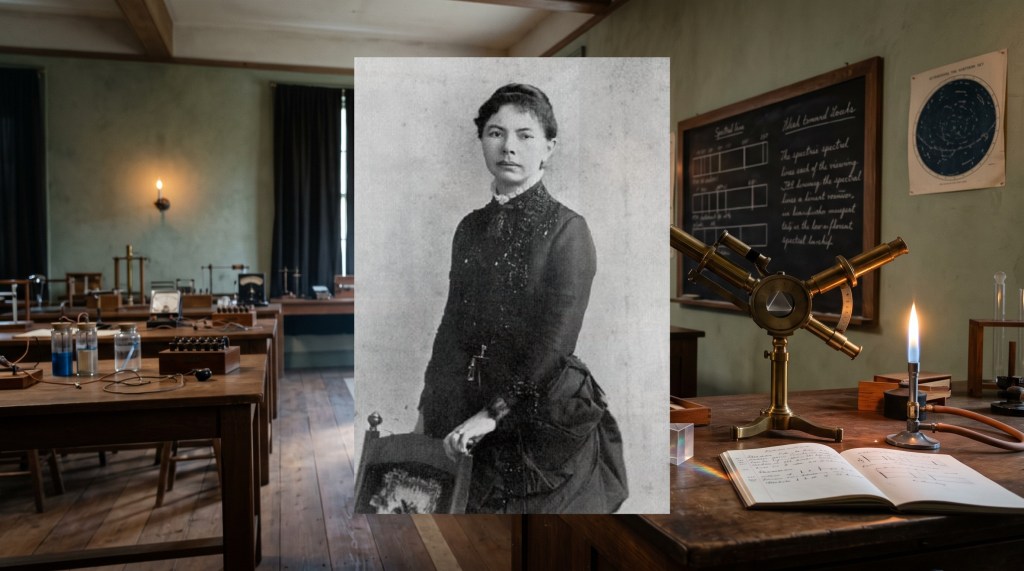
Sarah Frances Whiting: The Physicist Who Taught Women to Read the Light

In 1876, a woman walked into an empty room at Wellesley College and began to build. No laboratory. No instruments. No precedent. Only the fierce conviction that young women deserved to hold light in their hands and read its secrets. For thirty-six years, Sarah Frances Whiting taught physics and spectroscopy to generations who had been told the bench was not theirs. Then the world forgot her name entirely. Now, in this intimate fictional interview, she speaks – of flawed glass and cold observatories, of stubborn patience and spectral lines, of the quiet, radical act of saying: you may look for yourself.

Read the original post.

Bob Lynn | © 2026 Vox Meditantis. All rights reserved.

9 responses to “Sarah Frances Whiting: The Physicist Who Taught Women to Read the Light”

  1. Análisis Científico avatar

    Una lectura sumamente enriquecedora sobre Sarah Frances Whiting: The Physicist Who Taught Women t. Se agradece el rigor y la perspectiva práctica de los argumentos.

    Liked by 1 person

    1. Bob Lynn avatar

      Gracias, Análisis; y lo digo de verdad, no por simple cortesía. El rigor y la practicidad son los dos aspectos que más me esforcé por preservar en este trabajo, así que saber que se han logrado transmitir resulta verdaderamente gratificante. La propia Whiting no habría tenido mucha paciencia con quien acertara en la física pero descuidara la enseñanza, o viceversa; ella habría exigido ambas cosas bajo el mismo estándar de calidad. He intentado honrar ese principio.

      Me alegra que te haya resultado enriquecedor. Es prácticamente todo lo que puedo pedir.

      Bob

      Like

  2. Steven S. Wallace avatar
    Steven S. Wallace

    Bob Lynn —. You have really presented well this fairly unknown physicist who departed this vale of tears nearly a century ago. Where does your knowledge of this person come from? When did you create this? Was it a work of many weeks or did you come up with this piece in twenty four hours? How did you do it? What is your field of study? I would call you a savant, but I don’t think that is an apt description. You are a multi-disciplinary savant.

    An extraordinary piece of work!

    SSW

    Liked by 1 person

    1. Bob Lynn avatar

      Thank you – and I’ll take “multi-disciplinary savant” over “bloke who spends too many evenings in archives,” though the latter is probably more accurate.

      This is part of a series I started in early 2025 on forgotten and overlooked women in STEM, and one I’ve decided to revisit and prioritise over my other content for a while. I’ve always been drawn to the history of science, and somewhere along the way it became impossible to ignore how many women have simply been written out of the story – across astronomy, physics, chemistry, computing, palaeontology, medicine. Annie Jump Cannon classifying hundreds of thousands of stellar spectra. Chien-Shiung Wu disproving parity conservation. Jocelyn Bell Burnell spotting the first pulsar as a postgraduate. Eunice Foote identifying the greenhouse effect in 1856. The list goes on, and most of them never made the textbooks.

      I started the series with a more traditional autobiographical approach, which was fine but felt a bit flat after a while. So I decided to experiment with this interview format. It’s ambitious, I’ll grant you. I’m sure it annoys some readers, and I can see why others might find it disrespectful – putting words in a dead person’s mouth isn’t nothing, and I don’t take that lightly. But my hope is that it’s an interesting and illuminating way of understanding more about STEM, and of actually hearing the voices of these women rather than reading another dry summary of dates and publications.

      As for the “how long” question – let’s just say it wasn’t twenty-four hours, but it wasn’t many weeks either. Somewhere in between, fuelled by too much tea and a stubborn refusal to stop mid-sentence. My field of study is engineering rather than physics, if that’s what you’re asking. But I don’t think you need a degree in a subject to care about who got erased from its history.

      Thank you again. It means a lot that you stopped and read the whole thing.

      Bob

      Liked by 1 person

      1. Steven S. Wallace avatar
        Steven S. Wallace

        Well I think it’s a great thing.

        You’re not stealthy about your approach. If people think you are speculating on what these scientists would say or if they have a different opinion or think what you have reported in their interview then they may present the alternatives. You are very
        clear that this is a historical fictionalized account. You are reporting truth through a creative fictionalized lense. It is realistic fiction. You are very clear about that.

        And this is all originalized stuff. There is more in your report about this scientist than all of the rest of the internet. You are adding to the discussion by elevating these women scientists. The personal character is real. This particular scientist would have a greater following today if she were active. This person is a near great. She operates within her
        limitations like everyone else. She is also operating under the yoke of early 20th century attitudes about what women were capable of.

        So, in a nutshell, I think this is a great thing you are doing reviving and extolling these past women scientists. 👏🏻👏🏻👏🏻

        SSW

        Liked by 1 person

  3. Anna Waldherr avatar

    I love these stories of women who should NOT be forgotten. Thank you for helping preserve them.

    Liked by 1 person

  4. callimulligan avatar

    HI Bob, I’m calling it quits here w/ my web site. I can’t spend enough time with it to make it work. It’s great to see you doing so well w/ your site; Your work is always interesting. I hope to stay in contact via bluesky. –Calli

    Liked by 1 person

    1. Bob Lynn avatar

      Hi Calli,

      Thank you for the kind words, though I’m genuinely sorry to hear you’re feeling burned out by the site.

      If it helps offer some solidarity, I’m actually dialling back my own output for a bit. Life happens, and forcing words onto a screen when time is at a premium turns a craft into a chore. That said, when the margins open up, I still find so much satisfaction in sitting down to write – and you shouldn’t abandon that spark just because the upkeep of a traditional website feels like an uphill battle.

      Whatever you do, please don’t hang up the keyboard entirely. First and foremost, write for yourself. Strip away the noise of subscriber counts, algorithms, and release schedules. When you write purely to explore an idea that fascinates you, the pressure evaporates, and ironically, that’s usually when the right people end up finding your work anyway.

      The platform matters, too. To be blunt, the general WordPress ecosystem tends to be a bit hit-and-run – no slight against the thoughtful folks who do stick around, but the mechanics here lean more toward drive-by browsing than sustained engagement. Deep, niche thinking often struggles to breathe in that environment; it just gets lost in the ether.

      That’s why places with built-in reading cultures make such a difference. Different platforms cultivate entirely different mindsets in an audience. I actually went looking and saw you’ve already carved out a footprint over on Substack – that’s a fantastic home for what you do. Spaces like Substack and Medium are built around people actively seeking essays and long-form narrative rather than skimming past a blog feed.

      In fact, my own approach has shifted: I’m treating WordPress mostly as a landing page these days, posting short teasers that route people over to the main pieces on other platforms where the conversation actually has room to develop. You don’t need to maintain a heavy website to be a writer.

      Take a breather from the mechanics of running a site, let the dust settle, and when an idea strikes, just put it down for the sheer joy of it.

      I’ll certainly be keeping up with you on Bluesky and I’ll keep an eye out for your notes & posts on Substack, too.

      Feel free to reach out anytime on all my places.

      Best wishes,

      Bob

      Like

      1. callimulligan avatar

        Thank you so much, Bob, for writing. Such a thoughtful reply. I have indeed been going through my own process of reckoning, acceptance, and shifting direction over the course of this year,.
        Being dyslexic, I’m always coming up against my inability to be a prolific writer. Sadly, being prolific does seem to be a key component of building a successful website. For several years now I keep pushing and pushing, making myself try harder and harder. But over the past several months that maybe I need to simply let myself be. When I work at my own slow pace, I can feel the magic of words, language, and writing. When I force things, I don’t feel so well.
        Your many stories of women working hard against the odds, often in obscurity, are not simply interesting, they are very inspiring and validating for me.

        Liked by 1 person

Leave a Reply