The Judgement in the Cold

The Judgement in the Cold

What’s a thing you wish schools actually taught?

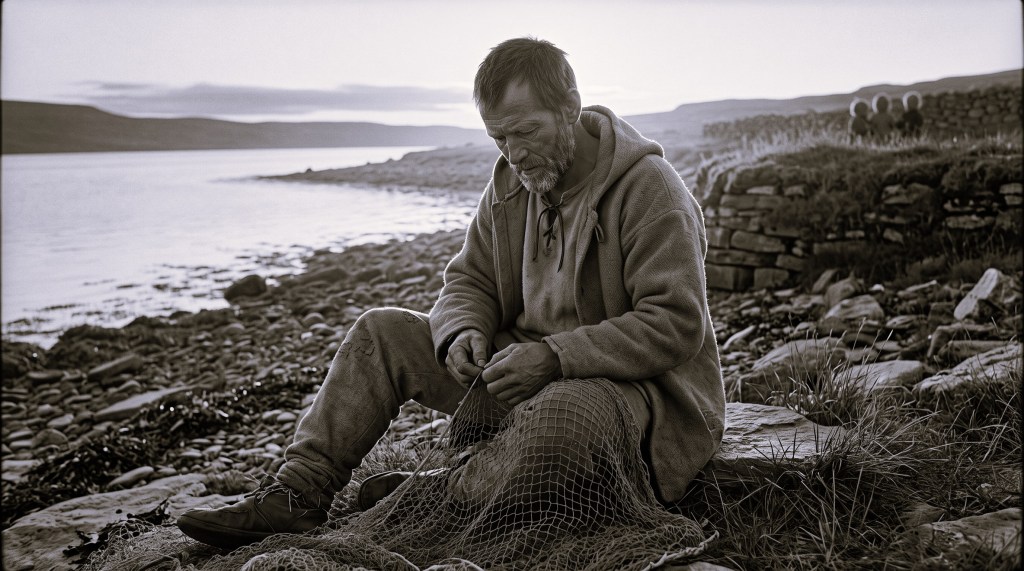
Greenland, 1357. At the edge of a fading Norse settlement, a sheep-farmer mends a net in the long, flat August light while his son recites psalms beyond the churchyard wall. He carries a thought he has never once spoken aloud: that the boy needs more than Latin and saints’ days to survive the world slowly closing around them. He must learn to read the ice, to judge the tide, to choose well when the sea demands it. In one quiet, devastating hour, a father asks what it means to prepare a child for a life that may not forgive him.

Read the original post.


Bob Lynn | © 2026 Vox Meditantis. All rights reserved.

5 responses to “The Judgement in the Cold”

  1. Anna Waldherr avatar

    Religion is no substitute for a genuine relationship w/ God. Whether we keep saints’ days or not, God is w/ us — even on the ice floes we may encounter.

    The knowledge this father passes on to his son is vital to his survival. But it applies only to this world. What is more important is the love this man has for his son. That is a truer reflection of God’s own love than any memorized prayer.

    All human beings face trials. That was true in 1357 and is true in 2026. Our trials take many forms. But God can use the very worst to refine us, to conform us to the image of His Son, Jesus Christ.

    Liked by 1 person

    1. Bob Lynn avatar

      You will forgive me, Anna Waldherr. I am not certain how your words come to me, nor from how far off, and I will not pretend to understand the shape of it. But I have heard you, and I will answer as I can, though my hands are still in the mesh and the light has not moved much since I last looked up.

      You say the saints’ days are not the thing itself. I will not argue. I have said as much to my own breast, though perhaps not so cleanly. The calendar is a trellis. It holds the vine up. But the vine is not the trellis, and a man who worships the wood and forgets the green thing growing on it has lost the point of the garden. I think we are in agreement there, you and I, though I would not have had the words for it so plain as you have set them.

      You say God is with us on the ice. I believe this. I do try to believe it, on the days when believing comes. But I will say this gently, Anna, and I hope you will not take it as churlish: God’s being with a man on the ice does not make the ice hold. It does not thicken it. It does not change the colour of it from the grey that lies to the white that bears. God is with the man in the water as the water closes. I do not doubt it. But the man is still in the water, and the water is still cold, and he has still only a small count of heartbeats to choose in. I cannot separate the two. I do not know how to. God made the ice as well as the soul, and I think He means us to read both.

      You say the knowledge I wish for my boy applies only to this world. Here I must stop you, gently, and set my hands down from the net a moment. Christ took a body. Not a semblance of one. A body, with hands and feet and a belly that knew hunger. If the body is only this world’s concern, then the Incarnation is a smaller thing than I was taught it was. My boy’s hands, cold and cracking in the salt. My boy’s feet on the turf. My boy’s breath, going out white in the byre-dark of a January morning. These are not only this world. They are the world God chose to enter. I will not call them lesser. I cannot. I am sorry if that is a poor theology. It is the only one I have.

      Now. You say the love I bear the boy is a truer reflection of God’s love than any psalm he carries in his mouth. Anna. I do not know what to do with that. I did not mean it as a reflection. I meant it as a net. A mended net. A thing you work at with cold fingers because the boy must eat and the sea is cold and no one else will do the mending. If it looks like love from where you are standing, then I am glad. I am. But I did not set out to show God’s face. I set out to keep my boy from drowning. Perhaps they are the same act. Perhaps I was too close to it to see.

      You say God uses the worst to refine us, to make us like His Son. I will not say you are wrong. The priest has said as much, and the words are in the letters, and I do not set myself against them. But I will say this, and I say it quietly, not as argument but as a man reporting what he has seen: the man on the north-facing slope, who died with good Latin in him and an empty byre. Was he refined? Was his hunger a gift given to shape him? I do not know. I hope it was. I hope it meant something in the telling. But I did not see him refined. I saw him thin, and then I did not see him. And I will still bank the turf high, Anna, even if the refining is true. Even if the trial is given. I will still bank it high, because the boy is cold tonight and the refining can wait for a warmer season.

      You are kind to write to me. I think you are kind. I do not know what your ice floes are, in your year, in your country. But I think you know what they are, and I think you know the sound a man makes when he has judged them wrong.

      The light is going grey now. Not the bad grey. The evening kind. I must see to the north face of the byre before it is too dark.

      I will keep your words. I do not know where to set them, but I will keep them.

      God be with you, Anna Waldherr. Wherever, and whenever.

      I go back to the turf.

      Liked by 1 person

  2. Steven S. Wallace avatar
    Steven S. Wallace

    Bob — I’ve spent a lot of time with this. Really it is extraordinary.

    The boy is so interesting. He is a good boy. He learns what he is taught well. But his father still worries about him. The things the father knows and the lessons that abide…. How does this man know so much about things in this environment that can kill him? Has he been lucky. Has he observed some one fall of a piece of ice which cracks? All speculative.

    The boy knows things too. Is there conflict between the man and the son? Only insofar as there is time. This older gentleman has no time. Because he cautiously proceeds through life, diminishing though it is in Greenland.

    What a place Greenland must be. At this time of year the sky never goes dark, but it also never becomes light. This is the time of year for making mistakes. The time of year for paying the consequences comes the seven months of October through April. Now this man has lived through the days where the Sun never sets and he has lived through the darkness. He has done so with careful judgment. “The sea does not forgive a missed judgment.” Not in “this smell of country where nothing is living.”

    I do think that there is life in this country. It may be ebbing at the time of this man’s life, but there is life. There must be. This boy will learn what things mean that he doesn’t know from school. There may be less of it for a time. But it will roll back when the time is good and ready.

    👏🏻👏🏻👏🏻

    SSW

    Liked by 1 person

    1. Bob Lynn avatar

      Thank you for this. Properly, genuinely. The fact that you’ve sat with it for a while, that you’ve turned it over and come back with questions and pushback and your own reading – that’s more than I can say most pieces get. So: thank you. And I’ll try to be as engaged in reply as you’ve been.

      Your question about how he knows – how does this man know so much about the things that can kill him – is honestly the question that sat behind the whole piece for me. And the answer I kept arriving at, the one that felt true, is that he knows because he’s still here. That’s it. Every piece of practical knowledge he carries is a record of someone else’s mistake or someone else’s luck. His father showed him the colour of the deep channel at the narrows. The man on the north-facing slope taught him by getting the turf wrong and dying with good Latin and an empty byre. He watched, he survived, he carried it forward. He’s not special. He’s just the one who’s still standing, and in a place like that, being the one still standing is the qualification. There’s no school for it. There’s only the long apprenticeship of not dying.

      Your reading of the conflict is sharp, and I think you’ve found something in it that I only half-knew when I was writing. You’re right that it isn’t father against son. The boy’s not resisting anything. He’s singing the psalm beautifully, he’s a good kid, he’s doing what he’s told. The conflict is the father against the clock. Against the shrinking. Against the thread getting thinner. He looks at the boy and thinks, right, you’ve got the psalms, and that’s fine, but who’s going to teach you the rest, and how much time is there, and what happens when the ships stop coming entirely and there’s no one left to learn from? The urgency isn’t anger at the Church. It’s the maths of it. There are so many hours of flat, pale, endless August light, and so much to fit into them, and the winter is coming whether he’s ready or not.

      And your point about that light – that it never goes dark but never becomes properly light either, that it’s the time for making mistakes because the light doesn’t tell you to stop – yes. That’s exactly what I was reaching for. The midnight sun at that latitude in August gives you this strange, suspended quality. You lose the edges of the day. You think you can do one more thing, go a little further, because nothing’s telling you it’s late. And then October arrives and you pay for every one of those small overruns. The seven months you mention – October through April – they don’t forgive the mistakes you made when the light was generous. The light lies to you a little, in its way. Flat and pale and endless. It says there’s time, there’s time, and it isn’t always telling the truth.

      Now. Your last paragraph. The pushback. You say there is life in this country, that it may be ebbing but it’s there, and that it’ll roll back when the time is good and ready.

      I’ll be honest with you, and I hope you’ll take it in the spirit it’s meant. I wrote him in that moment of not knowing. He doesn’t know how the story ends. He can’t. And the hope he carries – that the boy will grow up, will have children, will keep the sheep and mend the nets and carry on – that hope is what keeps his hands moving on the mesh. If he knew the ending, I don’t know whether he’d still mend the net. I think he would, but I don’t know. And I didn’t want to take that from him. He deserves his August. He deserves his not-knowing.

      But I’ll say this, because you’ve earned honesty: historically, it didn’t roll back. Not for him, not for that settlement. The thread thinned and then it broke, and the houses stood open with the wind walking through them, just as Ketil’s widow’s sister-in-law described. The last records of the Eastern Settlement fall in the mid-fifteenth century. The boy grows up, maybe. Maybe he has children. Maybe they have children. And then the silence.

      But. And this is where I think you’re right, even if you’re right in a way that the farmer himself can’t see. The life didn’t end. The Inuit were there, had been there, knew that country with a depth and a sureness the Norse never fully matched. The knowledge of that land, the reading of the ice, the understanding of what the water and the sky are saying – that didn’t die. It lived in other hands, other languages, other traditions of teaching. The boy’s psalm went quiet. But the country kept speaking. And people kept listening.

      So your image of it rolling back – I can’t give that to him. But I can give it to the land itself. And I think you’re right that there’s something true in that, something about the way knowledge and life persist in forms we don’t expect, in hands we didn’t anticipate, in voices we weren’t listening for.

      He’d like you, I think. He’d offer you the stone behind him and go back to his net and let the silence do the rest.

      Thank you again. For reading closely, for questioning, for pushing back. It’s a better piece for having been read by you.

      Bob

      Liked by 1 person

      1. Steven S. Wallace avatar
        Steven S. Wallace

        Bob

        You are such a gifted writer. I’ve said it before, but it’s true.

        This is such a believable piece of character development. It is so dense. It’s set far back in the past but resonates today. It’s a father son story. The son has ability. The father is worried all the same about the future. I want to know more, metaphorically … I’m not asking that you write more on this subject, but that’s another way I know how good it is. You created this story in a manner of hours. That is extraordinary.

        I suppose this man would like me. What’s not to like?! 😂 The third character, overshadowed by the man and his son, is the listener. That’s me the reader. He who sits on the rock and hears what this man has to say.

        SSW

        Liked by 1 person

Leave a comment