The Judgement in the Cold

The Judgement in the Cold

What’s a thing you wish schools actually taught?

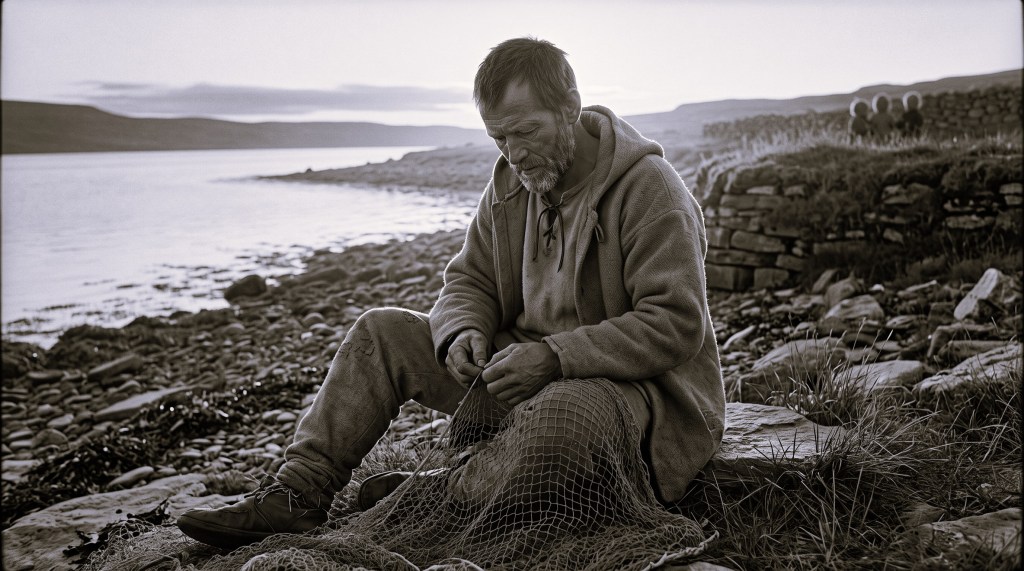
Greenland, 1357. At the edge of a fading Norse settlement, a sheep-farmer mends a net in the long, flat August light while his son recites psalms beyond the churchyard wall. He carries a thought he has never once spoken aloud: that the boy needs more than Latin and saints’ days to survive the world slowly closing around them. He must learn to read the ice, to judge the tide, to choose well when the sea demands it. In one quiet, devastating hour, a father asks what it means to prepare a child for a life that may not forgive him.

Read the original post.


Bob Lynn | © 2026 Vox Meditantis. All rights reserved.

2 responses to “The Judgement in the Cold”

  1. Anna Waldherr avatar

    Religion is no substitute for a genuine relationship w/ God. Whether we keep saints’ days or not, God is w/ us — even on the ice floes we may encounter.

    The knowledge this father passes on to his son is vital to his survival. But it applies only to this world. What is more important is the love this man has for his son. That is a truer reflection of God’s own love than any memorized prayer.

    All human beings face trials. That was true in 1357 and is true in 2026. Our trials take many forms. But God can use the very worst to refine us, to conform us to the image of His Son, Jesus Christ.

    Liked by 1 person

    1. Bob Lynn avatar

      You will forgive me, Anna Waldherr. I am not certain how your words come to me, nor from how far off, and I will not pretend to understand the shape of it. But I have heard you, and I will answer as I can, though my hands are still in the mesh and the light has not moved much since I last looked up.

      You say the saints’ days are not the thing itself. I will not argue. I have said as much to my own breast, though perhaps not so cleanly. The calendar is a trellis. It holds the vine up. But the vine is not the trellis, and a man who worships the wood and forgets the green thing growing on it has lost the point of the garden. I think we are in agreement there, you and I, though I would not have had the words for it so plain as you have set them.

      You say God is with us on the ice. I believe this. I do try to believe it, on the days when believing comes. But I will say this gently, Anna, and I hope you will not take it as churlish: God’s being with a man on the ice does not make the ice hold. It does not thicken it. It does not change the colour of it from the grey that lies to the white that bears. God is with the man in the water as the water closes. I do not doubt it. But the man is still in the water, and the water is still cold, and he has still only a small count of heartbeats to choose in. I cannot separate the two. I do not know how to. God made the ice as well as the soul, and I think He means us to read both.

      You say the knowledge I wish for my boy applies only to this world. Here I must stop you, gently, and set my hands down from the net a moment. Christ took a body. Not a semblance of one. A body, with hands and feet and a belly that knew hunger. If the body is only this world’s concern, then the Incarnation is a smaller thing than I was taught it was. My boy’s hands, cold and cracking in the salt. My boy’s feet on the turf. My boy’s breath, going out white in the byre-dark of a January morning. These are not only this world. They are the world God chose to enter. I will not call them lesser. I cannot. I am sorry if that is a poor theology. It is the only one I have.

      Now. You say the love I bear the boy is a truer reflection of God’s love than any psalm he carries in his mouth. Anna. I do not know what to do with that. I did not mean it as a reflection. I meant it as a net. A mended net. A thing you work at with cold fingers because the boy must eat and the sea is cold and no one else will do the mending. If it looks like love from where you are standing, then I am glad. I am. But I did not set out to show God’s face. I set out to keep my boy from drowning. Perhaps they are the same act. Perhaps I was too close to it to see.

      You say God uses the worst to refine us, to make us like His Son. I will not say you are wrong. The priest has said as much, and the words are in the letters, and I do not set myself against them. But I will say this, and I say it quietly, not as argument but as a man reporting what he has seen: the man on the north-facing slope, who died with good Latin in him and an empty byre. Was he refined? Was his hunger a gift given to shape him? I do not know. I hope it was. I hope it meant something in the telling. But I did not see him refined. I saw him thin, and then I did not see him. And I will still bank the turf high, Anna, even if the refining is true. Even if the trial is given. I will still bank it high, because the boy is cold tonight and the refining can wait for a warmer season.

      You are kind to write to me. I think you are kind. I do not know what your ice floes are, in your year, in your country. But I think you know what they are, and I think you know the sound a man makes when he has judged them wrong.

      The light is going grey now. Not the bad grey. The evening kind. I must see to the north face of the byre before it is too dark.

      I will keep your words. I do not know where to set them, but I will keep them.

      God be with you, Anna Waldherr. Wherever, and whenever.

      I go back to the turf.

      Liked by 1 person

Leave a comment