Which outdated technology do you miss the most, and why?
Friday, 18th July 2014
You will forgive an old woman her digressions. I have lived long enough to understand that the shortest path between two points is rarely the most instructive one, and if you choose to read what I have set down here, you must accept me as I am, wanderings and all. The Lord made me thus, and I have long since ceased apologising for it.
It is the eighteenth day of July, in the year two thousand and fourteen, and I am eighty-one years old. The summer has been generous to us this week: warm without cruelty, with a breeze that carries the smell of cut grass from the park at the end of the road. My neighbour’s boy attended to it yesterday evening, I believe, and the scent drifted through my open sitting room window and settled over everything like a benediction. I notice such things with greater keenness now than I once did. Age teaches you that, at least, if it teaches you little else.
I ought to record that my daughter telephoned this afternoon. She means well, my daughter, and I love her with the full and weary love that mothers carry for their children from the moment of birth until the final breath. She telephoned to suggest, once again, that I ought to learn to use something called a tablet. Not a medicinal tablet, you understand. A device. A glass screen no larger than a writing pad, upon which one apparently does everything one could ever wish: reads, writes, shops, converses with strangers, watches moving pictures. She says it will keep me connected.
I told her I have been connected to the things that matter since long before she was born, and that I did not require a piece of glass to accomplish it.
She responded, in the patient and slightly strained tone she reserves for these conversations, that it would allow her to write to me more easily, given the demands upon her time. I said that I had pen and paper, and that the Royal Mail had been delivering letters since before either of us drew breath, and that if she wished to communicate with me, there existed already a serviceable and dignified method for doing so. She laughed, bless her, though not without a trace of exasperation.
I am stubborn. I know it. My husband knew it. The Lord knows it, I should not doubt. But I have never believed that stubbornness and foolishness are the same condition, though younger people are frequently inclined to conflate the two. A person may stand firm upon a solid foundation without it constituting an error of judgement. Movement is not the same as progress. I have said this before, in these pages, and I shall no doubt say it again before I am done with the world.
What I know to be true is this: the world has grown very loud, and very fast, and has mistaken the combination for wisdom.
I read this week, in the newspaper, about the conclusion of the football. The World Cup has finished at last: Germany have won, against Argentina, and the nation of Brazil must now consider what comfort, if any, lies in the act of hosting when the host does not triumph. I wished the Brazilians well. I have always admired people who feel things openly, who grieve and rejoice without that English habit of suppression. There is something honest in it, something that the Book of Psalms would recognise entirely. But I am digressing again.
What I mean to say, and what drew me to take up this pen today in the first place, was a question I found printed in one of those weekly inserts that arrive folded inside the newspaper. I kept it aside, as I often do with things that require more than a passing moment of attention. The question was this: which outdated technology do you miss the most, and why?
I sat with it over my morning tea, and the answer came without a single moment’s hesitation.
My typewriter.
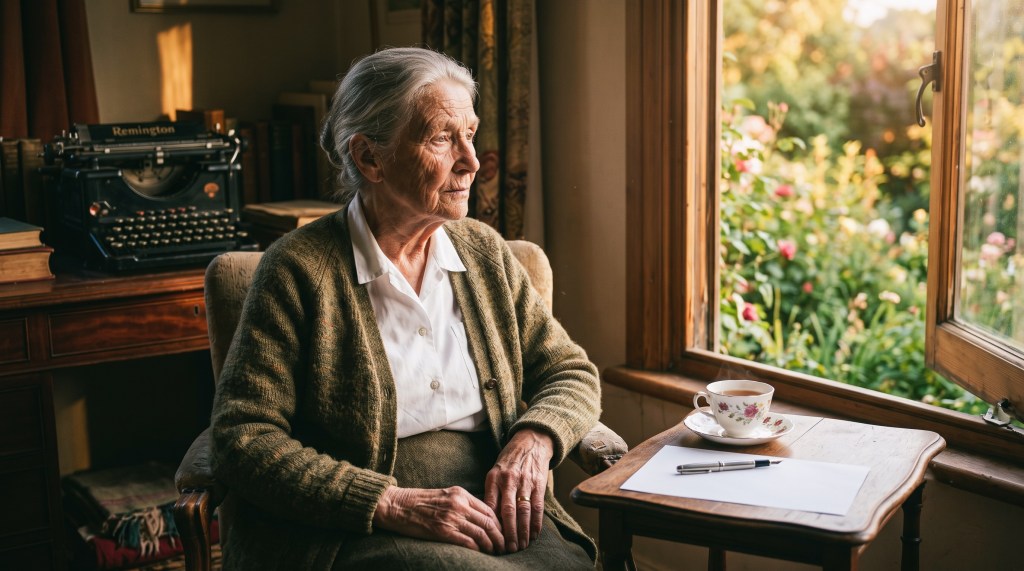
Not the electronic word processors that came later, with their small screens and their blinking cursors and their quiet implication that any error could be corrected without cost. No. I mean my original machine: a Remington, given to me when I entered my first position of employment, a secretarial post at a solicitor’s firm in the spring of nineteen fifty-one. It was a machine of serious weight, the weight of something built to last centuries, constructed on the understanding that durability was a virtue worth designing for. You placed a sheet of paper, crisp and white, and fed it through with a deliberateness that was itself a form of moral discipline. And then you typed.
The sound of it. I do not know how to convey that sound to someone who has never heard it: each key striking with a small, decisive report, like a miniature hammer making its covenant with the page, saying, this word is chosen, this word is fixed, this word shall stand. There was no deleting. There was no revision at the press of a key. You thought before you committed a word to the paper, because the paper held it permanently, and if you made an error, you either began again or accepted the error gracefully and worked around it with whatever dignity you could muster.
Is that not instruction enough for a life?
People speak to me now of freedom. The freedom of technology, the freedom to say anything to anyone at any instant, the freedom of infinite revision and infinite option. But freedom without consequence, without permanence, without cost: is that truly freedom, or is it merely a very comfortable form of carelessness? In my experience, the things that endure are the things that cost something in the making. A letter written with care and close attention, knowing it cannot be recalled once sealed and sent, bearing a stamp and crossing miles by human hand: that letter says something no flickering message on a glass screen can say. That letter has been paid for, in time and thought and the irreversible commitment of ink.
When the firm modernised in the early nineteen-eighties, I was told to learn the new computing system. I refused, for a time, with rather more firmness than was perhaps entirely necessary. My manager was a patient young man, and in the end I conceded, for one must earn a living, and I have never been a woman who placed her own preferences above her duties. But I kept the Remington at home. I used it for personal correspondence for many years after everyone else had moved along to other methods. My husband said I was very likely the last person in England to send typewritten Christmas cards. He said it with great affection, and I received it as the compliment it was intended to be.
He has been gone eleven years now. I still hear that percussion in my mind on certain evenings: the carriage return, the small bell that rang to tell you the line was ending, the satisfying lever-push that swept everything back to the left to begin again. Order. Regularity. A clear and honest marking of where one line ended and the next was to commence.
Perhaps that is what I miss most deeply. Not the machine itself, though I loved the machine and am not ashamed to say so. But the philosophy contained within it. The insistence that words carry weight. That to set something down is to mean it. That time, once given to a task, cannot be recovered, and ought therefore to be given with full deliberation and a clear conscience.
We live now in an age of drafts and revisions, of infinite delay and infinite option. My grandson tells me he can send a message and recall it before the recipient has opened it. I do not entirely understand the mechanics of the thing, but I understand the principle well enough: nothing is final. Nothing is truly committed. Nothing, in the end, is truly said. I find myself wondering, in the quieter hours of the night, what becomes of the soul when it is never required to commit itself to anything at all. The Scriptures do not ask us to send our word provisionally. They ask us to let our yes be yes, and our no, no.
But I am old, and I know I am old, and the world will not turn back on my account. I do not ask it to. The Lord did not promise us an unchanging world. He promised us something more durable: an unchanging truth within it, and it is to that truth I hold, and shall continue to hold, whatever the age produces by way of distraction.
Still. On a warm July evening, with the light softening at last across the garden wall and the sparrows making their small argument in the eaves, I find myself thinking of that Remington. Of the white page waiting to receive its words. Of the deliberate and irreversible choosing of what one wished to say, and the discipline of knowing that once it was said, it would stand.
There is a dignity in that irreversibility. In being required to choose carefully, because you know that you cannot take back what has been committed to the page.
I believe we have lost that dignity, and have not noticed the loss because we were moving too quickly to feel it go.
Tomorrow my daughter will visit, and she will raise the matter of the tablet again, and I shall remain firm. I am not afraid of being thought old-fashioned. An oak tree does not apologise for its roots, and I do not intend to begin.
My tea has gone cold. I shall make another cup presently and sit by the window until the light is gone entirely and there is nothing left to see but the dark shapes of the garden and the stars, if they are visible tonight, which they may not be.
That is enough for this day. Let the record show that on the eighteenth of July, in this year of great speed and short memory, one old woman sat in her kitchen and thought of a typewriter, and found, as she turned the thought over in her hands, that it was something very close to a prayer.
Bob Lynn | © 2026 Vox Meditantis. All rights reserved.


 Vox Meditantis
Leave a comment