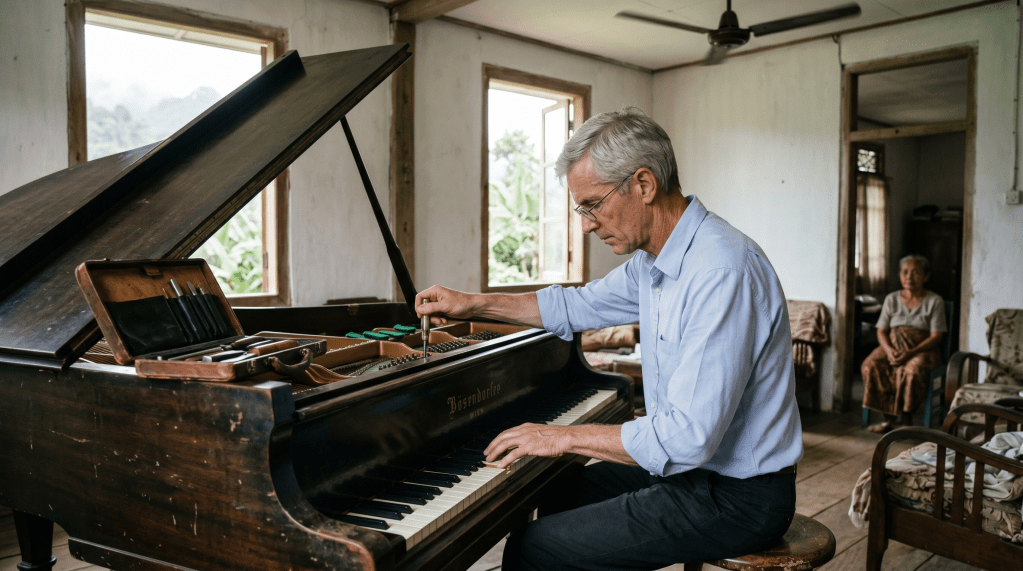
What’s the most interesting local custom you’ve encountered?
I: The Commission
I have tuned pianos in a decommissioned Soviet weather station north of Murmansk, in a Jesuit seminary outside Nairobi that smelled permanently of woodsmoke and rain, and in the private residence of a man in Macau who had purchased a Steinway Model D as a financial asset and never once lifted the lid. In each case I was asked the same question by whoever met me at the door: would I like a tour of the facilities? In each case I declined. I did not need a tour. I needed access to the instrument, a stable room temperature, and to be left alone.
This is not antisocial behaviour, despite what my daughter Claire believes. It is professional hygiene.
My name is Edmund Reeve. I am fifty-eight years old, and I tune and restore pianos for a specialist firm based in Bristol called Harwich and Sons, which has neither a Harwich nor any sons in its current employ, but which has been sending people like me to improbable corners of the world since 1961. I travel approximately two hundred and forty days per year. I own a flat in Clifton that I have furnished in what Claire calls early beige, and which I call practical. There is a good reading lamp. There is a shelf of books I have read and a shelf of books I intend to read, and the boundary between them is a matter of some personal discipline. There is a Broadwood upright I keep in reasonable condition, not because I play it with any frequency, but because silence, in my experience, is not the absence of sound. It is the absence of the right sound. The piano corrects for this.
I did not set out to become someone who spends his life adjusting the tension of piano wire in remote institutions. I studied music at Bristol in the 1980s, went straight into performance, and spent eleven years as a session musician and sometime accompanist for a mezzo-soprano named Diana Locke, who had a voice that could reorganise your understanding of what sound was for. I married her in 1991. We had two children: Claire, who is now thirty-two, teaches in a primary school in Cardiff, and sends me photographs of her garden with the expectation that I will comment on them. And Thomas.
I don’t speak about Thomas much, and this document is not the place to begin. I’ll say only that he was twenty-three when he died, eleven years ago, and that the world has been slightly less correctly tuned since then, and that I have been, in my methodical and unhelpful way, attempting to compensate.
Diana died of a brain aneurysm in 2017. We had been separated for four years by then, though not by any failure of love so much as a gradual and mutual recognition that grief will hollow out a marriage just as efficiently as malice, and considerably more quietly. We remained, in the formal sense, friends. I drove to Bristol Royal Infirmary when they rang me, and I sat with her for three hours before she went, and I was, in the formal sense, all right about it.
I am, in the formal sense, all right about most things.
The commission to Sulawesi came through in the first week of September.
The instrument was a Bösendorfer 170, manufactured in Vienna in 1934 and shipped at considerable expense to what was then the Dutch East Indies by an administrator named Cornelis van der Berg, whose taste in pianos was evidently more refined than his taste in colonial enterprise. The guesthouse it now occupied, the Lolo Guesthouse in Rantepao in the Tana Toraja region of South Sulawesi, had been built around it in some sense, the main sitting room expanded at some point in the past century to accommodate the instrument’s considerable width. This is not unusual. I have encountered entire architectural decisions made in deference to a piano. A Bösendorfer 170 in reasonable condition commands a certain respect, even from load-bearing walls.
The commission notes, written by our coordinator in Bristol, Marcus Webb, included the phrase condition reportedly excellent for age, which in my experience means anything from genuinely excellent to catastrophically deteriorated, with the word reportedly doing an enormous amount of work. I packed accordingly: full kit, two extra sets of tuning pins, voicing needles, felt, a selection of hammer shanks, and the small brass-clasped case of precision tools that has accompanied me so long its leather handle has conformed itself to the exact shape of my grip.
Marcus had also written, in brackets, as he always does when he wants to flag something without committing to its importance: (Locals say the piano has a ‘personality’. FYI.)
Locals always say the piano has a personality. What they mean is that it is old and makes unexpected sounds and they find this meaningful. What it actually means, in my experience, is deferred maintenance and a sympathetic resonance issue in the soundboard. I noted it and moved on.
The flight from Heathrow to Makassar takes the better part of a day, with a change in Singapore, and I have learned over twenty years of this work to treat long-haul travel as a form of enforced reading. On the Heathrow to Singapore leg I finished the last eighty pages of Robert Macfarlane’s Underland, a book about the geology and mythology of underground spaces, which Claire had given me for my birthday with a note saying she thought I’d find it grounding, apparently without registering the pun. It is an extraordinary book. I annotated it heavily.
On the Singapore to Makassar leg I started a translation of Seneca’s Letters to Lucilius, which I have been meaning to read properly for years and keep putting off. Seneca believed that travel was largely useless as a means of self-improvement. “You cannot escape yourself,” he wrote, approximately, to Lucilius, more than two thousand years ago. “The same heaviness of spirit follows you across the sea.” I find this simultaneously dispiriting and consoling, which is generally the mark of a useful idea.
From Makassar I took a domestic flight to Makale, then a car arranged by the guesthouse, a battered white minivan driven by a young man named Yosef who spoke excellent English, wore a faded FC Barcelona shirt, and pointed out landmarks with a running commentary I would normally have gently discouraged. I didn’t, this time. The landscape made me unexpectedly quiet.
The Torajan highlands are not what I had anticipated. I had looked at photographs before travelling, which I always do, but photographs of landscape are, in my experience, the most comprehensively misleading documents in existence. They flatten and compose and remove the smell of things. The road from Makale to Rantepao climbs through dense green hills under a sky of unsettled grey, and the vegetation is preposterous in its density, every hillside layered with palm and bamboo and the vivid impossible green of equatorial rice terraces cut into the slopes in long horizontal shelves. The light was soft and very strange.
“You are here for work?” Yosef asked.
“Yes.”
“What work?”
“I tune pianos.”
He considered this through the windscreen for a moment. “They bring you from England to tune a piano?”
“They bring me from England to tune this piano,” I said. “It’s a Bösendorfer 170. They don’t send just anyone.”
I was aware this sounded arrogant. It is also factually accurate.
The Lolo Guesthouse sat at the edge of Rantepao on a gentle slope overlooking a valley, a long, low-roofed building with a deep veranda and the characteristic Torajan tongkonan roof curving up at each end like the prow and stern of a boat, though the main building was a more modern construction and the traditional roof was mainly decorative. Flowering trees I couldn’t name dropped pink blossoms onto the red-painted steps. There was a dog asleep under a rattan chair.
A woman in her late thirties came out to meet me. She was brisk and organised and introduced herself as Rina Lolo, the manager and granddaughter of the guesthouse’s founder.
“Mr Reeve. Good journey?”
“Long,” I said, which is my standard answer regardless of the journey.
“The piano is in the sitting room. My grandmother has been asking when you would arrive.” She said this in a way that implied the asking had been frequent and had represented a logistical pressure. “She worries about it. She’s worried about it for years.”
“What are the main concerns? In terms of the sound.”
Rina tilted her head slightly. “She says it sounds sad.“
I waited to see if there was a technical qualification to follow this. There was not.
“I’ll take a look,” I said.
The Bösendorfer was in the back sitting room, which ran the length of the building and opened at the far end onto the valley view. It stood against the inner wall under two high windows, and the light fell across it in a way that was, I will admit, rather beautiful. The case was in better condition than I had expected, the lacquer dulled but uncracked, the cabinet sound. Someone had been keeping it clean. Rina told me the family had had it tuned twice in the past twenty years, once by a man from Makassar who she was not sure had been properly qualified, and once by a German piano technician on holiday who had done what he could in an afternoon.
I opened the lid.
The strings were original, which is remarkable at this age and in this climate. The soundboard had two very minor cracks, shallow and stable, both of which had been filled at some point with what looked like animal-hide glue, unevenly applied but not ineffective. Several hammer felts were hardened and would need voicing. Four strings were marginally flat in the upper register, almost certainly due to seasonal humidity. The bass strings had a slight brightness that was actually pleasing, a characteristic of old copper-wound steel that modern strings rarely replicate.
I pressed a key. Middle C. The note came out a little nasal in the mid-range, a little hollowed.
But the resonance, when the note decayed, was remarkable. It lasted longer than it should have, spreading upward through the strings in sympathetic vibration like something released rather than struck. I stood there and listened to it fade for longer than I normally would.
I understood, I thought, what Rina’s grandmother meant about personality.
I was given a room on the upper floor with a ceiling fan and a narrow desk under the window, which is all I require. I unpacked my tools and laid them in order on the desk’s surface, which is a habit I acquired from Diana and have never relinquished. She arranged her sheet music the same way. Everything in its correct place and sequence, because the performance begins before the performance begins.
From my window I could see the rear of the guesthouse compound, where three large tents were being erected in the garden, and several people were moving purposefully between the main building and an outbuilding carrying what appeared to be folded cloth. Cooking smells drifted up in the early evening air. There was a low, constant sound of voices.
I asked Rina at dinner what the preparations were for.
She looked at me with a small, assessing expression. “Ma’nene,” she said. “The ceremony of cleaning the ancestors. It happens every few years. For our family it is this week.”
“Cleaning the ancestors,” I repeated.
“We bring them out. Clean them, dress them in new clothes. Spend time with them.” She spoke straightforwardly, as one describes any family event. “It’s normal for us. Our dead are still with us. They don’t go away simply because they have died.”
I nodded. I ate my rice.
I noted it in my journal that evening as a point of cultural interest, the way I might note an unusual architectural feature or an unexpected local ingredient. Informative. Noted. Set aside.
I had a piano to tune in the morning.
I was already at the instrument by seven, working through the bass register in the early cool of the day, when I became aware that I was being watched. In the doorway that led through to the kitchen sat a very old woman in a dark batik dress, with white hair pinned back and hands folded in her lap. She was watching me with the patient, evaluating calm of someone who has been waiting for this moment for a very long time.
I straightened up. “Good morning,” I said, feeling somewhat self-conscious, as I always do when observed working. I am not a performer.
She said something in Torajan. She did not look away.
Rina appeared a moment later, clearly having anticipated this. “This is Mama Sanda,” she said. “My grandmother. She wanted to watch.”
“Of course,” I said.
Mama Sanda spoke again, and Rina translated without inflection: “She says the piano is glad you have come.”
“Tell her I’m glad to be here,” I said, which is not something I normally say.
There was a brief exchange. Then Rina said: “She asks if you would like to know about the man who used to play it.”
I was in the middle of a tuning sequence. I had my temperament strip in and three mutes positioned and I was at a stage that I generally prefer not to interrupt.
“Perhaps later,” I said.
Mama Sanda looked at me for a moment longer, then nodded, as if she had already known I would say this and had decided to forgive it. She folded her hands more firmly in her lap. She did not leave.
She stayed for two hours, and said nothing further, and I found, to my mild bewilderment, that I did not mind at all.
II: The Ceremony
I worked through the afternoon and into the early evening, and by the time I put my tools down the Bösendorfer was holding a tuning I was satisfied with in the middle and upper registers. The bass would need another session in the morning once the strings had settled. This is always the way with an instrument that has been left too long: you cannot simply impose the correct tension all at once. You have to approach it gradually, giving the soundboard and the frame time to adjust to each correction, or you risk the whole structure pulling against itself. Patience is not a virtue in piano restoration. It is a mechanical necessity.
I ate dinner alone on the veranda, reading Seneca, who was in this letter advising Lucilius on the importance of choosing one’s friends with great discrimination and then trusting them completely. I found myself disagreeing with the second half of this. Trust, in my experience, is not a decision you make. It is something that happens to you, usually at an inconvenient moment.
The preparations in the garden had intensified through the day. By evening there were perhaps thirty people moving through the compound, voices overlapping, children running between the adults’ legs with the tirelessness of children at a large family event. The smell of food – something slow-cooked and deeply savoury – had been present since mid-afternoon. Lanterns had been strung between the trees. I watched it all from my veranda chair with what I recognised, even then, as the detachment of a man who has spent so long observing other people’s warmth from a careful distance that he has half-convinced himself the distance is a preference.
Rina came out briefly to refill my water glass. She seemed lightly distracted, pleasantly so, the way people are when something they have been anticipating has finally arrived.
“It begins tomorrow morning,” she said, without my asking. “Early. You’ll hear us.”
“I don’t want to intrude,” I said.
“You won’t intrude.” She paused. “Mama Sanda says you should see it, if you want to. She thinks it would be useful for you.”
I found this an interesting choice of word. “Useful,” I repeated.
Rina smiled, in the way people smile when they are translating not just language but an entire cosmology into a form they suspect you can receive. “Her word,” she said. “Not mine.”
I did not sleep well.
This is not unusual in a new place. My body is, by now, well-accustomed to unfamiliar beds and ceiling fans and the sounds of foreign nights, but there is always a recalibration period, a night or two during which the mind runs slightly ahead of the body’s exhaustion, cataloguing and assessing. I lay in the dark and listened to the sounds from the compound below – voices lower now, a single guitar somewhere, the punctuation of laughter – and I read for a while, and then I lay with the book on my chest and thought, as I often do in the small hours, about the physics of sound.
A note, when you strike it, does not exist in isolation. It sets every sympathetically tuned string in the instrument vibrating in response, each one contributing its own overtone to the full sound, and it is this – the sum of all these invisible resonances – that gives a piano its character. Silence the sympathetic strings and the note becomes thin, isolated, technically accurate and completely without life. The whole is not simply greater than the sum of its parts. The sum of its parts, without the resonances, is barely anything at all.
I fell asleep at some point after this and dreamed, as I occasionally do, of Thomas. I don’t remember the content. I rarely do. I know only that it was him, because of the way the waking feels: not frightening, not sad, exactly. Simply the abrupt and familiar sense of absence, like a note struck in a room where all the sympathetic strings have been removed.
They woke the household at dawn.
Not intrusively – there was no single loud sound but rather a gradual accumulation of activity that filtered up through the floorboards and the thin walls: footsteps, murmured instructions, the sound of water, the low and rhythmic singing that I had not heard before, three or four voices in what sounded like a call and response. I lay still for a moment, locating myself, and then dressed in the grey light and went downstairs.
The sitting room was empty. The Bösendorfer stood in its corner, silent, the fallboard still closed as I’d left it. I put my hand briefly on the case, which is a habit I have and cannot fully explain, and then went out through the kitchen door into the compound.
The morning was soft and very clear, the kind of clear that only exists in highland equatorial air, where the night has drawn all the heat out and left something cool and slightly luminous behind. The valley below was half-filled with a thin mist that the early light was beginning to dissolve. Perhaps forty people were gathered in the compound now, dressed formally, the women in dark batik, several of the men in white shirts. There were flowers. There was more food. Children stood close to their parents with the solemnity children adopt when they understand that something significant is happening without fully knowing what.
I stood at the edge of all this and watched.
Yosef, who had driven me from Makale and was, it emerged, distantly related to the Lolo family by marriage, appeared at my elbow with a glass of sweet black coffee and handed it to me without comment, which I appreciated.
“Where are they going?” I asked. A column of family members was beginning to move from the compound, up a path that led through the trees towards the hillside above the guesthouse.
“To the liang,” he said. “The burial cliff. Where the ancestors are kept.”
I had read about the Torajan burial practices on the flight – the tau-tau, the carved effigies that stand in the cliff galleries watching over the valley; the coffins in the rock face, some of them centuries old; the baby graves in living trees. I had found it interesting in the way I find most things interesting, which is to say intellectually and at a remove.
“Can I watch?” I asked.
Yosef looked at me. “Mama Sanda said you should come.”
The path climbed for perhaps twenty minutes through bamboo and open scrub before the cliff face came into view, and I understood immediately, as one does with certain landscapes, that photographs had been entirely useless as preparation. The cliff rose perhaps thirty metres from a flat ledge of ground, dark grey limestone, and across its face were set the burial galleries: wooden balconies with carved railings, behind which the coffins were stacked, some of them visibly ancient, draped in cloth that had weathered to the colour of the rock. In front of them stood the tau-tau – the effigies, life-sized, carved and painted in varying degrees of age and refinement, their faces watchful, their hands open at their sides in a gesture that managed to be simultaneously welcoming and unbearably patient.
The family gathered below the cliff. There was no single moment of beginning. It seemed instead to proceed organically, families moving to their respective galleries, the low singing resuming, a rhythm of activity that was clearly well-known to everyone present and required no direction. Ladders were set against the cliff. Men climbed. Bundles of cloth were passed up, passed down.
I stood to one side on the ledge and watched, and drank my coffee, and said nothing.
What struck me first was the absence of the quality I had anticipated and braced against without realising I was doing so. There was no horror here. No grotesquerie, no ritual solemnity weaponised to exclude the outsider. It was, in its texture and emotional register, entirely familiar. It was a family gathering. People greeted one another. A child was passed between two aunts and objected briefly and was appeased. An older man was helped to sit on a low wall by a younger man who rested his hand briefly on the older man’s back as he sat – that small, efficient tenderness that passes between people who have known each other a very long time. Someone laughed at something. The sound carried clearly in the still air.
Then the family from the near gallery brought out their ancestor, and I found that I was not, after all, adequately prepared for what this looked like.
I will describe it factually, because that is what I am capable of. The body was wrapped in layers of cloth, many layers, accumulated across years of previous ceremonies. It was carried by two men, carefully, at shoulder height. It was placed with considerable gentleness on a cloth-covered surface that had been arranged on the ledge. And then the family gathered around it, close, in exactly the way a family gathers around one of its members at a table, and the old cloth was removed, fold by careful fold, and fresh water was brought, and the cleaning began.
It was not terrible. That is what I could not quite accommodate. It was not terrible, and it was not strange, and it was not a performance of grief. It was maintenance. It was the enactment of a refusal: a refusal to accept that the person who had lived and been known and been loved had become, simply by the biological fact of dying, a closed matter.
I thought of Seneca, involuntarily. You cannot escape yourself. And then a counter-thought, arriving with unusual force: but perhaps the self is larger than you think, and does not end where you have decided it ends.
I wrote neither of these things in my journal because I had not brought it, which I regretted.
The Lolo family came to their gallery last.
I had moved slightly further up the path to get a clearer view of the full cliff face, and I was at perhaps thirty metres’ distance when they began. Rina was there, and two older men I took to be her uncles, and several younger family members, and Mama Sanda, who had been brought up the path in a chair carried by two of the men and who now sat very upright at the centre of the family group with the authority of someone who has been the gravitational centre of a family for so long that the role has become structural.
The bundle they brought down from the gallery was smaller than I had expected. The man had been slight, then, or young, or both.
They unwrapped him slowly, and I watched from my distance, and then I stopped watching in any active sense because something happened to my vision that I had not anticipated and could not immediately account for.
The face was extraordinarily preserved. This happens, I would later learn, because of the meticulous treatment applied by Torajan tradition: the body is managed from the moment of death to remain intact, and the dry mountain air assists, and the layers of cloth protect. The face that emerged from those layers was the face of a man in his early thirties. Dark-haired, slight, a straight nose, a distinct set to the jaw, a high forehead.
He was dressed in a new shirt. White, short-sleeved. The family handled this part of the process with great competence and visible tenderness, the way you dress someone who cannot dress themselves – steadily, without fuss, smoothing the collar flat.
I looked at his face.
I looked at his face for what might have been three seconds or might have been considerably longer, and the thirty metres of distance between us, and the soft morning air, and the forty-odd people and the cliff galleries and the tau-tau and the mist dissolving in the valley below, all of it compressed suddenly to a single point of absolute stillness.
His name was Dani. I did not know this yet. I would learn it later.
What I knew, in that moment, was that I had a photograph in my wallet that I had carried for eleven years, in the left-hand interior pocket where I once kept my concert tickets. I knew the photograph’s dimensions, the slight crease across the upper-right corner where I had folded it once in some moment of distress and immediately regretted it. I knew the expression on the face in it: not smiling, not quite, but about to. The nose. The jaw. The forehead.
I had not cried at the funeral. I had organised it, as the functioning parent, and I had stood in the crematorium in a dark suit and I had held Claire’s hand, which was shaking, and I had been in the formal sense entirely all right. I had not cried at any point in the eleven years following, which had seemed to me not a failure but a form of competence: the strings properly tensioned, the hammer felts maintained, the instrument functional.
I had been wrong about this.
I understood, standing on a limestone ledge in the Sulawesi highlands in the early morning light, that I had been catastrophically, mechanically wrong about this.
The sound I made was not one I recognised as coming from me. It was not dignified. It did not build gradually and give me any opportunity to manage it. It arrived in full, from somewhere structural, the way a crack arrives in a soundboard – not as a slow deterioration but as the sudden declaration of a stress that has been accumulating, invisibly, for years.
I turned away from the cliff and faced the valley, and the mist was almost gone now, the rice terraces stepping down the hillside in their extraordinary green, and I stood with my back to everyone and shook in a way I had not shaken since I was a child, and it was the most alone I have ever been, and also, I think, the first time in eleven years that the full weight of what had happened had been permitted to land.
Thomas. Thomas, who had played the piano badly and with great feeling, picking out melodies by ear at the Broadwood in the front room of the house in Clifton, never once wanting a lesson, impervious to instruction, laughing at my precision and producing, despite all of this, something that was occasionally almost beautiful. Thomas, who died on a cycling road outside Shrewsbury on a Tuesday in October, wearing a red waterproof jacket, when a lorry crossed the white line. Thomas, who was twenty-three, and whom I have been carrying, in the left interior pocket, pressed against me every day, not gone, not closed, not ended, but whom I have been grieving in strict silence and impeccable solitude for eleven years, because I did not know another way, and did not think another way existed.
I did not hear anyone approach.
I became aware of Mama Sanda’s hands only when they closed around both of mine, and I looked down at them – small, dark, mapped with age – and could not speak, and did not try to.
She said something. Her voice was entirely steady.
Behind me, Rina translated, and her voice was also, impressively, steady.
“She says grief that comes late is still grief,” Rina said. “It still counts.”
I stood there with my hands held by an old woman on a mountainside, and the valley spread below us in the light, and I had absolutely no defence against any of it, and I was, I discovered, for the first time in a very long time, not in the formal sense all right.
I was in the actual sense all right.
The distinction, I was only now understanding, is everything.
III: The Breaking
There is a term in piano restoration for what happens when a crack in the soundboard is finally exposed to air after years of being papered over with inadequate repairs: checking. The wood moves. It adjusts to the new conditions. It sounds, when it happens, like something giving way, and to the uninitiated it is alarming. To someone who knows what they are hearing, it is the opposite. It is the instrument arriving, at last, at the truth of its own condition. Nothing can be properly repaired until it has first been accurately assessed.
I thought about this on the cliff ledge, because it is the kind of thought my mind produces under pressure: technical, structural, a reach for the familiar grammar of things I understand. I was aware, even then, that I was doing it, and I was aware that it was not going to work this time, and I did it anyway, because twenty years of professional habit does not stand aside simply because you have been broken open on a mountainside in South Sulawesi by the face of a dead man you have never met.
Mama Sanda held my hands and I let her.
This is not a small thing. I am not a person who lets people hold my hands. Diana used to say that being physically comforted by me was like being comforted by a wardrobe: present, solid, well-intentioned, fundamentally unable to participate. I had laughed at this when she said it, because it was accurate and because Diana had the gift of making accurate things about you feel like affection rather than diagnosis. I missed her, suddenly and sharply, in a way I had not allowed myself to miss her since the hospital. Two people, standing in a crematorium in Bristol in the rain two years apart, and I had been the same at both funerals: dark suit, functioning, formally all right, the wardrobe bearing its own weight and everyone else’s.
The valley below us was fully lit now. The mist was gone.
After some time – I cannot say how long, because my relationship with time had temporarily ceased to function with its usual precision – I became aware that the ceremony was continuing around us, quietly, without reference to the spectacle I had made of myself. This is, I think, one of the things that undid me most thoroughly: no one had paused. No one had exchanged a glance over my head or retreated in embarrassment or made any of the micro-adjustments that English social life demands when someone behaves unexpectedly in a public space. The Lolo family continued their work at the gallery. The singing continued. A child moved past us on the path and looked up at me with frank curiosity and then moved on.
My distress was not a disruption. It had simply been absorbed, without comment, into the fabric of the morning.
Rina was standing a little way behind her grandmother, and when I finally had sufficient command of myself to look up, she met my eyes with an expression I could not quite name. Not pity. Not the careful neutrality of someone managing a difficult situation. Something more considered than either.
“I’m sorry,” I said. My voice was functional but rough around the edges, like a key that needs regulation.
“Don’t apologise,” she said.
“It was not my – ” I stopped. “It wasn’t my intention to – “
“Mr Reeve.” She said it gently but with finality, in the tone of someone closing a door on a line of reasoning that does not need to be pursued. “You are at a ceremony for the dead. No one requires an explanation.”
Mama Sanda said something then, still holding my hands, and Rina translated: “She wants to know if you have lost someone.”
There is only one honest answer to this question, and I have spent eleven years not giving it, partly from a conviction that grief announced is grief performed, and I am not a performer, and partly from the simpler and less defensible reason that to say it plainly, in those exact words, would require me to be standing exactly where I was standing, with nowhere left to retreat to.
“My son,” I said. “Eleven years ago. He was twenty-three.”
Mama Sanda listened to the translation, and then she looked at me, and she did not say anything for a moment. She simply looked, in the way that very old people sometimes look at you, as if they are reading not what you have said but what you have been doing instead of saying it, and for how long.
Then she spoke.
“She says she knows,” Rina said. “She says she saw it when you played the piano yesterday.”
I had not played the piano. I had tuned it. I began to say so, and stopped, because I understood what she meant, and because the distinction, which would ordinarily seem important to me, did not at this moment seem important at all.
The photograph has been in my wallet for eleven years.
It was taken at Claire’s twenty-first birthday, in the garden of the Clifton house, on a Sunday afternoon in July that was warm enough for once to sit outside without pretending to be warm enough. Thomas is standing beside a hydrangea that Diana had grown from a cutting and was very proud of. He is wearing a grey shirt, untucked. He is not quite smiling but about to, in that characteristic way of his, as if something has just been said that he is deciding whether to find funny. His hair needs cutting. He is holding a glass of something.
That is the whole photograph. That is all of it.
I had looked at it so many times across those eleven years that I had stopped seeing it, in the same way that you stop hearing a note you have been sustaining for too long. It had become less a photograph than a routine. Part of my maintenance schedule. Open wallet, confirm presence, close wallet, continue.
I took it out now, standing on the cliff ledge, and looked at it properly for the first time in I could not have said how long, and it was as if the volume had been turned back up.
He looked like Dani.
Not identically – I want to be accurate about this, because accuracy matters to me even at the worst moments, perhaps especially at the worst moments. The resemblance was not uncanny or supernatural or any of the words that get attached to such things. It was the resemblance you might find between two men of similar age and colouring and build, both of them slight, both of them with something in the jaw and forehead that suggested a certain quality of attention, of interiority. A family resemblance between strangers, if such a thing is possible. A coincidence, in the strict sense: two things falling at the same point.
But I had spent eleven years carrying him in my inside pocket, and here was a man who had been brought down from a cliff face and dressed in a white shirt and arranged with great tenderness by his family, and the family was still here, and the ceremony was still going on, and the impulse that arrived in me then was so far outside my normal behavioural range that I examined it for a full minute before I trusted it.
I turned to Rina.
“I need to ask you something,” I said. “And I want you to know that I understand if the answer is no, and that I will not be offended, and that I recognise this is not my ceremony and not my family and not my custom.”
She waited.
“The man your family brought down,” I said. “I would like, if it’s possible, if it is in any way appropriate, to place this photograph near him. Not with him – not inside the ceremony, I don’t mean that. Not claiming any kinship or any right to be part of what you’re doing. Just near. Just so that my son is in the same place, for a little while.”
I heard myself say this and was aware that it would have been, to the Edmund Reeve of forty-eight hours ago, completely inexplicable behaviour. I was also aware that this did not matter.
Rina looked at me for a moment, and then looked at her grandmother.
What followed was a conversation in Torajan that lasted perhaps two minutes, during which Mama Sanda asked what appeared to be two or three questions, listening to the answers with her hands folded and her expression concentrated. Then she turned to me and spoke, and Rina translated.
“She asks if your son loved music.”
Something tightened in my throat. “Yes,” I said. “He played piano. Badly, but with great feeling.”
Rina translated. Mama Sanda’s expression shifted in a way I could not precisely name, but which I can only describe as a kind of satisfaction, as if something had been confirmed that she had already suspected.
She spoke again.
“She says,” Rina said, and there was something careful in her voice now, “that Dani also played the piano. That one. Downstairs. He played it badly, but she says – ” she paused, checking her own translation, “she says the piano didn’t mind.”
The silence that followed this was one of the more remarkable silences of my life.
“How old was he?” I asked, though I was not sure I wanted the answer to be what I suspected it would be.
“Thirty-one,” Rina said. “He died twelve years ago. A blood condition. Very sudden.”
I looked down at the photograph in my hand. I looked across at Dani, dressed in his white shirt on the cloth-covered surface, his family around him, the cliff face behind them with its galleries and its tau-tau and its centuries of accumulated presence.
Thirty-one. Twelve years ago.
Thomas. Twenty-three. Eleven years ago.
I am an analytical person. I do not believe in signs, in the supernatural architecture of coincidence, in the idea that the universe arranges things with intention. I believe in the physics of sound and the maintenance schedules of aged instruments and the prose of Seneca and the importance of a stable room temperature. I believe in what can be measured and what can be corrected and what can be, with sufficient patience and skill, restored.
And I also stood on that ledge and felt, with complete and uncharacteristic certainty, that I was exactly where I was supposed to be.
These two positions are, I am aware, in logical tension. I have decided I can live with that.
Mama Sanda spoke to the family.
There was a brief conference, the kind that happens in families where the structure of authority is clear and the elder’s opinion carries significant gravitational force. Two of Rina’s uncles looked at me, not unkindly, with the assessing attention of people deciding whether a stranger can be trusted with something precious. A younger woman, perhaps my age, asked Rina a question and received an answer and nodded slowly.
Then Mama Sanda looked at me and made a gesture with both hands, open and directing, towards the gallery.
“Come,” Rina said.
I followed.
I placed the photograph – carefully, on its edge, leaning against a fold of cloth to the left of where Dani lay, close but not touching, at the periphery rather than the centre, a quiet adjacency rather than an intrusion – and I stepped back, and the family closed gently around me, and the ceremony continued.
I will not attempt to describe the next three hours in full, because I am not sure I have adequate access to what happened in me during that time, and I mistrust writing that claims more interiority than the writer can genuinely account for. What I can describe is the surface of things, which were as follows.
The family worked. The cleaning was meticulous and loving, conducted with a combination of practical efficiency and evident tenderness that I found, the more I observed it, to be the most natural thing I had ever watched. This is the part I keep returning to when I think about it now: the naturalness of it. The complete absence of the effortful quality that I associate with grief in the English tradition, where every gesture seems slightly performed, staged against the backdrop of our collective embarrassment about the fact of death and our total lack of a coherent position on what it means.
Here there was no embarrassment. There was conversation, including a brief and apparently good-humoured disagreement between two of the uncles about the correct positioning of Dani’s collar. There was food, brought up from the compound in containers and shared on the ledge with the matter-of-fact generosity I had been encountering since my arrival. There was the singing, which ebbed and flowed without being directed, voices joining and falling away with the natural rhythm of people who have sung the same songs together for many years.
And there was Dani, present, attended to, the fixed and central point around which all of this moved.
I sat on a low wall a little way from the main group, because I did not want to be further inside the ceremony than I had been invited to be, and I drank the coffee that was pressed into my hands by someone whose name I didn’t know, and I watched, and I did, from time to time, cry, though more quietly now, in the way that follows the first structural break: the maintenance tears, you might call them. The ones that come once the initial pressure has been released and the damage can be properly assessed.
Yosef appeared at some point and sat beside me without ceremony, forearms on knees, looking at the cliff face.
“You all right?” he said.
“No,” I said. “Not especially.”
He nodded. “Good,” he said, in a tone that clearly meant something other than what it literally said. He sat with me for a while in silence and then went back down to the compound.
Mama Sanda came and sat beside me at one point, lowering herself carefully onto the wall with the assistance of her granddaughter. She did not speak. She seemed simply to intend to be present, which she was, with considerable force, in the way of people who have learned that presence is itself a form of action.
I looked at her profile: the white hair, the deep lines, the absolute steadiness of her expression. She had lost her son. Thirty-one years old, twelve years ago. She had been carrying that for twelve years and here she was, sitting in the morning sun on a limestone ledge, dressed in her best dark batik, having brought him down from the cliff and dressed him in a new shirt and spent the morning in his company.
“How do you do it?” I said, not expecting her to understand.
She turned and looked at me.
I tried to find a way to make the question translatable, but Rina was on the other side of the ledge, and Mama Sanda and I had no shared language, and so I did the only thing available to me, which was to gesture, inadequately, with one hand, towards the gallery, towards Dani, towards the whole of the morning, and then bring the hand back towards myself.
She watched this gesture with full attention.
Then she reached out and placed her hand flat against my chest, over the left interior pocket where Thomas’s photograph normally lived and was not living now because it was leaning against a fold of cloth twelve feet away, and she held it there for a moment, and said something very quiet.
I did not need a translation.
I understood that she was telling me that the carrying was the answer. That the carrying was not the problem to be solved but the practice to be sustained. That grief is not a task with a completion state but an ongoing relationship, like all relationships, requiring maintenance, requiring presence, requiring the willingness to occasionally bring the beloved out into the light and sit with them for a while.
I am a person who believes in maintenance. In showing up regularly, with the right tools, and doing the work.
It was, when I considered it in those terms, a completely logical position.
I put my hand over hers and she gave a small nod, as if we had confirmed something.
The ceremony concluded in the early afternoon. The families began, one by one, to return their ancestors to the cliff galleries, the reverse of the morning’s process: wrapped again, carried up, settled back into place. The tau-tau watched from their balconies with their open hands and their patient faces.
Rina came to me as the Lolo family began this process.
“Do you want to – ” she said, and gestured towards the photograph.
I had been thinking about this. I had reached a conclusion that surprised me, which is generally the mark of a thought worth having.
“Can I leave it with him?” I said. “Not permanently. Just until the ceremony is finished. Until he goes back up.”
She conferred with her grandmother.
“She says yes,” Rina said. “She says Dani will keep him company.”
I watched them wrap Dani in his fresh cloth, fold by fold, the family working together with the competence of long practice. The photograph went in at the last, tucked inside the outer layer. Not inside him, not claiming kinship. Simply adjacent, in the dark, two men of similar age and similar tenderness for pianos, travelling back up the cliff face together for a little while.
The gallery door was closed.
The tau-tau faced the valley.
I stood on the ledge as the families began to move back down the path, and I looked at the cliff, and I felt the thing I had been feeling since the morning but could now, with some distance from the initial structural damage, begin to name. It was not peace, exactly. It was something more provisional than peace, less resolved. It was the sensation of an instrument that has been correctly assessed and is now ready for the work of proper restoration: the damage acknowledged, the extent of it understood, the feeling of a man who has stopped pretending the crack is not there and can therefore begin, finally, to do something about it.
There is no quick repair for this kind of thing. Anyone who tells you otherwise is selling you a temporary remedy that will cause further damage. The correct approach is patient. It is methodical. It requires showing up, regularly, with the right tools.
I thought I could probably manage that.
I picked up my empty coffee glass and walked back down the path to the guesthouse, where the Bösendorfer was waiting for its final session, the bass register still unfinished, the strings settled overnight into their new tension, ready to be brought the rest of the way home.
IV: Resolution
I was at the piano by seven the following morning.
The compound was quiet. The tents had come down overnight and the garden had been restored to its ordinary state with an efficiency that suggested this was a well-practised operation, the aftermath of Ma’nene absorbed back into the regular rhythm of the household like a river returning to its banks after a flood: the banks changed slightly by the passage of water, the river itself unremarkable again. From the sitting room I could hear the kitchen beginning its day, the low percussion of preparation, someone’s radio at low volume producing something with a lot of brass.
I opened the fallboard and sat for a moment before beginning.
This is something I do not do as a rule. My professional habit is to move directly from arrival to assessment to action, the three stages of any restoration job, each flowing without pause into the next. Sitting at an instrument and doing nothing is not in my usual vocabulary. I sat and did it anyway, for perhaps five minutes, with my hands in my lap, looking at the keys.
The Bösendorfer 170, manufactured Vienna 1934, shipped at considerable expense to the Dutch East Indies by a colonial administrator with better taste in pianos than in empire, survivor of ninety-two years of tropical climate and two inadequate tunings and the accumulated musical attention of generations of a Torajan family: it stood around me in the early light and was extremely quiet.
I thought about Dani, up on the cliff in the dark, in his white shirt.
I thought about Thomas, keeping him company.
Then I began.
The bass register of an aged Bösendorfer requires a quality of attention that I find difficult to describe to people who have not done it, and will attempt to describe anyway, because it is relevant to what I want to say about the morning. The bass strings are long and heavy and have enormous tension, and when they have drifted from their correct pitch over years of deferred maintenance, they carry within them not just the single note they are supposed to produce but all the accumulated tension of that drift: the history of every fluctuation in humidity and temperature, every season, every year of being struck and left to settle into the wrong place. To bring them back you must work slowly, incrementally, a few cents at a time, letting the string and the frame adjust to each small correction before making the next one. If you rush it, if you try to impose the correct tension in one movement, the string will either break or revert, because the frame has accommodated itself to the wrong state and does not know yet how to hold the right one.
You have to be patient. You have to trust that the capacity for correctness is still there, unchanged by the years of drift, waiting for someone to listen carefully enough to find it.
I worked for three hours.
Mama Sanda came at nine, as she had the previous morning, and took her chair in the doorway, and folded her hands in her lap. She was in different clothes today, lighter, the batik a warm brown, and she looked, if anything, more at ease than she had before the ceremony, which I found I could now understand. She watched me work with the same patient attention as the day before, and I was again conscious of being watched, and again, to my own continuing surprise, was not troubled by it.
At one point I played a short sequence up through the bass register to check the tuning at the break, where the bass strings meet the tenor, the interval most likely to expose inconsistency. The notes came up clean and even, the transition smooth, the resonance spreading upward through the instrument in that long sustaining wave I had noticed on my first day.
Mama Sanda said something.
I looked up.
She was smiling, with her eyes slightly closed, in the manner of someone tasting something they had been waiting to taste for a long time.
I did not need Rina to translate this.
“Yes,” I said. “I know.”
I finished at ten thirty-seven, which I noted in my log. I played a slow chromatic scale from the lowest A to the highest C and then a sequence of intervals across the registers to confirm the temperament, and then I sat back and played, without entirely deciding to, the opening of the Goldberg Variations.
I have not performed in public since I was thirty-four years old, when I stopped being a session musician and began being a piano technician, a career change that everyone who knew me at the time treated as eccentric and which I have never once regretted. I play alone, occasionally, at the Broadwood in Clifton, when the silence is the wrong kind. I do not play for audiences.
I played for about two minutes. The Aria, unhurried, the bass line steady under the right hand’s ornamentation, the Bösendorfer doing what it had apparently been waiting ninety-two years to do, which was to demonstrate that it had not been sad at all, had never been sad, had simply been waiting for someone to bring it into its correct relationship with itself.
I stopped because I was not sure I could continue without losing my composure again, and one structural collapse per commission is my absolute professional ceiling.
When I turned, Mama Sanda had both hands pressed to her sternum, and her eyes were bright.
I thought of what she had said about grief that comes late. I thought that the same is probably true of music, and of many other things.
Rina had organised a late lunch before my car to Makale, and I ate it on the veranda with her and, to my slight surprise, Yosef, who had apparently stayed the night and was eating with the focused dedication of someone who has been up early and intends to make up for it. The valley below was cloud-shadowed and very green. The dog was under the rattan chair again, or possibly a different dog in the same posture; I had not looked closely enough to distinguish.
Rina asked about the piano’s prognosis.
I told her it was in excellent condition for its age, that the soundboard cracks were stable and needed only monitoring, that the regulation was now as close to original specification as I could get it without replacement parts I would have to order from Vienna, and that if they had it tuned every twelve to eighteen months by someone competent, and kept the humidity as stable as the climate allowed, it would outlast everyone present and probably their children.
She seemed pleased by this.
“Mama Sanda wants me to ask you something,” she said.
“Of course.”
“She wants to know if you will come back. When it needs tuning again.”
I have been asked this at several commissions over the years, and my standard answer is that the firm allocates commissions by availability and geography and that I cannot guarantee a return assignment. This is accurate. It is also, I was aware, not the question that was being asked.
“Tell her yes,” I said.
Rina relayed this. Mama Sanda, who was sitting further along the veranda in her chair with a glass of something yellow and cold, received the translation and nodded once, with the satisfied air of a person whose arrangements have been confirmed.
I looked at her and then looked away, at the valley, at the terraces and the distant green hillsides and the complicated sky.
“Tell her something else,” I said. “Tell her I’m grateful.”
Rina waited.
I found I had more to say than I had expected. “Tell her that I have been carrying my son for eleven years and believing that carrying him in silence was the respectful thing to do. The correct thing. And that I came here to tune a piano and I learned that I had been – that I was wrong about that.” I stopped. “Tell her the ceremony gave me something I didn’t know I needed. Tell her that I know that wasn’t its purpose, and that it wasn’t about me, and that I hope it is not impolite to say so anyway.”
Rina translated. Mama Sanda listened, and then she spoke at some length, and Rina listened carefully.
“She says you were not wrong to carry him,” Rina said. “She says the carrying is good. She says what you were wrong about was the silence. She says grief kept only inside cannot breathe and becomes something else. Something harder and less useful.” Rina paused. “She says she is glad the piano needed tuning.”
I looked down at my hands, which were resting on the veranda rail, and I thought about everything they had done over the past two days, and about what they would go back to doing tomorrow and the day after, and about the Broadwood in Clifton and the reading lamp and the shelf of books and the flat that Claire calls early beige and I call practical, and I thought that it was going to be different now, though I could not yet have told you precisely how.
“So am I,” I said.
Yosef drove me to Makale.
He had the radio on – something local, bright and rhythmic – and did not offer a commentary on the landscape this time, which I think was a kindness, a reading of what kind of journey this needed to be. I sat in the back with my tool case between my feet and my jacket folded on the seat beside me, and I watched the highlands go by: the terraces, the bamboo, the road climbing and descending through the green, the occasional cluster of tongkonan roofs with their boat prows against the sky.
At one point we passed a cliffside burial site, not the Lolo family’s, a larger one, visible from the road for perhaps thirty seconds before the road curved away. I could see the galleries from the car, the stacked coffins, the effigies on their balconies with their open hands.
I watched it until the road took it from view.
Then I opened my journal.
I want to be precise about what I wrote, because precision is what I have, and I offer it as such.
I wrote the date and the location, as I always do, and then I wrote, without premeditation and without stopping to revise, the following:
The writing prompt I have been set – by no one, since no one has set it, but I am setting it for myself now, on a domestic flight out of Makale at an altitude of low enough that I can see individual palm trees – is this: what is the most interesting local custom you have encountered?
I have been to forty-one countries in twenty-four years. I have encountered a considerable number of local customs. I choose Ma’nene.
I choose it not because it is dramatic or strange. I choose it because it is the most accurate thing I have ever witnessed.
Here is what I mean by accurate: it reflects the actual situation. The actual situation is that the people we have loved do not, when they die, cease to be the people we have loved. The relationship changes in certain logistical respects but does not end. We continue to carry them. We continue to be shaped by the fact of them. They continue to be, in any meaningful sense, present: in the catch of a resemblance on a cliff ledge, in the sound of a badly played piano, in the left interior pocket, in the weight of what goes unspoken. The Western custom, broadly stated, is to treat death as a severance, a hard border, an ending that must be accepted and processed and eventually moved beyond. We do not find this easy because it is not true, and we exhaust ourselves trying to believe something that the evidence of our own interior lives contradicts daily.
The Torajan position is simply: they are still here. Maintain the relationship. Show up. Do the work.
I find this eminently logical. I find it, if I am being precise, the most logical position I have ever encountered on the subject.
I am a man who tunes pianos. An instrument that has gone out of tune has not failed. It has not broken. It has not done something wrong that must be corrected with embarrassment and haste. It has simply drifted, over time, under the pressure of ordinary conditions, from its correct state. This is what instruments do. This is what everything does. The response to drift is not grief and it is not shame. It is attention. Careful, patient, skilled attention, applied steadily and without drama, until the thing has been brought back to what it was always supposed to sound like.
My son’s name was Thomas. He was twenty-three years old. He played piano badly and with great feeling, and his hair was always too long, and he found my precision funny rather than admirable, which I suspect was the correct response to it. He died eleven years ago and I have been carrying him incorrectly ever since, in the sense that I have been carrying him as a closed matter rather than an open one, as an ending rather than as what it actually is, which is an ongoing relationship with a changed set of logistical constraints.
I intend to correct this.
The correction will take time. It will need to be done incrementally, with patience, giving the frame time to adjust to each small change before the next one is introduced. It will require me to show up regularly, with the right tools, and to listen more carefully than I have been listening.
I believe I know how to do that.
I believe, in fact, that it is the one thing I have always known how to do.
I closed the journal.
The flight levelled out somewhere over the Sulawesi coast, and I looked out of the window at the landscape below, which was green and then less green and then the hard bright line of the shoreline and then the sea, the Banda Sea, lit from the west by a sun that was beginning to consider setting.
I thought about Thomas. Not about losing him; about him. About the Sunday afternoons at the Broadwood, his back to the room, picking out something he had heard on the radio, working it out by ear with the patient stubbornness of someone who has decided that knowing nothing about technique is not, in itself, a problem. About the way he laughed, which started quietly and then gathered, in the way a note gathers when the sympathetic strings begin to respond. About the hydrangea in the photograph and the grey shirt and the glass of something and the expression that was about to become a smile.
I thought about him for the duration of the flight to Makassar, which was fifty minutes, and I let the thoughts come and go without managing them, which is not something I have permitted myself in eleven years and which felt, variously, like relief and like pain and like the singular sensation of a string brought back to its correct tension: a resistance, and then a settling, and then a rightness that you recognise not because it is new but because it is what was always there, waiting.
I changed at Singapore.
There is a long transit corridor in Changi Airport between terminals two and three with a wall of windows facing west, and if your connection times are what mine were that evening, which is to say inconveniently long in the way of all connections that are not inconveniently short, you can sit in one of the grey upholstered chairs that line the windows and watch the sun go down over the airport and, beyond the airport, over the South China Sea.
I sat there for an hour with my journal on my knee and my toolcase between my feet and I watched the light change, which it did with the unhurried extravagance of equatorial sunsets, moving through yellow to orange to a deep and complicated red that turned the clouds into something a painter would have rejected as excessive.
I thought about Mama Sanda on her cliff ledge with her hands folded.
I thought about the tau-tau on their balconies with their open hands and their patient faces, watching the valley, watching the generations come and go below them, watching the light do exactly this, evening after evening, season after season, century after century.
I took out my phone and called Claire.
She answered on the third ring, slightly surprised – I do not ring without texting first, as a rule, because she has told me she finds unexpected calls alarming, which I have always attributed to her generation’s relationship with the telephone and which I now wonder, with the mild discomfort of a revised position, might have had more to do with my own emotional unavailability than with generational telephobia.
“Dad? Everything all right?”
“Yes,” I said. Then: “I’m in Singapore. I wanted to ring.”
A pause. “Just to ring?”
“Just to ring. I’ve been in Sulawesi. I’ll tell you about it when I’m back.”
“Was it interesting?”
I looked at the window. The sun was at the horizon now, cut in half by it, and the sea below was a sheet of copper.
“Yes,” I said. “Very. How’s the garden?”
She told me about the garden. I listened, properly, to all of it: the new climbing rose on the south wall, the problem with the slugs, the courgettes that were either thriving or not, she couldn’t yet tell. I asked questions. She sounded, by the end of it, somewhat cautiously pleased, in the way she sometimes sounds when I do something that suggests I have been paying attention, and which always contains within it a small sediment of surprise that I find I can no longer, in fairness, hold against her.
We spoke for twenty minutes, and when we rang off she said she loved me and I said it back, plainly, without the slight delay I have developed over the years of saying it as if I am confirming the time of a meeting.
It took approximately no extra effort.
I noted this.
The flight from Singapore to Heathrow departs at midnight and arrives into a grey English morning that is, whatever the season, always slightly unconvincing, as if England is aware it is being returned to after somewhere more vivid and is making a modest effort.
I sleep on long-haul flights with the assistance of earplugs and a neck pillow and a complete cessation of all reading material approximately forty minutes before I intend to sleep, a technique I developed over years and which works reliably. I slept for seven hours, which is exceptional, and did not dream, or if I dreamed I do not remember it, and the waking for once did not carry that quality of absence.
The cabin lights came up over somewhere that was probably the Bay of Bengal, and the crew moved through with the breakfast service, and I sat up and put my seat back and accepted a coffee and looked out of the window at the dark below.
I took out my wallet.
The left interior pocket was empty, which I had known and had been, intermittently, aware of across the past eighteen hours, in the way you are aware of a familiar weight that is no longer there. I had thought about it during the drive to Makale, and during the transit in Singapore, and in the small hours of the flight, and each time I had arrived at the same conclusion: that it was all right. That he was all right up there on the cliff, in the dark, in his temporary adjacency, and that Mama Sanda had been correct when she said Dani would keep him company, not because I believe in any metaphysical architecture that would make this literally true, but because the gesture had been made and received and meant something, and gestures that mean something have a kind of reality that does not depend on the literal.
I had his photograph in my memory with a fidelity that no paper image could match. Every element of it, in sequence, at any magnification: the hydrangea, the grey shirt, the glass of something, the expression that was about to become a smile.
I did not need to confirm his presence. He was present.
He has always been present. This was what I had been wrong about – not whether to carry him but what carrying him meant. I had been carrying him as a weight to be borne in silence, the way you hold a structural tension that you dare not release for fear the whole frame will give way. Mama Sanda carried Dani the other way: openly, periodically brought into the light, dressed in a new shirt, maintained. The weight is the same. The carrying is different. And the difference, I was only now understanding, is everything.
I filed my commission report on the train from Heathrow to Bristol Parkway, as I always do, using the standard Harwich and Sons template on my laptop while the English countryside moved past in the weak autumn light.
Bösendorfer 170, serial number [redacted], Lolo Guesthouse, Rantepao, Tana Toraja, South Sulawesi, Indonesia. Commission completed. Instrument tuned to A440 concert pitch across full compass. Regulation adjusted in upper register. Hammer felts voiced in mid-range. Soundboard cracks assessed: stable, historic repairs adequate, no further intervention required at this time. Recommend tuning every twelve to eighteen months. Resonance characteristics excellent for instrument of this age. Strings original, condition remarkable.
I paused at the notes field, which is where I record anything of professional relevance that the standard categories do not capture.
I wrote: Instrument has considerable character. Client should be advised that this is an asset rather than a fault.
I did not mention the ceremony.
Some things are not for commission reports.
The flat in Clifton was cold when I let myself in, because I had left a window fractionally open in the bedroom in the way I always do, and October had taken the opportunity.
I closed the window. I turned the heating on. I put my tool case on the workbench in the second bedroom that serves as my workshop, and I made tea, and I stood in the kitchen while it brewed and looked at the ordinary surfaces of my ordinary life: the books on their shelves, the reading lamp, the clean worktops, the early beige.
Then I went to the Broadwood.
It needed tuning. It always needs tuning, because no piano at home gets tuned with the regularity it deserves, not even a piano technician’s, perhaps especially a piano technician’s, in the way that a builder’s own house is always last. I sat down, not to tune it, just to sit.
I played, slowly, the same thing I had played in the Bösendorfer’s sitting room the morning after the ceremony: the Aria from the Goldbergs. It sounded thinner than the Bösendorfer, more domestic, the resonance shorter and less generous, a smaller room in which to exist. It sounded like home.
I played it to the end this time.
Outside, the Bristol evening was doing its best, which on a clear October night in Clifton is not negligible: the lights of the suspension bridge just visible from the sitting room window, the Avon gorge below it dark and deep, the sky holding the last of the light in the west.
I thought about Thomas sitting here at this piano, in this room, working something out by ear. I let myself think about it without management, without efficiency, without haste.
I thought about him for a long time.
Then I got up and found the Macfarlane, and the Seneca, and I sat in the chair under the reading lamp, and I read until I was tired, and I went to bed.
In the morning I would ring Claire and tell her about Sulawesi. I would describe the highland road and the tongkonan roofs and the extraordinary green of the rice terraces in the equatorial light. I would tell her about the Bösendorfer and about Mama Sanda and what she had said about grief and about the photograph, and about the white shirt, and about a man named Dani who had played badly and with great feeling and who had, it turned out, kept very good company.
I would tell her about her brother, probably, which is something we have circled for eleven years without quite landing on, the way you circle a note you cannot commit to, the resolution always deferred, always almost but not yet.
Not because it would be easy. It would not be easy.
But because she deserved it, and because he deserved it, and because the silence had gone on long enough, and because a Torajan grandmother on a cliff ledge in the Sulawesi highlands had placed her hand flat against my chest and told me, in a language I do not speak, something I already knew and had simply, for eleven years, refused to hear.
An instrument out of tune is not broken.
It has only drifted from where it should be.
All it requires is someone willing to show up, and listen carefully enough, and do the work.
Bob Lynn | © 2026 Vox Meditantis. All rights reserved.


 Vox Meditantis
Leave a reply to James Findon Cancel reply