If you had to describe your ideal life, what would it look like?
They gave us a writing prompt today. If you had to describe your ideal life, what would it look like? Janet, who runs this class, wrote it on the whiteboard in green marker and underlined it twice, which I think was meant to signal that it mattered. There are six of us sitting in a circle on plastic chairs in a community centre in Salford on a Saturday morning, and we all looked at the question, and then we all looked at the carpet, and then Janet said, just write whatever comes, which is the kind of thing people say when they have never once had to think too carefully about what they want.
I’ve been staring at this page for twenty minutes. I’m not stuck because the question is hard. I’m stuck because the answer I’ve got is not the one I’m supposed to have, and I’m still at that stage of being out where I second-guess whether my instincts are trustworthy. That stage lasts a while, I’m told.
Out. That’s the word we use. Being out. As though the rest of the world is simply a larger room.
I should tell you who I am, I suppose, though I’ll warn you now I won’t be making a meal of it. My name is Ray. I am fifty-three years old. Six months ago, I was released from HMP Frankland after serving twenty-two years of a life sentence. I went in at thirty-one. I came out with a paper bag containing my belongings, a bus pass, and a letter from the resettlement team explaining that this writing class, among other things, was a condition of my licence. Not a punishment. An opportunity, the letter said. I’ve been inside long enough to know that those two things are not always as different as they sound.
I don’t have a flat yet. I’m in a hostel in Eccles that smells of damp carpet and someone else’s cooking, and the walls are thin enough that I know more about my neighbour’s phone calls than I do about my own family. But that’s all right. It’s temporary. Most things are, if you wait long enough.
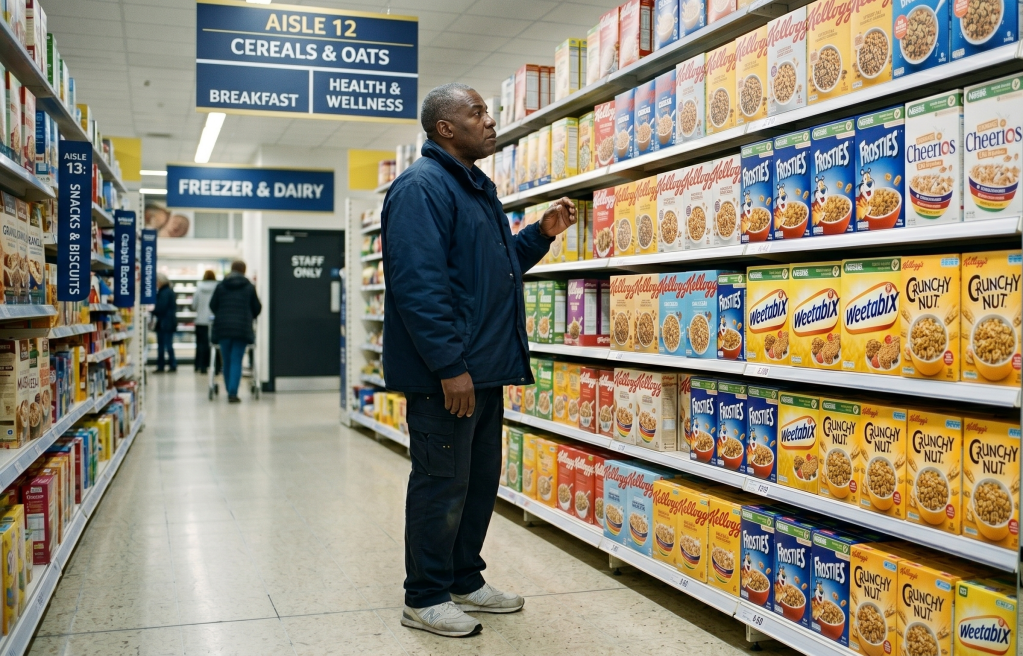
The reason I can’t answer Janet’s prompt has nothing to do with this room, or the plastic chair, or the green marker. It has to do with a Tuesday afternoon about six months ago, when my resettlement worker, a patient woman called Donna who has the remarkable gift of acting as though nothing I say surprises her, took me to a Tesco Extra on the Regent Road to help me do a shop.
I want you to understand that I had been genuinely looking forward to this. The supermarket. I’d thought about food, real food, the kind you choose yourself, more times than I could count over the years. It had become a sort of private ceremony in my head. I’d walk in, I’d know exactly what I wanted, I’d fill a basket like a normal human being and pay for it and carry it home. Simple. Civilised. Mine.
We got as far as the cereal aisle.
I stood there for, and I am not exaggerating, the best part of forty minutes. There is an entire wall of cereal in a Tesco Extra. I counted, at some point, because counting is a habit you develop and don’t easily lose – I counted sixty-seven varieties. Sixty-seven. There are people on this earth making a living deciding what goes on the front of a cereal box. There are whole departments. Meetings. Somebody’s career is the font on a box of Shreddies.
Donna stood beside me and didn’t say a word, bless her, because she’s good at her job and she knew. She’d seen it before, I imagine. The man who asked for twenty-two years to be given back to him, undone by breakfast options.
I left without buying anything. We went to a small corner shop on the way back and I got a loaf of bread and some butter, and that was enough. That was, if I’m honest, a relief.
So that is where I am starting from. That is the ground I am standing on when Janet asks me to describe my ideal life. Not from nowhere. From a cereal aisle in Salford, where I learned something about myself that I am still, six months on, trying to understand.
I’m not going to tell you what I did.
That’s not evasion, and it’s not shame, though I understand if you assume one or both. It’s just that I’ve found, in the six months since I came out, that the crime is the only thing most people actually want to know, and the moment you tell them, it becomes the only thing they can see. You watch it happen in real time. The face reorganises itself. Whatever conversation you were having stops being that conversation and becomes something else – an assessment, a calculation, a quiet adjustment of how close to stand. I’ve had enough of being calculated. I spent twenty-two years being processed by a system that knew my number better than my name, and I find I’m not in a rush to hand that over to strangers as well.
What I will tell you is the arithmetic. I think the arithmetic is more honest than the story anyway.
Twenty-two years, three weeks, five days.
I went in on a Thursday in October. The trees were still turning. I remember thinking, in the van on the way to Frankland, that at least I was going in autumn, because autumn was always the season I minded losing least. I don’t know why I thought that. Something to hold onto, maybe. You find things to hold onto.
I was thirty-one years old. I had a full head of hair and a temper I hadn’t yet learned to sit with. I had a mother who was alive. I had a brother, Marcus, who came to the trial every day and sat in the gallery and never once looked away, and I have never in my life before or since felt so simultaneously loved and destroyed by the same pair of eyes. I had a life, in other words, of the ordinary, unremarkable kind that you don’t know you’re grateful for until someone takes a door off its hinges and shows you the empty space where it was.
Here is some of what happened while I was inside.
My mother died in 2012. I was told on a Tuesday morning by a wing governor I’d never spoken to before that day and never spoke to again. He read from a sheet of paper. I signed something. I was taken back to my cell. There is a process for bereavement in prison, and it is a thorough and well-meaning process, and it is also one of the most profoundly lonely experiences a human being can have, because grief is not a process. Grief is a thing that needs a kitchen table and other people’s hands and the small, shapeless comfort of being somewhere familiar, and none of that is available to you. You grieve in a cell. You grieve at mealtimes. You grieve on schedule and then you fold it away because there is no alternative, and you find, years later, that it is still in there, folded, exactly as you left it.
Marcus got married in 2009. Had two daughters. The elder one is fifteen now, which I know only because Marcus told me in a letter, and I have met her precisely once, at a supervised visit in 2019, when she was eight years old and looked at me with a careful, measuring expression that reminded me so much of her father that I had to look at the table. Her name is Simone. She likes horses and mathematics, apparently. I don’t know what she sounds like when she laughs. I don’t know if she’s kind, or funny, or difficult in the mornings. I know her name and her age and that she likes horses. That is the sum of my knowledge of my own niece, and I am telling you this not for sympathy – I’ll ask you again, not for sympathy – but because I think it is the truest way I know to describe what twenty-two years actually means when you stop counting and start listing.
My hair is grey now. That one I was prepared for. The back and the knees I was less prepared for, but that’s age, and age at least has the decency to happen to everyone.
The world did what it always does and became unrecognisable in the usual ways. Smartphones arrived and then became everything. A pandemic came and went, and I watched it on a television mounted high on a wall and thought, with a peculiar detachment, that the rest of the world was finally learning what it felt like to be told you couldn’t go anywhere. I felt guilty for thinking it. But I thought it.
There is a strange discipline that long-term imprisonment teaches you, and it is this: you learn to stop measuring your life against the life you might have had. Not because the comparison isn’t painful – it is, it’s excruciating – but because it is also completely useless, and useless things are a luxury you cannot afford when space is limited. You become, out of necessity, a person who lives in the present tense. What is in front of me today. What I can do with what I actually have. It is, in its way, the same principle that every meditation teacher and self-help book in the world is trying to sell for twenty-four pounds ninety-nine, and I can tell you that it costs considerably more than that.
I’m not angry about it. I want to be clear about that, because people expect anger and sometimes, I think, they need me to have it on their behalf. But I did the time, and the time did what it did to me, and I came out the other side of it still standing and still, more or less, myself. That is not nothing. I’ve known men who didn’t manage it, and I don’t say that lightly.
What I am is something quieter than angry and harder to name. I am a man who stood in a cereal aisle and could not choose. I am a man who has signed back into the world with a bus pass and a paper bag and is now sitting on a plastic chair in Salford trying to explain to a blank page what he wants his life to look like.
It turns out that’s a complicated question.
It turns out I have some thoughts.
Everyone inside has a fantasy. Don’t let anyone tell you otherwise.
Not a fantasy in the way that word usually gets used – not escapism, not delusion, not the soft, irresponsible kind of dreaming that people do when they’re bored on a Sunday. I mean something harder and more necessary than that. I mean the thing you build, carefully and deliberately, over years, because you have to build something or the emptiness will build inside you instead, and you’ve seen what that looks like in other men and you have decided, quietly and without ceremony, that it won’t be you.
My fantasy was, by any reasonable measure, a modest one. I want to say that up front. I was never a man who wanted yachts. I didn’t lie on my bunk at Frankland imagining a penthouse or a sports car or anything that required a certain kind of wealth I’d never had and never expected. My fantasy was, at its core, simply this: I wanted my life back. The one that had been interrupted. I wanted to walk back into it like a man returning from a long and unwanted trip abroad, and I wanted the people I loved to be standing in the arrivals hall, and I wanted noise – God, I wanted noise – the chaotic, layered, overlapping noise of people who know each other well enough not to mind being loud in front of one another.
I wanted Christmas dinner at my cousin Paulette’s house.
That was the image I kept. If you’d asked me, in year four or year eleven or year nineteen, to close my eyes and show you where I was going when things got bad, it would be Paulette’s house on Christmas Day. The smell of it first – the distinct combination of roasting meat and something sweet and the faint undercurrent of whatever candle she always burned in the hallway. The television on too loud in the front room. Her kids – though they wouldn’t be kids by the time I got out, and I knew that, I tucked that knowledge away and ignored it – her kids on the floor with whatever they’d been given that morning. Her husband Carlton at the kitchen table with a can of something, doing nothing useful, being shouted at affectionately. Paulette herself moving between rooms at that distinct frequency she has, which is not quite rushed and not quite calm but something in between, and talking the whole time to people who may or may not be listening.
I had built this image over two decades until it had the weight and texture of memory. Until I could not, in some deep, unexamined part of myself, distinguish between something that had happened and something I was owed.
That is the trap, and I am telling you about it because I think it’s important, and because I’m fifty-three years old and have lost the appetite for pretending things were other than they were.
Paulette invited me for Christmas. Last Christmas, eight weeks after I was released, when I was still at the hostel and still learning which bus went where and still standing in the shower for twenty minutes at a time simply because I could, simply because there was no one to tell me to move along. She called me, and her voice was exactly the same as I remembered it – that slightly impatient warmth, like a radiator with a faulty dial – and she said, you’re coming for Christmas Ray, I’m not asking. And I said yes because I could not imagine saying anything else.
Carlton came to pick me up. He looked older, which was a shock even though it shouldn’t have been, and he gave me a handshake that turned into a hug that he disguised as a handshake, which is very Carlton, and we drove most of the way in a comfortable enough silence with the radio on. I watched Salford give way to the streets I grew up in and I felt something rising in me that I couldn’t name and wasn’t sure I wanted to.
We pulled up outside the house. The lights were on inside. I could see the glow of the tree through the front window.
Carlton turned the engine off.
I didn’t move.
He didn’t say anything, which told me he’d been warned, or had simply understood, or both. We sat there. The radio had gone off with the engine and so it was just the two of us in the dark and the faint sound of something – music, or voices, or the television, I couldn’t tell – coming from inside the house.
I sat there for an hour. Closer to an hour and a half.
And what I discovered, sitting in Carlton’s cold car outside the house I’d been building in my head for twenty-two years, was that the fantasy had no door.
What I mean by that is this. I had spent two decades constructing an image of arrival – the warmth, the noise, the smell, Paulette in motion, the kids on the floor – but I had never once, not in twenty-two years of building and refining and clinging to that image in the dark, imagined the moment of walking through the door. I had never placed myself inside the picture. I had always been the man looking at it from the outside, which is, when I think about it now, probably the most honest thing I could tell you about what long-term imprisonment actually does, underneath all the things it obviously does.
It makes you a spectator of your own life. Quietly, gradually, without your noticing. And then one day you’re sitting outside the thing you wanted most and you cannot make yourself go in, because you have been on the outside of the glass for so long that you have forgotten you were ever supposed to be the other side of it.
I went in eventually. Carlton got out of the car and came round to my side and opened the door and said, come on then, you daft sod, and I laughed, which broke something loose, and I went in.
It was wonderful and strange and exhausting, and Paulette cried when she saw me, and the food was exactly as I remembered it, and I left at half past seven in the evening and sat on the night bus home shaking gently from something that wasn’t cold.
The fantasy had sustained me for twenty-two years.
It just hadn’t prepared me for anything.
So. The ideal life.
I’ve been working up to this, and I think we both know it, and I’m going to ask you to stay with me because I’m aware that what I’m about to say is not going to sound like much. I’m aware that measured against the standard of what people usually mean when they answer this question – the house, the love, the achievement, the feeling of having mattered – what I want is going to sound so small as to be almost embarrassing.
I have decided I don’t care about that.
I want a window.
Not a view, necessarily. Not countryside or coastline or anything you’d put on a calendar. I mean a window that belongs to me, in a room that belongs to me, where the light comes in at whatever angle it comes in at for that specific address, and I know that angle because I have woken up to it enough mornings in a row to have stopped noticing it, which is the truest measure I know of somewhere being home. When you stop noticing the light, you’re home. In twenty-two years, I never stopped noticing the light.
I want a plant.
I’ve thought about this one more than I can reasonably justify. Something that requires a moderate level of attention – not something that will die if I forget it for a week, but not something that will survive absolutely anything either, because the point is the responsibility, and the responsibility needs to have some weight to it. I want to be the reason something lives. I want to have failed something small enough that I can try again. I want to learn, through something green and patient, that care is a practice and not an event, and that you do not have to be perfect at it to be enough.
I want to know my neighbour’s name.
Not their business. Not their history. Just their name, and the shape of them in passing, and the kind of nodding acknowledgement that asks nothing and offers something. Do you know how long it’s been since I had a neighbour in the ordinary sense? Someone adjacent to my life through the simple accident of architecture, who has no file on me, no assessment to make, no professional obligation to my wellbeing? Someone who is just – next door? I think about that sometimes, the radical plainness of it, and something in me loosens slightly, the way a jaw loosens when you’ve been clenching it and finally notice.
I want a conversation that goes nowhere.
About the weather, maybe, or something stupid that happened on the television, or a mutual, low-stakes opinion about whether the bins are being collected at the right time. A conversation with no purpose and no outcome and no clock on it. A conversation I can walk away from when I feel like it, not when I’m told to.
That last part is the thing I keep coming back to. When I feel like it. I keep turning those five words over like something I found on the ground and am not yet sure is valuable or just looks it.
Choice. I want to talk about choice, because I don’t think people who have always had it understand what it actually is. They think it’s the big things – the career, the city, the person you decide to love. And yes, it’s those things too. But before any of that, at the level below all of that, choice is texture. Choice is the ten thousand small decisions that make up an ordinary day, and that you make so automatically, so without friction or consequence, that they don’t register as decisions at all. What time to get up. What to eat. Whether to have the light on or off. Whether to be around people or not, whether to be loud or quiet, whether to go to sleep now or in an hour.
I want to decide when I sleep.
That is not a small thing. I want you to understand that that is not a small thing. When I say I want to decide when I sleep, I mean I want the full, unqualified ownership of my own body in time. I mean I want to be tired in my own way and on my own schedule and act on it without asking permission, without a lights-out, without the precise, grinding indignity of having even your unconsciousness administered by someone else. I mean I want to lie in the dark and feel the day ending because I have decided it is ending, and have that be the whole of the reason.
A key.
I want a key in my pocket. I think about this one the most, and I’m not entirely sure I can explain why, except to say that a key is a promise in metal. A key means there is a place that will be there when you return to it. It means you are trusted with the fact of somewhere. I had a key once, a whole bunch of them, on one of those coiled plastic keyrings that you put round your wrist when you’re doing something active, and I don’t think I ever once thought about what I was holding. I think about it now. I think about it when I walk back to the hostel and tap the fob against the reader and wait for the buzz, and it’s not the same, it’s not even close to the same, and I know the flat is coming because Donna tells me it’s coming, and when it comes there will be a key, and I think I will stand on the street outside it for a moment when they hand it over and just hold it in my hand before I do anything else.
None of this is the answer I had when I was inside.
The answer I had when I was inside was large and loud and full of people and had Paulette in it and Christmas and noise, and it was real, it kept me going, I am not saying a word against it. But that answer belonged to the man who went in at thirty-one with a full head of hair and a temper he hadn’t learned to sit with. This answer belongs to the man who came out.
And this is what I want to say, I think, the thing that has been sitting underneath all of it, waiting: I am not sure these two answers are as different as they look. I think they are both, at their core, about the same thing. About belonging somewhere. About mattering to something small enough to hold. About the profound, almost unbearable privilege of an ordinary life, which nobody tells you is a privilege because nobody tells you it can be taken.
Nobody tells you, and then someone takes it, and then you spend twenty-two years in a cell learning the hard way what you were always holding.
A window. A plant. A neighbour’s name. A conversation about nothing. A key.
That is my ideal life.
I’m sorry if you were expecting more. I’m not, actually. I’m not sorry at all.
I’m looking up from the page now.
I don’t mean that as a literary device, though I appreciate this is a writing class and Janet will probably take it as one. I mean it literally. I have put my pen down on the table and I am looking up, at the five other people in this room, and I want to say something to you – to all of you – and I’m going to try to say it without cruelty because cruelty is not my intention, and without softness either, because softness would be dishonest, and I find that I’ve used up my dishonesty allowance.
What have you written?
No, I mean it. What did you write when Janet put that question on the board in green marker and underlined it twice? Because I’ve been sitting in this circle long enough to have a reasonable sense of this room, and I think I know. I think you wrote about travel, or about love, or about a version of your work that is more fulfilling and better paid. I think you wrote about a house with more space in it, or a relationship with less difficulty in it, or a body that behaves more reliably than the one you currently have. I think, if I’m being precise about it, you wrote about a larger version of what you already have.
And I want to sit with that for a moment, because I think it’s worth sitting with.
When you have everything, which is to say when you have the ordinary – the window and the key and the neighbour and the conversation about nothing and the autonomous, unremarkable right to decide when you sleep – when all of that is simply the water you swim in, the thing so present it’s invisible, then the question what is your ideal life can only point in one direction. Outward. Upward. More. The question becomes an exercise in expansion, because expansion is the only direction available to someone who is already standing at the centre of their own life, fully inside it, fully entitled to it.
I am not criticising you for that. I want to be clear about that, because I can hear how this might sound coming from a man with my history, and the last thing I want is for this to become a sermon. I have been preached at by professionals for twenty-two years and I have no interest in adding to the sum total of that in the world.
But I am asking you, honestly, as a genuine question: how do you answer this honestly? How do you know what you want when you have never had to learn it the hard way? When you have never had it disassembled in front of you, component by component, until you can see exactly which parts were load-bearing and which ones were decoration? I had to lose everything to find out what everything actually consisted of. I had to go down to the floor of it. And the floor, I found, was not marble. It was not even particularly clean. It was just a window and a key and a plant and the name of the person next door, and that was the floor, and it was enough, it was more than enough, it was in fact everything.
So I’m asking because I don’t know the answer. I’m not asking rhetorically. I’m fifty-three years old and I’ve spent the last six months stumbling around in the world like a man in a room where someone’s moved all the furniture, and I have found that there are questions I no longer trust myself to answer alone. This might be one of them.
What I suspect, though I hold this lightly, is that there are two kinds of ideal. There is the ideal as aspiration, which is the one most people are writing about today – the life pulled forward by wanting, by the reasonable human hunger for more and better and different. That ideal is a valid and probably necessary thing. It is what gets people out of bed. I’m not arguing against it.
And then there is the ideal as recognition. The life you understand through loss. The one you can only see clearly from the outside, from a considerable distance, looking back at the lit window of something ordinary and thinking, with a feeling that has no clean name, that was it. That was already it, and I didn’t know.
I think these two ideals point at the same thing from opposite directions.
I think the person who wants more, and the person who has learned to want less, are both trying to describe the same room. They are just standing on different sides of the wall.
And I wonder sometimes – I’ve been wondering it for six months, since Tesco Extra and the cereal aisle and Carlton’s cold car and the half past seven bus home – I wonder which starting point gets you closer to the truth of it. Whether you can arrive at the floor of what matters without first losing the ceiling. Whether it’s possible to know, while you’re inside the ordinary, what the ordinary actually is.
I don’t think it is. And I’m not sure if that’s a tragedy or just the deal.
I’m not sure it can’t be both.
You’ll have noticed I still haven’t told you what I did. I mention that because I’m aware it’s sitting in the room with us, the way unspoken things do, taking up space, affecting the air pressure. Someone in this circle has been trying to work it out since I started writing – I can tell, and again, I’m not saying that unkindly, I’m saying it because it’s human and I’d probably do the same. We want to know what kind of man we’re dealing with. We want to know where to file him.
What I will say is this. Whatever you’ve decided, whatever category you’ve put me in, I’d like you to notice something. I have sat in this circle on this plastic chair in this community centre in Salford, and I have told you that my ideal life is a window, a plant, a key, a neighbour’s name. I have told you that I want the weight of an ordinary day. I have told you that I think you are lucky beyond your own accounting.
And now I’m asking you to consider whether the man who wants those things, and knows why he wants them, and can tell you exactly what they cost – whether that man is further from the truth of a life well lived than the one who has never had to think about it at all.
I think that’s worth at least a few minutes of your Saturday morning.
I think it might be worth more than that.
Janet is going to ask us to share what we’ve written in a moment. I can feel it coming the way you learn to feel certain things coming, which is a skill that stays with you and is not always welcome in civilian life.
I’ll read it if she asks. I’ve decided that while I’ve been writing, and it surprises me a little, the decision. Six months ago, I couldn’t stand in a supermarket aisle. So perhaps that’s something. Perhaps that’s the word for where I am right now: somewhere. Not arrived. Not fixed. Somewhere.
I want to say one last thing, and then I’ll stop, because I’m aware I’ve taken up more than my share of the air in this room today and Janet has been patient with me in the way that good people are patient, which is without making you feel the patience.
I wake up at five in the morning. Every morning, without exception, without an alarm, without any of the apparatus of waking that I understand most people require. It happens the same way each time. One moment I’m asleep and the next I’m not, completely and instantly, the way you surface from water. No transition. No groggy middle ground. Just: awake, and it is five in the morning, and the room is dark except for where it isn’t.
In the hostel the light comes in from a street lamp through a curtain that doesn’t quite reach the window frame. It falls on the opposite wall at an angle, a pale orange bar of it, and it moves slightly when there’s traffic outside, the shadows of passing cars sliding across it in a way that is almost alive. I lie there and I watch it. I don’t reach for anything. I don’t try to go back to sleep because I know by now that isn’t available to me. I just watch the light on the wall and wait for the room to change.
I did this inside too, which is the thing I haven’t yet decided what to do with. In Frankland the light came differently – institutional windows, different angles, different quality of dark – but the fact of it was the same. Me, awake at five, watching what the morning did to the room before anyone had thought to ask anything of the day. Before the day had become anything required of it.
Out here it is different in ways I’m still cataloguing. The sounds are different, looser, less uniform. There’s a bird somewhere near the hostel that starts up around twenty past five and has a call I don’t recognise and haven’t yet managed to look up, which is something I intend to do and keep not doing, and I find I don’t entirely mind the not knowing because it gives me something to look forward to at twenty past five, which is a small and slightly absurd thing to say but is also simply true.
I am still learning to want things in a way that doesn’t frighten me.
I mean that plainly, not as a flourish. There is a version of wanting that I learned inside which is essentially armoured – you want the thing, but you want it from behind glass, from a distance, in a way that has been carefully managed so that the wanting itself cannot undo you. You keep your wanting at a useful arm’s length. It sustains you but it doesn’t touch you, because if it touches you and then it’s taken, or if it touches you and then it arrives and is different from what you imagined, which is what happens, which is what always happens, you won’t be able to fold it away again. So you manage it. You are, for two decades, the facilities manager of your own desire.
Coming out means learning to want things at full volume again. Unarmoured. And that is, I will tell you honestly, one of the most frightening things I have ever attempted, and I have had some practice with frightening things.
Some mornings I lie there and I think about the flat that is coming. I let myself think about it properly, without the glass in the way, the full unmediated version. A door that is mine. A window at whatever angle the building gives me. The cumulative ordinariness of the same four walls becoming known to me, morning by morning, until I stop noticing the light.
And I can feel, when I do that, when I let it be real instead of managed, I can feel something that is large and complicated and not entirely comfortable, and I’m not always certain whether it is grief or something closer to hope, because from the inside they are not as different as the words suggest. They are both about time. They are both about what you have lost and what you are owed and the uncertain, ongoing negotiation between those two things.
I watch the light on the wall.
I don’t know, on any given morning, whether that is a sad thing or the beginning of an answer, and I have come to think, slowly, across these six months of bus passes and corner shops and plastic chairs and writing prompts, that it might simply be both, at the same time, without resolution, and that this is not a problem to be solved but a fact to be lived with, like the light itself, which does not ask you how you feel about it. It just comes in. It falls where it falls. It moves when something else moves.
At some point the bird starts. At some point the room becomes morning and I get up and become a man with a day in front of him, which is not nothing, which is so far from nothing that I lack the words for it and have sat here for ten minutes trying to find them and have decided, in the end, to leave the space where they would be.
I think sometimes about the cereal aisle. I think about the sixty-seven boxes and the wall of choice and Donna standing beside me saying nothing with great professionalism, and I think about how I walked out with nothing that day, nothing at all, and went to the corner shop for bread and butter, and I think: yes. Start there. Start with the bread and the butter and the knowledge that you can go back tomorrow.
Start with what you can hold.
Everything else can wait.
Bob Lynn | © 2026 Vox Meditantis. All rights reserved.


 Vox Meditantis
Leave a reply to DD Cancel reply